
The machine's stages, cooling, mounting, duty and maintenance belong in Oil-Free Piston Compressors: Architecture, Duty and Package Selection. The two reviews should exchange information while retaining separate responsibilities.
Establish the process requirement
Identify why oil-free compression is being requested. Obtain the relevant process specification, equipment instruction or customer requirement, and name the person responsible for accepting it. A general preference for oil-free equipment is not a complete specification.
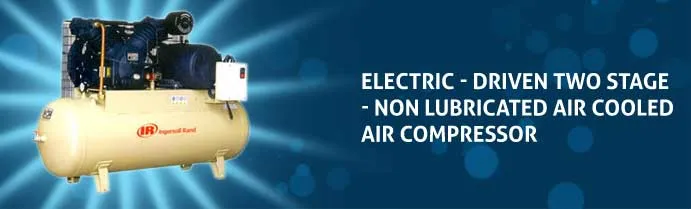
Representative images of machine types we sell, service and rent. Models and capacities are confirmed against your duty.
List the actual air users and their interaction with the process. Record where air may contact product, packaging, equipment or an instrument. Keep different requirements separate rather than assigning one unverified air-quality description to the whole site.
Define the required condition at the user
Document the applicable particle, moisture and oil requirements, together with pressure and operating conditions. Record the point at which each requirement applies. The compressor outlet and the process connection must not be treated as interchangeable evidence locations without review.
Do not assume that oil-free compression means dry air, particle-free air or an automatically compliant process. Review the complete air path and identify what treatment and verification the application requires.
Process question | Evidence or record |
|---|---|
Why is oil-free requested? | Process or equipment requirement |
Where is the air used? | Point-of-use schedule and layout |
What condition is required? | Documented limits and operating conditions |
What equipment remains in service? | Receiver, dryer, filter and pipework register |
How will acceptance be demonstrated? | Agreed test or assessment plan |
Who accepts deviations? | Named process and technical reviewers |
Review the existing system before a compressor change
If an oil-lubricated unit is being replaced, include the existing receiver, dryer, filters, distribution and point-of-use equipment in the review. A change of compressor does not by itself establish the required condition throughout the retained system.
Record what will be reused, inspected, serviced or replaced. Keep the basis for those decisions in the project record. Where existing contamination or equipment condition is uncertain, identify the investigation needed rather than assuming a successful conversion.
Select treatment against the requirement
Consider moisture control, filtration, pressure loss and downstream distribution as parts of one specification. Ask for the relevant equipment performance information at the actual operating conditions. Do not select a treatment package solely because its connection size matches the compressor.
Drying and filtration decisions must be checked against the stated process requirement and selected equipment documentation. Avoid generic promises about what one filter, one dryer or an oil-free label will achieve. Detailed equipment selection remains subject to technical review.
Keep specialist uses within their own review
Food and pharmaceutical applications require the actual process criteria and acceptance responsibilities. Do not represent an industrial oil-free piston unit as automatically food-approved, GMP-compliant or suitable for every product-contact duty.
Laboratory, dental and medical applications need their specific equipment and process requirements. A general industrial selection is not evidence of clinical suitability. Refer those users to the dedicated application review instead of expanding an unsupported claim on this page.
Agree acceptance and continuity together
Specify the proposed verification locations, method, operating conditions and required records. Confirm the applicable standards and test methods before using a named purity class or compliance claim. Preserve supplier documentation, test results and deviations as separate evidence items.
For a critical process, include the required air condition in the continuity plan. Review how maintenance or equipment loss affects compression, treatment and delivery. Redundancy should follow the documented requirement; it should not be assumed from the number of machines alone.
Request a process-air review
Provide the process requirement, selected or existing piston model, treatment arrangement, distribution information and available test records. The result should be a requirement-and-acceptance record that can be checked, not simply a recommendation to purchase oil-free equipment.
Oil-free reciprocating air compressors
Important architecture note — & must not become duplicate pages
The current 650-page architecture contains two closely related identities:
- under the Reciprocating Compressor pillar
- under the Oil-Free Compressor pillar
They should not contain duplicated body copy, metadata or identical search intent.
For the production architecture:
should remain the reciprocating-technology perspective:
- Piston Architecture
- Stage Configuration
- Duty Cycle
- Receiver / Mounting
- Cooling
- Maintenance
- Reciprocating Selection
should become the oil-free process-air perspective:
- Why Oil-Free Is Required
- Process Interaction
- Contamination Risk
- Oil Requirement
- Water / PDP
- Particles
- Treatment
- Point-of-Use Verification
- Reliability
- Oil-Free Piston Model Verification
This creates two genuinely different user journeys instead of SEO cannibalisation.
It also says piston technology can support process applications where pressure and duty fit the technology, while duty limits remain manufacturer-specific.
It does not specify universal:
- Piston-Ring Material
- Cylinder Coating
- Dry-Running Mechanism
- Crankcase Isolation
- Bearing Lubrication Arrangement
- Seal Design
- Oil Migration Barrier
- Clearances
- Maximum Pressure
- FAD Range
- Duty Percentage
- Service Interval
Do not invent the internal oil-free piston architecture
Actual construction must come from the manufacturer/model.
The engineering equation
Oil-free architecture solves one part of the requirement.
01 — start with why oil-free is required
The first question should be:
Why does this process require oil-free compression?
Possible reasons should come from:
- or other documented project criteria
- Do not choose oil-free merely because it sounds technically superior
02 — then ask whether reciprocating technology fits the duty
Oil-free and reciprocating are two different selection dimensions.
Reciprocating technology for:
Oil-free requirement does not automatically mean oil-free piston
The technology still has to fit the operating profile.
03 — FAD still comes first
Oil-free architecture does not establish compressor capacity.
The machine still has to provide:
Required free air delivery
A process-sensitive compressor that does not supply adequate flow is still incorrectly selected.
04 — motor HP does not define the requirement
A request such as:
“We need a 10 HP oil-free piston compressor”
The useful questions are:
With What Air-Quality Requirement?
Motor rating comes later.
05 — pressure must come from the application
Oil-free does not define:
The actual machine must be verified against the pressure required at the process.
06 — oil-free ≠ one pressure class
Some oil-free reciprocating equipment may operate at one pressure range.
Other architectures may differ.
No generic bar / PSI band
07 — duty cycle remains critical
Manufacturer-specific limits can involve:
- Loaded Operating Time
- Cooling
- Starts per Hour
- Discharge Temperature
- Pressure
- Environmental Conditions
Oil-free ≠ continuous duty
The manufacturer still defines permissible operation.
08 — select for how long the machine must make the air
The governing reciprocating rule:
Select not only for how much air the compressor can make
BUT FOR HOW LONG IT IS EXPECTED TO MAKE IT.
Oil-free architecture does not remove this requirement.
09 — intermittent demand can favour reciprocating
Reciprocating compressors can be attractive where demand is:
Characterised by Long Idle Periods.
If the process also has a documented oil-free requirement, an oil-free reciprocating model may deserve evaluation.
10 — sustained demand may change the technology decision
Rotary screw technology may deserve consideration.
Oil-free piston should not be forced into a duty better served by another verified oil-free technology
11 — OIL-FREE SCREW vs OIL-FREE RECIPROCATING
The correct question is not:
Which oil-free technology is better?
Then choose the architecture.
Oil-free ≠ single stage
- Oil-free ≠ two stage
- Oil-free ≠ multi-stage
The actual model must define both attributes.
Oil-free ≠ air-cooled
- Oil-free ≠ water-cooled
- 14 — receiver configuration is separate
Reciprocating equipment can also vary by receiver configuration.
Therefore an oil-free piston machine may be:
- Base-Mounted / Separate Receiver
- where actual product architecture supports it
- Oil-free does not determine storage configuration
That does not mean the complete air stream is automatically contamination-free
16 — atmospheric air still contains water & particles
Atmospheric air contains:
- Other Contaminants Depending on Environment
- Compression concentrates those contaminants
Oil-free piston ≠ dry air
Oil-free piston ≠ particle-free air
17 — compressor technology alone does not determine final air quality
This directly.
Oil-free reciprocating technology is only one component in this chain.
19 — final specification belongs at the process
The final air-quality specification should be defined:
WHERE THE AIR CONTACTS THE PROCESS.
Therefore compressor-room air quality alone is not sufficient evidence.
20 — process interaction should be classified
For food/beverage applications, the source distinguishes:
- Non-Product-Contact Utility Air
- Direct Product-Contact Air
This framework is useful beyond food as a general way of asking:
How sensitive is the process to the compressed air?
21 — food factory ≠ automatic oil-free piston
It says the old blanket claim that food-plant air must universally be:
22 — direct product contact requires stronger specification discipline
Microbiological Risk Where Relevant
23 — oil-free ≠ food-grade certification
Specific food-safety or regulatory compliance should only be represented where:
- Appropriate Equipment Documentation Exists
- Required Validation Is Performed
Oil-free piston ≠ certified food air
and says each can have materially different specifications.
Oil-free reciprocating should therefore be evaluated against the actual air category.
25 — pharma air-quality requirements
Possible requirements around:
- Microbiological Risk Where Relevant
- Point-of-Use Condition
- The site quality/process team should define the acceptance criteria
26 — oil-free piston ≠ gmp compliance
The source's preferred claim is:
“System configuration developed against the customer's documented process and air-quality requirements.”
“AUTOMATICALLY GMP/FDA COMPLIANT.”
Laboratory requirements can vary widely.
The correct questions include:
What Equipment Consumes the Air?
Does Air Contact a Sample?
What Purity Is Required?
Oil-free reciprocating may suit some verified duties.
Laboratory ≠ automatic oil-free piston
29 — medical air is a separate boundary
An ordinary industrial oil-free reciprocating compressor should not be represented as a regulated:
simply because it is oil-free.
Painting can be sensitive to:
Oil-free reciprocating may deserve consideration in some systems.
Oil-free compressor alone does not guarantee paint-quality air
Point elsewhere in the oil-free framework.
31 — cnc / precision machines
Oil-free reciprocating should not be automatically specified for CNC machinery.
The machine manufacturer's compressed-air requirement should define:
Avoid technology selection by industry name.
32 — drying may still be required
Moisture control can involve:
Oil-free piston technology does not remove this requirement.
33 — refrigerated dryer selection
Refrigerated dryer selection can consider:
- Required Pressure Dew Point
- The compressor's oil-free designation does not define dryer size
Pdp comes from the process
35 — filtration may still be required
Filters can target:
Oil-free ≠ no filters
36 — no single filter removes everything
This.
A treatment system should target actual contamination risks.
37 — filter pressure drop still matters
Filters protect the process.
But restricted filters can create pressure loss.
Maintenance should follow:
Oil-free architecture does not make treatment losses disappear.
Air quality is a system property
Pipework, storage and operating environment matter.
New oil-free compressor ≠ automatically clean existing network
39 — existing system conversion needs review
If replacing an oil-lubricated compressor with oil-free reciprocating equipment, review:
- Point-of-Use Treatment
- rather than assuming the compressor change alone establishes the desired result
40 — tank-mounted oil-free reciprocating
Where a verified manufacturer offers this configuration, integrated storage can be useful.
Oil-free ≠ tank-mounted
The receiver still needs to be appropriate for:
41 — base-mounted oil-free reciprocating
A separate-receiver configuration may also exist where verified.
This can potentially support:
- or other system architectures
- Again, manufacturer/model verification controls
42 — air-cooled oil-free reciprocating
Oil-free and cooling architecture are independent variables.
Do not infer air cooling from “oil-free.”
43 — water-cooled oil-free reciprocating
Likewise, some verified architecture may use water cooling.
44 — single-stage oil-free reciprocating
Possible only where actual manufacturer documentation confirms it.
Do not infer from small physical size.
45 — two-stage oil-free reciprocating
Stage architecture should follow:
46 — higher-pressure oil-free piston duty
Reciprocating technology can support certain higher-pressure duties with suitable staged architecture.
But oil-free suitability must still be independently verified.
47 — maintenance still exists
Oil-free does not mean maintenance-free.
Depending on reciprocating architecture, service can still involve:
- and other model-specific parts
- Exact scope must follow the manufacturer's service requirements
48 — do not copy oil-lubricated maintenance into an oil-free model
That content should not automatically be applied to an oil-free reciprocating compressor.
Service must follow actual architecture.
49 — do not invent oil-free wear intervals
The source provides no universal:
values for oil-free piston equipment.
50 — reliability is more than compressor technology
A sensitive process can still fail because of:
- Loss of Compressor Capacity
- Therefore oil-free reliability should be engineered at system level
- Do not automatically impose N+1
52 — treatment redundancy may be as important as compressor redundancy
Two oil-free piston compressors cannot preserve required air quality if the only critical treatment stage fails.
Therefore redundancy should review:
Generation + treatment + storage + distribution
53 — OIL-FREE RECIPROCATING vs OIL-LUBRICATED RECIPROCATING
This should remain a neutral engineering comparison.
Oil-lubricated
Can introduce additional contamination mechanisms.
Oil-free
Requires verified manufacturer architecture and may deserve evaluation where process oil requirements justify it.
or complete lifecycle cost.
54 — OIL-FREE RECIPROCATING vs OIL-FREE SCREW
A useful decision framework:
Decision Area | Oil-Free Reciprocating | Oil-Free Screw |
|---|---|---|
Oil-free requirement | Verify model | Verify model |
FAD | Verify model | Verify model |
Pressure | Verify model | Verify model |
Intermittent duty | Strong evaluation potential where model permits | Evaluate actual economics |
Sustained high-hour duty | Verify very carefully | Often stronger rotary evaluation path |
Stage architecture | Model-specific | Model-specific |
Cooling | Model-specific | Model-specific |
Final air quality | System-dependent | System-dependent |
Maintenance | Model-specific | Model-specific |
Universal winner | No | No |
This is a selection framework—not a ranking.
“Oil-free piston = class 0.”
Any recognised classification must be supported by appropriate model/test documentation.
56 — no generic zero-oil number
or another oil-content value for generic oil-free reciprocating equipment without supporting evidence.
“Oil-free” is not permission to invent a numerical performance specification.
57 — no generic food / pharma approval claim
from compressor architecture alone.
58 — model data required before product publication
For every oil-free reciprocating compressor, verify:
- Manufacturer's Oil-Free Definition
- Do not infer values from another model
59 — customer data to request
Why Is Oil-Free Required?
How Does Air Interact With the Process?
Required Point-of-Use Pressure
Water / Pressure Dew Point Requirement
Other Process Contamination Requirements
“We need an oil-free piston compressor”
into a technical specification.
60 — oil-free reciprocating selection gate
Why oil-free?
Document the reason.
Why reciprocating?
Verify that the duty profile suits piston technology.
What FAD?
Capacity first.
What pressure?
Point of use first.
What duty cycle?
Do not exceed model limits.
What stage architecture?
Manufacturer-specific.
What cooling?
Manufacturer-specific.
What air quality?
Particles, water, oil and other relevant criteria.
What treatment is still required?
Oil-free does not eliminate dryers or filters.
What receiver / storage is needed?
Give storage a purpose.
What happens if the compressor fails?
Define criticality.
What documentation proves the oil-free claim?
Evidence before publication.
Then select the actual machine.
Oil-free reciprocating in one line
An oil-free reciprocating compressor should be selected when the process justifies oil-free compression and the actual piston machine can deliver the required FAD, pressure and duty
While the complete treatment and distribution system delivers the documented air-quality requirement at the point of use
Oil-free defines a technology requirement
- Reciprocating defines a compression family
- The process decides whether the combination is right
- Oil-free requirement
- FAD
- Pressure
- Duty cycle
- Reciprocating architecture
- Stage configuration
- Cooling
- Particles
- Moisture
- OIL
- Treatment
- Storage
- Reliability
- Point-of-use verification
It also establishes the critical air-quality boundary:
COMPRESSOR TECHNOLOGY ALONE DOES NOT DETERMINE FINAL POINT-OF-USE AIR QUALITY.
And the complete treatment sequence remains:
PROCESS REQUIREMENT → REQUIRED AIR QUALITY → TREATMENT ARCHITECTURE.
Compressed air. engineered for uptime
- Oil-free reciprocating air compressors
- Define why oil-free is required
- Verify why reciprocating fits
- Verify FAD
- Verify pressure
- Respect duty cycle
- Verify stage & cooling architecture
- Engineer drying & filtration
- Define reliability
- Verify air quality at the process
- Claim only what the model documentation supports
- Primary CTA
Request an Oil-Free Reciprocating Compressor Assessment
Secondary CTAs
Send Your Process-Air Requirement
Compare Oil-Free Reciprocating vs Oil-Free Screw
Review Oil-Free Piston Duty Cycle
Review Dryer & Filtration Requirements
Verify an Oil-Free Compressor Model