
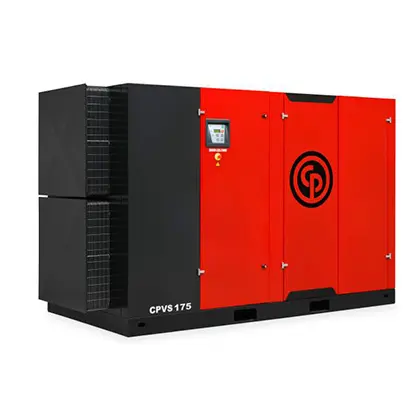
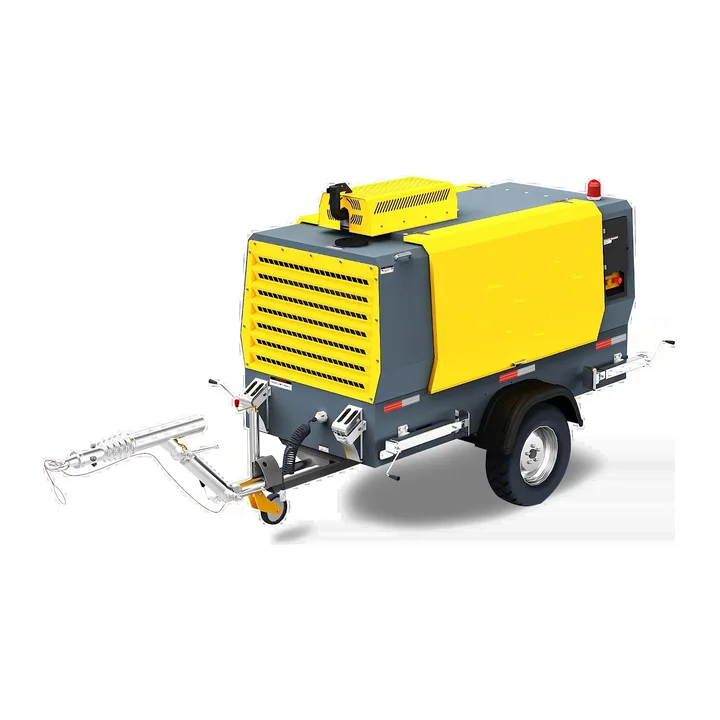
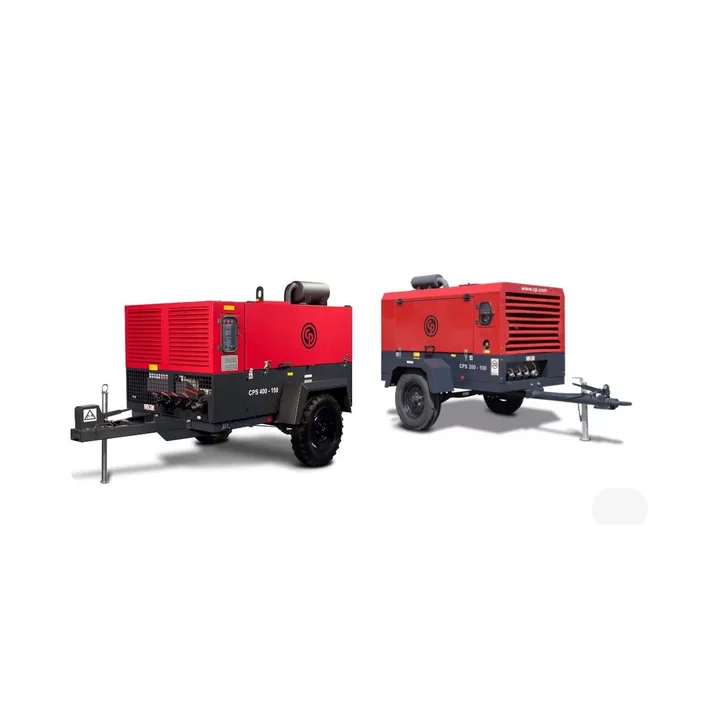
 Portable dieselSite machines typically 100–600 cfm; hire fleet 50–2,000 cfm at 2–30 bar. Trailer, skid and towable packages for sites, drilling and blasting.Explore →
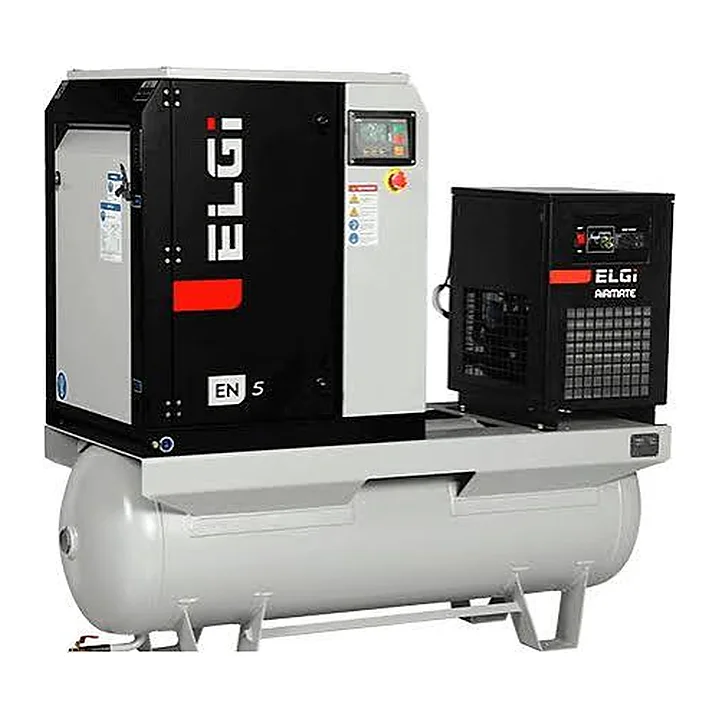 Rotary screwFixed-speed and VSD, oil-injected and oil-free, 5–500 hp, with dryers and receivers.Explore →
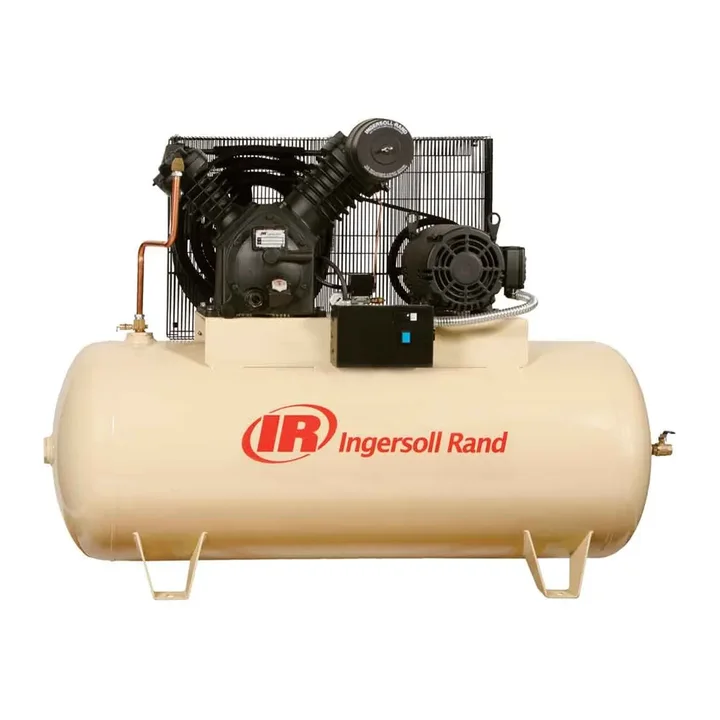 Reciprocating (piston)Single- and two-stage, tank-mounted and base-mounted, for workshops, garages and plants.Explore →
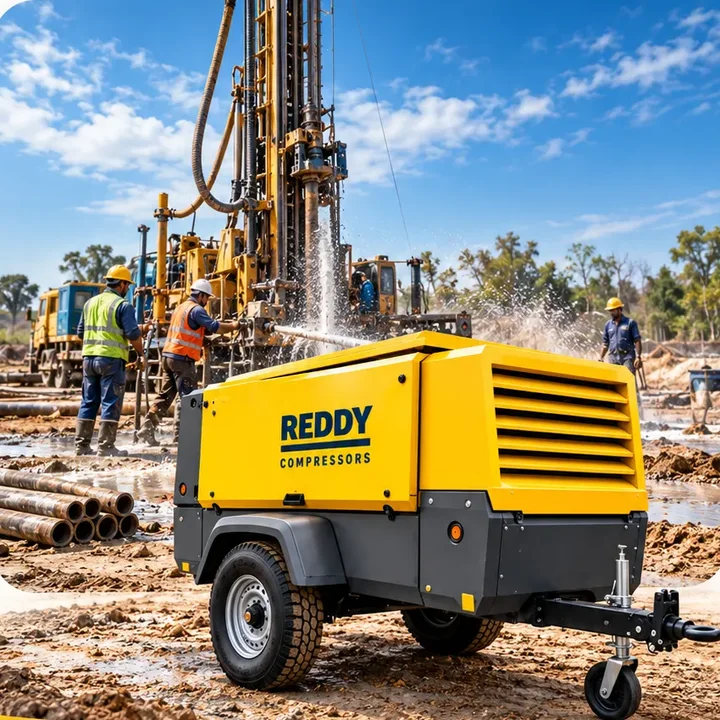 Borewell and DTH600–1,500 cfm at 200–400 psig (13.8–27.6 bar), special units up to 35 bar, for water-well and DTH drilling rigs. All types, brands and models.Explore →
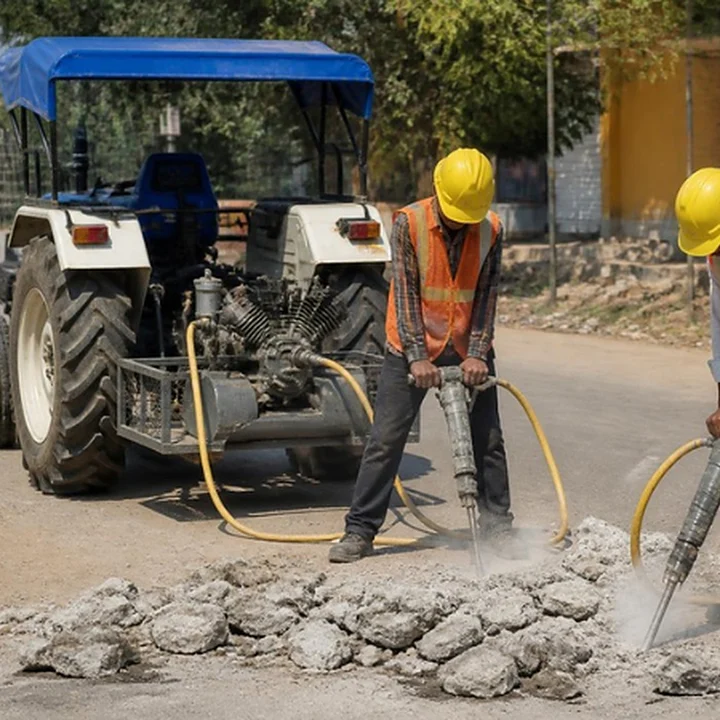 Tractor-mountedPTO-driven piston compressors, 100–140 cfm at 7–10 bar, mounted or on a trolley behind a 35–60 hp tractor, for breakers, rock drills and farm work. Sales and hire.Explore →
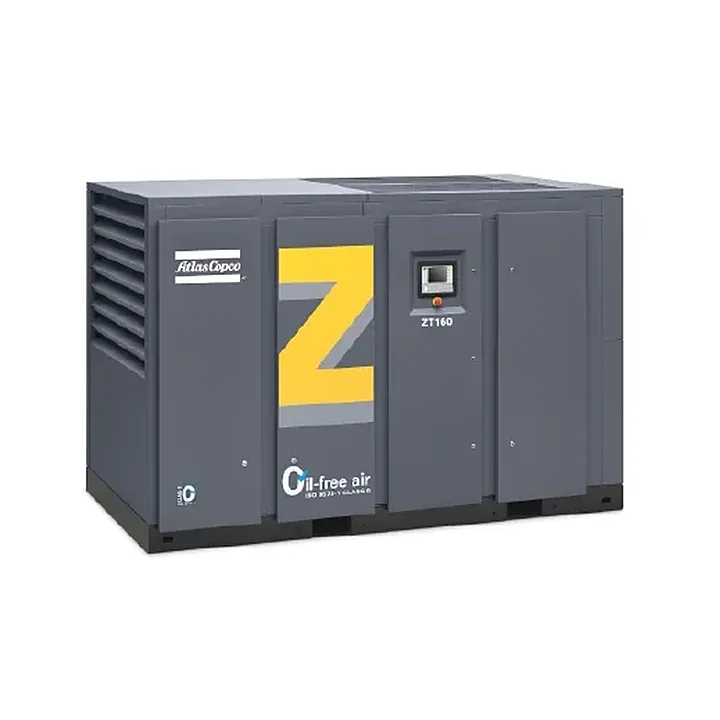 Oil-freeOil-free screw and piston compressors for food, pharma, electronics and instrument air, with ISO 8573-1 Class 0 machines where certified.Explore →
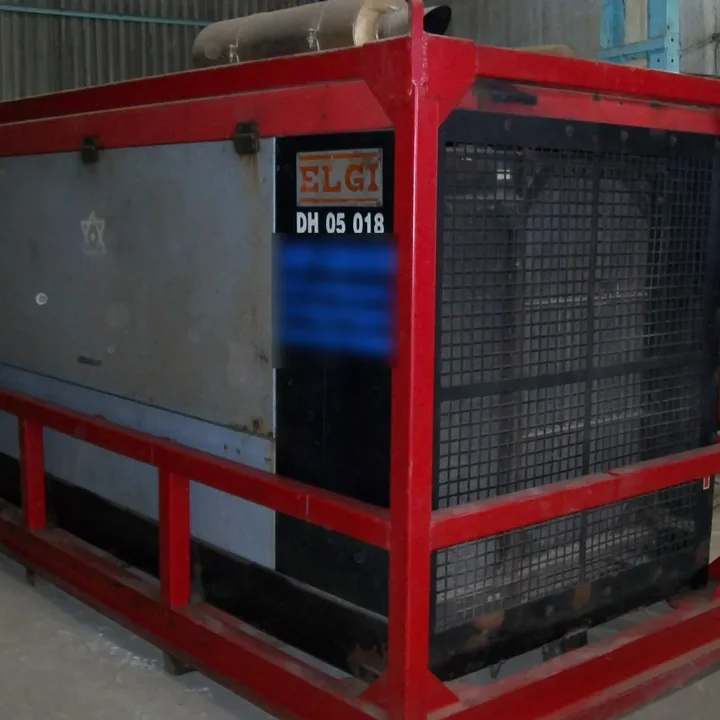 Skid and stationarySkid-mounted diesel and electric packages for plants, quarries and long-term site installations.Explore →
 Used and refurbishedInspected and overhauled machines of all makes, with a six-month warranty (from the invoice date; consumables excluded) and parts support.Explore →
How are air compressors classified?
Every air compressor belongs to one of two families, and the family tells you a great deal about how the machine behaves before you look at a single brochure.
Positive-displacement compressors trap a fixed volume of air and reduce that volume to raise its pressure. Piston, rotary screw, scroll, rotary vane and tooth compressors all work this way. Their flow stays fairly steady as discharge pressure changes, which is why they cover almost every workshop, factory, construction, mining and drilling duty in India.
Dynamic compressors, mainly centrifugal, accelerate air with a high-speed impeller and then slow it in a diffuser so that velocity becomes pressure. Their flow changes noticeably with pressure, and they are most efficient at large, steady flows in big plants.
On top of the compression principle, buyers usually describe compressors in three further ways:
- By lubrication: oil-lubricated (oil-injected) or oil-free compression chamber.
- By drive: electric motor, diesel engine or tractor power take-off (PTO).
- By mounting: stationary base- or tank-mounted, skid-mounted, towable portable, or tractor-mounted.
A “450 cfm diesel portable” and a “75 kW oil-injected VSD screw” are both rotary screw compressors; they simply differ in drive, mounting and control. Keeping these labels separate avoids most of the confusion in compressor enquiries.
Air compressor types compared
The table below gives typical ranges across makes. They are not limits: individual models sit above and below them, and the exact figures must always come from the manufacturer’s data for the model being offered.
| Type | Principle | Typical size / flow | Typical pressure | Duty pattern | Best for |
|---|---|---|---|---|---|
| Reciprocating (piston), single- and two-stage | Positive displacement | About 1–50 hp; larger industrial units | 7–12 bar (101.5–174 psig); 30 bar and more multi-stage | Intermittent, with rest periods | Workshops, garages, small plants, high-pressure duties |
| Rotary screw, oil-injected, fixed-speed | Positive displacement | About 5–500 hp | 7–13 bar (101.5–188.5 psig) | Continuous, steady load | Factory plant air running many hours a day |
| Rotary screw, oil-injected, VSD | Positive displacement | Similar to fixed-speed | 7–13 bar | Continuous, variable load | Plants whose demand changes by shift or season; trim duty |
| Rotary screw, oil-free (dry or water-injected) | Positive displacement | Medium to large | Usually 7–10 bar | Continuous | Pharma, food, electronics, textiles, process air |
| Scroll | Positive displacement | About 1–30 hp | 7–10 bar | Light to moderate, quiet | Clinics, laboratories, dental and small oil-free users |
| Centrifugal | Dynamic | Very large, often above 1,000 cfm | Up to about 10 bar for plant air | Steady base load | Large plants with high, stable demand |
| Portable diesel (screw) | Positive displacement | About 50–2,000 cfm | 7–35 bar (101.5–507.6 psig) | Site work, no grid power | Construction, blasting, drilling, shutdowns, hire |
| Electric portable / skid (screw) | Positive displacement | Wide range | 7–25 bar | Long-term site use with power | Tunnels, plants, quarries with grid supply |
| Tractor-mounted (PTO piston) | Positive displacement | About 100–140 cfm | 7–10 bar (101.5–145 psig) | Short, mobile jobs | Rock drills, breakers, rural and farm construction |
| Borewell / DTH (screw) | Positive displacement | About 600–1,500 cfm | 13.8–27.6 bar (200–400 psig); special units to 35 bar | Heavy, continuous while drilling | Water-well and DTH drilling rigs |
| Booster | Usually piston | Matched to the primary compressor | Raises existing air to about 20–40 bar and more | Matched to the process | PET blowing, pressure testing, deep drilling |
For side-by-side detail, the technology comparison centre goes further on each pairing.
Reciprocating (piston) compressors
A crankshaft drives a piston up and down a cylinder. On the down-stroke the inlet valve opens and air is drawn in; on the up-stroke the air is compressed until the delivery valve opens into the receiver. In a two-stage machine, air compressed in a large low-pressure cylinder passes through an intercooler before a smaller high-pressure cylinder takes it to final pressure. Cooling between stages lowers the work needed and keeps valve and ring temperatures under control.
Piston compressors are simple, robust and repairable with ordinary workshop skills. They tolerate dusty rooms better than many people expect, and spares such as valves, rings and gaskets are widely available. Their limitation is duty cycle: most are designed to run part of the time and rest in between, and a piston machine forced to run continuously will run hot, carry oil over and wear its valves early.
Variants include air-cooled and water-cooled, oil-lubricated and oil-free, single-, two- and multi-stage, and base-mounted or tank-mounted units. See the reciprocating air compressors hub, how a piston compressor works and two-stage reciprocating compressors.
Rotary screw compressors
Two meshing helical rotors, one male and one female, form pockets of air that shrink as the rotors turn, carrying air from the inlet end to the discharge end. Compression is continuous rather than pulsed, so the machine runs smoothly and is designed for long hours.
Oil-injected screws spray oil into the rotors to seal the clearances, absorb the heat of compression and lubricate the bearings. A separator removes the oil from the air afterwards. Normal discharge temperature is about 75–95 °C. These machines are the default choice for general factory air.
Oil-free screws keep the compression chamber dry, using timing gears so the rotors never touch, usually in two stages with intercooling. Water-injected designs are a further variant. They are chosen when the process cannot tolerate any risk of oil in the air.
Fixed-speed or VSD: a fixed-speed screw runs at constant speed and controls output by loading and unloading. A variable-speed drive changes motor speed to follow demand. Fixed speed suits stable demand; VSD suits demand that varies materially; larger plants often combine both as base load plus trim.
See the rotary screw compressors hub, oil-injected screws, oil-free screws, fixed-speed screws and VSD screws.
Oil-free, scroll and tooth compressors
“Oil-free” describes the compression chamber, not the whole machine: bearings and gears are still lubricated, but sealed away from the air. Oil-free air is specified where air touches the product, the patient or a sensitive process: pharmaceutical, food and beverage, electronics, laboratory, dental and medical air. Even then, intake air carries hydrocarbons and moisture, so drying and filtration are still needed to reach the ISO 8573-1 class the process requires.
A scroll compressor uses one fixed and one orbiting spiral to squeeze air towards the centre. It is quiet, has few moving parts and is usually oil-free, which suits clinics, laboratories and small users. Tooth compressors use two claw-shaped rotors and are a compact oil-free option for moderate flows.
See the oil-free air compressors hub, what oil-free means, scroll compressors and tooth compressors.
Centrifugal compressors
An impeller spinning at very high speed throws air outward; a diffuser converts that velocity into pressure. Plant-air machines normally use two or three stages on an integrally geared design with intercoolers between stages. The compression path is oil-free.
Centrifugals are efficient at large, steady flows but have a limited turndown range before surge, so they work best as base-load machines with screws handling the variation. They need clean, cool intake air and good cooling water, conditions that deserve particular attention in Indian summers.
Centrifugal machines are usually the right answer above roughly 2,000 cfm when the demand is steady for most of the day: a textile spinning mill, a glass or float-glass line, an automotive paint shop, a refinery or fertiliser plant, or a large PET-bottling hall. Below that, or where demand swings, a rotary screw station with a VSD trim machine normally costs less to buy and to run. The pages in this section take a buyer through that decision and through the operating points, surge, choke and control, that decide whether a centrifugal station runs well in Indian ambient conditions.
Explore the centrifugal range
- Centrifugal air compressors: selection and support – the hub: when a centrifugal beats a screw, the selection method, and how we support centrifugal stations.
- How centrifugal compressors work – impellers, diffusers, intercooling and the oil-free compression path, stage by stage.
- Single-stage centrifugal compressors – low-ratio machines for blower-like and low-pressure plant duties.
- Multi-stage centrifugal compressors – two- and three-stage plant-air machines with intercoolers between stages.
- Integrally geared centrifugals – the bull-gear and pinion layout used by most plant-air centrifugals, and what it means for maintenance.
- Plant-air centrifugal compressors – base-load machines for large factories, with screws handling the swing.
- Process centrifugal compressors – gas and process-air duties where the gas, not just the pressure, sets the design.
- Axial compressors explained – very large flows at low ratio; we provide service and spares support only.
- Centrifugal compressor service: what we do and what needs the OEM – the honest boundary between our field service and high-speed machinery work.
- Blowers vs compressors – when a Roots, screw or turbo blower is the better machine for a low-pressure duty.
Electric-driven or diesel-driven?
The drive is a separate decision from the compression type. Electric-driven compressors are the normal choice wherever reliable grid power exists: lower running cost per unit of air, no fuel logistics, no exhaust, and simpler maintenance. Stationary plant compressors are almost always electric, and electric portables and skids serve long-term sites with a power supply.
Diesel-driven compressors carry their own engine and are independent of the grid. That makes them essential for construction, road work, pipelines, blasting, borewell drilling and emergency standby. They need fuel management, engine servicing and attention to high-ambient operation; in an Indian summer of 40–45 °C, and above 45 °C on open sites, cooling-package design, clean coolers and correct safety shutdowns (high discharge temperature, low engine oil pressure, high coolant temperature) decide whether a machine runs through the afternoon.
See diesel portable compressors, electric portable compressors and diesel or electric rental air.
Portable, tractor-mounted and borewell compressors
These types are defined by how they are mounted and powered rather than how they compress.
- Portable diesel compressors are screw compressors with their own engine on a towable chassis. The 185–250 cfm class typically runs one or two breakers or a small rock drill at about 7 bar (101.5 psig); 250–400 cfm at 7–10 bar runs two to four breakers, rock drills or a blasting nozzle; 400–600 cfm at 7–14 bar (101.5–203.1 psig) serves crawler drills, quarrying, a No. 6 or two No. 5 blasting nozzles and shutdown standby.
- Tractor-mounted compressors are PTO-driven piston compressors of about 100–140 cfm at 7–10 bar (101.5–145 psig), carried on a 35–60 hp tractor or trolley, for breakers, rock drills and rural construction.
- Borewell and DTH compressors are high-flow, high-pressure screw packages, typically 600–1,500 cfm at 200–400 psig (13.8–27.6 bar), with special units up to 35 bar (507.6 psig).
- Skid-mounted compressors sit on a fixed frame for long-term site and plant use without a towing chassis.
See tractor and PTO-driven compressors, the borewell and DTH compressor library and stationary vs portable screw compressors.
Booster compressors
A booster takes air that is already compressed, typically at 7–10 bar or from a portable, and raises it further, to about 20–40 bar and beyond. Because the inlet air is already dense, a booster is much smaller than a single machine doing the whole job. Typical uses are PET bottle blowing, pressure testing of pipelines and vessels, and deep DTH drilling where a primary compressor feeds a booster on the rig.
The booster must be matched to the primary compressor’s flow and pressure, and both need proper aftercooling and moisture separation. See booster compressors, PET blowing compressors and booster-assisted drilling air.
Compressor or blower?
Blowers move large volumes of air at low pressure, typically below 1 bar, for aeration, pneumatic conveying, drying and combustion air. Using a 7 bar compressor and throttling it down for a low-pressure job wastes a great deal of energy. Equally, a low-pressure requirement does not always mean a small machine: some low-pressure duties need very large flows. See blowers vs compressors.
How to choose the right type of air compressor
Choose the air first and the machine second. Horsepower and the label on the canopy follow from the duty. Work through these steps in order:
- Define the flow as FAD. Add up what the tools or process actually consume, allow for realistic simultaneity and leakage, and compare offers only on free air delivery at the stated pressure. Comparing one maker’s displacement figure with another’s FAD is not like-for-like.
- Define the pressure at the point of use. Work backwards: required pressure at the tool, plus pipe and hose loss, plus treatment loss, plus control band. Every extra bar costs roughly 7% more power, so do not add pressure as a safety margin.
- Describe the duty pattern. Hours per day, shifts, and how much demand varies. Intermittent duty points towards piston; sustained duty towards screw; variable sustained duty towards VSD; very large steady duty towards centrifugal base load.
- State the air quality. General tool air, painting, instrument air and product-contact air need different treatment. Decide whether oil-free compression is genuinely required or whether an oil-injected screw with the right dryer and filters meets the ISO 8573-1 class.
- Decide the drive and mounting. Grid power available and the machine stays put: stationary electric. No power or the machine moves between sites: diesel portable or tractor-mounted. Long project with power: electric skid or portable.
- Check the site. Ventilation and heat rejection, dust, ambient temperature, electrical supply, space, access for service and, for portables, towing and road access.
- Decide buy, rent or used. Short or uncertain projects often suit hire; permanent plant air usually suits purchase; a refurbished machine can fit a tight budget or a standby role when its history is known.
- Plan the lifecycle. Service intervals, spares availability, energy cost over the years and who will support the machine on site.
Quick guide by application
| Application | Usual type | Watch for |
|---|---|---|
| Small garage or tyre shop | Tank-mounted piston | Duty cycle, receiver size, moisture in lines |
| CNC and machine shop running two or three shifts | Oil-injected screw, fixed-speed or VSD | Pressure set too high, leakage, dryer sizing |
| Textile, packaging or automotive plant | Several screws with sequencing; VSD trim | Machines fighting each other, pressure drop in headers |
| Pharma or food plant | Oil-free screw or scroll, with dryer and filters | Required ISO 8573-1 class at point of use |
| Construction, road and pipeline sites | Diesel portable screw | Correct cfm band, hose sizing, high-ambient cooling |
| Village, farm and rural construction | Tractor-mounted PTO piston | Tractor HP, PTO speed, guarding |
| Borewell and DTH drilling | High-pressure portable screw, sometimes with booster | Pressure for depth and hammer, flow for hole cleaning |
| PET bottle blowing | Screw plus booster, or high-pressure piston | Oil-free requirement, dew point, booster matching |
For the screw-versus-piston decision in particular, read rotary screw vs reciprocating compressors.
Common mistakes when choosing a compressor type
- Buying by horsepower or headline cfm. Two machines with the same motor can deliver different FAD at different pressures.
- Running a piston compressor on continuous duty. It will run hot, pass oil and need valves far sooner than it should.
- Oversizing “for safety”. An oversized fixed-speed screw spends long periods unloaded, consuming power for no air.
- Raising pressure to hide pipework problems. Fix restrictive pipes, hoses and filters rather than paying for extra bar every hour.
- Specifying oil-free without defining air quality. The compressor is one link; the dryer, filters and distribution decide what reaches the process.
- Ignoring the compressor room or site. Poor ventilation, recirculating hot air and dust cause many high-temperature trips in Indian conditions.
How to read a compressor specification sheet
Once you know which type of compressor suits the job, the data sheet decides which machine. Two compressors with the same kW rating can differ in delivered air, power drawn and the conditions they will tolerate. Read these lines before you compare prices.
| Line on the data sheet | What it really means | What to check |
|---|---|---|
| Free air delivery (FAD) | Air actually delivered at the outlet, converted back to inlet conditions, in m³/min or cfm | Stated to ISO 1217 (Annex C for fixed speed, Annex E for variable speed) at your working pressure, not “displacement” or “piston displacement” |
| Working pressure | Pressure at which the FAD was measured; often the unload or maximum pressure | Compare quotes at the same pressure; a 10 bar variant delivers less air than the 7.5 bar variant of the same frame |
| Maximum working pressure | Highest pressure the package may run at continuously | Your set point plus control band must sit below it, with the safety valve above it |
| Motor rating (kW or hp) | Nameplate output of the main motor | Not the power drawn; the package also feeds the fan and, if fitted, the dryer |
| Package input power | Total electrical power drawn at rated conditions | Use this, not motor kW, for running cost |
| Specific power | Package input power ÷ FAD, in kW per m³/min | Lower is better; compare only at equal pressure and on the same basis |
| Design ambient | Highest cooling-air temperature the package is designed for | For Indian plant rooms, ask for the stated maximum (often 40–46 °C) and the derating above it |
| Duty rating | Continuous, or a percentage on-time for pistons | A piston quoted for intermittent duty is not a 24-hour machine |
| Oil carry-over, noise, dimensions | Residual oil in mg/m³, sound level in dB(A), footprint and weight | Carry-over sets how much filtration you need; noise sets where the machine can stand |
Worked example: two 37 kW quotes (illustrative)
Machine A delivers 6.2 m³/min (6.2 × 35.315 = about 219 cfm) at 7.5 bar g (108.8 psig) with 42.5 kW package input. Machine B delivers 6.6 m³/min (about 233 cfm) at the same pressure with 44.0 kW input.
- Specific power A: 42.5 ÷ 6.2 = 6.855 kW per m³/min.
- Specific power B: 44.0 ÷ 6.6 = 6.667 kW per m³/min.
- For a plant using 6.0 m³/min for 6,000 hours a year: A uses 6.0 × 6.855 × 6,000 = about 2,46,800 kWh; B uses 6.0 × 6.667 × 6,000 = about 2,40,000 kWh.
- Difference: about 6,770 kWh a year. At an assumed tariff of ₹8.50/kWh, that is about ₹57,600 a year, every year.
Machine B draws more power but costs less to run, because it delivers more air per kW. This simple method assumes energy in proportion to air delivered; real costs also depend on how each machine controls at part load. Our specific power comparison calculator and specific power guide go further.
Typical pressure and flow by application
The quick guide above names the usual type for each application. The table below adds the numbers you need to size the machine. Values are typical starting points, not a substitute for the tool or process maker’s data.
| Application | Pressure needed at point of use | Typical supply | Air quality to plan for |
|---|---|---|---|
| Air tools and assembly lines | About 6.2 bar g (89.9 psig) at the tool inlet | Piston or screw set around 7–7.5 bar g | Water removed; lubricated or oil-free tools as specified |
| Spray painting | About 2–4 bar g at the gun; HVLP caps much lower | Piston or small screw at 6–7 bar g | Dry, oil-free at the gun: dryer plus coalescing filtration |
| CNC machines | Usually 5–6 bar g at the machine | Screw at 7–7.5 bar g | Dry air; clean air for spindle and tool-change systems |
| Instrument air in process plants | About 4–7 bar g | Screw, often duplicated for standby | Pressure dew point around −40 °C: desiccant dryer |
| Abrasive blasting | About 6.9 bar g (100.1 psig) at the nozzle | Diesel or electric portable screw; a 3/8 in (No. 6) nozzle uses about 200 cfm when new at 100 psig, and roughly 255–270 cfm once worn one size | Moisture separator and aftercooler to stop abrasive clogging |
| Breakers and rock drills | About 6–7 bar g | Portable or tractor-mounted unit; roughly 50–145 cfm per hand-held breaker or rock drill, depending on its size | Line lubricator if the tool needs it |
| Borewell and DTH drilling | About 13.8–27.6 bar g, set by depth, water column and hammer | High-pressure portable screw, 600–1,500 cfm | Hole-cleaning flow matters more than air quality |
| PET bottle blowing | About 30–40 bar g | Screw plus booster, or high-pressure piston | Oil-free, dry air at the moulds |
| Nitrogen generator feed | About 7–10 bar g at the generator inlet | Screw sized to the generator’s air-to-nitrogen ratio | Dry, filtered air; oil vapour shortens adsorbent life |
| Dental and laboratory air | About 5–7 bar g | Oil-free piston or scroll | Oil-free, dry, filtered |
For each application, add the expected pressure drop through dryer, filters and pipework to the point-of-use pressure before you choose a set point. More detail is on our PET compressor, borewell compressor and nitrogen generator pages.
The compressed-air system around the compressor
A compressor alone rarely gives usable air. Every item between the airend and the machine on the shop floor either protects air quality or costs pressure, and every bar lost has to be made up at roughly 7% more power.
| Component | Job | Typical pressure drop when clean | Sizing point |
|---|---|---|---|
| Aftercooler and separator | Cools discharge air and removes most liquid water | About 0.1 bar | Usually built into the package; check its approach temperature in hot rooms |
| Air receiver | Buffers demand peaks and steadies control | Negligible | Size for control band and peak demand, not by habit |
| Dryer | Lowers the pressure dew point | About 0.2–0.3 bar | Correct for inlet temperature, ambient and pressure |
| Filters | Remove particles, oil aerosol and vapour | About 0.1–0.2 bar each, rising as they load | Match the ISO 8573-1 class needed, no more |
| Drains | Remove condensate without wasting air | None | Level-sensing zero-loss drains rather than timer drains that blow air on every cycle |
| Pipework | Carries air to users | Aim for about 0.1 bar across the main network | Loop mains, generous bore, minimal fittings |
Add the clean-condition drops and a plant with dryer, two filters and pipework already loses about 0.5–0.8 bar before the hose and regulator. That loss is why a compressor that “should” be big enough sometimes is not. A pressure-drop survey often recovers more than a new machine would.
How Indian conditions change the choice
Most catalogue figures assume temperate conditions. Plants in Telangana, Andhra Pradesh and much of India must allow for four extra factors.
- Heat. Summer ambients of 42–45 °C, plus the heat the compressor itself puts into the room, can push intake air above the package’s design ambient. Ask for the design ambient and plan room ventilation or ducted cooling air at the selection stage, not after the first summer trip.
- Monsoon humidity. Moist air means far more condensate, so dryers and drains must be sized for the wet season, not an average day.
- Dust. Construction, quarry and cement sites load intake filters and coolers quickly. Heavy-duty or pre-filtration options and easy cooler access matter more than a small price difference.
- Power quality and altitude. Voltage variation and imbalance raise motor current and temperature; VSD packages also need harmonic and surge protection. On the Deccan plateau at about 500 m, inlet pressure is roughly 0.95 bar a, about 6% below sea level, so each m³ of FAD carries about 6% less air by mass.
Worked example: monsoon condensate (illustrative)
A screw compressor delivers 10 m³/min FAD of intake air at 35 °C and 80% relative humidity, compressing to 7 bar g.
- Water entering with the air: about 19 kg per hour (around 0.029 kg of water per kg of dry air, at about 10.9 kg of dry air per minute).
- The aftercooler cools the air to about 45 °C at 8.0 bar a. Saturated air at that state holds far less water, so about 14 litres per hour condense in the package.
- A refrigerated dryer at a 3 °C pressure dew point removes about another 4.6 litres per hour.
- Total: about 18.6 litres per hour, or about 450 litres in a 24-hour day.
That is a 200-litre drum filled roughly every 11 hours from one 10 m³/min machine. Undersized drains, a dryer selected for 25 °C inlet or a blocked separator will pass this water downstream. See our air dryer page for dryer selection.
New, used, refurbished, rental or AMC: choosing the route
Once the type and size are clear, decide how to get the air. Each route suits a different duty and risk.
| Route | Best when | What to check |
|---|---|---|
| New compressor | Long-term base load, high running hours, energy cost matters most | FAD and specific power at your pressure, design ambient, scope of supply; see our screw compressor price guide |
| Used or refurbished | Moderate hours, tight budget, quick availability | Running hours, airend condition, measured FAD; our used and refurbished machines carry a six-month warranty from the delivery or invoice date on the whole compressor, excluding consumables, misuse or wrong oil, service by others, and accident or site damage |
| Rental | Projects, shutdowns, breakdowns, trial before buying, uncertain demand | cfm and pressure at the tool, fuel or power, hose and duration; compare with our rental versus ownership calculator |
| AMC on an existing machine | The machine is right for the duty and needs planned care | Service intervals by running hours, parts scope, records kept for warranty and audit |
Whichever route you take, confirm performance at handover. Our commissioning and acceptance guide lists what to measure.
How Reddy Compressors helps
Reddy Compressors has served industry since 2002 from our office at Tarnaka, Secunderabad. We are an independent multi-brand specialist, not an authorised dealer, and we sell, rent and service machines from ELGi, Atlas Copco, Ingersoll Rand, KAESER, Chicago Pneumatic, Doosan and others. We have tie-ups with all major and reputed brands. Because we are not tied to one maker, we can recommend the type that fits your duty rather than the one we happen to stock.
- Selection: we work from your flow, pressure, duty and air quality to the right type, size and control, and compare offers on a consistent FAD basis.
- Sales: new compressors, and used or refurbished machines where their history supports it. For long-term projects we can supply brand-new compressors to site.
- Rental: our own fleet of diesel and electric machines, including high-pressure units, from 50 to 2,000 cfm and 2 to 30 bar, through our temporary air engineering centre.
- Service: more than 20 service engineers and technicians covering the whole of Telangana and Andhra Pradesh, for preventive maintenance, AMC, breakdown repair, overhaul and air audits.
- Spares: identified from the make, model, serial number, nameplate photo or old part, with fit confirmed before we quote, and supplied across India.
Our team across Reddy Generators and Reddy Compressors has also delivered temporary power-and-air packages for large projects, including multiple high-pressure compressors for an oil and gas development at Kakinada, so we understand how compressors fit into a complete site utility. Call +91 99590 60718 or +91 92468 88812, or email info@reddycompressors.com or reddycompressors@gmail.com.
What to send us
- What the air must run: tools, machines or process, and how many at once
- Required flow (cfm or m³/min) and pressure at the point of use, if known
- Hours of running per day and whether demand is steady or variable
- Air-quality need: general, painting, instrument or product-contact
- Power available on site, or whether diesel is needed
- Existing compressor details with a nameplate photo, if replacing one
- Site location, duration (for hire) and any timing constraints
Frequently asked questions
What are the main types of air compressors?
The main types are reciprocating (piston), rotary screw, scroll, rotary vane, tooth and centrifugal compressors. The first five are positive-displacement machines that squeeze a trapped volume of air; centrifugals are dynamic machines that use impeller speed. Buyers also group compressors by drive (electric, diesel or tractor PTO), by lubrication (oil-injected or oil-free) and by mounting (stationary, skid, portable or tractor-mounted). Boosters raise already-compressed air to higher pressure.
Which type of air compressor is best for a factory?
For most factories running one or more full shifts, an oil-injected rotary screw compressor is the usual choice because it is designed for continuous duty and gives stable pressure. Choose fixed speed for steady demand and VSD where demand varies materially. Larger plants often use several screws with sequencing, or a centrifugal for base load. Product-contact air in pharma or food may justify oil-free compression with suitable drying and filtration.
Is a screw compressor better than a piston compressor?
Neither is better in every case. A screw compressor suits sustained demand, long running hours and stable pressure, and is quieter and smoother. A piston compressor suits intermittent use, small workshops and some high-pressure duties, and is simple and cheap to repair. Running a piston machine continuously shortens its life, while a screw that runs only a few minutes at a time may never warm up properly. Decide on the actual duty pattern.
What is the difference between oil-free and oil-injected compressors?
In an oil-injected compressor, oil enters the compression chamber to seal, cool and lubricate, and is separated from the air afterwards, leaving a small residual carry-over that filters remove. In an oil-free compressor, no oil enters the compression chamber at all. Oil-free is chosen where any oil risk is unacceptable to the product or process. Both still need drying and filtration to meet a defined ISO 8573-1 air-quality class.
Should I choose a diesel or electric compressor?
Choose electric where reliable grid power is available and the machine stays in one place or on a long project: running cost is lower and there is no fuel to manage. Choose diesel where there is no power, where the compressor moves between sites, or for emergency standby. On hire, the choice often depends on site power, duration and the noise and exhaust limits of the location.
What is a tractor-mounted air compressor used for?
A tractor-mounted compressor is a piston compressor driven by the tractor’s power take-off, typically about 100–140 cfm at 7–10 bar (101.5–145 psig) on a 35–60 hp tractor or trolley. It runs breakers, rock drills and small pneumatic tools for rural construction, farm work, trenching and village infrastructure, where a towed diesel portable would be larger or costlier than the job needs.
How do I know what size of compressor I need?
Start with the free air delivery the tools or process consume and the pressure needed at the point of use, then allow for realistic simultaneous use and leakage rather than a fixed percentage. Add pressure losses through pipes, hoses, dryers and filters. If you are replacing a machine, its nameplate and running hours help. If you are unsure, tell us what the air must run and we will work it out with you.
What is an air compressor and how does it work?
An air compressor is a machine that takes in atmospheric air and raises its pressure so the air can store and deliver energy. Positive-displacement types, such as piston and screw compressors, trap a volume of air and reduce it mechanically. Dynamic types, such as centrifugal compressors, speed the air up with an impeller and convert that speed into pressure. An electric motor or diesel engine drives the machine, and a receiver, dryer and filters make the air usable for tools, machines and processes.
What does FAD mean on a compressor?
FAD means free air delivery: the volume of air the compressor actually delivers at its outlet, expressed at inlet conditions, usually in m³/min or cfm. It is measured to ISO 1217 at a stated working pressure. FAD is lower than displacement, which is simply the swept volume of the cylinders or rotors and ignores leakage and heating losses. Always size and compare compressors on FAD at your working pressure. To convert, 1 m³/min equals 35.315 cfm.
How do I choose a compressor supplier?
Choose a supplier who sizes the machine from your measured or calculated demand, quotes FAD to ISO 1217 and package input power at your pressure, and states the scope of supply clearly. Check that they can service the machine, supply spare parts and offer rental cover during breakdowns. An independent multi-brand supplier can compare makes on equal terms. Reddy Compressors, Secunderabad, supplies and services all major makes across Telangana and Andhra Pradesh.
Should I buy a new compressor, a used one, or rent?
Buy new for a long-term base load with high running hours, where energy efficiency pays back over years. Buy used or refurbished when hours are moderate, budget is tight or you need a machine quickly, and insist on running hours, an airend check and a warranty. Rent for projects, shutdowns, breakdowns or when future demand is uncertain. For a site running a single shift, a good used screw compressor can be the lowest total-cost option.
Related pages
- Industrial air compressor selection: the complete engineering guide
- Reciprocating air compressors
- Rotary screw compressors
- Rotary screw compressor selection guide
- Oil-free air compressors
- Centrifugal air compressors
- Scroll air compressors
- Booster compressors
- Diesel portable compressors
- Electric portable compressors
- Tractor and PTO-driven compressors
- Borewell and DTH compressors
- Rotary screw vs reciprocating compressors
- Blowers vs compressors
- Technology comparison centre
Technical content reviewed by D. Srinivas Reddy, Managing Partner and service engineer, Reddy Compressors. Last updated 7 November 2026. How our engineering content is reviewed.