
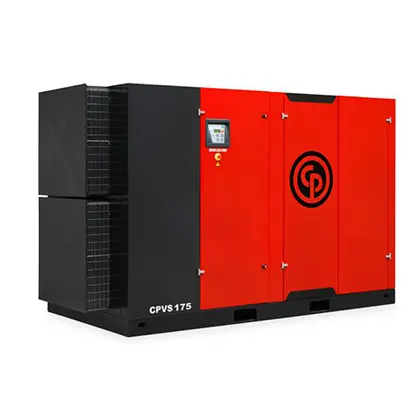
Why screw compressors suit heavy duty
A rotary-screw compressor compresses air between two meshing helical rotors, so delivery is continuous rather than a series of piston strokes. That gives smoother pressure, lower vibration and a high duty cycle, which is why screw machines dominate factories, quarries, mines, construction and drilling.
Stationary screw compressors
A stationary machine is fixed in a plant room or utility area and normally runs from an electric motor. It feeds air through receivers, dryers, filters and a distribution header to many users.
- Best for continuous, concentrated demand: production lines, fixed paint shops, packaging, assembly, process plants and fixed mine infrastructure
- Lower energy cost per unit of air where grid power is available
- Easy to add dryers, filters, heat recovery, variable-speed drive and multi-machine sequencing
- Easier noise control and planned maintenance
Portable screw compressors
A portable machine is a self-contained package, usually diesel-driven, mounted on a trailer, skid or truck. It brings air to the work where there is no grid power or where the work front keeps moving.
- Best for quarry and rock drilling, road and civil works, site blasting and painting, demolition, pipeline and bridge work, and emergency use
- Quick deployment and independence from the grid
- Air is delivered close to the tool, so very long pipelines are avoided
- Needs more frequent field inspection because of dust, heat, rain, vibration and changing ground
Side-by-side comparison
| Parameter | Stationary | Portable |
|---|---|---|
| Installation | Fixed | Mobile or relocatable |
| Prime mover | Usually an electric motor | Usually a diesel engine |
| Environment | Plant room, controlled | Outdoor, dust, rain, heat |
| Air distribution | Fixed piping network | Flexible hoses |
| Duty profile | Continuous plant demand | Project or moving demand |
| Air treatment | Wide choice of dryers and filters | Application-specific |
| Energy cost | Usually lower (electricity) | Higher (diesel) |
| Maintenance | Centralised and predictable | More frequent, in the field |
Mining and quarrying usually need both
Stationary machines suit an established layout with concentrated demand, power available and long continuous running. Portable machines suit drilling locations that change, exploration, benches that move, and sites with poor roads or power. In many operations portable units support early or moving work while stationary plant serves permanent production areas.
Sizing: more than CFM
Check pressure at the tool while it is working, not at the compressor gauge. A machine that reads 7 bar at no load can deliver far less at a distant rock drill through an undersized hose. See the CFM, PSI and bar selection guide and the screw compressor selection guide.
Diesel or electric
Electric drive wins where power is stable and annual running hours are high. Diesel wins where there is no grid, the job is temporary or the site is remote. With diesel, fuel use, engine loading, filtration and maintenance become the main lifecycle costs; see diesel portable compressors and portable compressor fuel systems.
Efficiency on each side
- Stationary: variable-speed drive, master controller and sequencing, lowest workable pressure, leak control and heat recovery
- Portable: engine-speed regulation, pressure-demand control, tools matched to the machine, clean filters, correctly sized hoses, and timely oil and separator service
The most efficient machine is not the smallest or the largest. It is the one that runs closest to the duty it was selected for. Leakage drains both kinds; see leakage reduction.
Maintenance priorities
| Stationary | Portable |
|---|---|
| Intake ventilation and room temperature | Engine oil, coolant and fuel filtration |
| Oil and separator condition | Dust-loaded air filters |
| Dryer performance and condensate drains | Compressor oil and air-oil separator |
| Cooler cleanliness | Radiator and oil-cooler cleaning |
| Belt or coupling inspection | Trailer, tyres, tow-bar and brakes |
| Electrical protection and vibration trend | Hoses, couplings, shutdown and alarm tests |
Ten questions before you buy
- Which tools or machines run at the same time?
- What pressure is needed at the point of use?
- How many hours a day will it run?
- Is the work location fixed or changing?
- Is reliable electrical power available?
- What are the ambient temperature and dust conditions?
- Is dry, filtered or oil-free air needed?
- What fuel or electricity cost is acceptable?
- Are service and spare parts available locally?
- What expansion is expected?
The decision
Choose stationary when demand is central, continuous and supported by permanent infrastructure. Choose portable when mobility, remote operation and fast deployment matter most. Many mining, quarrying and infrastructure businesses do best with both, sharing maintenance planning and standard consumables. Reddy Compressors supplies, services and rents both kinds; send your tool list, pressure and site conditions and we will size it with you.