
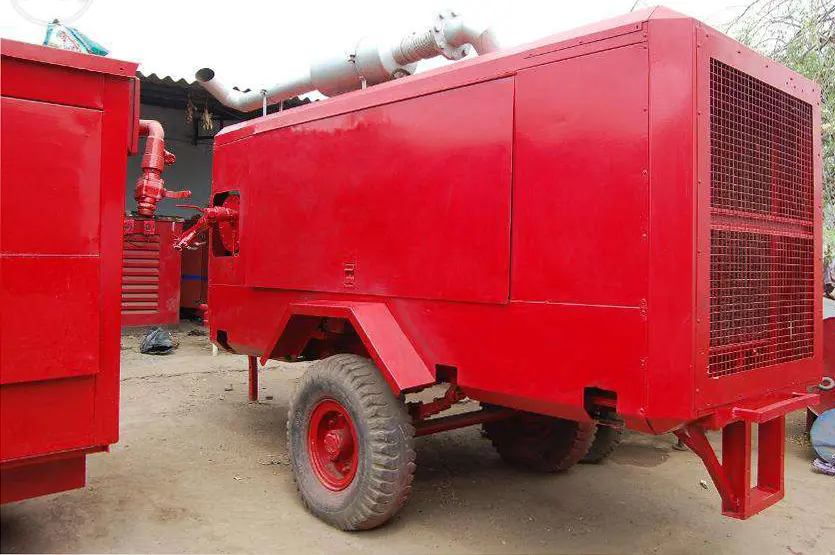
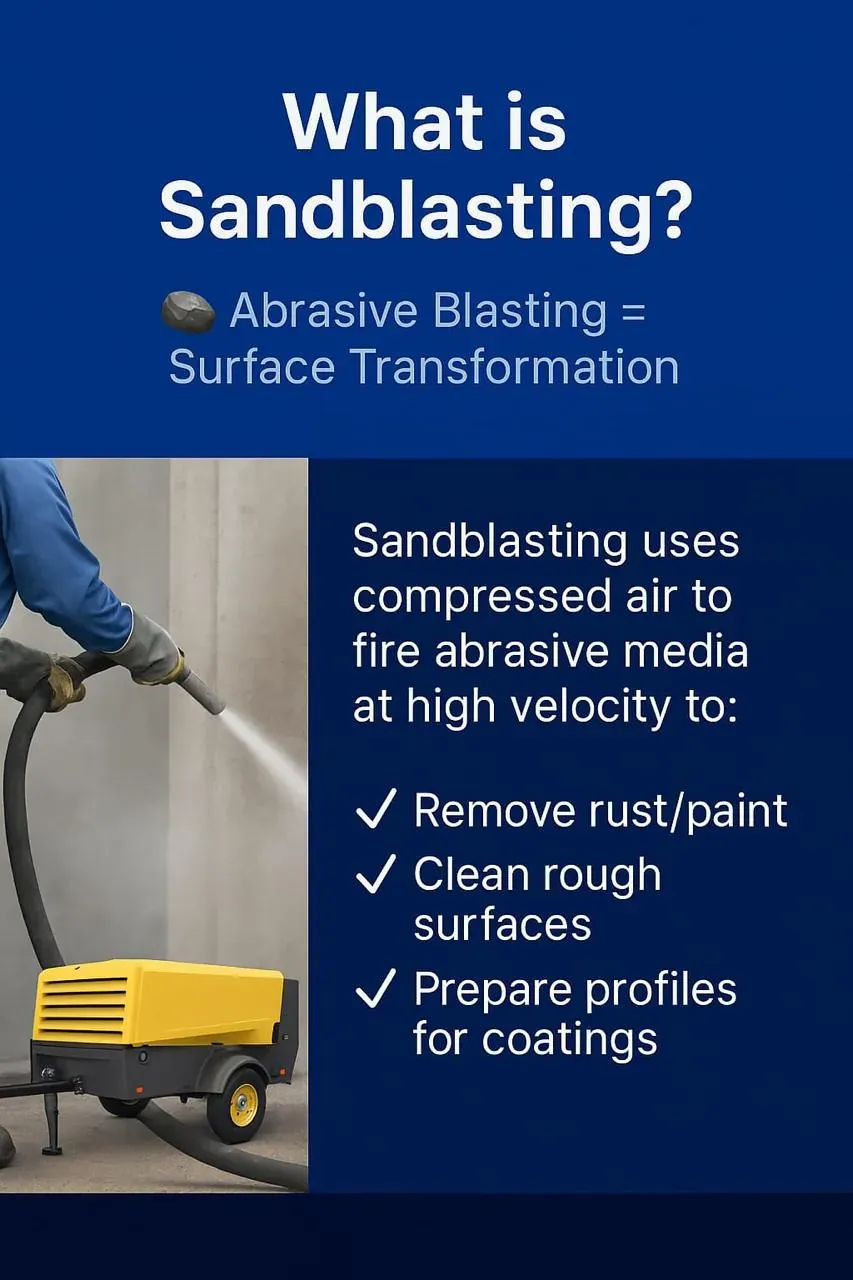
Sandblasting needs a lot of air at a steady pressure, and it needs that air to be dry. A compressor that is too small, a hose that is too long or narrow, or wet air reaching the blast pot will slow the job and spoil the finish. Reddy Compressors hires portable diesel and electric compressors for sandblasting and abrasive blasting, sized to the nozzles you will run, with the hoses and moisture control the job needs.
How much air does a blasting job need?
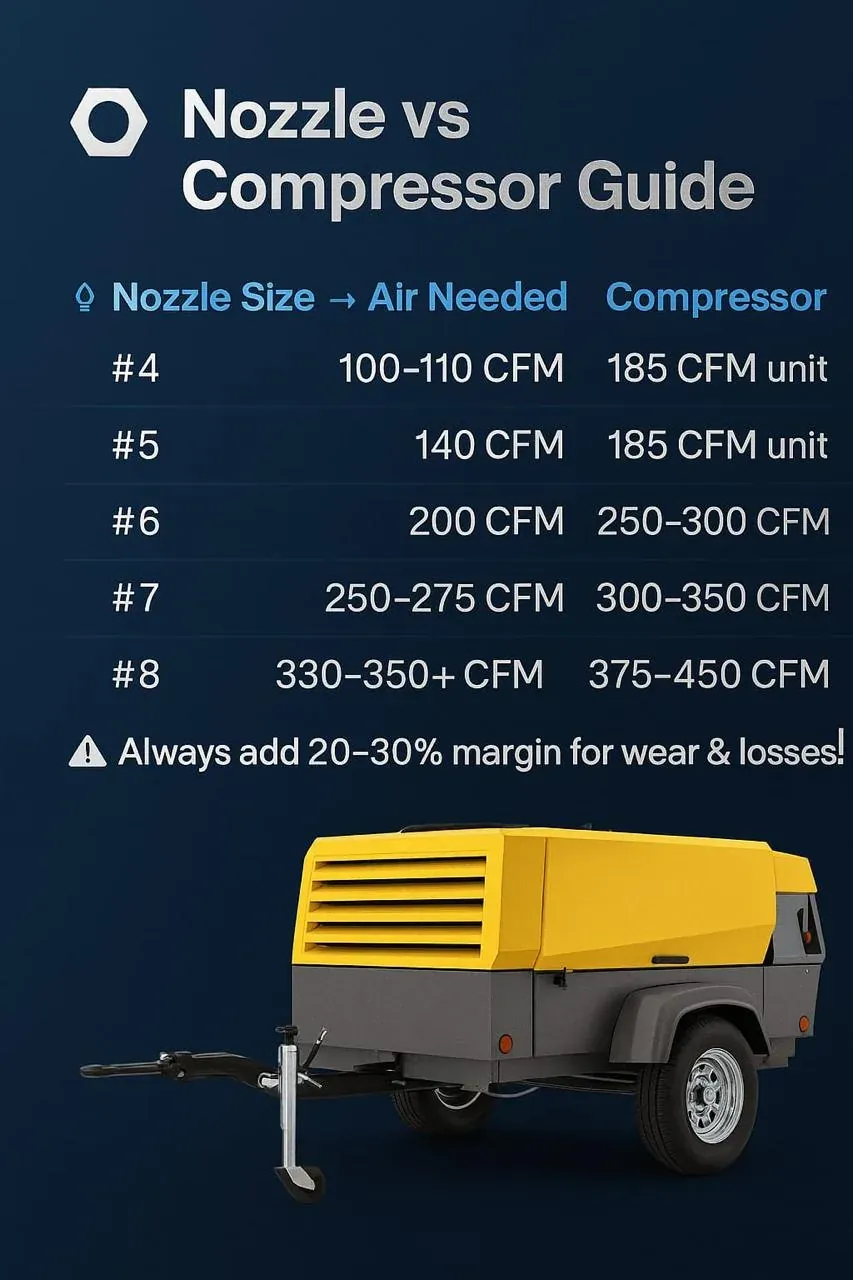
The compressor is sized from the nozzle. Air consumption rises steeply with nozzle bore and with pressure at the nozzle. As a rough guide at around 7 bar (100 psi) at the nozzle:
- A No. 4 nozzle (about 6 mm bore) uses roughly 80 to 90 CFM.
- A No. 5 nozzle (about 8 mm) uses roughly 130 to 150 CFM.
- A No. 6 nozzle (about 9.5 mm) uses roughly 190 to 200 CFM.
- A No. 7 nozzle (about 11 mm) uses roughly 250 to 260 CFM.
- A No. 8 nozzle (about 12.5 mm) uses roughly 330 to 340 CFM.
These figures are typical published values for new nozzles. Nozzles wear: as the bore opens up, the same nozzle uses more air. Add an allowance for wear, for the blast pot and for any air-fed helmet, and plan for the number of nozzles that will run at the same time. Two No. 6 nozzles together already need a compressor in the 400 CFM class.
Pressure at the nozzle, not at the compressor
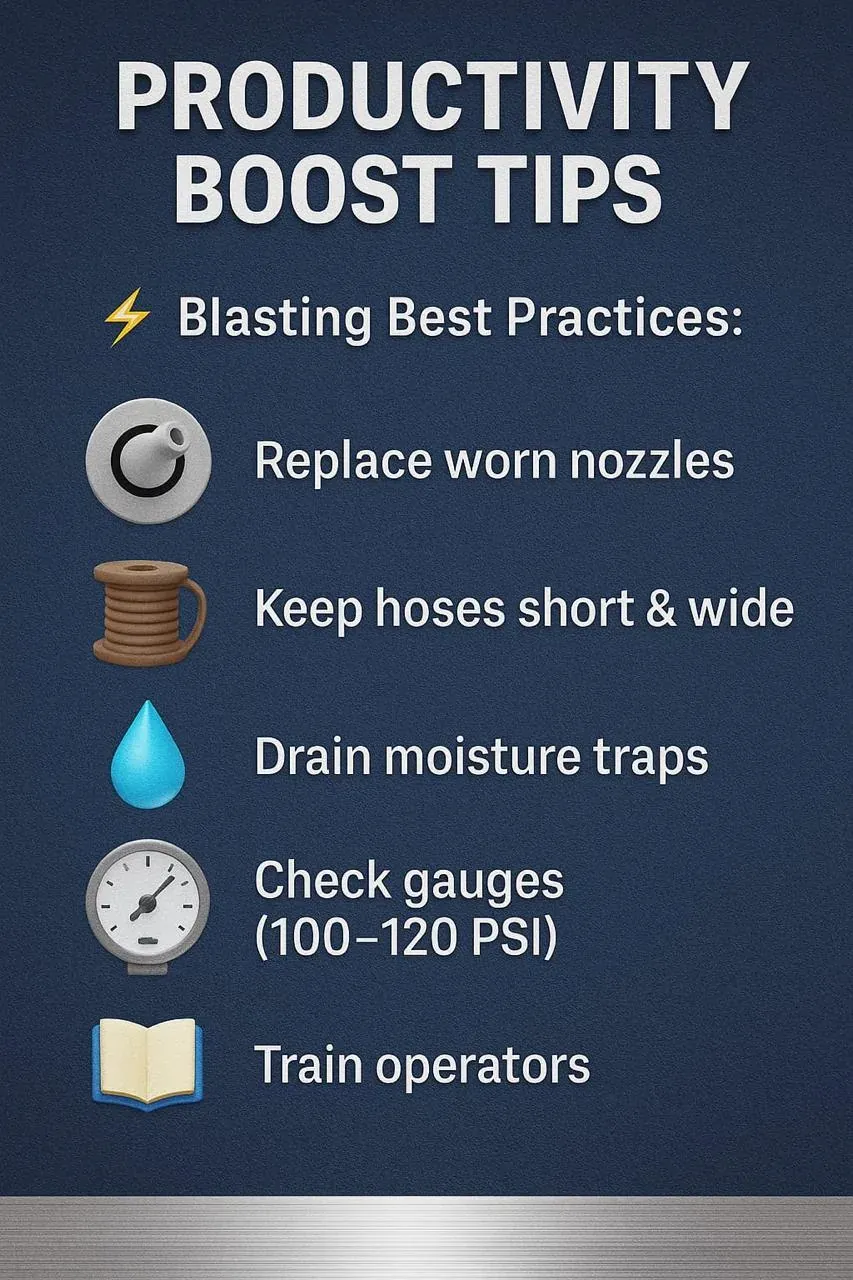
Blasting productivity depends on the pressure at the nozzle. Every metre of hose, every coupling and the blast pot itself take some pressure away. Long, narrow hoses can lose 1 bar or more before the air reaches the operator, and every bar lost slows the work. We size the compressor's working pressure and the hose bore together so that the nozzle sees the pressure the job needs. Where the hose run is long, a larger bore hose is usually a better answer than a bigger compressor.
Dry air prevents choked pots and poor finishes
Compressed air leaving a compressor is hot and saturated. As it cools in the hose and pot, water condenses. Wet air makes abrasive clump, chokes the metering valve and leaves moisture on the steel surface, which affects coating adhesion. For blasting we plan:
- an aftercooler or cooling run and a moisture separator with a working drain at the compressor;
- an automatic or manual drain on the blast pot and line filter;
- where the coating specification demands it, a dryer between the compressor and the pot.
Drain the separator and pot regularly through the shift, especially in humid weather.
What we supply on hire
- Portable diesel compressors from compact units for single-nozzle work to high-volume machines for multi-nozzle crews, within our rental range of 50 to 2,000 CFM.
- Electric compressors for sites with a reliable power supply, such as workshops and fabrication yards.
- Air hoses, couplings and manifolds sized to the flow and distance.
- Moisture separators, line filters and, where needed, dryers.
- Delivery, start-up and collection, with service support during the hire.
Blast pots, abrasive, nozzles and protective equipment are arranged by the blasting contractor unless agreed otherwise in the rental proposal.
Typical sandblasting applications
- Surface preparation of steel structures, tanks, pipelines and vessels before painting.
- Rust and old coating removal during plant maintenance and shutdowns.
- Fabrication yards preparing new steel for coating.
- Restoration of concrete, stone and brick surfaces.
- Ship, rail and heavy-equipment refurbishment.
What to tell us when you ask for a quote
- Number of nozzles running at the same time and their size.
- Working pressure you want at the nozzle.
- Hose length from compressor to blast pot and from pot to nozzle.
- Whether the air must be dried, and the coating specification if there is one.
- Site location, hire period and working hours per day.
- Diesel or electric, and whether power is available on site.
Send these through the rental enquiry, call +91 99590 60718 or +91 92468 88812, or email reddycompressors@gmail.com.
Safety
Abrasive blasting is hazardous work. Operators need supplied-air respiratory protection, protective clothing and properly secured hose couplings with whip checks. Hoses must be rated for the working pressure. Keep the compressor's exhaust away from the breathing-air intake of any air-fed helmet. Follow the coating specification and site safety rules for dust control and abrasive disposal.