
What the interface includes
A pressure-blast pot is a pressure vessel that holds abrasive and meters it into a stream of compressed air. The compressor makes the air, but the result at the nozzle depends on the parts that join the two. When we set up a blasting compressor, we treat the following as one system:
- Compressor service valve and discharge pressure setting.
- Aftercooler, moisture separator and any filter or dryer.
- Supply hose from compressor to pot, its bore, length and couplings.
- Pot inlet piping, inlet ball valve and any moisture trap fitted to the pot.
- Pot pressure rating, pop-up (sealing) valve, exhaust or blow-down valve and pressure relief arrangement.
- Remote control system (pneumatic or electric deadman), control lines and the choke and metering (mixing) valve.
- Blast hose and nozzle, which set the actual air demand.
Nozzle sizing itself is covered on our abrasive blasting nozzle and air supply page. This page is about joining the pot to the compressor safely and without losses.
How a blast pot uses compressor air
When the operator presses the deadman handle, the remote control opens the air inlet valve and closes the exhaust. Air pressurises the vessel and seats the pop-up valve. Air also flows along the pot’s piping to the metering valve at the base, where abrasive falls into the air stream and travels down the blast hose. Releasing the handle closes the inlet and vents the pot so the pop-up drops and the pot can be refilled.
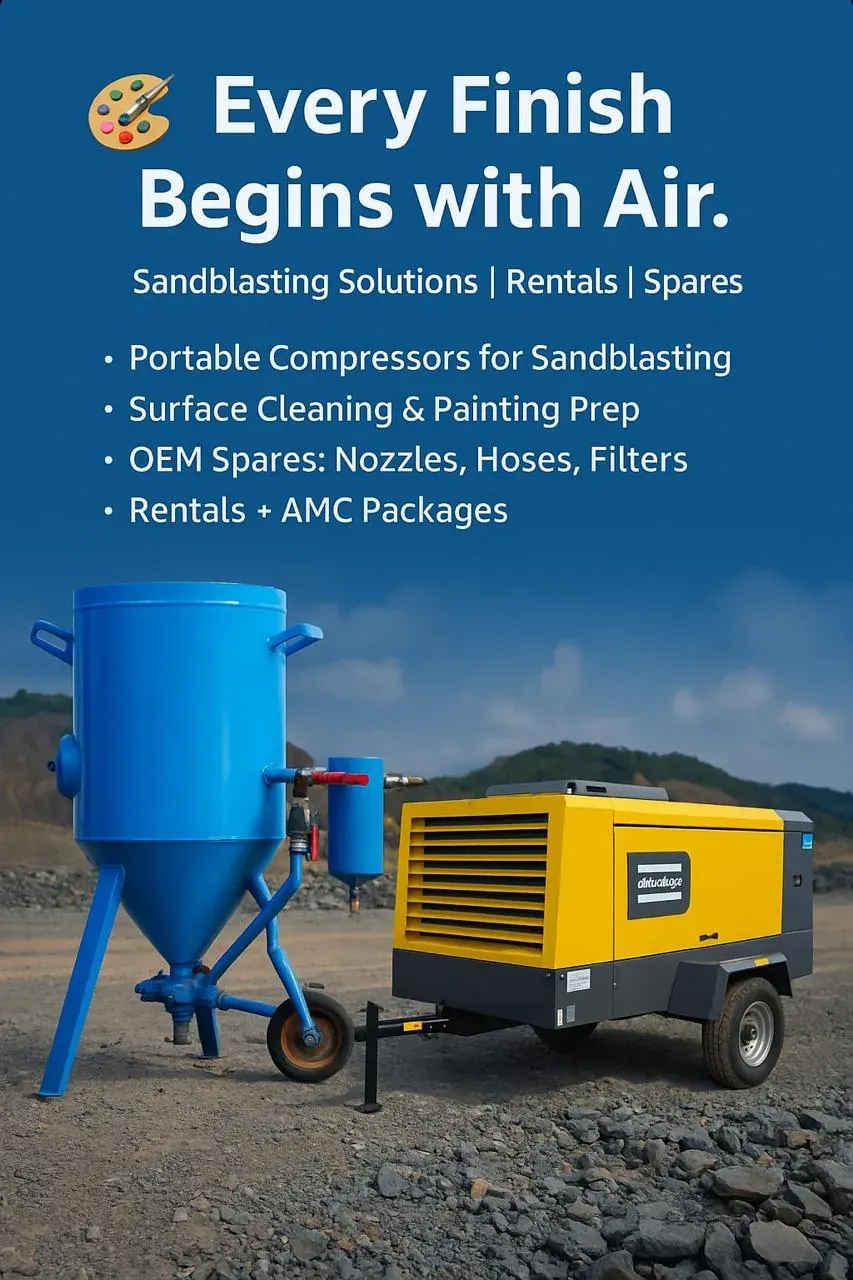
Three consequences matter for the compressor. First, the pot’s own inlet piping and valves are usually sized for its largest intended nozzle; feeding it through a smaller hose or reducer creates a bottleneck. Second, every start fills the vessel, so the compressor sees short demand peaks on top of steady nozzle flow. Third, any water entering the pot wets the abrasive, which then bridges over the metering valve and causes surging or choking.
Pressure rating: compressor capability is not pot permission
Blast pots carry a maximum allowable working pressure on their nameplate, commonly in the region of 10–12 bar (145–174 psig) for typical contractor pots, though ratings vary and must be read from the actual vessel. Many portable compressors can deliver more than this, particularly high-pressure drilling machines in the 17–24 bar (246.6–348.1 psig) class.
- Never connect a pot to a compressor whose maximum pressure exceeds the pot rating unless a correctly rated pressure regulator and relief device protect the pot.
- Hoses, couplings, valves, moisture separators and dryers must each be rated for the maximum pressure they can see.
- Pot inspection, relief valve setting and any repair are the responsibility of the equipment owner and competent personnel, following the maker’s documentation and site rules.
- Do not weld, drill or modify the vessel.
For most steel blasting, a compressor working at 8.5–10 bar (123.3–145 psig) gives a nozzle pressure of about 7 bar (101.5 psig) and stays inside common pot ratings. High-pressure blasting with special nozzles and pots is a separate, engineered set-up.
Pressure losses from compressor to pot
| Point | What to look for | Typical fix |
|---|---|---|
| Compressor service valve | Small valve outlet on a large machine; partly open valve | Use the main outlet; fully open the valve |
| Aftercooler and separator | Undersized unit, blocked core, drain stuck closed | Match capacity to compressor flow; clean and test drain |
| Supply hose | Too small a bore, excessive length, kinks, many couplings | 1-1/2 to 2 in hose; shortest practical route; fewer joints |
| Couplings | Reduced-bore claw couplings or quick couplers | Full-bore couplings with safety pins and whip checks |
| Pot inlet | Reducing bushes, small inlet ball valve | Keep inlet at the pot’s design bore |
| Pot piping and metering valve | Worn or partly closed valves, damaged seals | Inspect and service to the pot maker’s instructions |
The quickest diagnostic is to read pressure at the compressor, at the pot inlet and with a needle gauge at the nozzle, all while blasting. The difference between readings shows where the losses are. A pressure drop of more than about 0.5 bar across the supply hose and pot inlet together is worth investigating.
Air treatment before the pot
Water is the enemy of a blast pot. The aftercooler and moisture separator should sit between the compressor and the pot, as close to the pot as hose layout allows, so that air cools and drops its water before entering the vessel. A separator placed right at the compressor outlet may see air that is still warm, and further condensation then happens in the hose and pot.
- Cool the air with an aftercooler sized for the full compressor flow.
- Remove water and oil droplets in a separator with a working automatic or manual drain.
- Add a coalescing filter where the coating specification requires oil-free, clean air.
- Use a refrigerated dryer (typical pressure dew point about +3 °C) or desiccant dryer for humid sites, long hoses or high-specification coatings.
- Drain the pot’s own moisture trap at every break and check the abrasive is dry and free-flowing.
Equipment options are described on our aftercooling and moisture separation and temporary air treatment trains pages.
Remote controls, isolation and depressurisation
A deadman control that stops blasting when the operator lets go is standard practice and is required by most site rules. The control air supply for the deadman and any pneumatic remote valves comes from the same compressor line, so control lines must be intact, free of water and correctly connected. Water in control lines causes sticking valves and delayed stops.
- Fit an isolation valve at the pot inlet so the pot can be depressurised and isolated without stopping the compressor.
- Vent the pot fully through its exhaust before opening the fill port or working on the pot or hose.
- Never disconnect a pressurised hose; close the source, vent, then uncouple.
- Restrain every coupling with safety pins and whip checks.
- Keep the compressor operator and blast crew in communication, particularly where the compressor is far from the pot.
Multiple pots on one compressor
Large jobs often run two or more pots from one compressor through a manifold. Each pot then needs its own isolation valve, and the manifold and main supply hose must be sized for the combined flow. Add up the nozzle demands, allow for wear, add respirator air and any tools, and check the compressor delivers the total at the required pressure. If one crew’s nozzle is larger or more worn, it will take a bigger share and starve the other. Balancing nozzle sizes and replacing nozzles on a schedule keeps both crews productive. See our hose and manifold distribution page for layouts.
Interface checklist before blasting starts
- Confirm pot nameplate rating and compressor maximum pressure; fit a regulator and relief if needed.
- Check hose, coupling and treatment equipment ratings.
- Lay supply hose by the shortest practical route; fit safety pins and whip checks.
- Test the aftercooler, separator and drains.
- Function-test the deadman and remote valves with the pot empty.
- Fill with dry abrasive and set the metering valve.
- Measure pressure at the compressor, pot inlet and nozzle while blasting, and record the figures.
- Agree who operates and refuels the compressor and who services the pot.
How Reddy Compressors helps
Sandblasting air is a core part of our business, not a side line. Over the years we have supplied many compressors for sandblasting, both as outright sales and on hire, to painting, coating and surface-preparation contractors and to plants doing their own maintenance blasting. That experience shapes how we size, equip and service every blasting package we send out.
From Tarnaka, Secunderabad, we sell, rent and service compressors for blasting contractors as an independent multi-brand specialist covering ELGi, Atlas Copco, Ingersoll Rand, KAESER, Chicago Pneumatic and other makes. Our rental fleet runs from 50–2,000 cfm and 2–30 bar, diesel and electric, and we supply blasting compressors with aftercoolers, moisture separators, supply hoses and couplings, and dryers where the job needs them.
We set the compressor working pressure to suit your pot rating and nozzle, check the air route on commissioning and service the compressor on hire. The blast pot, respirator system and blasting method remain the contractor’s equipment and responsibility. Our service teams cover all of Telangana and Andhra Pradesh, and we supply across India. See sandblasting compressor hire.
What to send us
- Blast pot make, capacity and nameplate pressure rating (a photo helps).
- Pot inlet size, remote control type and number of pots.
- Nozzle numbers and blast hose sizes.
- Supply hose length needed from compressor position to pot.
- Air quality required by the coating specification.
- Site location, duration and shift pattern.
Frequently asked questions
Why is my blast pot surging or choking?
The most common cause is moisture: water reaches the pot, wets the abrasive and makes it bridge over the metering valve. Check the aftercooler and separator are working and draining, drain the pot’s moisture trap, and use dry abrasive. Other causes include a metering valve set too open, low air pressure at the pot, a damaged pop-up valve or a worn nozzle drawing more air than supplied.
Can I connect a high-pressure drilling compressor to a blast pot?
Only if the pot, hoses and every fitting are protected against pressures above their rating. A drilling compressor may deliver 17–24 bar (246.6–348.1 psig), while many blast pots are rated far lower. Set the compressor to a lower working pressure where its controls allow, and fit a correctly rated regulator and relief device. If in doubt, use a compressor whose maximum pressure suits the pot.
What size air hose should run from the compressor to the blast pot?
For a single No. 5 or No. 6 nozzle, a 1-1/2 in (38 mm) supply hose is a typical minimum; for No. 7 or No. 8 nozzles, long runs or two pots, 2 in (50 mm) or larger is usual. Match the hose to the pot inlet bore, use full-bore couplings and keep the route short. An undersized supply hose is a frequent cause of low nozzle pressure.
Where should the moisture separator go in a blasting set-up?
After the aftercooler and as close to the blast pot as the layout allows. Air keeps cooling along the hose, so a separator right at a hot compressor outlet can let water condense downstream in the hose and pot. An aftercooler followed by a separator near the pot, with drains that work, removes most liquid water before it reaches the abrasive.
Who is responsible for the blast pot on a hired compressor job?
On a normal compressor hire, we supply, set up and maintain the compressor and any air treatment and hoses we provide. The blast pot, remote controls, respirators and the blasting work stay with the blasting contractor, including pot inspection and relief-valve settings. We agree the scope in writing before mobilisation so that everyone on site knows who checks and operates each item.
Related pages
Technical content reviewed by D. Srinivas Reddy, Managing Partner and service engineer, Reddy Compressors. Last updated 17 October 2026. How our engineering content is reviewed.