
What is a tractor-mounted compressor?
A tractor-mounted compressor uses the tractor as its engine. Instead of buying, fuelling and servicing a separate diesel engine, the owner couples a reciprocating (piston) compressor to the tractor’s PTO shaft. The same tractor that tows the machine to the field, quarry or village road then drives it on site.
The package is simple: a guarded PTO drive shaft with universal joints, a belt or gearbox step-up, an air-cooled two- or three-cylinder compressor, an unloader and pressure switch or pilot valve, a receiver tank with a safety valve and gauge, and an outlet manifold for hoses. It is either mounted on the tractor’s three-point linkage or built on a small two-wheel trolley that the tractor draws behind it.
This is why tractor compressors are common across rural Telangana and Andhra Pradesh. Many farmers and small contractors already own a 35–60 hp tractor. Adding a compressor turns that tractor into a mobile air plant for the off-season, for contract work in neighbouring villages, or for the farm’s own well, field and building jobs.
How the PTO drive works
The PTO is a splined shaft at the rear of the tractor, driven from the engine through the PTO clutch. On most tractors used in India the standard PTO speed is 540 rpm, reached at a specific engine speed marked on the tachometer. Some tractors also offer a 540E (economy) or 1,000 rpm setting.
A piston compressor of this size runs best well above 540 rpm, so the drive steps the speed up through V-belts and pulleys or a gearbox. The operator engages the PTO at low engine speed, brings the engine up until the tachometer shows rated PTO speed, and holds it there. Running below rated speed cuts air delivery roughly in proportion; running above it overspeeds the compressor and its valves.
When the tool stops, pressure rises in the receiver and the unloader holds the suction valves open (or opens a bypass) so the compressor turns without pumping. The tractor keeps running at a light load until air is needed again. The engineering of speed ratios, power matching and cooling is covered in detail on our tractor and PTO-driven compressor engineering page.
Typical specification
| Item | Typical range | What it means for you |
|---|---|---|
| Free air delivery (FAD) | About 100–140 cfm (about 2.8–4.0 m³/min) | Enough for one hand-held rock drill, or one to two breakers, depending on the tool |
| Working pressure | 7–10 bar (101.5–145 psig) | Matches most construction breakers and rock drills, which are rated around 6–7 bar at the tool |
| Compressor type | Two- or three-cylinder reciprocating, air-cooled, oil-lubricated | Simple, repairable in the field, tolerant of dust if the filter is cared for |
| Drive | Tractor PTO, normally 540 rpm, stepped up by belt or gearbox | The tractor must hold rated PTO speed under load |
| Tractor size | Usually 35–60 hp, with a working live or independent PTO | Larger outputs and higher pressures need the upper end of the range |
| Mounting | Three-point linkage, or separate two-wheel trolley | Linkage is compact; trolley frees the tractor and spreads weight |
| Air storage | Receiver tank with safety valve, gauge and drain | Smooths tool demand and collects condensate |
These are typical figures for the class, not the rating of any particular model. Each machine has its own nameplate delivery and pressure, and the air that reaches the tool depends on PTO speed, hose bore and hose length. We confirm the figures for the specific machine before we quote.
Mounted or trolley: which arrangement suits you?
Both arrangements use the same compressor principle. The choice is about the tractor, the terrain and how you work.
| Question | Linkage-mounted | Trolley-mounted |
|---|---|---|
| Moving between work points | Very manoeuvrable; lifts clear of rough ground | Longer outfit; needs room to turn and reverse |
| Load on the tractor | Weight hangs on the rear; front ballast may be needed | Weight sits on the trolley wheels |
| Releasing the tractor | Tractor is tied up while the compressor is in use | Trolley can stay on site if a second tractor or separate engine is arranged |
| Driveline | Short shaft, small articulation angles | Longer shaft; angles change on slopes and turns |
| Hydraulic linkage condition | Must hold the load without creeping down | Not critical |
| Typical user | Farmer or contractor moving often between small jobs | Contractor staying several days at one quarry, canal or road stretch |
Before supplying a linkage-mounted unit we check the linkage category, lift capacity and the tractor’s front-end weight. For a trolley, we check the hitch, the PTO shaft length at full turn and on uneven ground, and whether the guard covers the full length.
Which tools can a tractor compressor run?
The tool decides the air. A tractor compressor of 100–140 cfm is designed around one heavy tool or two lighter ones. The common pairings are:
- Hand-held rock drill (jack hammer) for blast holes, plug-and-feather splitting and anchor holes. A heavy hand-held drill can use most of the compressor’s output by itself.
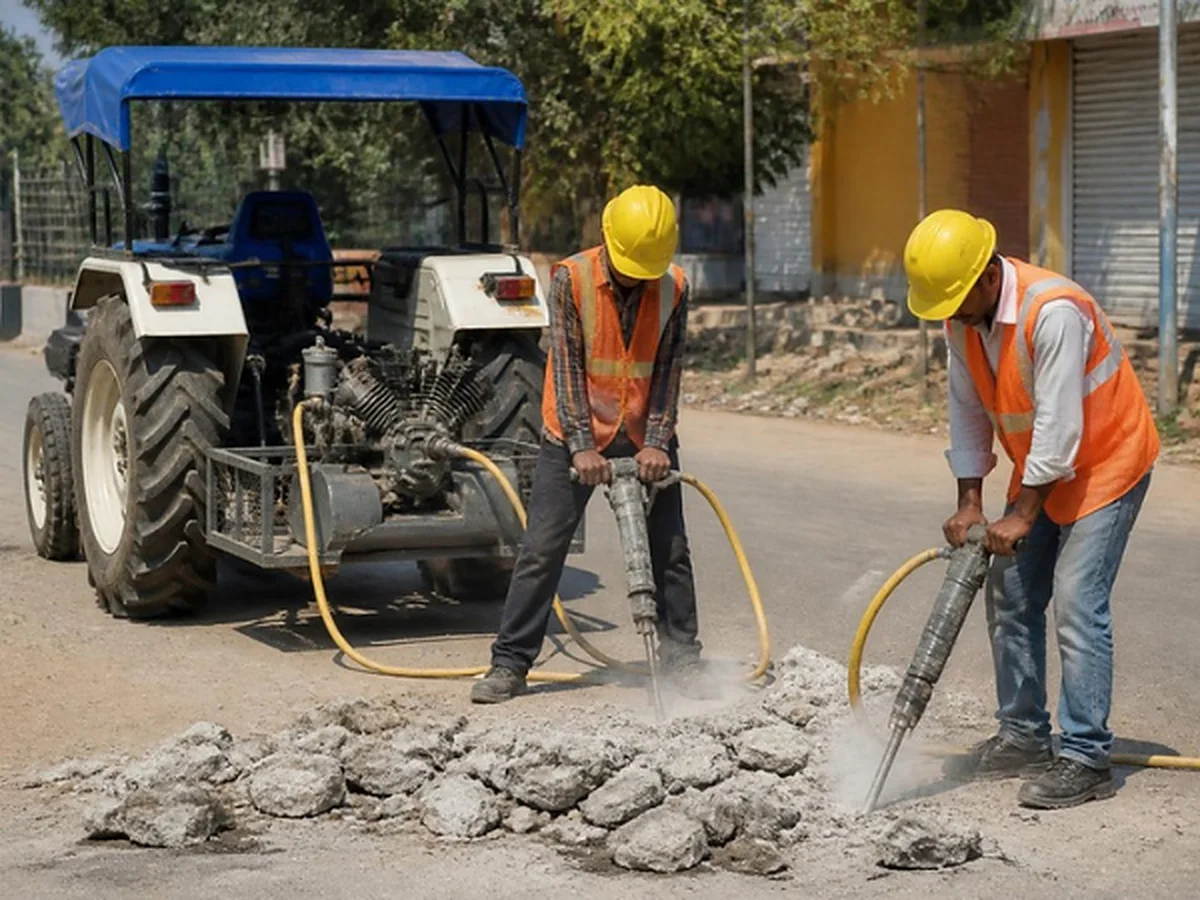
- Pneumatic breakers (paving and demolition breakers) for concrete, asphalt, hard soil and rock. Light and medium breakers can often run in pairs; heavy breakers usually run one at a time.
- Clay spades and diggers for trench walls in hard murram and clay.
- Blow guns and cleaning lances for clearing drilled holes, wells and foundations.
- Small air motors, pumps and impact wrenches for field repairs.
- Tyre inflation on the farm.
The rule is simple: add up the air consumption of every tool that will run at the same time, at its working pressure, from the tool maker’s data, then allow for wear and hose losses. If the total is close to or above the compressor’s FAD, the tools will slow down, breakers will lose impact and drill steel will stick. Our page on breakers, rock drills and air tools explains tool air demand, lubricators and hose sizing in more depth.
Hoses matter as much as the compressor. A long run of narrow hose can lose a significant part of the pressure before the air reaches the tool. Keep runs as short as the site allows, use the bore the tool maker recommends, fit an in-line lubricator for percussive tools, and secure every coupling with a whip check.
Where tractor compressors are used in Telangana and Andhra Pradesh
Tractor compressors earn their place where the job is small, the site is rural, and access is by farm track rather than a truck road.
- Small quarrying and stone work: drilling holes for splitting granite and building stone, dressing blocks, and drilling for controlled blasting carried out by licensed people.
- Boulder breaking in fields: drilling and splitting boulders to clear land for cultivation, plantations and farm roads.
- Trenching: breaking hard ground and rock for water pipelines, cables and drains in villages and new layouts.
- Canal and irrigation work: breaking rock and old concrete on distributaries, field channels, check dams and lining repairs.
- Road work: cutting and breaking concrete and bitumen for culverts, cross-drains and patch repairs on rural roads.
- Open-well deepening: drilling and breaking rock at the bottom of open wells where a tractor can reach the well head.
- Foundations and small civil works: breaking rock for building foundations, compound walls and poles.
- Small rock drilling: shallow holes with hand-held drills for anchors, pins and splitting.
Summer conditions across the Deccan matter. Ambient temperatures in the mid-40s °C and red dust put stress on both the tractor and the compressor. A clean intake filter, clear cooling fins and a tractor radiator free of chaff and dust are the difference between a machine that runs all day and one that overheats by noon.
What a tractor compressor cannot do
A tractor compressor is the right tool for hand-held work. It is the wrong tool for jobs that need high pressure or large air volume.
- Borewell DTH drilling: down-the-hole hammers for water borewells typically need around 600–1,500 cfm at 200–400 psig (13.8–27.6 bar). A 100–140 cfm, 7–10 bar tractor unit cannot lift cuttings or drive a DTH hammer. See our borewell and DTH compressor library.
- Crawler and wagon drills: these normally need a 400–600 cfm diesel portable or larger.
- Abrasive blasting: only the smallest nozzles fall within a tractor unit’s output, and blasting needs steady, dry air through an aftercooler and separator; a diesel portable is the practical choice.
- Several heavy tools at once: three or four breakers need a 250–400 cfm portable.
- Continuous plant air: factories and workshops are better served by an electric screw or piston compressor.
When the job outgrows a tractor unit, we will say so and offer a diesel portable compressor on sale or hire instead.
Buying or hiring a tractor compressor
The decision usually comes down to how many days a year the machine will work and whether the tractor is free to drive it.
| Situation | Usually better to | Why |
|---|---|---|
| You own a suitable tractor and have regular rock or breaking work every season | Buy | The tractor is already paid for; the compressor earns from contract work |
| One well, one trench or a few weeks of breaking | Hire | No capital tied up; return the machine when the job ends |
| Your tractor is needed for ploughing or haulage at the same time | Hire, or hire a diesel portable | Tying up the tractor may cost more than the compressor saves |
| You want to test whether contract breaking pays in your area | Hire first, then buy | Proves the demand before you invest |
| Larger air or higher pressure needed | Hire a diesel portable | The tractor unit is outside its class |
Count the tractor’s cost honestly: fuel at PTO load, engine hours, clutch and PTO wear, and the farm work it is not doing. A tractor compressor saves the cost of a separate engine, but not the cost of running one. Our rental versus ownership calculator helps compare the options with your own numbers.
Maintenance in brief
Tractor compressors are simple, but they work in dust and heat with operators who are often new to compressors. Most failures come from a few neglected checks.
- Before starting: check compressor oil level, tractor engine oil and coolant, belt tension and guard condition; drain the receiver.
- Every day: clean the compressor air filter in dusty work, blow the cooling fins clear, check the PTO shaft guard and universal joints, and listen for valve knock.
- Weekly: grease universal joints and the shaft slide, check the unloader and safety valve operate, inspect hoses and couplings.
- At the maker’s interval: change compressor oil, replace the filter element, inspect valves and gaskets, check pulley alignment.
- At overhaul: replace piston rings, valve plates and springs, bearings and seals as measured, and test the receiver safety valve.
Signs that something is wrong include oil carry-over at the tool, slow pressure build-up, the safety valve lifting, hot cylinder heads, belt squeal and vibration in the shaft. Detailed checklists and fault causes are on our tractor compressor maintenance, faults and safety page.
Safety around PTO shafts and air
The rotating PTO shaft is the biggest hazard on a tractor compressor. It can catch a loose dhoti, saree, towel or sleeve in a moment and pull a person in.
- Keep the full PTO guard, tractor master shield and compressor-side shield in place, with the guard’s restraint chains fitted so the guard does not spin.
- Never step over or reach across a turning shaft. Stop the PTO, stop the engine and remove the key before any adjustment.
- Run the compressor only at its rated PTO speed. Never drive a 540 rpm machine from a 1,000 rpm PTO or through an adapter.
- Keep children and animals away from the tractor and shaft while working.
- Treat the receiver as a pressure vessel: drain it daily, keep the safety valve free and never adjust it upwards.
- Fit whip checks on hose joints and release pressure before uncoupling a hose.
- Give operators ear, eye and hand protection, and use water or dust control when drilling or breaking rock and concrete.
- Blasting must be done only by licensed persons under the applicable rules.
Sizing a tractor compressor for breakers and rock drills: a worked example
Size a tractor compressor from the tools, not from the tractor. Start with each tool’s air consumption at its working pressure, add the tools that genuinely run together, then allow for wear, leakage and hose loss. Only then work back to the PTO power the tractor must supply.
| Tool (typical class) | Typical weight | Air use at about 6 bar(g), cfm | Air use, m³/min |
|---|---|---|---|
| Light breaker | 10–15 kg | 25–40 | 0.7–1.1 |
| Medium breaker | 18–25 kg | 40–55 | 1.1–1.6 |
| Heavy breaker | 28–40 kg | 55–80 | 1.6–2.3 |
| Hand-held rock drill | 18–25 kg | 60–100 | 1.7–2.8 |
| Clay spade | 8–12 kg | 20–35 | 0.6–1.0 |
| Blow gun or cleaning lance (while open) | – | 10–25 | 0.3–0.7 |
These are class-typical ranges. Always use the figure on the tool’s own data plate or manual.
Example (illustrative): two breakers on a farm-road cutting
A contractor wants to run two medium breakers rated at 50 cfm each at 6 bar(g), plus a cleaning lance of 20 cfm used about a quarter of the time. Each breaker has 20 m of 19 mm (3/4 inch) hose with an in-line lubricator.
- Tools running together: 2 × 50 = 100 cfm. Assume both breakers run at the same time, because that is the case the compressor must cover.
- Diversity on the lance: 20 × 0.25 = 5 cfm. Running total: 100 + 5 = 105 cfm.
- Tool wear allowance, 10%: 105 × 1.10 = 115.5 cfm. Worn breaker pistons and valves use more air than new ones.
- Leakage at couplings and lubricators, 5%: 115.5 × 1.05 = 121.3 cfm. Call it about 120 cfm free air delivery at rated PTO speed, which is 121.3 ÷ 35.315 = 3.43 m³/min.
- Pressure: the breakers need 6 bar(g) at the inlet. Allow about 0.5 bar for 20 m of 19 mm hose, the lubricator and couplings, so the compressor should cut out at about 7 bar(g), not lower. Pressure drop varies roughly with the fifth power of bore, so 12.5 mm hose instead of 19 mm gives about (19 ÷ 12.5)5 = 1.525 ≈ 8 times the loss. Small hose is the commonest reason a correctly sized unit feels weak.
- Compressor shaft power: a small air-cooled piston compressor at 7 bar(g) needs about 25 hp per 100 cfm (about 4 cfm per hp). 121.3 × 25 ÷ 100 = 30.3 hp.
- Drive losses: a belt or gearbox step-up is about 95% efficient. 30.3 ÷ 0.95 = 31.9 hp at the PTO shaft.
- Continuous loading margin: do not load a PTO above about 85% of its rated power for hours at a time, especially in a 45 °C summer. 31.9 ÷ 0.85 = 37.5 PTO hp.
- Tractor engine power: PTO power is typically about 86% of rated engine power. 37.5 ÷ 0.86 = 43.6 hp.
Result: a 120–140 cfm class unit at 7 bar(g) on a tractor of at least 45 hp, with 50 hp more comfortable in summer and dust. If one breaker is replaced by a hand-held rock drill of 90 cfm, the demand rises to about 90 + 50 = 140 cfm before allowances, so the drill and breaker should be worked alternately, not together.
PTO power needed for each compressor size (typical, at 7 bar(g))
| Free air delivery, cfm | m³/min | Compressor shaft hp | PTO hp needed (85% loading) | Tractor engine hp, about |
|---|---|---|---|---|
| 60 | 1.70 | 15 | 19 | 22 |
| 80 | 2.27 | 20 | 25 | 29 |
| 100 | 2.83 | 25 | 31 | 36 |
| 120 | 3.40 | 30 | 37 | 43 |
| 140 | 3.96 | 35 | 43 | 50 |
| 160 | 4.53 | 40 | 50 | 58 |
The table uses the same steps as the example: shaft hp ÷ 0.95 for the drive, ÷ 0.85 for continuous loading, ÷ 0.86 from PTO to engine. At 10 bar(g) a single-stage piston compressor needs roughly 15–20% more power for the same delivery, so move one row down. An older tractor that no longer makes its rated power also needs a row of margin.
Rock drilling with a tractor compressor: what is realistic
A tractor compressor drives hand-held pneumatic rock drills, often called jackhammers, that drill holes of about 32–40 mm for blasting, plug-and-feather splitting, anchors and pins. A 100–140 cfm unit runs one such drill at full output.
- Depth: holes are drilled in steps with extension steels, typically about 0.8 m at a time. In practice hand-held drilling is limited to about 3 m. Beyond that the weight of steel, poor flushing of cuttings and operator fatigue make progress very slow.
- Pressure matters more than people expect: drilling rate falls noticeably with every bar lost at the drill. A drill rated at 6 bar(g) that receives 5 bar(g) through a long, thin hose drills markedly slower and sticks its steel more often.
- Open wells: blast holes in a well floor are realistic where the tractor can reach the well head and the floor can be dewatered. Wet drilling or a water flush keeps silica dust down.
- Blasting: drilling is the compressor’s job; charging and firing holes is for licensed persons only.
Why a tractor unit cannot drill a borewell
A down-the-hole (DTH) hammer needs air for two jobs: driving the hammer and lifting cuttings up the annulus between the drill pipe and the hole wall. Take a 165 mm (6.5 inch) hole with 89 mm (3.5 inch) drill pipe:
- Annulus area = π ÷ 4 × (0.165² − 0.089²) = 0.7854 × (0.027225 − 0.007921) = 0.7854 × 0.019304 = 0.01516 m².
- For an uphole velocity of about 20 m/s, needed to carry chips clear: 0.01516 × 20 = 0.303 m³/s = 18.2 m³/min, or about 18.2 × 35.315 = 642 cfm.
- A 120 cfm tractor unit gives 120 ÷ 35.315 = 3.40 m³/min = 0.0566 m³/s. In the same annulus that is 0.0566 ÷ 0.01516 = 3.7 m/s, far too slow to lift cuttings.
Pressure is the second barrier. Every 10 m of water standing above the hammer adds about 0.98 bar of back-pressure, so a hammer working 100 m below the water level needs nearly 10 bar more than it would dry. That is why borewell work uses high-pressure diesel compressors of about 17–35 bar(g), not a 7–10 bar tractor unit.
Buying a second-hand tractor compressor: inspection checklist
A used tractor compressor can be good value, but wear hides well on a machine that only runs when the tractor is free. Check the following before agreeing a price.
| Check | How to check | Warning signs |
|---|---|---|
| Delivered air | Pump-up test at rated PTO speed (see below), engine speed confirmed with a tachometer | Below about 85% of the class rating |
| Rings and cylinders | Watch the crankcase breather under load; check oil in the discharge line and receiver drain | Heavy blow-by, oil mist at the breather, oily condensate |
| Valves | Listen at each head when loaded; feel head temperatures after 15 minutes | Knocking, one head much hotter than the others, slow build-up |
| Unloader and pressure switch | Close the outlet and let it reach cut-out, then open a tap and watch it reload | Safety valve lifting before unloading, hunting, failure to reload |
| Gearbox or belt drive | Check gearbox oil level and colour; listen for whine; inspect pulley grooves and alignment | Metal particles in oil, gear noise, worn grooves, cracked belts |
| PTO shaft and guards | Match the spline to your tractor (6-spline for 540 rpm, 21-spline for 1,000 rpm on common 35 mm shafts); check universal joint play and telescoping overlap; confirm full guard coverage with restraint chains | Play in the cross bearings, missing or split guards, shaft too short for your linkage |
| Receiver | Inspect inside through the drain or inspection opening; look for pitting, dents and weld repairs; ask for any thickness or hydraulic test record | Heavy internal rust, welded patches, no working drain |
| Safety valve and gauge | Confirm the set pressure is marked and matches the receiver rating; check the gauge reads zero when empty | Seized, painted over, wired shut or set above the receiver rating |
| Hoses, couplings, frame | Inspect hose covers and ends, coupling claws and seals; on trolleys check axle, tyres and hitch | Bulged or cracked hose, worn couplings, cracked frame welds |
The pump-up test, with arithmetic (illustrative)
Close every outlet, empty the receiver, run at rated PTO speed and time the rise between two pressures. Free air delivery is then about: receiver volume × (pressure rise in bar ÷ 1.01325) ÷ time in minutes.
Example: a 300 litre (0.3 m³) receiver rises from 2 to 7 bar(g) in 33 seconds.
- 0.3 × (5 ÷ 1.01325) = 0.3 × 4.935 = 1.480 m³ of free air.
- 1.480 ÷ (33 ÷ 60) = 1.480 ÷ 0.55 = 2.69 m³/min = 2.69 × 35.315 = 95 cfm.
- If the unit is sold as 120 cfm (3.40 m³/min), a healthy machine should take about 1.480 ÷ 3.40 = 0.435 min, or 26 seconds. At 95 ÷ 120 = 79% of rating, rings or valves are worn and the price should reflect an overhaul.
Hot air in the receiver makes the test read slightly high, so treat it as a check to within about 10%, add the volume of any hose left connected, and repeat it twice.
Fuel use per hour: a reasoned estimate
Fuel use depends on how hard the compressor works, not on tractor size alone. Take the 120 cfm example above (illustrative):
- Loaded, the compressor takes about 31.9 hp at the PTO. Unloaded, a piston compressor still absorbs roughly 25% of that, about 8 hp.
- If it runs loaded 70% of the time: 0.7 × 31.9 + 0.3 × 8.0 = 22.3 + 2.4 = 24.7 hp average at the PTO.
- Engine output = 24.7 ÷ 0.86 = 28.7 hp = 28.7 ÷ 1.341 = 21.4 kW.
- A tractor diesel held at rated PTO speed but part-loaded uses roughly 260–300 g of fuel per kWh. 21.4 × 260 = 5.6 kg/h; 21.4 × 300 = 6.4 kg/h.
- At about 0.835 kg per litre of diesel: about 6.7–7.7 litres per hour, or about 54–62 litres in an eight-hour day.
Idling at full PTO speed while nobody is using air still burns fuel. Dropping the engine to idle with the PTO disengaged during long breaks, and fixing coupling leaks, saves more than most operators expect.
How Reddy Compressors helps
Reddy Compressors has served industry from Tarnaka, Secunderabad since 2002. We are an independent multi-brand specialist that sells, rents and services compressors, with a team of over 20 service engineers and technicians who cover the whole of Telangana and Andhra Pradesh. Equipment and spare parts are supplied across India.
- Sales: tractor-mounted and trolley-mounted compressors matched to your tractor’s HP, PTO type and linkage, supplied with the correct guarded PTO shaft, receiver with safety valve and gauge, and the hoses and fittings the job needs.
- Hire: tractor compressors for short jobs, and when the job is bigger, diesel portables from our own rental fleet.
- Service and repair: valves, rings, gaskets, bearings, unloaders, belts, PTO shafts, universal joints, safety valves and gauges on all makes.
- Spare parts: identified from the machine (make, model, serial, nameplate photo or the old part) with fit confirmed before we quote. See find my part.
- Advice: an honest answer on whether a tractor unit suits the job, or whether you need a larger portable.
Visit or write to us at Srinilayam, 12-13-200, First Floor, Street No. 1, Tarnaka, Secunderabad 500017. Phone +91 99590 60718 or +91 92468 88812, WhatsApp +91 99590 60718, or email reddycompressors@gmail.com.
What to send us
- Tractor make, model, HP and PTO speed options (photo of the PTO shaft end helps)
- Mounting preference: linkage or trolley
- The tools you will run, their make and model, and how many at once
- The work: rock or concrete type, hole depth, hours per day and hose length needed
- Site location, and for hire, the start date and how long you need the machine
- For service or parts: the compressor nameplate photo and a description or video of the problem
Frequently asked questions
How much air does a tractor compressor give?
A typical tractor-mounted piston compressor delivers about 100–140 cfm (about 2.8–4.0 m³/min) at 7–10 bar, or about 100–145 psig. The exact figure depends on the model and on holding the tractor at its rated PTO speed. Hose length and bore reduce what reaches the tool, so we confirm the delivery for the specific machine and your hose layout when we quote.
What size tractor do I need for a PTO air compressor?
Most tractor compressors in this class are matched to tractors of about 35–60 hp with a working 540 rpm PTO. The larger outputs and higher pressures need the upper end of that range. Engine HP alone is not enough to decide; the PTO power, speed, spline type and the condition of the clutch and linkage all matter, so we check your tractor before recommending a machine.
Can a tractor compressor be used for borewell drilling?
No. A tractor compressor is not suitable for borewell DTH drilling. Water borewells typically need about 600–1,500 cfm at 200–400 psig (13.8–27.6 bar) to drive the hammer and lift cuttings, many times what a tractor unit can give. It is suitable for hand-held rock drills, breakers, cleaning and open-well rock work. For borewells, use a high-pressure diesel portable.
How many breakers can a tractor compressor run?
Usually one heavy breaker or hand-held rock drill, or two light to medium breakers, depending on each tool’s air consumption at working pressure. Add up the consumption of every tool running at once from the maker’s data and compare it with the compressor’s delivery, leaving margin for wear and hose losses. If the total is too high, the tools slow down and wear faster.
Is it better to buy or hire a tractor compressor?
Buy if you own a suitable tractor and have regular breaking or drilling work through the year, because the tractor is already paid for. Hire for a single well, trench or a few weeks of work, or when your tractor is needed for farm work at the same time. For larger jobs, hiring a diesel portable is often more practical than tying up a tractor.
Do you service tractor compressors of all makes?
Yes. As an independent multi-brand specialist we service tractor-mounted and trolley-mounted compressors of different makes, including valves, piston rings, gaskets, bearings, unloaders, belts, PTO shafts, universal joints, safety valves and gauges. Send a photo of the nameplate and a short description or video of the fault, and we will identify the parts and confirm fit before quoting.
Can I run a 540 rpm compressor on a 1,000 rpm PTO?
No. Running a 540 rpm compressor from a 1,000 rpm PTO, or through an adapter that allows it, overspeeds the drive and compressor and can cause valve, bearing and shaft failure. It also defeats the guarding arrangement. Use the PTO speed the compressor is built for, set the engine to the speed marked for that PTO, and keep all guards in place.
How much diesel does a tractor compressor use per hour?
For a 100–140 cfm unit at 7 bar(g) running two breakers, expect roughly 6–8 litres per hour, depending on how much of the time the compressor is loaded, the tractor’s condition and the heat. The tractor must stay at rated PTO speed, so it burns fuel even when the compressor is unloaded. Long hoses, leaks and running tools at higher pressure than needed all raise consumption. Disengaging the PTO and idling during long breaks is the simplest saving.
What decides the price of a second-hand tractor compressor?
Mainly its delivered air against its rating, the state of rings and valves, the gearbox or belt drive, the receiver’s internal condition, and whether the PTO shaft and guards are complete and match your tractor. A pump-up test at rated PTO speed shows wear quickly: a unit delivering under about 85% of its class rating needs an overhaul, and that cost belongs in the price. A rusted receiver or missing guards should be treated as defects, not extras.
How deep can a tractor compressor rock drill go?
With a hand-held pneumatic rock drill, holes of about 32–40 mm are practical to about 3 m, drilled in stages with extension steels. Deeper holes become very slow because the steel gets heavy and cuttings no longer clear well. The drill should receive its rated pressure, usually about 6 bar(g), at the inlet, so use short hose of the correct bore. Deep holes and borewells need a crawler drill or DTH rig with a large diesel compressor.
Which breaker size suits a tractor compressor?
A 100–140 cfm tractor unit runs one heavy breaker of about 28–40 kg, or two light to medium breakers of about 10–25 kg at the same time. Heavy breakers use about 55–80 cfm each at 6 bar(g), so two together exceed most tractor units once wear and leakage are allowed for. Check the breaker’s rated air use and pressure, add 10–15% for wear and leaks, and compare the total with the compressor’s delivery at rated PTO speed.
Related pages
- తెలుగులో చదవండి: ట్రాక్టర్ మౌంటెడ్ కంప్రెసర్
- हिंदी में पढ़ें: ट्रैक्टर माउंटेड कंप्रेसर
- Tractor and PTO-driven compressor engineering
- Tractor compressor maintenance, faults and safety
- Breakers, rock drills and air tools: air supply
- Reciprocating air compressors
- Portable air compressors
- Compressed air for quarries
Technical content reviewed by D. Srinivas Reddy, Managing Partner and service engineer, Reddy Compressors. Last updated 7 November 2026. How our engineering content is reviewed.