
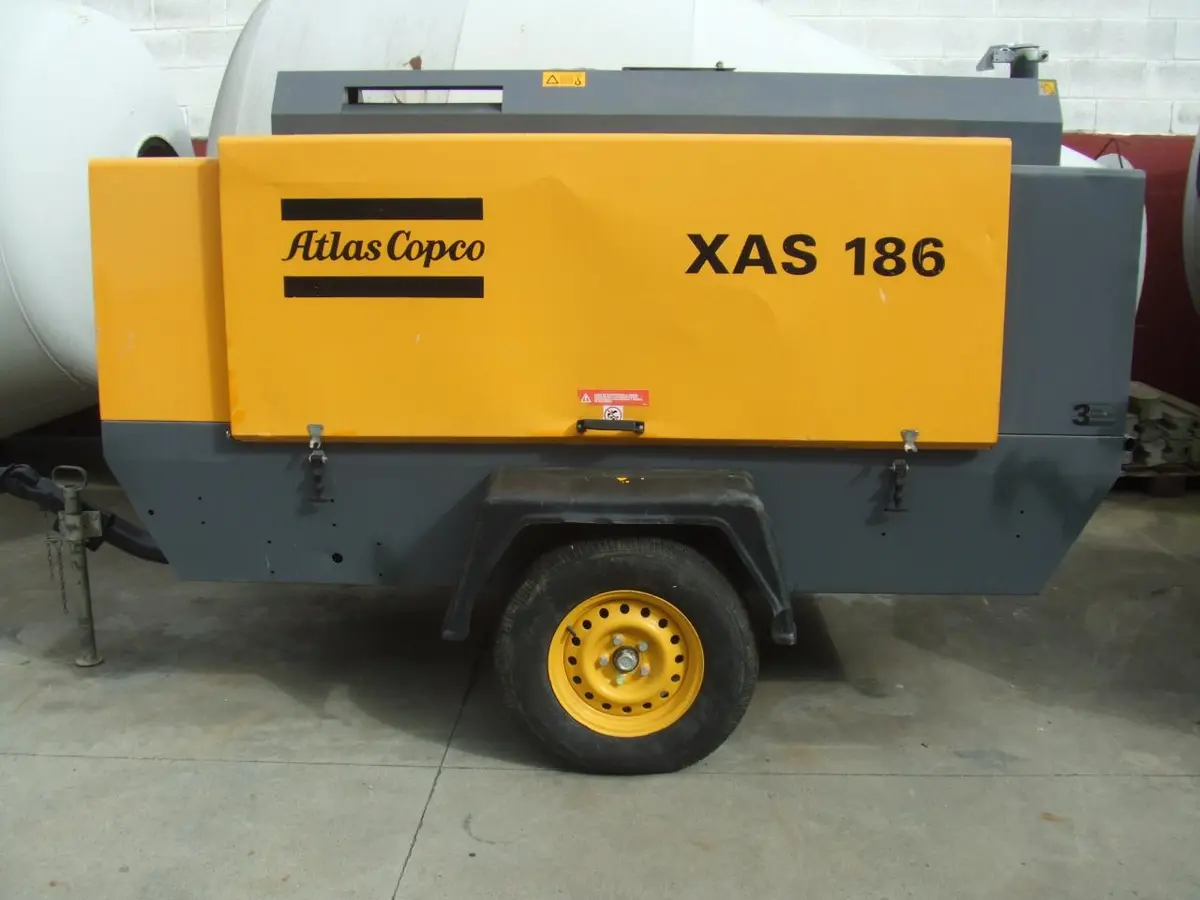
What is a portable air compressor?
A portable compressor brings the air to the job instead of piping it from a plant room. The package combines a prime mover, usually a diesel engine or an electric motor, with an oil-injected rotary screw airend, an oil separator, oil and air coolers, a control system and safety shutdowns, all inside a weatherproof canopy on a wheeled chassis or skid. Construction contractors, drilling crews, blasting and painting contractors, pipeline teams and plant maintenance departments use them for breakers, rock drills, DTH hammers, blasting pots, pipeline testing and temporary plant air.
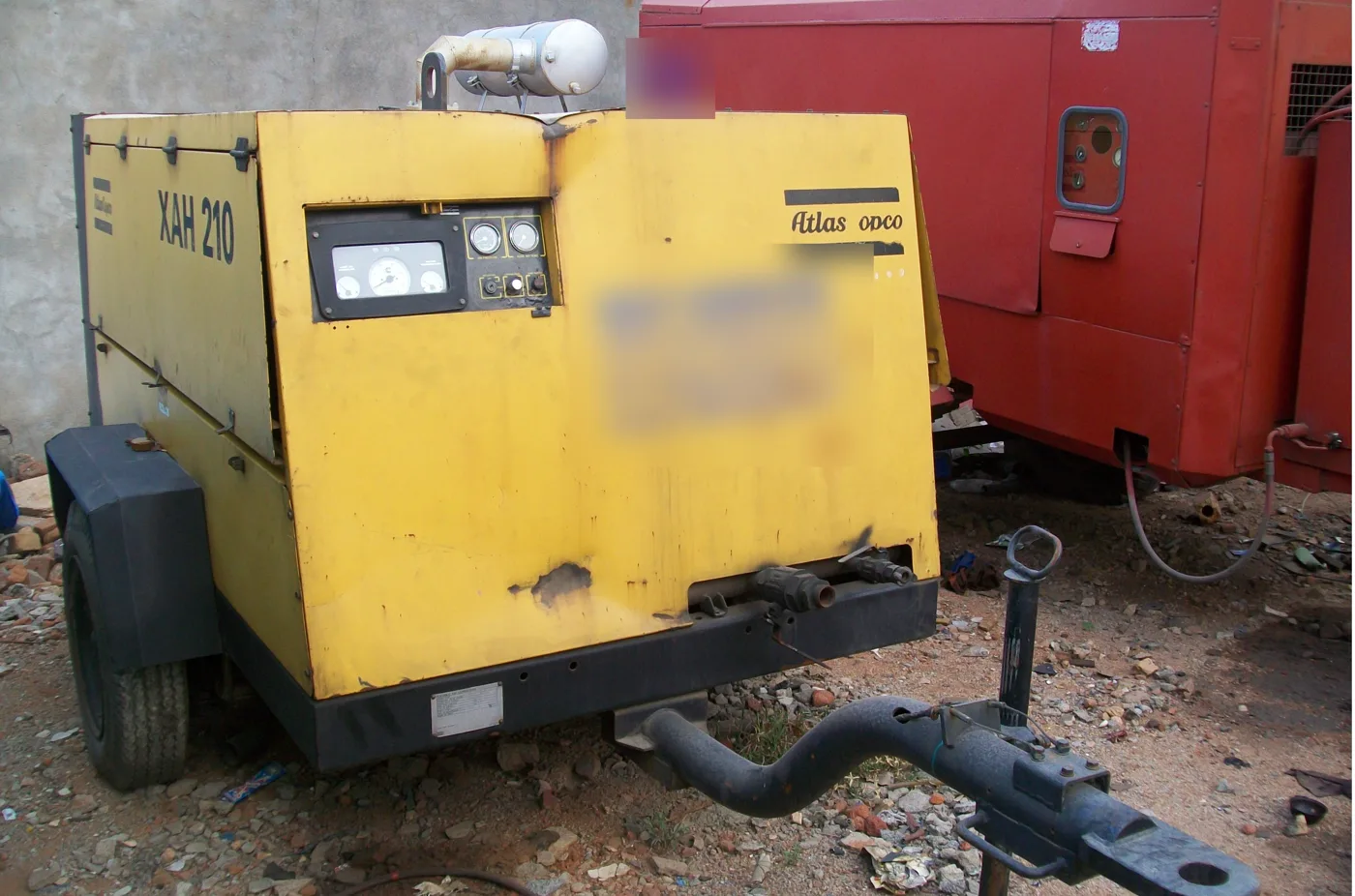
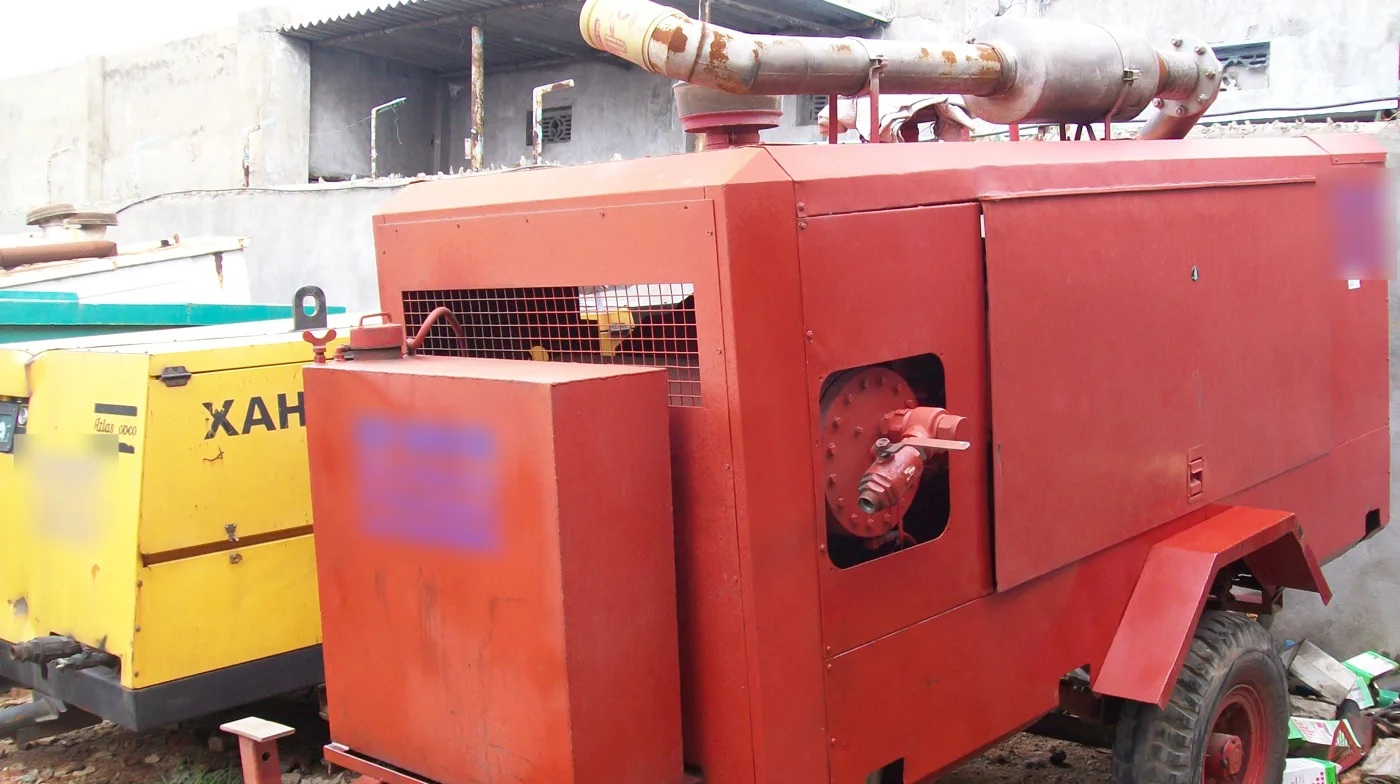
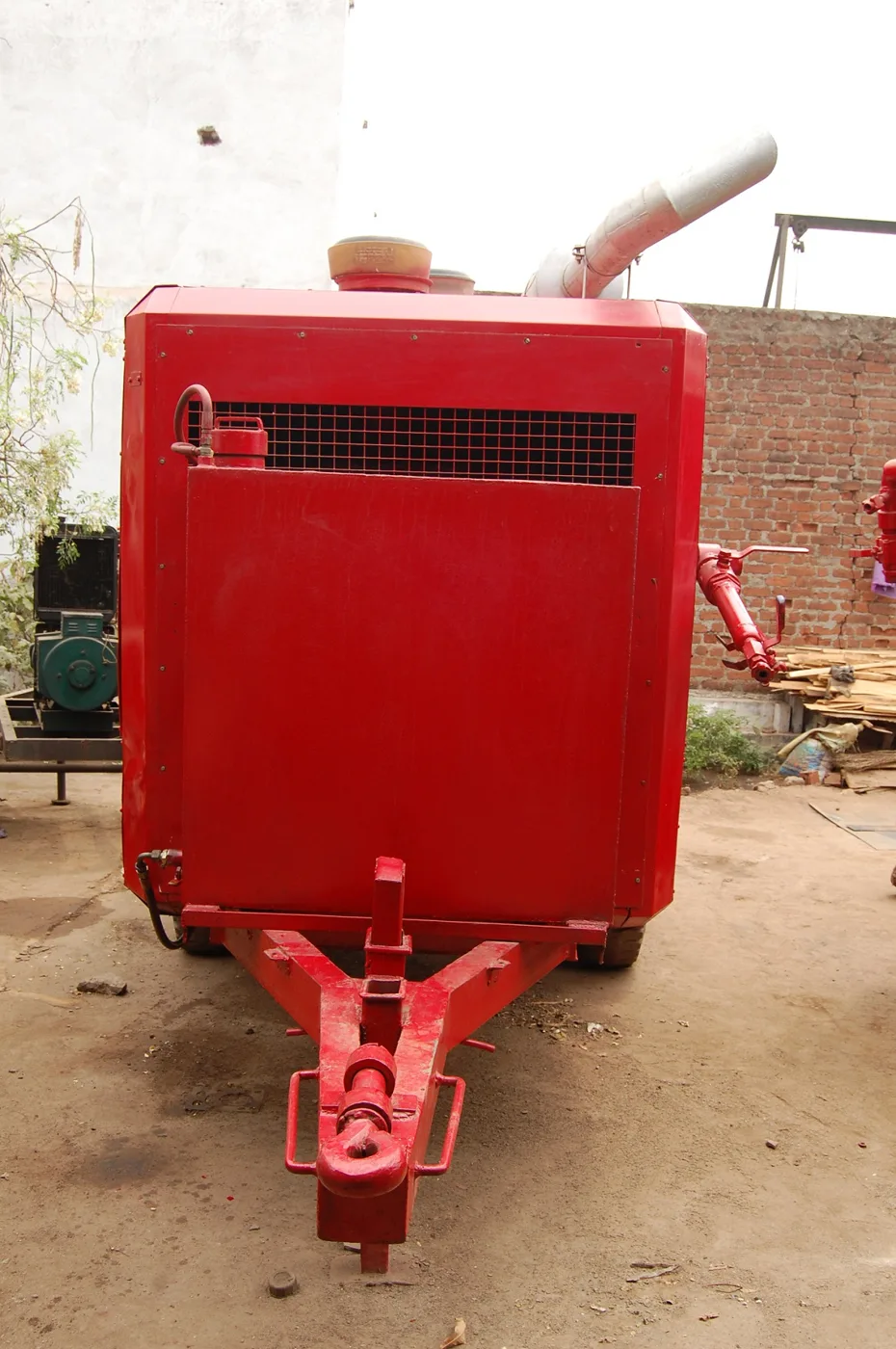
Photographs from Reddy Compressors’ own fleet and workshop.
Almost all modern portables of 100 cfm and above use rotary screw compression, because a screw airend delivers steady, pulsation-free air, tolerates continuous duty and is compact for its output. Smaller piston machines survive mainly as tractor-driven units (see tractor-mounted air compressors and tractor and PTO-driven compressors) and workshop compressors. For the engineering of the package as a whole, see portable compressed-air engineering, and for how a towable unit differs from a plant-room machine, read stationary vs portable screw compressors.
Diesel or electric: which drive do you need?
The drive is the first decision because it settles fuel, power, mobility and noise.
Diesel-driven portables carry their own engine, fuel tank, batteries and cooling. They are the default on open sites with no grid supply, on jobs that move along a road, canal or pipeline, for drilling and blasting in remote places and for short-notice work. Our diesel portable compressors guide covers engines, airends, cooling design, high-ambient operation, safety shutdowns, towing, service and rent-versus-buy in depth.
Electric-driven portables use a motor and draw power from the grid, a site substation or a DG set. They suit long jobs in one place, tunnels and enclosed buildings, plant standby and planned shutdowns, and they usually cost less to run where grid power is available. The trade-off is the electrical interface: supply capacity, starting current, cable route and protection. See electric portable compressors and the rental view in diesel or electric rental air.
| Question | Points to diesel | Points to electric |
|---|---|---|
| Is there a suitable three-phase supply at the work area? | No, or too weak for starting current | Yes, within sensible cable distance |
| How often does the machine move? | Daily or weekly | Rarely; stays for weeks or months |
| How long is the job? | Days to a few weeks | Months, or plant standby |
| Are exhaust or noise restricted? | Open site, no restriction | Tunnel, building, night work near housing |
| What pressure is needed? | High-pressure drilling, remote blasting | Normal 7–10 bar plant or construction air |
Portable compressor size classes: which cfm do you need?
Size is the delivered air (free air delivery, FAD) at the working pressure, not engine horsepower. 1 m³/min is about 35.3 cfm. These are the bands we use across our sales and rental work. They describe typical uses; the actual tool consumption and simultaneity always decide.
| Class | Approx. m³/min | Typical pressure | Typical work |
|---|---|---|---|
| 100–185 cfm | 2.8–5.2 | 7 bar (101.5 psig) | One breaker or rock drill, small blasting nozzle, cleaning, light maintenance, rural works |
| 185–250 cfm | 5.2–7.1 | 7 bar, some 10 bar | One or two breakers, small rock drill, small sandblasting nozzle; not for DTH drilling |
| 250–400 cfm | 7.1–11.3 | 7–10 bar (101.5–145 psig) | Two to four breakers, rock drills, one No. 5 blasting nozzle (one No. 6 from about 300 cfm), construction, plant maintenance, standby |
| 400–600 cfm | 11.3–17 | 7–14 bar (101.5–203.1 psig) | Crawler and quarry drilling, two No. 5 blasting nozzles, pipeline testing and drying support, shutdown or standby plant air |
| 600–1,500 cfm high-pressure | 17–42 | 13.8–27.6 bar (200–400 psig), special units to 35 bar | Borewell and water-well DTH drilling, deep holes, large pipeline and process projects |
Each band has its own detailed page:
- Compact portable compressors for the 100–185 cfm class and tight access.
- Medium portable compressors for the 185–400 cfm construction and maintenance classes.
- Large portable compressors for 400–600 cfm drilling, blasting and standby.
- High-flow portable compressors where volume matters more than pressure.
- High-pressure portable compressors for 600–1,500 cfm drilling packages.
Two mistakes recur. The first is buying by cfm alone: a 400 cfm machine at 7 bar and a 400 cfm machine at 14 bar are different machines with different engines and different fuel bills. The second is sizing from tool catalogues without allowing for hose losses, wear on tools and the fact that a delivered-air rating is given at stated reference conditions, so a hot, dusty or high-altitude site will see less margin.
Pressure classes: 7, 10, 14 and 20–35 bar
Pressure is set by the tool or process, plus the pressure lost in hoses, fittings and treatment between the compressor and the tool. Ask for a delivered-air figure at the pressure you will actually run, and remember that every extra bar costs roughly 7% more power, so over-specifying pressure costs fuel for the whole job. Our working pressure and pressure budget page and pressure budget builder help you work it out.
| Pressure class | psig | Typical use | Detail page |
|---|---|---|---|
| 7 bar | 101.5 | Breakers, rock drills, air tools, general construction, blasting | 7 bar portables |
| 10 bar | 145 | Longer hose runs, blasting with higher nozzle pressure, plant air backup | 10 bar portables |
| 12 bar | 174 | Drilling and industrial duties needing margin over 10 bar | 12 bar portables |
| 14 bar | 203.1 | Quarry and crawler drilling, pipeline work, demanding blasting | 14 bar portables |
| 20 bar | 290.1 | DTH drilling, borewell work, pipeline testing | 20 bar portables |
| 25 bar | 362.6 | Deep borewell and water-well drilling | 25 bar portables |
| 30 bar | 435.1 | Deep or wet holes, special drilling | 30 bar portables |
| 35 bar | 507.6 | Special high-pressure drilling units | 35 bar / about 500 psi portable air |
Some packages let the operator select the working pressure within a range, trading flow for pressure. That flexibility is useful for a rental fleet or a contractor whose jobs change; see variable-pressure portable compressors. For drilling, the bands we use are roughly 200–250 psig (13.8–17.2 bar) at 600–900 cfm, 250–300 psig (17.2–20.7 bar) at 800–1,200 cfm and 300–400 psig (20.7–27.6 bar) at 1,000–1,500 cfm, with special units to 35 bar.
Applications: where are portable compressors used in India?
Construction and infrastructure
Road, bridge, metro, canal and building work uses portables for breakers, rock drills, chipping, anchor drilling, shotcrete support and cleaning. The 185–400 cfm classes at 7 bar dominate. See temporary air for construction work zones and air supply for breakers, rock drills and air tools.
Borewell, water-well and DTH drilling
Drilling needs both volume, to lift cuttings up the annulus, and pressure, to drive the DTH hammer and overcome water head. That pushes the duty into the 600–1,500 cfm high-pressure class. Start with the borewell and DTH compressor library, DTH drilling compressors and water-well drilling compressors.
Abrasive blasting and painting
Blasting is sized by nozzle bore and pressure, and it needs dry, cool air. A portable for blasting normally needs an aftercooler and moisture separator, and often filtration before the blast pot. See sandblasting compressor hire, abrasive blasting nozzle and air supply and the abrasive blasting air demand calculator.
Industrial plants, power and steel
Plants hire portables for planned shutdowns, breakdown cover of the main compressor, peak demand and project construction. One of our projects at a steel plant in Andhra Pradesh ran a 450 cfm diesel portable round the clock for a coating contractor, with our operators on 12-hour shifts and oil change and servicing every 300 running hours. See temporary air for planned shutdowns and temporary air for compressor breakdown.
Pipelines, oil and gas
Pipeline drying, pigging support and pressure testing need large, often high-pressure air for days at a time. Our team supplied a temporary power-and-air package for an oilfield-services contractor on a natural-gas development at Kakinada, including compressors of 1,100 cfm at 300 psig, 1,000 cfm at 275 psig and 750 cfm at 150 psig, with generators, operators and commissioning.
Oil-free duties
Food, pharma, electronics and some process work cannot accept oil carry-over. Oil-free portables exist for these jobs; see oil-free portable air compressors and temporary oil-free air supply.
Inside the package: what separates a good portable from a poor one
Two machines with the same cfm can behave very differently on an Indian site in May. These are the systems to look at, each with its own page:
- Controls. Unloading and modulation (or electronic control) match air output to demand, protect the engine at start and hold pressure steady. See portable compressor controls.
- Cooling. Oil cooler, engine radiator and charge-air cooler must reject heat at summer ambients of 40–45 °C, and above 45 °C on open sites, with dust in the air. The cooler layout, fan and louvre area decide whether the machine runs through the afternoon. Normal oil-injected screw discharge temperature is about 75–95 °C. See portable compressor cooling.
- Fuel system. Tank size for a full shift, water separation and fuel filtration matter more than brochure figures, because fuel quality varies. Typical litres per hour depend on load. See portable compressor fuel systems and fuel supply and refuelling.
- Safety shutdowns. High discharge temperature, low engine oil pressure and high coolant temperature shutdowns protect the airend and engine. They must be tested, never bypassed.
- Engine and exhaust. Engine condition decides availability on long hire. See portable compressor engine overhaul interfaces and exhaust aftertreatment interfaces.
- Air treatment. Raw portable air is hot and saturated. For blasting, painting and instrument work, add portable aftercoolers, portable moisture separators and portable air filtration packages.
- Chassis and towing. Axle, tyres, brakes, lights and lifting eye must be fit for the roads to site; skids suit crane-placed or truck-mounted units.
How to select a portable compressor: step by step
- List the tools or process. Each tool’s air consumption at its rated pressure, and how many run at the same time.
- Add allowances. Hose and fitting losses, tool wear and a sensible margin, not a doubling.
- Fix the working pressure. The tool pressure plus the pressure budget to the tool. Do not round up to the next class without reason.
- Choose the drive. Diesel or electric, based on power at site, mobility, duration and restrictions.
- Check site conditions. Ambient temperature, dust, altitude, access, towing route and parking space.
- Decide air treatment. Aftercooler, separator, filtration or dryer for the end use.
- Decide rent, buy new or buy used. By utilisation, duration and how much maintenance you can carry.
- Plan service and spares. On hire jobs we service every 300 running hours with an oil change; owned fleets need the same discipline.
Rent, buy new or buy used?
| Option | Best when | Watch for |
|---|---|---|
| Rent | Short or uncertain jobs, peak demand, breakdown cover, project phases, special pressure classes | Clear scope: operators, fuel, servicing, hoses, transport and demobilisation |
| Buy new | High utilisation over years, contractor fleets, long-term projects | Selection fit, after-sales spares and service capability in your area |
| Buy used or refurbished | Budget-limited fleets, standby units, moderate hours | Engine and airend condition, hours, history and technical due diligence |
For the rental side, start with the temporary air engineering centre, temporary air hire or buy, long-term hire and how to brief us for a rental. For used machines, see used and refurbished compressors for sale and used compressor technical due diligence.
Maintenance, faults and fleet management
Portables fail in predictable ways: blocked coolers and high-temperature shutdowns in summer, dirty fuel and water in the tank, flat batteries and starting faults, worn intake filters in dust, separator elements left too long, and unloader or control faults that leave the machine running loaded or refusing to build pressure. Good fleets service by running hours, log every shutdown cause and inspect coolers and filters more often in the dry, dusty months.
- Diesel portable compressor troubleshooting
- Diesel compressor starting and charging diagnostics
- Portable compressor service and field-duty reliability
- Portable compressor fleet management
- Portable compressor engine parts
Diesel consumption and running cost per shift
Fuel is the largest running cost of a diesel portable, and it can be estimated before the machine reaches site. A diesel engine in good condition burns about 0.21–0.23 kg of fuel per kWh of output near its rated load. At a diesel density of 0.835 kg/L, 0.225 kg/kWh is 0.27 L per kWh.
Worked example (illustrative): a 450 cfm, 7 bar g diesel portable on a construction site, 8-hour shift, loaded 60% of the time, diesel at an assumed ₹90/L.
- Delivery: 450 / 35.315 = 12.74 m³/min.
- Engine load when compressing: about 85 kW including the cooling fan, which is 6.7 kW per m³/min at 7 bar g.
- Fuel when loaded: 85 kW × 0.225 kg/kWh = 19.1 kg/h; 19.1 / 0.835 = 22.9 L/h.
- Fuel when unloaded: at reduced engine speed a typical portable burns 25–35% of its full-load fuel; at 30%, 6.9 L/h.
- Per shift: 4.8 h × 22.9 L/h = 109.9 L loaded, plus 3.2 h × 6.9 L/h = 22.0 L unloaded: about 132 L, or about ₹11,880.
- Per unit of air: 4.8 h × 60 × 12.74 = 3,670 m³ of free air delivered, so 3.6 L of diesel per 100 m³, or about ₹3.24 per m³.
For comparison, an electric portable doing the same work draws about 85 / 0.94 = 90.4 kW loaded and about a quarter of that unloaded: 4.8 × 90.4 + 3.2 × 22.6 = 506 kWh a shift, about ₹4,300 at an assumed ₹8.50/kWh. Diesel costs about 2.8 times as much per shift here, which is why long jobs near a suitable supply favour electric drive.
Check real consumption by the fill-to-fill method: fill the tank to the neck, log hours and loaded hours, refill to the neck and divide. Consumption that rises at the same work points to blocked air or fuel filters, worn injectors, a speed control that holds the engine at full speed when unloaded, or leaks downstream making the machine run loaded longer.
Rent or own: a break-even example (illustrative)
Assume a new machine of this class costs ₹20,00,000, keeps 25% of its value after 8 years, and capital costs 10% a year on an average 60% of the price tied up. Yearly fixed cost of ownership = depreciation ₹1,87,500 + capital ₹1,20,000 + insurance at 1% ₹20,000 + routine inspection ₹60,000 = ₹3,87,500. At an assumed hire charge of ₹1,50,000 a month, ownership breaks even at 3,87,500 / 1,50,000 = 2.6 months of use a year. Fuel and operators cost the same either way; servicing and wear parts, which a hire charge usually covers, add to the owner’s side in proportion to hours run, so the real break-even comes somewhat later. Hire still wins when the need is uncertain, when the pressure class is one you rarely use, or when breakdown cover and servicing included in the hire matter more than the fixed cost. Run your own figures in the rental versus ownership calculator.
Towing and site safety checklist
Towing and set-up carry risks that the machine’s own shutdowns do not cover. Use this check before every move and at every new location.
| Check | What good looks like |
|---|---|
| Hitch and towing eye | Eye or ball coupling matches the vehicle, locked and pinned; drawbar free of cracks; height set so the machine tows level |
| Safety chain or breakaway cable | Connected to the vehicle, not to the coupling itself |
| Axle, tyres and wheel nuts | Tyres at the stated pressure with no cuts; nuts torqued and re-checked after the first trip after a wheel change; no play in wheel bearings |
| Brakes | Overrun brake and parking brake working; parking brake released before moving |
| Lights and reflectors | Tail, brake and indicator lamps working with the vehicle; reflectors clean |
| Jockey wheel and props | Raised and locked before moving |
| Canopy and load | Doors locked, no hoses or tools loose on top, fuel cap closed, no leaks |
| Ground at site | Firm and level within the maker’s stated slope; wheels chocked; clear of trench edges and overhead lines |
| Exhaust and cooling air | Exhaust pointed away from people, doors and trenches; never inside basements, tunnels or tanks without forced ventilation; air inlet and outlet clear of walls |
| Hoses | Rated above the safety valve setting; claw couplings pinned; whip restraints on every joint; system depressurised before any disconnection |
| Fuel and spills | Engine stopped for refuelling; drip tray under the machine on soil or near water |
Portable compressor controllers: what each alarm means
Older portables use analogue gauges with mechanical switches that cut the fuel solenoid on a fault. Newer units use an electronic controller that also reads the engine control unit and shows engine fault codes. Either way, a shutdown is a message about the machine, and the reset button is not the repair. Trip values below are typical; the machine’s own settings apply.
| Alarm or shutdown | What it protects | Usual causes | First checks |
|---|---|---|---|
| High compressor discharge temperature (often set around 110–120 °C) | Airend and oil | Blocked oil cooler, low compressor oil, stuck thermostatic valve, clogged oil filter, high ambient with recirculating hot air | Oil level, cooler fins, thermostatic valve, oil filter, parking position |
| Low engine oil pressure | Engine bearings | Low oil, diluted oil, failed sender, worn engine | Dipstick, oil smell for fuel, gauge reading against sender |
| High engine coolant temperature or low coolant level | Engine head and gasket | Blocked radiator, slack fan belt, leak, failed thermostat | Radiator from both sides, fan belt, coolant level when cool |
| Engine overspeed | Engine and airend | Governor or actuator fault, speed control setting | Do not restart until the speed control is checked |
| Charging fault | Battery and controller supply | Alternator belt, alternator, loose terminals | Belt, terminals, voltage at running speed |
| Low fuel or water in fuel | Fuel injection system | Empty tank, contaminated diesel, full water separator | Drain separator, inspect fuel, change fuel filters |
| Air filter restriction (warning) | Engine and airend intake | Dust loading | Change or clean element per maker; inspect the safety element |
| Separator differential pressure high (warning) | Fuel use and oil carry-over | Element loaded with varnish or dirt | Replace element; review oil condition |
| Fail to start or crank timeout | Starter motor | Weak battery, fuel air-lock, fuel solenoid | Battery voltage while cranking, fuel bleed |
Log each shutdown with the time, ambient temperature and hours. Repeated afternoon temperature trips are a cooling problem, not a controller fault. More on the hardware is on portable compressor controls.
Service kits by running hours
A portable has two machines in one frame, and each has its own schedule. The intervals below are typical maker figures; follow the maker’s schedule and shorten them in dust, heat and round-the-clock work, as with the 300-running-hour service on hire jobs described above.
| Interval (running hours) | Engine | Compressor |
|---|---|---|
| Daily or every 10 h | Oil and coolant level, fuel water separator drain, fan belt, leaks | Oil level, air filter indicator, discharge temperature, safety valve and hoses |
| 250–500 h | Engine oil and oil filter, fuel filters, air filter as indicated | Compressor oil filter (at the first service and per maker), cooler cleaning |
| 1,000 h | Valve clearance check on many engines, fan and alternator belts, coolant condition | Compressor oil change, separator element (or on differential pressure), scavenge line and orifice check |
| 2,000 h or yearly | Coolant change, hoses, injector check if smoke or fuel use is high | Safety valve test, inlet and minimum pressure valve kits, shutdown function test |
When ordering a service kit, give the engine model and serial number as well as the compressor model, because the same compressor can be built with different engines. Parts identification is covered on portable engine parts.
Buying a used or refurbished portable: inspection checklist
A used portable is two used machines. Inspect both, and inspect them hot and under load.
- Hours: the hour meter usually counts engine running hours. Compare it with the service record and the condition of controls, panels and filters; a new meter on an old machine is common. Where the controller records loaded hours, the ratio shows how hard it worked.
- Engine: cold start without long cranking; smoke clearing within a minute (persistent blue means oil burning, black means over-fuelling or a blocked air filter, white that persists may mean coolant); oil pressure at hot idle above the maker’s minimum; no oil in coolant or coolant in oil.
- Blow-by: with the engine hot and loaded, heavy or pulsing fumes, or oil, from the crankcase breather indicate worn rings or liners.
- Airend: no rumble, knock or tick that rises with load; discharge temperature stable over at least 30 minutes at full load; no oil at the shaft seal.
- Delivery: test at rated pressure against a calibrated nozzle or flow meter, or with a receiver pump-up check; see the pump-up test.
- Package: cooler fins clear, separator differential pressure normal, all shutdowns proven by test, chassis and drawbar free of cracks and weld repairs, axle and brakes sound.
Used and refurbished compressors sold by Reddy Compressors carry a six-month warranty from the delivery or invoice date, covering the whole compressor. It excludes consumables, misuse or wrong oil, service by others, and accident or site damage. Current machines are listed on used compressors for sale.
How Reddy Compressors helps
Reddy Compressors, Srinilayam, 12-13-200, First Floor, Street No. 1, Tarnaka, Secunderabad 500017, has served industry since 2002. We sell, rent and service portable compressors of ELGi, Atlas Copco, Ingersoll Rand, KAESER, Chicago Pneumatic, Doosan and other makes as an independent multi-brand specialist, not an authorised dealer, so our advice follows your duty rather than one brand’s range. We have tie-ups with all major and reputed brands.
- Rental: diesel portables and high-pressure units from our own fleet, within 50–2,000 cfm and 2–30 bar, with operators, servicing and site support as agreed. Recent hire work includes two 450 cfm 150 psig units and a 400 cfm 100 psig unit for a power-plant project, a 400 cfm unit for an infrastructure contractor at Raichur and three 450 cfm units for a lift irrigation project in Kurnool district.
- Sales: new portables, brand-new machines supplied to site for long-term projects, and checked used and refurbished units.
- Service and spares: more than 20 service engineers and technicians covering all of Telangana and Andhra Pradesh; spares identified from make, model, serial and nameplate with fit confirmed before quoting. Equipment, rentals and spares are supplied across India.
What to send us
- Application and tools (type, number, how many run together).
- Required airflow (cfm or m³/min) and working pressure (bar or psig).
- Diesel or electric preference, and site power available.
- Site location, access, expected ambient conditions and duration.
- Hours per day and whether you need operators.
- Rent, buy new or buy used; for spares or service, the make, model, serial and nameplate photo.
Watch
A short explainer on this topic
Slide-by-slide engineering explainers from Reddy Compressors. More in the video library.
Frequently asked questions
What size portable air compressor do I need for a jackhammer?
Add up the air consumption of every breaker that will run at the same time, at its rated pressure, then allow for hose losses and tool wear. One heavy breaker usually sits in the 100–185 cfm class at 7 bar; two to four breakers move you into the 250–400 cfm class. Check the actual tool consumption from its documentation rather than a general figure.
What is the difference between cfm and pressure on a portable compressor?
cfm is the volume of air delivered, measured as free air delivery; pressure, in bar or psig, is how hard that air is pushed. Tools need both. A compressor rated 400 cfm at 7 bar is not the same machine as one rated 400 cfm at 14 bar: the higher-pressure unit needs more engine power and fuel. Always specify the cfm at your working pressure.
Should I rent or buy a portable diesel compressor?
Rent when the job is short, uncertain, seasonal or needs a pressure class you do not use regularly, or when you need cover during a breakdown. Buy when the machine will work many hours every month for years and you can maintain it. A used or refurbished unit suits standby or budget fleets, provided the engine and airend are checked properly.
What compressor is used for borewell drilling?
Borewell and DTH drilling normally uses high-pressure portable screw compressors in the 600–1,500 cfm range at about 13.8–27.6 bar (200–400 psig), with special units up to about 35 bar. Volume lifts the cuttings and pressure drives the hammer against depth and water head. The right size depends on hole diameter, depth, hammer and expected water.
Can a portable compressor be used for sandblasting?
Yes. Size it from the nozzle bore and blasting pressure, then add allowance for hose and pot losses; a No. 5 nozzle usually needs the 250–400 cfm class; one No. 6 nozzle uses about 200 cfm when new and about 280–300 cfm allowing for wear, and is normally run from a 300 cfm compressor; two No. 6 nozzles need about 560–600 cfm, or about 750 cfm with long hoses and air-fed helmets. Fit an aftercooler and moisture separator, and filtration where coating quality matters, because hot, wet air causes flash rust and coating defects.
Why does my portable compressor shut down in summer afternoons?
The most common cause is high discharge temperature or high engine coolant temperature, when blocked coolers, a dirty radiator, low oil level, wrong oil or poor ventilation cannot reject heat at summer ambients of 40–45 °C, or above 45 °C on open sites. Park the machine with clear airflow, clean coolers regularly in dusty months and check oil level and condition. Never bypass a safety shutdown to keep running.
Do you supply portable compressors outside Telangana and Andhra Pradesh?
Yes. Our service teams cover all of Telangana and Andhra Pradesh, and we supply compressors, rental machines and spare parts across India, with project-based site support where feasible. Our projects have included hire work in Karnataka as well as across Andhra Pradesh and Telangana. Send your duty, site location and duration and we will advise what is practical.
How much diesel does a portable air compressor use per hour?
Roughly 0.27 litres per kWh of engine output when loaded. A 450 cfm, 7 bar g diesel portable needs about 85 kW and burns about 23 L/h fully loaded and about 7 L/h unloaded. Over an 8-hour shift at 60% loaded time that is about 132 litres. Smaller 185–250 cfm units use proportionally less, and high-pressure drilling units use much more. Measure your own figure by filling the tank to the neck, logging hours, and refilling.
What is included in a portable compressor service kit?
A complete kit covers both the engine and the compressor. The engine side usually includes engine oil, the oil filter, fuel filters and the water separator element, and the air filter elements when they are due. The compressor side includes the compressor oil filter, compressor oil, the separator element, and at longer intervals inlet and minimum pressure valve kits. Give the engine model and serial number as well as the compressor model, because the same compressor may be fitted with different engines.
Is a refurbished portable compressor worth buying?
It can be, for standby units, budget fleets and contractors with moderate annual hours, provided both the engine and the airend are checked. Inspect it hot and loaded: blow-by, smoke, oil pressure, airend noise, discharge temperature stability and delivery at rated pressure. Reddy Compressors’ used and refurbished compressors carry a six-month warranty from the delivery or invoice date on the whole compressor, excluding consumables, misuse or wrong oil, service by others, and accident or site damage.
What should I check before towing a towable compressor?
Check that the towing eye or ball coupling matches the vehicle and is locked and pinned, the safety chain or breakaway cable is attached to the vehicle, tyres are at the stated pressure, wheel nuts are tight, and the overrun and parking brakes work. Confirm that the lights work with the vehicle, the jockey wheel is raised, canopy doors are locked and nothing is loose on top. At site, park on firm level ground, chock the wheels and point the exhaust away from people.
Related pages
Field guide
Choosing portable air: The engineering behind the number
A portable compressor is easy to treat as a utility: tow it in, start it, connect the hose. The jobs that go wrong are the ones where the air was specified by a single figure, usually cfm. The better question is what pressure and flow reach the work while it is running, for as long as the job lasts.
Define the work. Calculate the air. Protect the pressure. Engineer the system. Then select the compressor.
Start at the point of use
The pressure on the compressor gauge is not the pressure at the tool. Between them the air passes through the outlet valve, aftercooler, separator, manifold, fittings, hose, couplings and bends, and every restriction takes pressure. A nozzle, a hammer or a breaker is the real customer for the air, so portable-air engineering works backward from it to the machine.
Undersized hose is the commonest way to waste a good compressor. For a given flow a smaller bore means higher velocity and more friction loss, so the last fifty metres of airline can matter as much as the machine. You can check a line with the pipe sizing calculator.
Pressure and flow do different jobs
In drilling, pressure drives the hammer and flow carries cuttings up the hole. Too little pressure weakens the blow; too little flow leaves cuttings in the hole, which slows penetration, wears bits and can stick the string. A bigger compressor is not automatically the answer: the air has to match the hole size, depth, hammer and formation. The annular velocity tool shows how hole and rod size set the return velocity.
In blasting, the nozzle sets the demand. As the nozzle wears its bore grows and it takes more air, so pressure at the nozzle falls even though the compressor is unchanged. Operators then blame the compressor. Check the nozzle before the machine, and see blasting air demand.
Site conditions change the rating
- Altitude. Thinner air reduces what the compressor can take in, and the engine may lose power too.
- Heat and dust. High ambient temperature cuts cooling margin; a dusty radiator, blocked cooler or hot-air recirculation does the same.
- Duty. A machine that holds its rating for an hour may not hold it through a continuous 24-hour job.
So ask what capacity the package can sustain on this site, not only what the nameplate says.
Why high pressure is a different regime
At 7 bar a portable machine serves tools, general construction and small blasting. Between roughly 10 and 14 bar the range widens to blasting, quarry work, larger tools and production drilling. At 20 to 35 bar and beyond, the work is typically DTH and deep-hole drilling, booster feed and specialist processes. Higher pressure ratios raise discharge temperature and mechanical load, which is why high-pressure packages often compress in two stages. High pressure also demands rated hoses, couplings and restraints, correct relief protection and safe depressurisation procedures. A hose that suits 7 bar must never be assumed to suit a higher duty.
One large machine or two smaller ones
For a 1,000 cfm requirement the options include one 1,000 cfm unit, two 500 cfm units, a 750 plus a 250, or a base unit with a temporary peak unit. One large unit is simpler. Several smaller units give staging and cover for a failure, and can follow a varying load more closely. The right answer depends on demand variability, what a stoppage costs, transport, space and fuel at part load.
Oversizing has a price in hire cost, fuel, transport and poor part-load running. Undersizing costs more: falling pressure, slow drilling, long hours and project delay, with a machine that is running perfectly but asked for more than it can give. Build the figure from base demand, realistic simultaneous demand, a genuine growth allowance and a sensible contingency. The demand calculator does this.
Compare hire on output, not on day rate
The cheaper day rate is not always the cheaper job. Count transport, fuel, mobilisation, hoses and accessories, breakdown exposure, service response and the crew time lost when pressure is unstable. See rental versus ownership for the break-even.
Eight variables of a sound portable-air solution
| Variable | What it asks |
|---|---|
| Airflow | Enough air for the real simultaneous demand |
| Pressure | Enough pressure at the point of work |
| Duty | Can it sustain the operating pattern |
| Distribution | Hoses and fittings that keep the loss low |
| Environment | Capacity corrected for temperature, altitude and severity |
| Reliability | Built to survive the intended duty |
| Efficiency | Air made without needless fuel or energy |
| Support | Service, spares and technical backup to protect uptime |
Measure before you replace
Low pressure, slow drilling, weak tools and high fuel use are symptoms. Common causes outside the compressor are leaking hoses, a worn nozzle, blocked filters, long or narrow hose, wrong regulator settings, altitude and a duty that has changed. Record discharge pressure, pressure at the tool, hose diameter and length, nozzle or tool size, engine load, fuel use and ambient temperature, then compare with the intended duty.
Stationary or portable?
The question under the machine choice is whether the air source should be fixed or should move with the work. Both are usually screw compressors, so the difference is in how they are used.
| Parameter | Stationary screw | Portable screw |
|---|---|---|
| Installation | Permanent, in a plant or compressor room | Mobile or relocatable |
| Usual prime mover | Electric motor | Diesel engine |
| Distribution | Central piping network | Flexible hoses near the work |
| Duty | Continuous plant demand | Project or mobile demand |
| Air treatment | Full dryer and filter options | Specific to the application |
| Energy cost per unit of air | Usually lower on grid power | Higher, with diesel |
| Environment | Controlled room | Dust, rain, heat and vibration |
| Maintenance | Planned and centralised | More frequent field inspection |
Choose stationary where demand is concentrated, continuous and supported by permanent power and piping. Choose portable where work fronts move, power is limited or air is needed quickly. Mines and quarries often use both: stationary air for fixed production areas and portable air for moving benches and new work fronts. A portable unit close to the work also avoids the pressure lost in a long pipeline. Capacity in either case is combined simultaneous demand plus system losses, leakage and a reserve, and pressure should be verified at the tool while it is working.
If you have a requirement, the equipment selection enquiry asks for the application, pressure at the point of use and the hose or pipe run, which is what an engineer asks first.
Calculators and worked examples
These tools give indicative figures for screening, comparison and for preparing an enquiry. They run in your browser and send nothing. No prices or tariffs are assumed: enter your own to see costs. Efficiencies and other figures shown are example values: replace them with your own. Results are not a performance guarantee or a design certificate; final selection is confirmed by a service engineer against the machine data sheet and the site.
Compressed air demand estimate
Add up the air your tools and processes use, apply duty and simultaneity, then add leakage and growth allowances to reach a capacity to enquire about.
The worked example below shows the method with fixed numbers. Turn on JavaScript to change the inputs.
Worked example
Inputs
- Unit for the air each tool uses: L/s
- Group A: number of tools: 6
- Group A: free air each (in the unit above): 4
- Group A: duty (%): 40
- Group B: number of tools: 2
- Group B: free air each (in the unit above): 15
- Group B: duty (%): 60
- Group C: number of tools: 1
- Group C: free air each (in the unit above): 40
- Group C: duty (%): 80
- Simultaneity of all tools (%): 65
- Leakage allowance (%): 15
- Growth allowance (%): 10
Result
- Connected demand: 94 L/s = 199 cfm
- Average demand (duty-weighted): 59.6 L/s = 126 cfm
- Simultaneous peak: 61.1 L/s = 129 cfm
- Design basis (higher of average and peak): 61.1 L/s = 129 cfm
- Design capacity with allowances: 77.29 L/s = 4.64 m³/min = 163.8 cfm
Method. Average demand = Σ(number × air per tool × duty). Peak = Σ(number × air per tool) × simultaneity. The peak can never be lower than the average, so the design basis is the higher of the two. Design capacity = design basis × (1 + leakage) × (1 + growth).
What to take from it. Leakage and growth allowances move the answer as much as any single tool. Where you can, replace catalogue figures with measured ones.
Technical content reviewed by D. Srinivas Reddy, Managing Partner and service engineer, Reddy Compressors. Last updated 7 November 2026. How our engineering content is reviewed.
Pipe pressure drop and sizing
Check the pressure drop and air velocity in a compressed-air line, or find the smallest bore that keeps the drop within a target.
The worked example below shows the method with fixed numbers. Turn on JavaScript to change the inputs.
Worked example
Inputs
- Flow (m³/min free air): 12
- Inlet pressure (bar g): 7
- Pipe length (m): 150
- Inside diameter (mm): 80
- Roughness (mm): 0.046
- Fittings allowance (% extra length): 30
- Air temperature (°C): 30
- Target pressure drop (bar): 0.1
Result
- Pressure drop: 0.059 bar (0.839% of the inlet gauge pressure)
- Air velocity: 5.22 m/s
- Reynolds number: 2,06,066
- Smallest bore for the target drop: 73 mm inside diameter
- Velocity check: Within the usual main-header target of about 6 m/s or less
Method. Darcy–Weisbach: ΔP = f × (L/D) × ρv²/2, with the friction factor f from the Swamee–Jain relation and air density taken at mean line pressure. Fittings are allowed for as extra equivalent length. Typical commercial steel roughness is about 0.046 mm.
What to take from it. Pressure drop varies roughly with the fifth power of the bore at constant flow, so a larger main is a cheap way to hold pressure.