
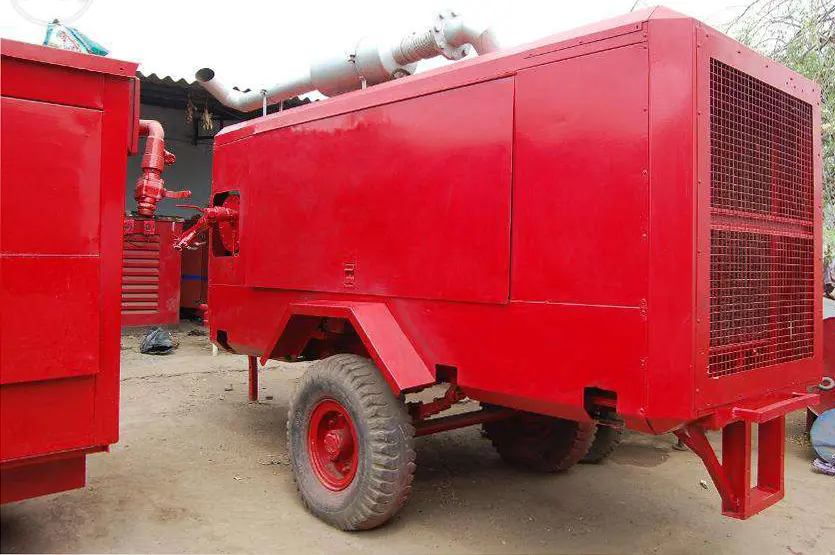
Temporary oil-free air supply should be specified as a complete delivered-air service: the required airflow, pressure and contaminant limits at the agreed connection or point of use, maintained throughout the rental period. Selecting an oil-free compressor is one part of that service. Intake conditions, cooling, drying, filtration, receivers, hoses, existing pipework and changeover arrangements determine whether the process receives acceptable air.
This guide explains how to plan temporary supply for contamination-sensitive production, planned maintenance, commissioning and breakdown recovery. It develops the quality-specific requirements that follow the temporary-air duty specification and site survey. It helps plant engineers, quality teams and procurement staff compare proposals on a common basis and decide what evidence is needed before production uses the air. It does not designate an industrial rental package as breathing air, medical air or a validated sterile utility.
1 Start with the process exposure
A request for oil-free rental air often begins when a permanent compressor fails or a shutdown approaches. The first engineering question is where that air goes. Air touching a product, primary packaging or a sensitive process surface has a different consequence of contamination from air operating an isolated actuator. A single plant header can serve both duties, so the most familiar equipment name may not identify the controlling requirement.
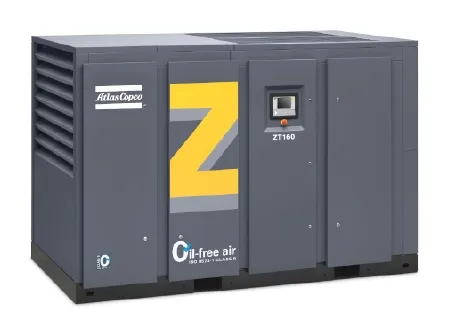
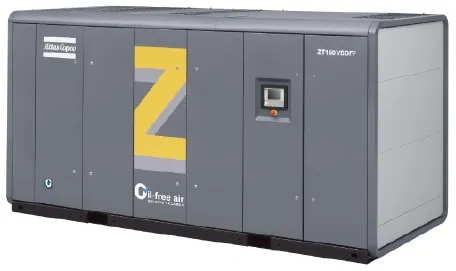
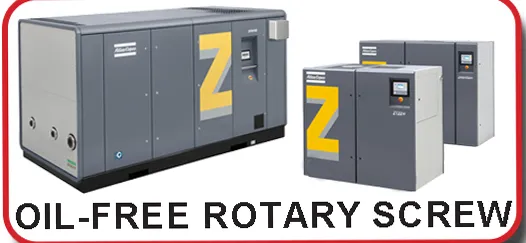
Representative images of machine types we sell, service and rent. Models and capacities are confirmed against your duty.
Trace the temporary connection to the actual users. Record whether air contacts product directly, contacts surfaces that later touch product, enters an enclosed process, or remains within a pneumatic mechanism. Identify downstream lubricators, local dryers, regulators and final filters. A lubricated tool branch should not be mistaken for a clean process-air branch merely because both originate from the same compressor room.
Ask the process owner what would happen if oil, water or particles exceeded the accepted limit. Possible consequences include rejected coatings, damaged instrumentation, contaminated packaging or a production hold. These consequences determine the monitoring, release authority and recovery arrangements. They do not justify inventing a universal air specification for every food, pharmaceutical or electronics facility.
For an emergency, agree the minimum service that can be safely restored. Supplying selected non-contact users may be possible before a sensitive process is released. Keep those boundaries physically and operationally clear; a provisional restart of utility air must not silently become approval for every connected production operation.
2 Understand what oil free describes
Oil-free compression avoids the intentional introduction of lubricating oil into the compression chamber. Depending on machine design, bearings, gears or other mechanisms may still use lubricant outside the air compression space. The supplied Sullair technical explainer makes this distinction between the compression process and the lubrication needs of other components.
Drive selection is a separate decision. An electric motor does not, by itself, make a compressor oil-free; a diesel engine does not, by itself, make the compressed-air path oil-injected. Confirm the compressor technology and the evidence for the offered model, rather than inferring air quality from its power source.
Oil-free generation also does not remove atmospheric moisture or automatically prevent downstream contamination. A clean compressor connected through an unsuitable hose or a contaminated receiver can deliver unacceptable air at the process. The useful specification therefore includes both the compressor requirement and the quality required at the receiving boundary.
An oil-injected compressor with downstream purification represents a different equipment arrangement. If the project expressly requires oil-free compression, a treatment-based alternative is a proposed deviation that needs technical and quality approval. Do not substitute it simply because the quotation uses phrases such as clean air, filtered air or technically oil-free.
3 Translate quality language into measurable requirements
ISO 8573-1 classifies compressed-air purity with respect to particles, water and oil, and identifies additional gaseous and microbiological contaminants. A complete project specification should identify the relevant contaminants, limits and measurement location. The ISO catalogue describes the classification framework; it does not certify a particular rental installation. [1]
Avoid an isolated statement such as Class 0 air without saying which contaminant it concerns. An oil classification is not automatically a water, particle or microbiological classification. For a Class 0 requirement, document the agreed numerical specification, the relevant certification scope and the applicable test conditions. Do not interpret the class label as a promise that every possible contaminant is absent.
Define oil coverage explicitly: liquid oil, aerosol and vapour may require different measurement provisions. A report addressing one fraction must not be presented as proof of total-oil performance unless its method and scope support that conclusion. Equally, a filter element rating is not a measurement of the assembled system at the process connection.
State pressure dew point at the specified operating pressure for moisture control. Identify the particle size ranges and concentration limits required by the process. Where microbiological or particular gaseous contaminants matter, specify them separately with the responsible process specialist. Do not add a generic sterile-air assertion to a standard industrial rental enquiry.
4 Prepare a usable quality duty record
The quality duty record accompanies the airflow and pressure specification. It should be short enough for a supplier to answer precisely, but detailed enough that the acceptance team can test what was ordered. An unanswered item remains an open requirement, not an assumed pass.
Requirement | Record in the enquiry | Confirm in the response |
|---|---|---|
Delivery boundary | Named tie-in and critical users | Scope up to that boundary |
Oil requirement | Compression technology and oil limit | Model evidence and test scope |
Moisture | Pressure dew point and pressure | Dryer capacity at site conditions |
Particles | Size ranges and limits | Treatment and sampling arrangement |
Other contaminants | Process-specific requirements | Suitable methods and exclusions |
Net airflow | Normal, peak and minimum duty | Delivered flow after package losses |
Pressure | Minimum and permitted maximum | Operating band and loss allowance |
Release evidence | Samples, operating states and approver | Timing and responsibilities |
Record the duration and production calendar as well. A weekend shutdown with a short restart window may need quality testing before the permanent plant is isolated. A long rental may need periodic verification and planned treatment maintenance. Both projects can use the same compressor while requiring different service arrangements.
The supplied rental brochure illustrates oil-free and instrument-quality air as separate offerings. Treat its capacities and connection sizes as historical supplier examples, not proof of current Reddy Compressors inventory. Obtain a project-specific equipment schedule and current supporting documents before confirming availability or performance.
5 Review the evidence for the actual offered package
Request the manufacturer, model, proposed operating pressure and applicable capacity data. Where certification supports an oil-quality claim, identify the product range, test conditions, contaminant coverage and any limitations. A certificate for a different range or a general brand statement cannot identify the machine arriving at site.
Connect the documentary evidence to the rental asset. Record its asset number, maintenance condition, treatment components and relevant inspection history. This does not imply that every rental requires a new type test. It ensures that the performance evidence, the equipment supplied and the installation duty refer to the same technical configuration.
Separate three kinds of evidence: design or type-test evidence for the compressor, service and cleanliness evidence for the deployed components, and installed-system acceptance evidence. Each answers a different question. A sound package needs an appropriate combination; one impressive document should not conceal a missing delivery-boundary test.
Ask how substitutions will be handled. A replacement dryer, hose, receiver or backup compressor can change the pressure loss, purity performance or sampling boundary. Record the change, confirm compatibility and determine whether additional verification is needed before the changed system supplies sensitive users.
6 Control intake and deployment conditions
Survey the intake environment during the activities expected while the rental operates. Nearby diesel exhaust, solvent use, painting, vehicle movements and dusty work can change the air entering the compressor. A quiet inspection before production begins may not represent the operating environment.
Position equipment with suitable cooling airflow, access and separation from contamination sources, using the equipment instructions and site assessment. For engine-driven packages, consider both the machine's exhaust and adjacent engines. For electric packages, nearby combustion sources remain relevant even though the compressor itself has no engine exhaust.
Record expected ambient temperature, exposure to rain or flooding, altitude where relevant, and cooling arrangements. Apply the supplier's capacity and treatment corrections to those conditions. Temporary enclosures or barriers must not cause hot-air recirculation or obstruct cooling. A noise measure that compromises thermal performance can also compromise continuity.
Repeat the review when the site changes. A new unloading zone or temporary generator beside the intake is an operating change, even if nobody touches the compressor controls. Assign someone to inspect the deployment area during the rental, rather than relying only on the initial survey photograph.
7 Select treatment for the delivered air duty
Treatment follows the contaminant requirements and actual inlet conditions. Aftercooling and separation remove condensed bulk water where the package is designed to do so. A dryer addresses water vapour to the specified pressure dew point. Filtration addresses the contaminants for which the selected elements and housings are rated. These functions should not be collapsed into the single word filter.
A refrigerated dryer and an adsorption dryer have different operating characteristics and achievable moisture performance. Select from corrected capacity data at the expected pressure, inlet temperature and ambient conditions. For adsorption equipment, include regeneration consumption and switching behaviour in the airflow and pressure assessment.
Do not automatically add every available filter. Unnecessary elements consume pressure and create service points without necessarily improving the required quality. Conversely, omitting a required stage because the compressor is oil-free can leave a particle, moisture or intake-contaminant requirement unresolved. The supplier should explain the purpose and performance basis of each stage.
Where oil-vapour adsorption or specialised final filtration is required, address loading, service life, temperature sensitivity and replacement evidence. Pressure differential alone does not establish remaining adsorption capacity. The treatment plan should state how deterioration is detected and what operational action follows.
8 Preserve cleanliness through the temporary air path
Treat every component downstream of the quality-producing stage as part of the delivery system. Receivers, hoses, manifolds, valves, couplings and sampling fittings can introduce or retain contamination. Review material suitability, previous service, cleaning evidence, storage condition and protection of open ends.
New components are not automatically clean. Manufacturing debris, assembly residues and handling contamination can remain. Previously used equipment may be acceptable when its condition and preparation are demonstrated for the duty. Neither newness nor previous use should replace evidence appropriate to the process.
Use identifiable connections and protect cleaned components during transport and installation. Record which items belong to the quality-controlled path. Prevent a general workshop hose or lubricated tool connection from being added during an urgent adjustment without review. Small temporary additions can bypass the discipline applied to the main package.
Address the receiving system too. An existing header with oil deposits or a wet receiver may contaminate air from a new oil-free source. Decide whether cleaning, replacement, segregation or a dedicated temporary line is necessary. A treatment package upstream cannot certify the cleanliness of all pre-existing downstream surfaces.
9 Calculate net capacity at the agreed reference basis
Compare flow figures only after aligning their reference conditions and measurement boundaries. A compressor's free-air delivery, a customer's normal cubic metres per hour and actual line volume are not automatically interchangeable. State pressure, temperature and moisture basis when converting or comparing them.
For a simplified arrangement where regeneration consumes a fraction f of gross compressor delivery, the required gross flow is Qgross = Qnet / (1 − f). This relationship is valid only for that defined fractional-consumption model. Some dryers have fixed or cyclic purge behaviour, so use their actual data when selecting equipment.
Illustrative example: a process requires 900 m³/h net on an agreed reference basis. If assumed regeneration consumption is 12% of gross delivery, the corresponding gross requirement is 900 / 0.88 = 1,022.7 m³/h. An offered 1,000 m³/h gross package would provide only 880 m³/h under this simplified assumption, before any additional losses.
If a further 30 m³/h continuous sample or auxiliary demand exists downstream, include it in the demand first: (900 + 30) / 0.88 = 1,056.8 m³/h. These are teaching calculations, not measured consumption or selected equipment. Confirm whether sampling is continuous, whether purge is already deducted from the quoted rating, and whether all flows use the same reference basis.
10 Establish pressure without sacrificing quality
The compressor discharge pressure must cover the minimum pressure at the critical user plus the losses through treatment and distribution, with a justified control allowance. Check the maximum permitted pressure of the downstream system as carefully as the minimum service pressure. More discharge pressure is not a substitute for suitable equipment sizing.
Consider an illustrative duty requiring at least 6.0 barg at the critical user. Assume 0.35 bar through treatment, 0.20 bar through the temporary hose and manifold, and 0.15 bar through the final connection at design flow. The upstream pressure requirement is 6.70 barg before an appropriate control allowance is established. These assumed losses need supplier data or measurements before project use.
If treatment loss later increases by 0.25 bar while upstream pressure remains 6.70 barg, the user could receive only 5.75 barg under the same flow assumptions. Opening an untreated bypass may recover pressure but invalidate air quality. The operational response should investigate the restriction and use a qualified alternate path or agreed load reduction.
Evaluate peak demand, dryer switching and standby transfer separately. Average pressure can conceal brief dips that stop a sensitive process. Position pressure measurement where it represents the critical user, and select a recording interval capable of capturing the relevant event.
11 Design changeover to maintain the approved boundary
Prepare the tie-in arrangement with the plant team before connecting equipment. Identify isolation points, non-return arrangements, possible backfeed and how the permanent and temporary sources interact. Define who controls each valve and who authorises the transition. Follow the site's isolation and pressure-system procedures using competent personnel.
Commission the temporary package through a suitable discharge or test arrangement before exposing sensitive users. The cleaning, purging and stabilisation method must be appropriate to the system materials and process. Do not prescribe a universal purge duration or use a visual impression of clear air as proof of acceptable oil, moisture or particle levels.
If temporary and permanent supplies operate together, consider the quality of both sources and the cleanliness of the common header. A qualified temporary compressor cannot compensate automatically for contamination entering from the other source. Define when each source may connect, and what happens if one loses its quality status.
Keep a rollback arrangement where the process permits it. Rollback should restore an accepted service state, not merely reopen a familiar valve. When neither source is acceptable, the operating plan needs an agreed controlled response for affected users rather than an improvised bypass.
12 Test the installed system at meaningful locations
Agree the acceptance plan before mobilisation so that sampling fittings, instruments and laboratory support are available when needed. Specify what is measured, where, under which operating state, by whom and against which limit. Include measurement uncertainty and an agreed conformity decision rule where results approach a limit.
Use sampling locations to distinguish package performance from downstream contamination. A package-outlet result and a critical-use result can help locate a problem, but neither represents every untested branch. Sample plumbing must itself be suitable for the contaminant and method; an inappropriate sample line can bias or contaminate the result.
Pressure dew-point measurement should represent the stated line-pressure condition or use a justified conversion. A reading after pressure reduction should not be casually reported as the operating-pressure dew point. Likewise, an instrument's non-detect result means below its stated detection capability under that method, not proof of absolute absence.
Record the operating load, temperature, pressure and relevant dryer state during testing. A passing result at low flow does not automatically demonstrate performance at peak load or the hottest expected inlet condition. Where full duty cannot be reproduced before restart, document the evidence limitation and agree how the remaining operating state will be assessed.
13 Build continuity around accepted air
A standby compressor should restore both air quantity and the required quality. A spare general-purpose unit may support utility loads but cannot automatically replace the qualified process-air source. Include treatment capacity, clean connections, control arrangements and acceptance status in the standby plan.
Consider shared failures. Two compressors feeding one dryer may protect against a compressor trip while remaining vulnerable to dryer failure. Separate compression trains sharing a single electrical supply, fuel arrangement or contaminated header still have common dependencies. Select redundancy in response to the consequences of losing the defined service.
Stored air can bridge some interruptions, but its useful duration depends on vessel volume, usable pressure range, temperature behaviour and demand. It does not provide indefinite capacity and cannot correct a purity failure already present in the stored air. Size and verify the buffer for the actual transfer sequence.
Test the intended response where practicable: trip signal, standby start, valve transition, pressure recovery and quality status. Record the demonstrated interruption rather than claiming uninterrupted supply from the number of machines on site. If production cannot tolerate the demonstrated response, revise the arrangement before relying on it.
14 Maintain the quality evidence during the rental
An initial acceptance test establishes an initial condition. Continued service depends on operating within the accepted envelope and maintaining the equipment. Keep a shift record of pressure, load, relevant temperatures, dryer condition, dew point where monitored, drain operation and abnormal events.
Define separate responses for machine faults and quality faults. A running compressor can deliver air that fails a moisture requirement. An acceptable pressure reading does not overrule a confirmed contaminant excursion. Operators need clear instructions for notification, alternate supply, affected-user isolation and permitted restart.
Select inspection and sampling frequency from process consequence, system stability, measurement capability and the quality plan. Avoid universal daily or weekly testing claims. Continuous instruments can provide trends for selected parameters, but do not necessarily measure every contaminant named in the specification.
Reassess after events that could change performance: treatment maintenance, a hose replacement, prolonged shutdown, flooding, a revised intake environment or a standby-package substitution. Preserve the original results and add the new evidence with the configuration change so the operating history remains traceable.
15 Investigate excursions without hiding their consequences
When a result exceeds its limit, first protect the affected process according to the agreed response. Confirm the measurement method and sample integrity while investigating equipment and operating conditions. A suspected instrument problem should be checked, but it is not a reason to erase the original result.
For rising moisture, review inlet conditions, flow, dryer operation, regeneration, drains and potential bypass leakage. For oil findings, review intake exposure, compressor and treatment evidence, downstream contamination and sampling materials. For particles, consider installation debris, deteriorating components, treatment condition and the cleanliness of the receiving system.
Compare results across the agreed locations and timestamps. A satisfactory package outlet with an unsatisfactory point of use suggests a different investigation from failures at both locations. The evidence should guide the diagnosis; do not attribute every problem to the rental compressor or the customer's piping without supporting observations.
Record corrective work and demonstrate recovery under suitable conditions. The process owner decides the disposition of potentially affected production using the relevant quality system. A supplier's restored pressure or replacement filter does not retrospectively establish that previously supplied air met the specification.
16 Compare proposals on an equivalent service scope
The lowest daily compressor rate may exclude the dryer, clean distribution, sampling, standby arrangement or testing necessary for the duty. Compare the complete installed service across the same duration, operating hours, net airflow, pressure and quality boundary.
Include mobilisation, treatment energy or purge consumption, maintenance, consumables, inspection, measurement and demobilisation. Establish who pays for repeat testing after a supplier-driven substitution or an out-of-specification event. Clear responsibilities reduce delay when an urgent technical decision is required.
Ask for explicit deviations rather than broad statements of compliance. If a proposed package meets the normal flow but not the peak, or can deliver the specified quality only at a lower inlet temperature, show that limitation in the comparison. Commercial acceptance should follow an understood technical scope.
Claims of avoided product loss or improved yield belong in project conclusions only when the production and measurement evidence supports them. An oil-free rental may reduce an identified contamination risk, but it does not prove a financial saving merely by being installed.
17 Practical questions before ordering
Does oil free mean that a dryer is unnecessary
No. Oil-free compression addresses the compression technology and associated oil introduction. Moisture control remains a separate requirement. Select drying from the required pressure dew point, operating conditions and net delivery duty.
Can a diesel compressor supply oil free air
Yes, an engine can drive an oil-free compression system. Confirm the actual compressor design and quality evidence. Assess intake exposure to exhaust and other site contaminants independently of the compression principle.
Can existing rental hoses be used
They may be suitable when their materials, condition, previous service and preparation meet the project requirement. General-purpose hoses with unknown contamination history should not be assumed acceptable for sensitive process air. Document the proposed air path.
Is a compressor certificate enough for production release
It supports the stated compressor performance within its scope. Production release also depends on the installed treatment, distribution, receiving system and process requirements. Agree the installation evidence and approving authority before changeover.
Can filtered oil injected air replace specified oil free compression
Only as an explicitly reviewed alternative where the process owner accepts the technology, risk controls and performance evidence. A similar sales description or outlet filter rating does not establish equivalence to the original requirement.
Does this guide cover breathing or medical air
No. Those duties have additional application-specific requirements and require a separately designed and verified supply. An industrial oil-free package must not be relabelled for those uses solely because its compressor carries an oil-quality classification.
18 Arrange a temporary oil free air assessment
Send the required net flow and reference basis, minimum and maximum pressure, quality specification, critical-use locations, operating hours, rental period and site address. Include the reason for temporary supply, available power or fuel arrangements, existing treatment, proposed tie-in and the intended production release date.
Reddy Compressors supports project enquiries from its Secunderabad and Hyderabad base, with Telangana and Andhra Pradesh as priority regions. Equipment availability, specialist package sourcing, capacity, quality evidence and mobilisation arrangements require project-specific confirmation. Emergency coordination does not imply a guaranteed response time or automatic process approval.
For a productive assessment, provide the current air-quality reports and the relevant portion of the site piping diagram where available. These help distinguish a compressor replacement from a project requiring treatment, clean distribution or a dedicated temporary process connection.
Sources and evidence basis
20 Sources and scope of supporting evidence
[1] ISO 8573-1:2010 — Compressed air — Part 1: Contaminants and purity classes. Official catalogue consulted for the classification scope. https://www.iso.org/standard/46418.html. Use the applicable standard and relevant test-method documents for a project specification; this article does not reproduce their full requirements.
[2] User-supplied 022156_Sullair How Does an Air Compressor Work Blog_R2.pdf. Relevant sections explain oil-lubricated versus oil-free compression, cooling, separation and discharge through treatment. Used for the technology distinction, with delivered-system contamination considerations developed separately here.
[3] User-supplied Air-Compressors-broucher.pdf. Relevant instrument-quality and oil-free rental sections illustrate separate service categories and application contexts. Historical catalogue capacities, response statements and supplier availability are not adopted as Reddy Compressors commitments.
Engineering calculations and scenarios in this article are illustrative original examples with stated assumptions. They are not measurements, product guarantees or evidence of an installed project's compliance. The installed-system measurement plan, operating procedures and release decisions remain specific to the agreed application.