
Interactive resource
Use the working tool for this page
This page has a matching worksheet, calculator or comparison resource. It runs in your browser: enter your own measured values and keep the evidence behind every result.
Open resourceCompressor Nameplate Interpretation
Technical applicability, manufacturer data, legal inspection and publication gates are not assumed closed.
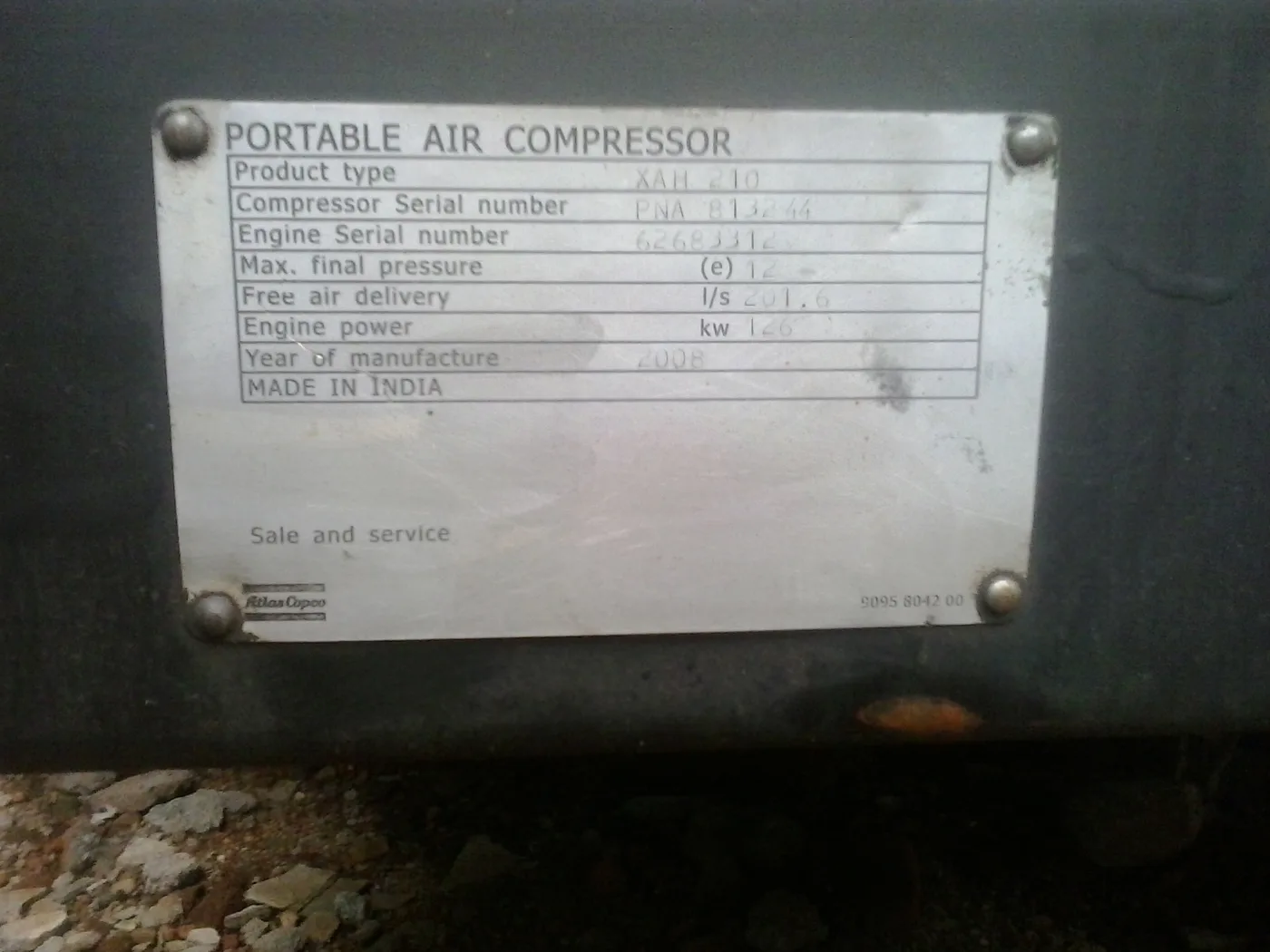
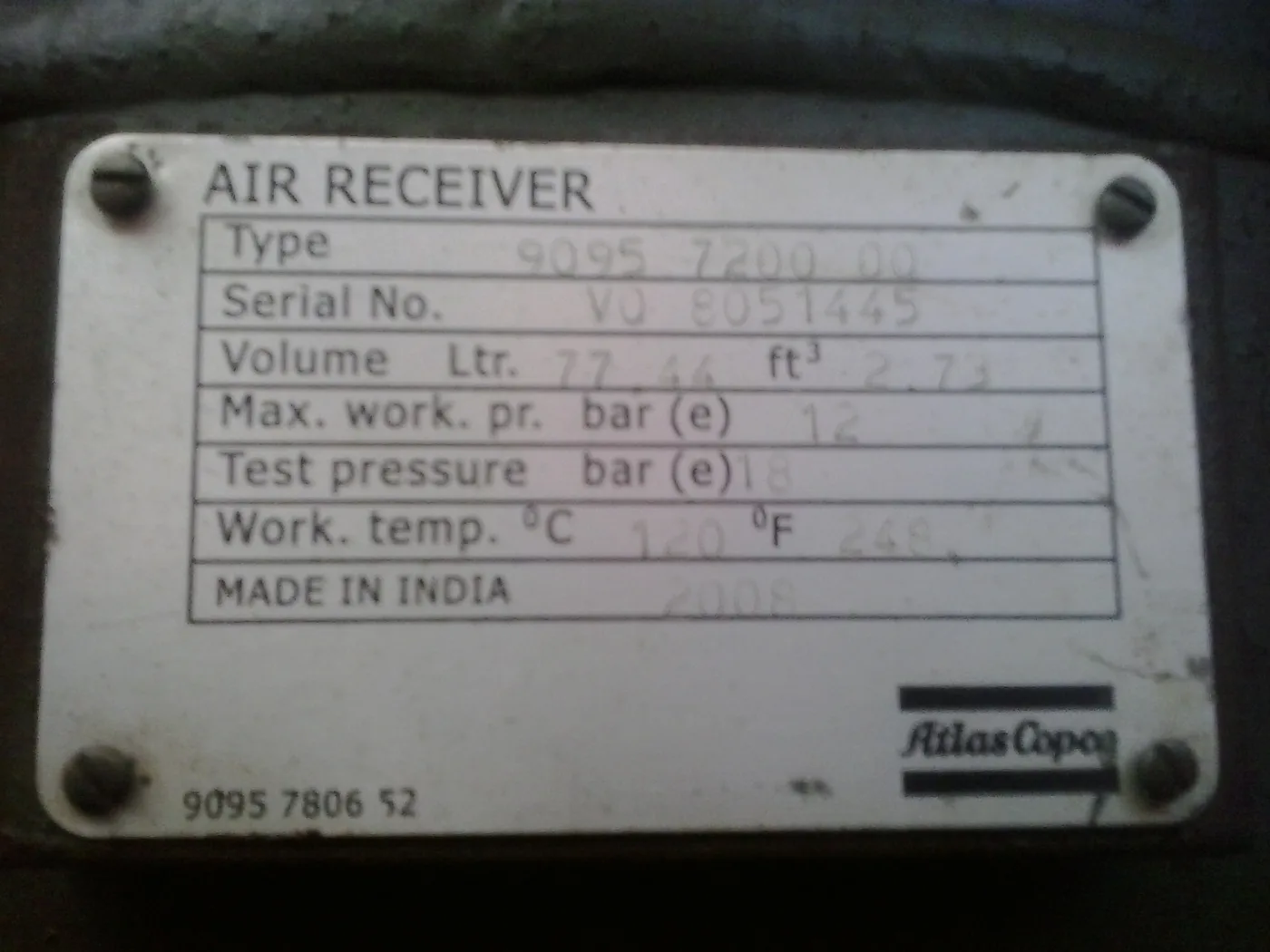
Photographs from Reddy Compressors' own fleet and workshop.
1. Engineering answer and decision boundary
A compressor nameplate is an identification and rating record, not a complete performance curve, parts catalogue, service certificate or proof of suitability for a new application. Its markings must be transcribed exactly, interpreted against the correct equipment category and matched to serial-applicable manufacturer documentation. A plate can establish what the manufacturer marked on a specific assembly at a particular point in its lifecycle; it cannot by itself establish present condition, achievable flow at a different pressure, part interchangeability, regulatory compliance in a new jurisdiction, or the identity of subsequently replaced components.
2. How to capture a plate without losing its meaning
Photograph the entire installed machine and its surroundings first, then each distinct plate: package, airend, motor, pressure vessel, dryer, electrical panel and auxiliary equipment. Preserve unaltered originals with date, location, asset tag and photographer. Capture a square-on overview plus legible close-ups with lighting that avoids glare; take a second view if stamping is shallow. Do not polish away original paint, corrosion or stamped characters merely to improve a photograph. Record uncertain characters as uncertain rather than silently guessing a zero, letter O, one or letter I.
A plate is an assertion about its mounted component. A motor plate does not substitute for a package rating; a vessel plate does not establish the compressor discharge pressure setpoint; an airend plate does not establish the delivered system flow. For removable assemblies, photograph the installation interface and record evidence that the plate still belongs to the observed assembly.
Capture field | Required record | Why it matters |
|---|---|---|
Plate role | Package / motor / vessel / airend / dryer / panel | Prevents cross-component interpretation |
Asset identity | Plant tag, location, photographs, date | Links evidence to actual machine |
Exact transcription | Characters, punctuation, units and symbols | Preserves source semantics |
Confidence | Legible / ambiguous / missing / altered | Controls what can be asserted |
Document match | Manual, drawing, OEM serial applicability | Validates interpretation |
Decision | Accepted / conditional / hold | Prevents unsupported use |
3. Nameplate hierarchy: package, component and site labels
A packaged compressor may have a manufacturer package plate, a prime-mover plate, a motor plate, an airend or pump identification, receiver certification plate, controller identification and user-applied plant labels. They can disagree for legitimate reasons, such as a motor replacement or controller retrofit, but such disagreement must trigger a configuration review. Site asset numbers and stickers are useful internal keys; they are not manufacturer serial numbers unless the underlying controlled records prove that relationship.
Distinguish the original equipment manufacturer, packaged-system integrator, authorised assembler, component maker and current service organisation. The name on the motor plate is often not the package maker. A component marking such as a bearing code or motor frame cannot justify ordering a compressor-specific replacement without serial-specific bill-of-materials evidence.
4. Field-by-field annotated nameplate guide — mandatory engineering asset
The following guide is an interpretation template, not a claim that every compressor carries every field. Markings vary by technology, maker, production era and market. Every interpretation below must be attached to the photographed source and a named reviewer.
Plate marking | What it can establish | What it cannot establish | Required corroboration |
|---|---|---|---|
Manufacturer / assembler | Identifies the named maker of the marked assembly | Do not assume the maker manufactured all components | Check legal entity, plate role, OEM record |
Model / type | Provides a manufacturer designation for a product family or variant | A model alone rarely fixes every serial-dependent revision | Cross-check serial-applicable configuration list |
Serial number | Provides the manufacturer identity key on that assembly | Do not infer build date or compatibility from digits | Validate against OEM register or controlled records |
Production year / date | May identify manufacturing period if explicitly marked | Not proof of commissioning or remaining life | Compare shipment, commissioning and service history |
Revision / variant / option code | May encode package configuration or change state | Code meanings are OEM-specific | Obtain code legend and revision-specific BOM |
Maximum allowable pressure / PS | Indicates a stated equipment pressure limit when explicitly defined | Not the same as normal operating setpoint or compressor delivery capability | Confirm boundary, temperature and applicable vessel records |
Rated working pressure | States a rated pressure at defined conditions | Do not equate with vessel PS or adjustable controller limit | Check performance sheet and pressure-control settings |
Flow / capacity | States a value in a particular flow convention | m³/min, Nm³/h, ACFM and FAD are not automatically equivalent | Obtain reference pressure, temperature, humidity and test basis |
Motor rated power | Electrical/mechanical nameplate rating for the motor | Not compressor absorbed power or actual electrical consumption | Check motor efficiency, load, drive and metered input |
Voltage / phases / frequency | Defines electrical supply ratings on relevant equipment | Not permission to operate on any nearby supply | Verify wiring, protection, frequency and actual supply |
Full-load current / FLA | Motor current rating under defined conditions | Not necessarily starting current or compressor-package input | Check starting method and protection study |
Speed / rpm | States rated rotational speed on the identified component | Motor rpm is not necessarily airend rpm | Verify gearbox, pulleys and variable-speed envelope |
Ambient / temperature limits | Defines marked thermal envelope if present | Does not resolve cooling airflow or derating on its own | Confirm manual, site conditions and cooling design |
Duty / service factor | May describe operating duty or motor service allowance | Does not prove suitability for unlimited cycling | Verify duty definition and start/stop limits |
Lubricant / refrigerant / gas | Identifies specified media when marked | Cannot substitute for materials compatibility assessment | Use current OEM approved fluid schedule |
Mass / dimensions | May support handling and layout planning | Package mass may exclude accessories or stored fluids | Verify current as-built lifting and transport drawings |
Protection rating / IP | May describe enclosure ingress protection | Not explosion protection or suitability for washdown alone | Check entire package, glands and environment |
Hazardous-area marking | May specify certification for a marked component | Component marking does not certify the entire package | Verify certificate scope, installation and area classification |
Conformity marks / certificates | May identify a declaration or conformity regime | Logo alone does not establish current jurisdictional acceptance | Obtain valid declaration and relevant schedule |
Vessel volume / test pressure | May appear on receiver or pressure component | Hydrotest pressure is not permissible continuous operation | Use current statutory inspection and vessel dossier |
Airend or pump code | Identifies rotating element or assembly | Does not prove a spare fits a particular package revision | OEM exploded drawing, serial and supersession approval |
Controller / software revision | May identify electronic platform or firmware | Display value may differ from original build | Obtain current as-found configuration and backups |
5. Pressure: never collapse different ratings into one number
Different pressure markings may describe different physical boundaries: compressor discharge, receiver design pressure, relief-device setting, control cut-out, downstream regulator setting, dryer allowable pressure and pressure-vessel proof test. Their units and reference basis matter. bar(g) is gauge pressure; bar(a) is absolute pressure. At an illustrative atmospheric pressure of 1.013 bar(a), 8 bar(g) corresponds to about 9.013 bar(a), not 8 bar(a). This arithmetic is a unit illustration, not an operating recommendation.
A vessel stamped PS 11 bar and a package rated at 8 bar(g) do not automatically permit operating the compressor at 11 bar. The limiting assembly and the approved protection architecture govern. Record each pressure alongside the exact plate, boundary, reference, allowable temperature and evidence document. Do not adjust a pressure switch, relief valve or operating envelope on the strength of one plate alone.
6. Flow: nameplate capacity is not automatically delivered air
Capacity labels can represent displacement, inlet volume, free-air delivery, standardised or normalised volume, or actual flow at a specified location. Temperature, absolute pressure, humidity and compressibility influence conversion. The label “m³/min” is incomplete for comparing two sources unless the reference conditions and measurement basis are known. In particular, free-air delivery at a defined compressor discharge pressure must not be confused with theoretical piston displacement or a peak advertising value.
For ideal-gas screening of the same dry gas, with consistent absolute units and no phase change, equivalent volumetric flow at two states can be approximated as Q₂ = Q₁ × (P₁/P₂) × (T₂/T₁). This is a physical-state conversion, not a manufacturer performance correction. Compressibility and humidity may matter; use the accepted measurement standard and manufacturer curve for actual procurement.
7. Electrical markings and motor-package separation
A three-phase motor plate may list multiple voltage connections, frequencies, currents, power ratings, speeds, insulation classes and duty classes. These are not interchangeable rows: each rating belongs to its corresponding supply and connection. If a replacement motor carries a different rating, record the changed assembly and verify coupling, overload protection, cooling, starting, enclosure and controller settings before commissioning.
As a screening relation, three-phase real electrical input P ≈ √3 × V × I × PF / 1000 kW, using line voltage, line current and power factor for balanced sinusoidal conditions. A motor plate kW may describe rated mechanical output rather than real input. Variable-speed drives and harmonics can make simple current-based estimates misleading; use an appropriate power analyser at the correct boundary.
8. Two nominally identical models: a worked identity comparison
Illustrative, fictional records: Compressor A and Compressor B both carry the family designation “RS-75”. A has package serial RS75-19-0042, build revision C, 400 V/50 Hz motor and an airend recorded as AE-12; B has serial RS75-22-0188, revision F, a different controller and airend recorded as AE-12R. The shared family designation does not establish interchangeability. Neither airend is declared compatible here; all codes are examples only.
Disposition: HOLD any proposed cross-fit between A and B until the OEM or competent technical authority supplies the serial-applicable parts list, supersession evidence and required installation controls. A nameplate cannot confirm oil chemistry, gasket material, control firmware or warranty consequences. Record the hold in the annotated guide with a named owner and due date.
9. Worked case: pressure, units and reference-state mismatch
Illustrative plate 1 reads “Capacity 6.8 m³/min @ 7.5 bar(g)” with no visible reference-state note; plate 2 reads “450 Nm³/h” with an accompanying document defining normal conditions. Multiplying 6.8 × 60 yields 408 m³/h numerically, but it does not prove that the first value equals 408 Nm³/h. The flow definitions and reference conditions are missing. Do not select the larger or smaller package by numeric comparison alone.
A defensible enquiry records each quoted capacity verbatim, asks the manufacturer whether the value is FAD, actual inlet flow or another convention, captures test conditions, and compares duty-point curves on a common validated basis. If the required flow is defined at the point of use, add verified downstream losses and simultaneity rather than treating a package plate as a point-of-use guarantee.
10. Worked case: motor replacement and conflicting plates
Illustrative installed package plate identifies a 55 kW compressor. Its replacement motor plate shows 60 hp at one frequency and 45 kW at another. The numbers may be reconcilable by frequency-specific ratings and the distinction between package designation and motor output, but that cannot be assumed. Record the motor serial, connection, frequency, protection settings and evidence of the authorised replacement. The as-found equipment is a modified configuration until verified.
Do not convert horsepower to kW and treat a nominal match as approval. If conversion is useful only for screening, 1 mechanical hp ≈ 0.7457 kW; 60 hp ≈ 44.7 kW. Verify the plate’s horsepower definition and rating row. The final engineering decision needs the motor data sheet, service factor, thermal suitability, compressor absorbed-power profile and installer sign-off.
11. Worked case: missing or damaged serial marking
An unreadable plate is an identity hold, not permission to reconstruct a serial from a sticker. Search non-invasive corroborating evidence: original commissioning dossier, purchase records, controlled photographs, manufacturer serial lookup, stamped frame identifiers and service records. Record confidence for each source. If evidence conflicts, do not merge two machine histories. Keep provisional identification separate from confirmed OEM identity.
Where the plate itself must be replaced, preserve the original photographs and obtain manufacturer or competent authority authorisation for a replacement marking. Never restamp or invent regulated vessel details. Mark asset identification as “provisional—service and procurement restricted” until the authority closes the record.
12. Worked case: a receiver plate is mistaken for compressor rating
A receiver carries a maximum allowable pressure of 12 bar while the compressor package plate gives rated discharge pressure of 8 bar(g). The 12 bar receiver figure does not establish the compressor’s safe pressure, relief setting or delivery capacity. The responsible engineer must verify the full system pressure envelope, installed protection and current receiver inspection status. Pressure changes are a controlled modification, not a nameplate interpretation exercise.
13. Worked case: two-speed or variable-speed marking
A motor plate lists 50 Hz and 60 Hz speed rows. A site operator assumes 60 Hz can be selected to obtain 20% more compressor flow. This inference ignores airend speed limits, cooling, motor current, shaft loading, discharge temperature, lubrication and the package controls. The correct response is to hold any speed change and request the OEM-approved operating envelope and revised protection settings.
14. Worked case: nameplate evidence versus condition evidence
A 2017 compressor package retains its original nameplate and has been stored for three years. The plate can still help identify the original configuration, but it says nothing about bearing condition, seals, moisture ingress, oil oxidation or controller battery condition. Age and hours alone do not establish remaining life.
15. Evidence hierarchy and source control
Give highest interpretive weight to a legible original manufacturer marking linked to the correct physical assembly, then serial-specific OEM build records, signed as-built change records and current OEM manuals. Generic brochures, reseller listings and visual similarity can provide search leads but cannot close serial-specific compatibility or legal requirements.
Where two authoritative records conflict, preserve both and escalate; do not silently choose the newer-looking source. A newer generic catalogue can be less applicable than an older serial-specific bill of materials. Document supersession as a traceable chain rather than replacing the old part number in the master record without history.
17. Workflow: from photograph to controlled engineering decision
Stage | Required control |
|---|---|
1 — Intake | Receive asset ID, location, equipment role, plate images and enquiry objective. |
2 — Segment | Separate package, motor, receiver, airend and auxiliary markings. |
3 — Transcribe | Copy exactly, including units, punctuation, uncertain characters and multiple rating rows. |
4 — Verify | Match serial and revision against current OEM build records and approved modifications. |
5 — Interpret | Map each marking to its specific physical boundary and rated conditions. |
6 — Reconcile | Resolve conflicting values, replacements and incomplete records; keep holds visible. |
7 — Decide | Classify each intended use as accepted, conditional or rejected, with evidence. |
8 — Archive | Store originals, reviewer identity, document revisions and signed disposition. |
18. Practical enquiry form: what to request from the customer
Ask for machine overview photos, each full nameplate, close-ups of ambiguous characters, existing asset tag, exact required task (identification, maintenance, spare, resale, capacity check or replacement), current operating location and electrical supply, service history, controller screen identification, known modifications, applicable OEM manuals and any pressure-vessel documentation. Ask for duty pressure and flow separately from plate markings. Do not request a customer to expose live electrical terminals or remove protective guards to obtain a photo.
19. Field inspection and safety boundaries
A nameplate review is primarily documentary. If physical access is needed, site-approved isolation, lockout, depressurisation, thermal and electrical safety procedures must be followed by competent personnel. Do not reach into guarded rotating equipment or enter an electrical cabinet merely to read a serial. For hazardous-area equipment, apply the facility’s approved inspection and ignition-control procedures. An illegible plate does not justify unsafe access.
20. Error patterns and corrective decisions
21. Technical FAQ — answer-ready, evidence-bounded
Is a model number enough to order parts?
No. It is a search key; serial number, revision and approved supersession evidence normally govern compatibility.
Does a compressor plate prove current capacity?
No. It may state an original rating; current performance requires valid duty-point and condition evidence.
What if the serial is unreadable?
Use documented corroborating sources, label the identity provisional and hold critical procurement decisions.
Is a receiver pressure rating the compressor pressure rating?
No. The vessel and compressor have distinct boundaries and protection requirements.
Can I compare two flow values both in m³/min?
Only after confirming whether both use the same flow convention, reference conditions and duty point.
Is motor nameplate power the electrical input?
Often not; motor kW commonly denotes mechanical output at rated conditions.
Can two same-model compressors use the same separator?
Not without serial-specific parts confirmation and any relevant configuration changes.
Does a CE or other marking prove local legal acceptance?
Not by itself. Verify the actual conformity scope, jurisdiction, edition and applicable installation.
Does the plate show manufacturing date?
Only if a date is explicitly marked or decoded through an authoritative OEM source.
Can a plate be replaced after damage?
Only through a controlled, authorised process retaining original evidence and regulated marking requirements.
Can I operate at the highest pressure number visible?
No. Different numbers refer to different boundaries; the approved system limit governs.
Does a VSD allow any motor frequency?
No. The package, airend, motor and controls have approved operating limits.
Can a machine be released after long storage because its plate is legible?
No. Storage condition and recommissioning require separate evidence.
What is the minimum usable photograph?
An unaltered, legible plate image tied to the correct physical assembly and asset identity.
What does “hold” mean?
The proposed technical conclusion cannot be relied upon until the named missing evidence is resolved.
Who approves the interpretation?
A competent named technical authority with access to applicable OEM and site records.