
Capability should describe what can actually be supported
A large industrial website can easily create the impression that every product, technology, brand and service shown is automatically available.
That is not the standard we want for Reddy Compressors.
It will cover almost every major branch of compressed-air engineering:
- Stationary Compressors
- Portable Compressors
- Diesel & Electric Systems
- High-Pressure Air
- Oil-Free Air
- Borewell & DTH
- Rental / Hire
- Service
- Repairs
- Overhaul
- Spare Parts
- Air Treatment
- Receivers
- Distribution
- Controls
- Energy
- Applications
- Engineering Knowledge
- But website coverage and commercial capability are not always the same thing
- A technical page may explain a technology
- A product family may be sourced only against a project
- A rental unit may depend on current fleet availability
- A service capability may depend on machine type, location and technical scope
- A spare part may depend on manufacturer and serial-number verification
For that reason, Reddy Compressors will describe capabilities with controlled, transparent status language rather than implying that everything shown is permanently stocked, owned or immediately available.
Our capability model
Reddy Compressors is being developed around six connected capability groups:
01 — equipment
Permanent and project-specific compressed-air equipment.
02 — rental / hire
Temporary, project and continuity compressed air.
03 — service & lifecycle support
Maintenance, diagnostics, repairs and overhaul.
04 — spare parts & component support
Machine-specific identification and sourcing.
05 — air treatment & system components
Drying, filtration, storage and associated equipment.
06 — compressed-air system support
Application, pressure, flow, distribution and operating-condition guidance.
01 — compressor equipment
Multiple Technologies for Different Duties
There is no single compressor type that is appropriate for every application.
Reddy Compressors' platform therefore supports an application-led approach across several major equipment families.
Rotary screw compressors
Rotary screw technology is widely used where industrial customers require sustained compressed-air delivery.
Potential configurations include:
- Oil-Injected
- Oil-Free
- Fixed Speed
- Variable Speed
- Air-Cooled
- Water-Cooled
- Tank-Mounted
- Base-Mounted
- Integrated Dryer Packages
- Single-Stage
- Two-Stage
Selection should consider:
- • required FAD
- • operating pressure
- • demand profile
- • annual operating hours
- • control philosophy
- • cooling
- • air treatment
- • service accessibility
- • lifecycle cost
- Explore Rotary Screw Compressors →
Reciprocating compressors
Piston compressors remain relevant across:
- • workshops
- • garages
- • intermittent manufacturing
- • service facilities
- • smaller industrial requirements
- • specialised pressure duties
Possible architectures include:
- Single Stage
- Two Stage
- Multi Stage
- Lubricated
- Oil-Free
- Air-Cooled
- Water-Cooled
- Tank-Mounted
- Base-Mounted
- The correct choice depends on duty rather than simply initial purchase price
- Explore Reciprocating Compressors →
Portable diesel compressors
Compressed Air Where the Work Happens
Portable diesel compressors support applications where mobility and independent power matter.
Potential applications include:
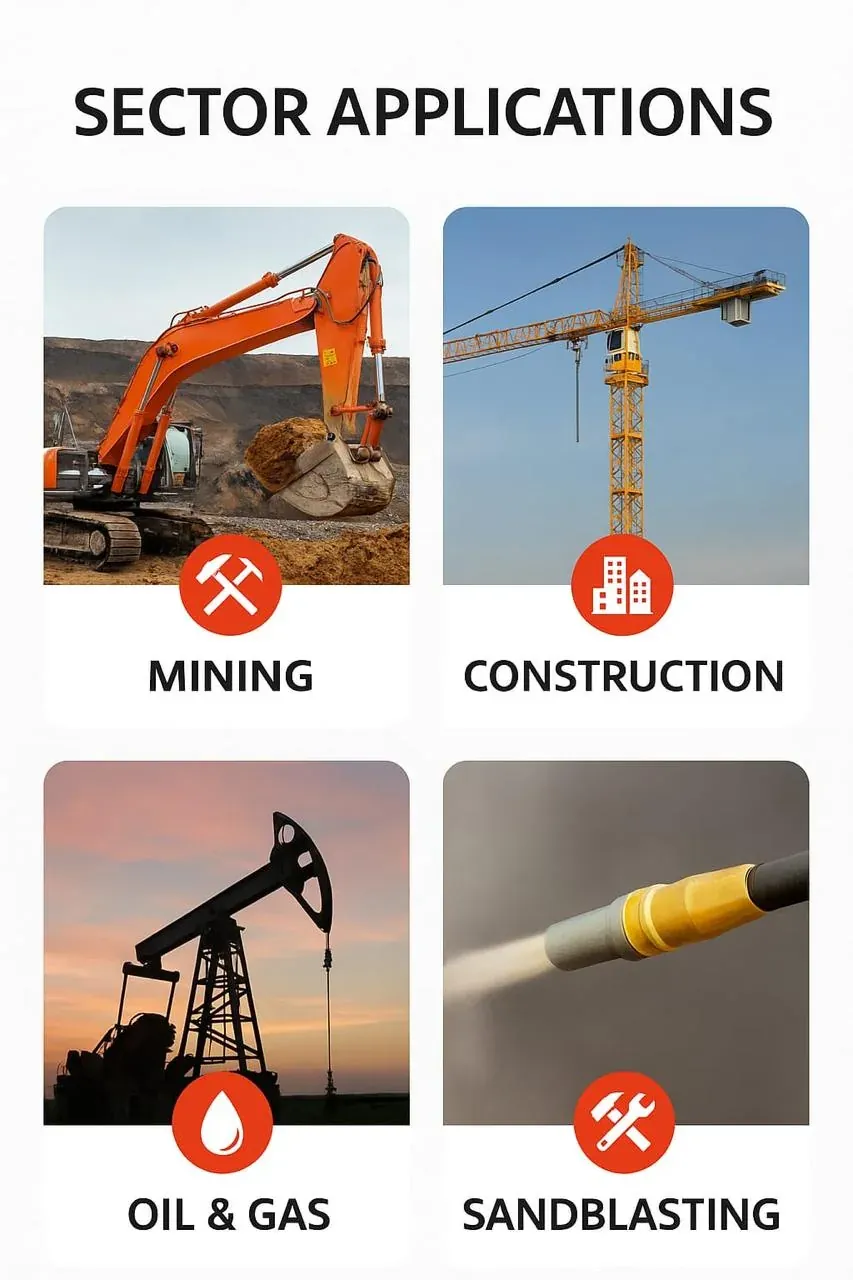
- Construction
- Mining
- Quarrying
- Drilling
- Borewell
- DTH
- Sandblasting
- Road Breaking
- Pneumatic Tools
- Pipeline Work
- Temporary Plant Air
Selection should consider:
- CFM + Pressure + Application + Operating Conditions
- not CFM alone
Portable electric compressors
Where suitable electrical infrastructure exists, electric portable or relocatable compressors can support temporary or project air without a dedicated diesel engine.
Potential advantages can include:
- • no local diesel engine
- • indoor suitability in appropriate environments
- • lower engine-maintenance burden
- • compatibility with temporary industrial-air requirements
Final selection still depends on power availability, starting requirements, mobility and site conditions.
Oil-free compressors
Oil-free compressed-air requirements may arise where contamination control has significant process consequences.
Potential applications can include:
- • pharmaceuticals
- • food and beverage
- • electronics
- • selected process operations
- • sensitive instrumentation
The complete system still requires consideration of:
- Compressor Technology
- Drying
- Filtration
- Distribution
- Air Quality at Point of Use
- Oil-free compression is not a substitute for complete air-quality engineering
High-pressure & high-volume compressors
Certain applications require combinations of pressure and airflow beyond normal plant-air duty.
Potential applications include:
- • DTH drilling
- • borewell drilling
- • mining
- • quarrying
- • blasting
- • specialist industrial processes
- High pressure and high flow are different engineering variables
- The requirement must define both
Borewell & DTH compressors
Borewell and drilling requirements deserve their own capability pathway.
Selection may require consideration of:
- • hammer size
- • bore diameter
- • pressure requirement
- • airflow
- • drilling depth
- • geology
- • groundwater
- • altitude
- • hose losses
- • flushing requirement
This makes borewell compressor selection a system-engineering exercise rather than simply choosing the largest available machine.
Centrifugal, gas, blower & specialty technologies
However, these should be represented according to verified commercial capability.
Some may be:
- Project Engineered
- Sourced on Request
- Knowledge Only
- rather than automatically described as owned stock or standard Reddy inventory
- That distinction is intentional
02 — rental / hire capabilities
Temporary Equipment. Permanent Engineering Discipline
Rental can support customers when ownership is unnecessary, unavailable or commercially inefficient.
Potential rental requirements include:
- • construction
- • infrastructure
- • drilling
- • DTH
- • mining
- • quarrying
- • sandblasting
- • compressor breakdown
- • planned shutdown
- • maintenance
- • temporary capacity
- • production peaks
- • commissioning
- • project work
Rental equipment categories
Depending on verified current availability or sourcing, rental pathways can include:
- Diesel Portable Compressors
- Electric Compressors
- Oil-Free Compressors
- High-Pressure Compressors
- High-Volume Compressors
- Borewell / DTH Compressors
- Industrial Temporary-Air Compressors
- Air Dryers
- Aftercoolers
- Filters
- Receivers
- Hoses & Distribution
The rental requirement should be defined by:
- Required CFM
- Working Pressure
- Application
- Site
- Operating Hours
- Rental Duration
- Connection Arrangement
- Hose / Pipe Distance
- Air-Treatment Requirement
Rental continuity capability
Critical users should ideally think about temporary compressed air before permanent equipment fails.
A continuity plan can identify:
- • temporary compressor position
- • connection point
- • required flow
- • required pressure
- • pipe or hose size
- • air-quality requirement
- • electrical or fuel requirement
- This can make temporary deployment more controlled
- Rental is therefore not just a fleet capability
- It can also be a business-continuity capability
03 — service & lifecycle capabilities
Service the Machine. Understand the System. Protect the Operation
Reddy Compressors' lifecycle capability extends across the operating life of compressed-air equipment.
Preventive maintenance
Scheduled maintenance may include activities appropriate to the actual equipment, operating hours and manufacturer requirements.
Potential areas include:
- • filters
- • lubricants
- • separators
- • belts
- • coolers
- • drains
- • inspection
- • operating-condition checks
- The exact maintenance scope depends on machine and contract
AMC
Annual Maintenance Contract structures can be developed according to:
- • equipment covered
- • service frequency
- • labour scope
- • included/excluded parts
- • inspection requirements
- • reporting
- • location
- AMC should not automatically be described as “guaranteed uptime.”
- The appropriate commitment depends on the actual contract
Breakdown diagnostics
A breakdown requirement should be approached through:
- Machine Identification
- → Symptom
- → Operating Condition
- → Measurement
- → Diagnosis
- → Corrective Action
- → Verification
- The objective is to identify the cause rather than simply clear the alarm
Compressor repair
Repair pathways can cover compressor-side and associated equipment issues according to machine technology and condition.
Potential categories include:
- • rotary screw
- • reciprocating
- • portable
- • high-pressure
- • air-treatment equipment
- Final repair scope depends on diagnosis
Air-end overhaul
Major rotary screw compressor repair can involve airend assessment and overhaul where technically and economically justified.
A proper overhaul decision should consider:
- • condition
- • hours
- • bearings
- • clearances
- • service history
- • failure mode
- • replacement alternatives
- No blanket “as good as new” claim should be made without machine-level evidence
Reciprocating compressor overhaul
Potential work can involve:
- • cylinders
- • piston assemblies
- • rings
- • valves
- • bearings
- • gaskets
- • associated components
- Again, final scope depends on inspection
Portable compressor service
Portable equipment can require support across two interconnected systems:
Compressor Package + Diesel Engine
Potential service areas can include:
- • filters
- • fluids
- • separators
- • coolers
- • compressor controls
- • engine-side maintenance
- • hoses
- • fuel system
- • batteries
Condition monitoring
Where appropriate, machine condition can be better understood using:
- • pressure
- • temperature
- • vibration
- • oil condition
- • differential pressure
- • operating history
This supports movement from schedule-only maintenance toward evidence-informed maintenance.
04 — installation & commissioning capabilities
A Good Compressor Can Be Made Unreliable by a Bad Installation
Installation is part of compressed-air engineering.
A project may therefore require review of:
- Location
- Ventilation
- Foundation
- Electrical Supply
- Piping
- Receiver
- Dryers
- Filters
- Drainage
- Service Access
- Control Integration
Commissioning
Commissioning can include, where relevant to scope:
- • equipment inspection
- • connection verification
- • fluid checks
- • start-up
- • controller settings
- • pressure observation
- • temperature observation
- • leak inspection
- • operating test
- • handover
- Manufacturer procedures remain controlling for the actual machine
Recording baseline pressure, temperature, settings, operating hours and alarm status so future maintenance has a known reference condition.
Relocation & shifting
Industrial operations sometimes need compressors moved because of:
- • plant modification
- • expansion
- • process relocation
- • replacement
- • project completion
- A relocation requirement can involve more than transport
The new location may change:
- • ventilation
- • piping length
- • electrical supply
- • foundation
- • service access
- • drainage
- • operating environment
Relocation should therefore be treated as reinstallation, not merely moving machinery.
05 — spare parts capabilities
The Right Part Starts With the Right Machine
Reddy Compressors can support parts enquiries across multiple compressor categories according to the available machine information and sourcing capability.
Identifying:
- • manufacturer
- • model
- • serial number
- • compressor technology
- • required component
- • part number
- • machine photograph
- • nameplate photograph
Part categories
Potential support categories include:
Rotary screw
Air filters • Oil filters • Separators • Lubricants • Belts • Valves • Sensors • Seals
Reciprocating
Piston rings • Valves • Gaskets • Bearings • Cylinder components • Pressure switches
Portable diesel
Compressor-side parts • Engine-side components • Filters • Hoses • Controls
Air treatment
Dryer components • Filter elements • Drains • Valves • Receiver accessories
Final compatibility must be verified against the specific machine.
Genuine, compatible & replacement parts
Part terminology should also be transparent.
Where relevant, components should be identified as:
- Genuine OEM
- Verified Compatible / Aftermarket
- Other Identified Replacement
- A compatible component must never be labelled “genuine OEM” if it is not
- That is part of Reddy Compressors' evidence and transparency standard
06 — air treatment capabilities
The Compressor Produces Air. Treatment Makes It Suitable for the Process
This includes:
- • air dryers
- • filters
- • receivers
- • air-system accessories
The expanded capability model includes:
- Aftercooling
- Bulk Moisture Separation
- Refrigerated Drying
- Desiccant Drying
- Particulate Filtration
- Coalescing Filtration
- Activated-Carbon Treatment
- Condensate Drainage
- Oil-Water Separation
- Air Receivers
Dryers
Dryer selection should consider:
- • flow
- • inlet temperature
- • ambient temperature
- • pressure
- • required pressure dew point
- • acceptable pressure loss
- Dryer capacity should not be quoted without understanding rating conditions
Filtration
Different filters target different contaminants.
Potential functions include:
- • particulate removal
- • liquid/aerosol reduction
- • downstream fine filtration
- No single filter should be represented as removing every possible contaminant
Air receivers
Receiver capability includes selection and application guidance around:
- • storage
- • buffering
- • cycling
- • transient demand
- • wet/dry receiver placement
But:
An air receiver stores air. it does not create continuous compressor capacity
This distinction is fundamental.
07 — piping & distribution capabilities
From Compressor Room to Point of Use
Reddy Compressors' long-term system capability extends to understanding how compressed air moves through the facility.
Potential areas include:
- Pipe Sizing
- Ring Mains
- Headers
- Branches
- Pressure Drop
- Flow Velocity
- Regulation
- Hoses
- Point-of-Use Distribution
- Leakage
- The objective is not simply to generate pressure
- It is to preserve enough pressure for productive use
Leakage & system loss
Leaks can become continuous loads.
Pressure drop can make a healthy compressor appear inadequate.
A system assessment may therefore consider:
- Compressor Capacity
- + Treatment Loss
- + Pipe Loss
- + Leakage
- + Actual Demand
- before recommending additional machinery
08 — controls & monitoring capabilities
Compressed-air systems increasingly depend on control intelligence.
Potential areas include:
- • compressor controllers
- • load/unload control
- • VSD control
- • multiple-compressor sequencing
- • operating alarms
- • remote monitoring
- • condition data
- Not every machine supports every digital capability
- Current compatibility must be confirmed before recommendation
Multiple-compressor systems
When several compressors share one system, capability can extend to examining:
- • base-load machine
- • trim machine
- • pressure bands
- • sequencing
- • unnecessary unloading
- • operating hours
At this level, compressed air becomes a utility-system problem rather than an individual-machine problem.
09 — energy & performance capabilities
Efficiency Is a System Property
Potential engineering support can therefore include:
- Pressure Review
- Demand Profiling
- Leakage Assessment
- Specific-Power Analysis
- Load/Unload Review
- Sequencing Review
- Distribution Review
- Any published savings outcome requires an appropriate baseline and measurement
- No universal percentage should be promised
10 — borewell, DTH & drilling capability
Drilling compressed air should be selected according to:
- Hammer
- Hole Diameter
- Depth
- Pressure
- Flow
- Geology
- Altitude
- Flushing Requirement
- Hose Losses
The platform will support engineering content and enquiry pathways for:
- • water-well drilling
- • DTH drilling
- • blast-hole drilling
- • quarry drilling
- • foundation drilling
- • high-pressure drilling
- • booster-assisted systems
- Final equipment availability remains subject to current confirmation
11 — pneumatic & construction-air capability
Compressed-air equipment can serve:
- Rock Drills
- Jackhammers
- Paving Breakers
- Road Breaking
- Concrete Breaking
- Sandblasting
- Guniting
- Cable Laying
- Fibre Blowing
- Pneumatic Tools
The compressor should be selected from the combined demand of the downstream equipment, required working pressure and duty cycle.
12 — multi-brand capability
Support the Customer's Installed Reality
Industrial customers frequently operate mixed fleets.
Reddy Compressors therefore adopts a multi-brand philosophy.
But every manufacturer relationship should be represented accurately.
Capability status language
Every relevant product, brand or service can be assigned one of the following statuses.
Sales available
A verified commercial supply pathway exists for the specific requirement.
Rental available
Rental capability exists, subject to current equipment availability.
Service supported
Technical service capability exists for the relevant equipment family and scope.
Parts supported
A parts-identification or sourcing pathway exists.
Project engineered
The requirement needs technical definition and project confirmation.
Sourced on request
Equipment is not represented as permanent owned stock; sourcing depends on current supplier confirmation.
Customer-owned equipment supported
Reddy Compressors may support installed customer equipment without implying formal manufacturer authorisation.
Knowledge only
The website provides educational or engineering information, but no automatic commercial capability is claimed.
Verification required
Current evidence is insufficient to publish the capability as confirmed.
Supporting or supplying equipment does not automatically make every manufacturer an official Reddy Compressors partner.
What “all types / all models / all brands” should mean
It does not mean falsely claiming:
- Every model is stocked
- Every brand is authorised
- Every machine can be rented immediately
- Every part is available
Instead, it means the platform is designed to accommodate:
- • major compressor technologies
- • historic and current models
- • multiple brands
- • different drive types
- • varied pressure/flow classes
- • sales
- • rental
- • service
- • parts
- • engineering knowledge
- The actual status of each requirement is then verified
That is the difference between a large catalogue and a credible industrial platform.
What we do not claim automatically
A capability page should never become an excuse to overstate the business.
Therefore we do not automatically claim:
- • every compressor is in stock
- • every rental unit is immediately available
- • nationwide technicians at every location
- • universal emergency-response times
- • guaranteed uptime
- • all-brand authorisation
- • fixed energy savings
- • universal warranties
- • all specialist technologies as owned operational capability
- Where confirmation is required, the website should say so
The complete capability chain
Reddy Compressors is being developed toward a lifecycle architecture that can connect:
Requirement
Change the asset when lifecycle evidence supports it.
This is the capability model that turns individual services into one compressed-air lifecycle platform.
Capability by customer need
“I need to buy a compressor.”
Equipment Selection → Sales
“I need air temporarily.”
Rental / Hire
“My compressor has stopped.”
Diagnostics → Repair → Rental Continuity if required
“I need a borewell compressor.”
DTH / Drilling Requirement Engineering
“I need this part.”
Model & Serial Verification → Parts
“We have water in the air line.”
Air-Treatment Assessment
“Our pressure is low.”
System Diagnosis
“Our electricity consumption is high.”
Demand / Pressure / Leakage / Control Review
“We need a new compressor room.”
Equipment + Treatment + Storage + Distribution + Installation
This is how the capability page should function: not merely as a list, but as an operating gateway.
Our capability principle
Capability should be specific enough to be useful and controlled enough to be credible
We want Reddy Compressors to become broad enough to support complex compressed-air questions.
But credibility requires boundaries.
That approach is more valuable than claiming everything.
Closing
From equipment to the complete compressed-air lifecycle
Reddy Compressors' capability architecture spans:
- Compressor Equipment
- Portable & Drilling Air
- Rental / Hire
- Service
- AMC
- Diagnostics
- Repairs
- Overhaul
- Installation
- Commissioning
- Relocation
- Spare Parts
- Air Treatment
- Receivers
- Piping
- Controls
- System Engineering
- Knowledge & Calculations
Reddy compressors
Compressed air. engineered for uptime
Sales • Rental / Hire • Service • Installation • AMC • Repairs • Overhaul • Spare Parts • Air Treatment • System Support
Primary CTA
Tell Us Your Compressed-Air Requirement
Secondary CTAs
Explore Compressor Technologies
Request Rental / Hire
Request Service
Request Spare Parts
Discuss a System Requirement