
Compressed-air equipment changes from the moment it starts operating
Filters gradually load.
Lubricants age.
Coolers accumulate contamination.
Separators develop differential pressure.
Belts and couplings wear.
Valves change condition.
Connections can leak.
Sensors can fail.
Controls that once matched production may no longer match the plant after production changes.
That means compressor reliability cannot be treated as something decided only on the day equipment is purchased.
It has to be managed throughout the operating life of the asset.
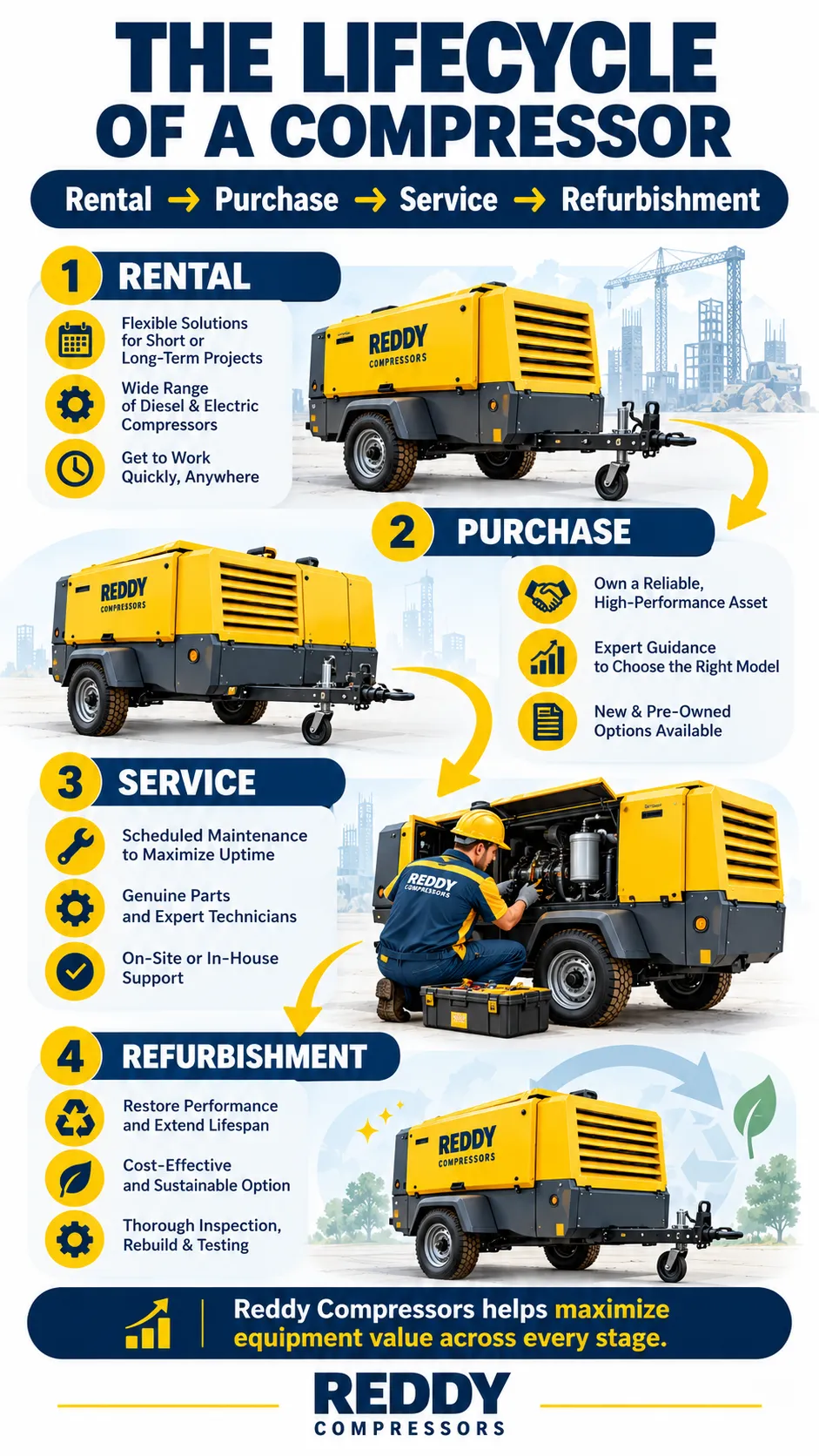
The complete lifecycle pathway as:
Selection → supply → installation → operation → maintenance → repair → overhaul → replacement
and specifically states that each equipment decision should be treated as the beginning of an operating relationship rather than the end of a transaction.
Our lifecycle principle
- Support the decision before supply
- Support the machine after supply
- Support the system as operating conditions change
A lifecycle relationship can begin before the customer owns the compressor.
It may start with:
What compressor do we need?
Later the question becomes:
How should it be installed?
Then:
When should it be serviced?
Then perhaps:
Why is it running hot?
Later:
Is it worth overhauling?
And eventually:
Should it be replaced?
Each question belongs to the same equipment lifecycle.
The reddy compressors customer lifecycle
01 — requirement
Has the existing asset reached the point where another solution makes more sense?
↓
14 — next lifecycle
Begin again from the new operating requirement.
01 — requirement definition
The lifecycle starts before the compressor is selected
A poor first decision can remain expensive for years.
If a machine is:
- • oversized
- • undersized
- • incorrectly pressurised
- • poorly matched to duty
- • unsuitable for its environment
- • difficult to service
- then later maintenance cannot completely correct the original selection problem
The first lifecycle responsibility is therefore to understand:
- Flow
- Pressure
- Demand Profile
- Air Quality
- Duty
- Environment
- Reliability Requirement
- Lifecycle Cost
This reflects the master philosophy that compressed air should be engineered as a system and supported throughout its lifecycle.
02 — equipment selection
Different operating profiles may justify different compressor technologies.
The selection discussion can include:
- Rotary Screw
- Reciprocating
- Portable Diesel
- Portable Electric
- Oil-Free
- High-Pressure
- Other Specialist Technology
- The customer should not have to begin with detailed compressor knowledge
They can begin with:
What does the air need to do?
The lifecycle is stronger when the initial machine genuinely matches the application.
03 — commercial path: buy, rent or support existing equipment
Not every requirement needs a new permanent compressor.
Depending on duty, a customer may need:
- Purchase
- for long-term demand
- Rental / Hire
- for temporary projects or continuity
- Repair
- where an existing asset remains viable
- Overhaul
- where major restoration is technically and economically justified
- Upgrade
- where selected modifications can improve useful life or system operation
- This keeps lifecycle thinking broader than repeated equipment replacement
04 — equipment supply
Once a machine is selected, the supply stage should confirm what is actually being delivered.
Depending on scope:
- • manufacturer
- • model
- • configuration
- • flow
- • pressure
- • accessories
- • treatment equipment
- • receiver
- • controls
- • documentation
- • installation scope
- • commissioning scope
- • warranty terms where applicable
The objective is to move from:
Generic equipment category
to:
Verified supply configuration
05 — pre-installation review
The machine now has to become part of a real site.
Lifecycle support therefore moves from procurement into integration.
A pre-installation review can consider:
- Location
- Ventilation
- Foundation
- Electrical Supply
- Pipework
- Air Treatment
- Drainage
- Service Access
An installation that makes future maintenance difficult creates lifecycle problems from day one.
So serviceability should be considered before the equipment is fixed permanently in position.
06 — installation
A capable compressor can perform poorly inside an unsuitable installation.
Installation quality can affect:
- • cooling
- • pressure stability
- • vibration
- • maintenance access
- • air treatment
- • reliability
- Therefore the lifecycle view does not separate equipment from installation
- The installed environment becomes part of the machine's operating condition
07 — commissioning & baseline
Commissioning should establish:
Does the equipment operate correctly now?
But it should also create a reference for the future.
Useful baseline information can include:
- Operating Pressure
- Temperature
- Controller Settings
- Operating Hours
- Alarm Status
- Initial System Condition
- This gives future service visits something to compare against
- Without a baseline, gradual deterioration is harder to recognise
08 — operator awareness
After commissioning, operators become part of the lifecycle.
They may be the first to notice:
- • unusual noise
- • increased temperature
- • changing pressure
- • leaks
- • abnormal cycling
- • fault messages
- • condensate issues
- • unusual vibration
- Operator awareness does not replace technical service
But it can help identify developing conditions before they become larger failures.
09 — preventive maintenance
Maintenance performed before the failure chooses the timing
Preventive maintenance shifts intervention into a planned operating window.
Maintenance must remain model-specific rather than applying one universal interval to every machine. Intervals can depend on manufacturer, model, operating hours, lubricant, environment, temperature, dust, duty and service history.
Potential maintenance areas include:
- Air Intake
- Lubrication
- Cooling
- Separation
- Drive Components
- Electrical Condition
- Drains
- Controls
- The goal is not merely to “complete the service.”
- It is to preserve operating condition
10 — AMC / planned service support
A maintenance contract should have a defined scope.
Possible structures can include:
- Maintenance Only
- Scheduled inspections and labour
- Labour + Defined Consumables
- Selected planned service items
- Semi-Comprehensive
- Broader scope with stated exclusions
- Comprehensive
- Wider defined parts and labour coverage subject to contract terms
A professional AMC should identify:
- • equipment
- • service frequency
- • labour
- • consumables
- • included/excluded parts
- • breakdown arrangements
- • site/travel conditions
- • reporting
- • exclusions
- It should not automatically be described as a guarantee of zero downtime
Baseline before taking over existing equipment
When Reddy Compressors begins maintaining an existing compressor, the starting condition matters.
Recording:
- • equipment condition
- • operating hours
- • existing faults
- • leakage
- • service history where available
- • alarm history
- • outstanding repairs
- • non-standard modifications
This prevents a new service relationship from beginning with an unknown technical baseline.
11 — service should create information
A service visit should leave behind more than replaced filters.
Useful records can include:
- Machine Identification
- Operating Hours
- Pressure
- Temperature
- Alarm History
- Visible Condition
- Components Replaced
- Recommendations
- Next Service Requirement
This information becomes the equipment's maintenance history and summarises the principle as:
BETTER HISTORY → BETTER DECISIONS.
This is one of the most important ideas in lifecycle support.
12 — condition monitoring
Scheduled maintenance tells us when to inspect.
Condition information helps tell us what is changing.
Where relevant and practical, condition review can include:
- • pressure
- • temperature
- • operating hours
- • load state
- • differential pressure
- • vibration
- • alarms
- • visible leakage
- The goal is not to create dashboards for their own sake
- It is to answer operating questions
Is temperature increasing?
Is filter restriction rising?
Are unloaded hours increasing?
Is one machine carrying disproportionate duty?
Condition information should lead to a decision.
13 — breakdown diagnostics
A BREAKDOWN IS A LIFECYCLE EVENT—not JUST AN EMERGENCY
When a compressor trips, the goal should not simply be:
Reset it and get it running.
A root-cause workflow:
- Capture
- → Inspect
- → Measure
- → Isolate
- → Identify
- → Repair
- → Verify
- → Review
This matters because the alarm may describe the event without describing its cause.
For example:
High temperature
may involve:
- • high ambient temperature
- • dirty cooler
- • poor ventilation
- • hot-air recirculation
- • lubricant condition
- • fan condition
- • sensor issues
And:
Low pressure
may involve:
- • leakage
- • restricted inlet
- • control problems
- • airend condition
- • excessive demand
- • treatment restriction
- • distribution loss
Lifecycle support means understanding why the machine reached the failure condition.
14 — repair
Once the fault mechanism is understood, repair should correct the actual condition.
Depending on equipment, this may involve:
- • controls
- • valves
- • sensors
- • cooling system
- • seals
- • hoses
- • drive components
- • lubrication system
- • airend-related parts
- • reciprocating components
An important completion rule:
THE REPAIR IS COMPLETE ONLY WHEN THE ORIGINAL PROBLEM IS VERIFIED AS CORRECTED.
That prevents “part replaced” from automatically becoming “problem solved.”
15 — temporary rental continuity
Sometimes the permanent machine cannot return to service immediately.
Then the lifecycle support decision may become:
Repair
or:
Temporary air
or:
BOTH
Rental can support:
- • breakdown continuity
- • planned maintenance
- • overhaul
- • shutdown
- • temporary production peaks
- • project demand
- This connects the rental business directly to lifecycle reliability
- Rental is not only a separate product category
- It can be part of the maintenance strategy
16 — spare parts support
Lifecycle support depends heavily on parts availability and correct identification.
The workflow should begin with:
- Manufacturer
- Model
- Serial Number
- Part Number
- Component Identity
- Compatibility
Possible components include:
- Filters
- Separators
- Lubricants
- Belts
- Valves
- Sensors
- Seals
- Gaskets
- Coolers
- Electrical Components
- The correct part supports reliability
- The wrong part can create a new failure mechanism
17 — critical spares
For production-critical compressors, some failures should be anticipated before they occur.
Critical-spares planning can consider:
Failure Consequence
×
Procurement Lead-Time Exposure
The objective is not to stock every possible part.
It is to identify selected components whose unavailability could create disproportionate downtime.
Lifecycle support therefore connects service history with inventory planning.
18 — major overhaul
Eventually some equipment reaches a stage where routine repair is no longer enough.
Possible overhaul triggers such as:
- • declining performance
- • abnormal mechanical noise
- • bearing condition
- • oil carryover
- • repeated failures
- • high operating hours
- • loss of compression efficiency
- • significant internal wear
But it also makes an important point:
High hours alone do not prove that a rebuild is required
Inspection matters.
Structured overhaul
A controlled overhaul sequence:
This is substantially stronger than treating overhaul as cosmetic refurbishment.
19 — rebuild or replace?
An ageing compressor should not automatically be replaced.
It also should not automatically be rebuilt.
Consider:
- Overhaul Cost
- Equipment Age
- Condition
- Efficiency
- Parts Availability
- Reliability Requirement
- Replacement Lead Time
- Future Utilisation
- Overhaul should have an economic and technical reason
- That is the correct lifecycle principle
20 — upgrades & retrofits
Sometimes the machine remains viable but part of the system can be improved.
Potential lifecycle interventions may include:
- • control upgrades
- • VSD retrofit where technically appropriate
- • remote/condition monitoring
- • cooling improvements
- • treatment upgrades
- • distribution changes
- The decision should be based on the actual equipment and operating requirement
- An upgrade should solve a defined problem
- Not simply modernise equipment unnecessarily
21 — system optimisation
Over time, the plant around the compressor can change.
New machines are added.
Production increases.
Demand becomes more variable.
Pipework is extended.
Filters and dryers change.
The original compressor system may therefore need reassessment even when the machines themselves remain serviceable.
Review:
- Demand
- Pressure
- Leakage
- Sequencing
- Storage
- Treatment
- Distribution
- Lifecycle support should follow the plant as well as the compressor
22 — energy & lifecycle performance
A compressor that was efficient when selected may no longer operate efficiently in a changed plant.
Potential indicators include:
- • excessive unloaded operation
- • unnecessarily high pressure
- • increased leakage
- • poor sequencing
- • rising treatment pressure drop
Energy review therefore belongs throughout the operating life—not only during equipment procurement.
23 — used & refurbished equipment
Lifecycle support may also include equipment entering service after previous use.
The condition should be represented accurately.
Possible classifications include:
- Used
- Inspected
- Serviced
- Repaired
- Refurbished
- Rebuilt
- Each should describe an actual documented scope
The lifecycle should begin from the equipment's real current condition, not an assumed “as-new” condition.
24 — customer communication through the lifecycle
Different lifecycle stages require different information.
At purchase:
What are we supplying?
At commissioning:
What was the starting condition?
At service:
What was inspected and replaced?
At breakdown:
What failed and why?
At overhaul:
What was measured and restored?
At replacement:
Why is replacement now justified?
Good lifecycle support creates a record of these decisions.
25 — the customer does not have to start over each time
A long-term service relationship can gradually build equipment history.
That history can include:
- Machine Identity
- Service History
- Fault History
- Parts Used
- Operating Hours
- Condition Trends
- Previous Recommendations
- Major Repairs
- Then the next decision does not start from zero
This is the practical value of:
BETTER HISTORY → BETTER DECISIONS.
- 26 — customer lifecycle by business area
- Equipment customer
Select → Supply → Install → Maintain → Upgrade → Replace
Rental customer
Define → Mobilise → Operate → Maintain → Demobilise
Service customer
Inspect → Maintain → Diagnose → Repair → Verify
Parts customer
Identify → Verify → Source → Install → Record
System customer
Measure → Diagnose → Improve → Verify → Monitor
Different entry points.
One lifecycle philosophy.
27 — lifecycle support for multi-brand fleets
Industrial customers may operate several compressor brands simultaneously.
Where verified capability exists, lifecycle support can therefore be organised around the installed fleet rather than forcing every machine into one manufacturer's service model.
However:
Brand-Specific Capability Must Be Verified.
Different machines may require:
- • different service intervals
- • different lubricants
- • different controls
- • different diagnostics
- • different parts
- Multi-brand support should therefore remain machine-specific
28 — seasonal operations
Some industries have clear production seasons.
The source master proposes a useful lifecycle structure:
Before season
Inspection • Service • Treatment Review • Pressure Check • Backup Planning
During season
Condition Monitoring • Alarm Response • Critical-Spare Readiness
After season
Detailed Inspection • Repair / Overhaul Decisions
This is an excellent example of lifecycle support being adapted to how the customer actually operates.
29 — continuity planning
For production-critical compressed air, lifecycle support should ask:
Is one compressor a single point of failure?
Can another machine carry essential demand?
Can non-critical loads be isolated?
Is temporary-air connection available?
Are selected critical spares identified?
This moves the conversation from:
React to breakdown
toward:
Plan for continuity
30 — replacement
Eventually every industrial asset reaches a replacement decision.
Replacement should be considered when evidence supports it.
Possible factors include:
- Condition
- Recurring Repair Cost
- Parts Availability
- Efficiency
- Reliability
- Future Capacity Requirement
- Technology Change
- Remaining Useful Life
The replacement recommendation should explain:
Why the existing machine no longer represents the better lifecycle decision
That is more credible than replacing equipment simply because it is old.
31 — the next lifecycle starts before the old one ends
Replacement should not simply copy the machine being removed.
The customer's requirement may have changed.
Before selecting the new compressor, ask again:
What is current demand?
What pressure is genuinely required?
Has air quality changed?
Has production expanded?
Has distribution changed?
Is redundancy still appropriate?
A replacement project is an opportunity to correct accumulated system assumptions.
The reddy compressors service philosophy
The operating service architecture as:
The stated objective is not merely to complete a service visit, but to understand machine condition and determine the appropriate next action.
Four levels of service intervention
A useful hierarchy:
Level 1 — routine
Inspection and scheduled consumable/service work.
Level 2 — condition correction
Addressing wear, leakage, cooling problems, pressure loss or abnormal operation.
Level 3 — failure repair
Diagnosing and correcting a specific breakdown.
Level 4 — major restoration
Airend overhaul, rebuilding or major component intervention.
Not every machine needs the same level of work.
Lifecycle support should escalate according to condition.
What customer lifecycle support does not mean
It does not mean:
Guaranteed zero downtime.
It does not mean:
Every part is always in stock.
It does not mean:
Every machine should be repaired forever.
It does not mean:
Every old compressor should be replaced.
It does not mean:
One maintenance interval fits every brand and model.
The lifecycle approach is more disciplined:
Inspect the condition
- Understand the duty
- Choose the appropriate next action
- Our customer lifecycle standard
- Select for the application
Avoid creating a poor lifecycle on day one.
Install for reliable operation
Make maintenance and operating conditions part of the design.
Create a baseline
Know where the equipment started.
Maintain before failure
Control the timing of intervention where possible.
Build equipment history
Use each service event to create information.
Diagnose before replacing parts
Find the mechanism behind the fault.
Use rental when continuity requires it
Keep temporary air inside the reliability strategy.
Overhaul when justified
Restore major equipment for a technical and economic reason.
Replace when the evidence supports it
Do not make age alone the decision.
Closing
THE VALUE OF A COMPRESSOR IS REALISED OVER YEARS OF OPERATION—not ON THE DAY THE PURCHASE ORDER IS ISSUED
That means lifecycle support must connect:
- Selection
- Supply
- Installation
- Commissioning
- Operation
- Maintenance
- Monitoring
- Diagnostics
- Repair
- Spare Parts
- Rental Continuity
- Overhaul
- Upgrade
- Replacement
The Reddy Compressors mission explicitly calls for practical support pathways through the full chain from selection to replacement and for equipment decisions to become the beginning of a longer operating relationship.
Reddy compressors
- Compressed air. engineered for uptime
- Select well
- Install well
- Maintain intelligently
- Diagnose systematically
- Repair what is justified
- Replace when the evidence says it is time
- Primary CTA
Discuss Your Compressor Lifecycle Requirement
Secondary CTAs
Request Preventive Maintenance
Discuss AMC
Request Breakdown Support
Request Spare Parts
Review Overhaul vs Replacement
Plan Rental Continuity