
Why rotary screw compressors are not selected by motor power alone
Most enquiries begin with "We need a 30 HP compressor", "We need a 50 HP VSD" or "Replace our existing screw with the same size". These are useful starting points, but none of them defines the requirement. Two compressors with similar motor ratings can deliver different airflow at different pressures, so a machine sized by horsepower alone may still be wrong for the process.
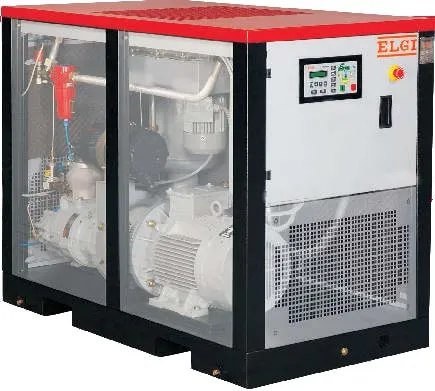
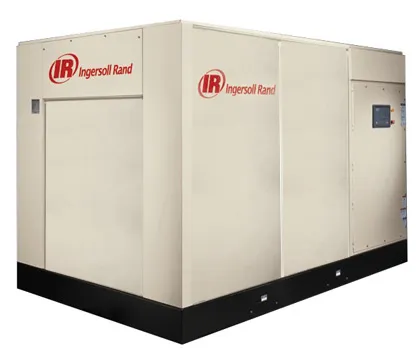
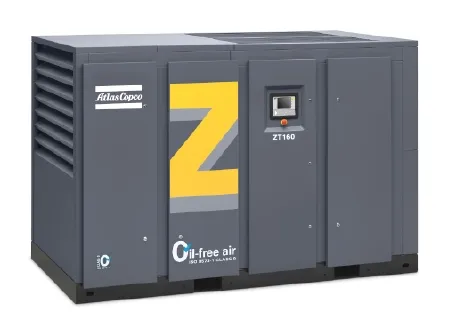
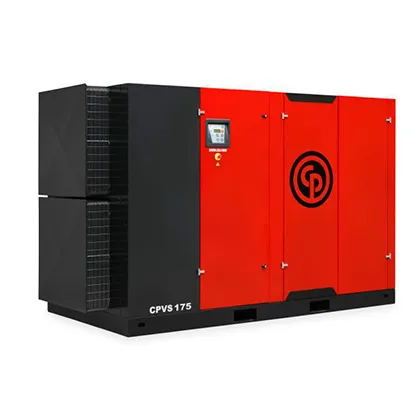
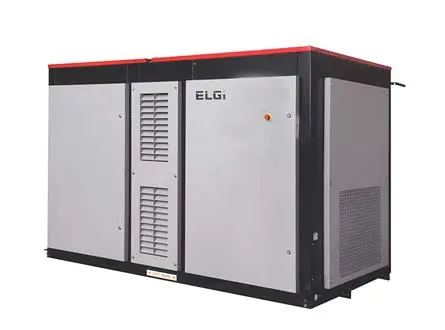
Representative images of machine types we sell, service and rent. Models and capacities are confirmed against your duty.
- HP / kW describes motor size.
- FAD describes usable compressor capacity.
- Pressure describes the condition at which that air is delivered.
All three must be read together. The first question is not "What motor size do you want?" but "What must the compressed air operate, and at what pressure?"
How does a rotary screw compressor work?
The heart of the machine is the airend: a male rotor with convex lobes and a female rotor with concave flutes, meshing inside a close-fitting casing. As the rotors turn, air enters the open pockets at the inlet end. The inlet port closes, the pocket is trapped, and as the rotors keep turning the meshing line moves along the rotors so the pocket shrinks and the air is compressed. When the pocket reaches the discharge port, the air leaves at full pressure. Many pockets are at different stages at once, so delivery is continuous rather than pulsed.
In an oil-injected machine, oil is sprayed into the airend. It seals the small clearances between rotors and casing, absorbs the heat of compression and lubricates the bearings. The air-oil mixture passes to a separator vessel, where most oil drops out by direction change and the rest is captured by a separator element. The oil returns through an oil cooler and oil filter, with a thermostatic valve holding the oil at the right temperature: hot enough to drive off moisture, cool enough to protect the oil. Normal discharge temperature is about 75–95 °C. The air then passes through an aftercooler and, usually, a moisture separator before the dryer.
Capacity is controlled at the inlet valve. In load/unload control the valve opens fully or closes; in modulation it throttles; in a VSD machine the motor speed changes so the airend delivers only what is needed. Minimum pressure valves, safety valves, blow-down valves and temperature and pressure sensors protect the package. See how rotary screw compression works.
Where do rotary screw compressors fit in Indian industry?
Rotary screw technology is a strong option where demand is regular or sustained and needs stable pressure, compact installation, automatic control and integration with dryers, receivers and filtration. As demand grows, the compressor stops being a standalone product and becomes part of the plant's utility infrastructure.
| Industry | Typical air use | What matters most |
|---|---|---|
| Automotive and auto components | Pneumatic tools, robots, clamping, paint shops | Stable pressure, dry air for painting, multi-machine sequencing |
| Pharmaceuticals and bulk drugs | Process and instrument air, packaging, tablet presses | Defined ISO 8573-1 class, often oil-free, low dew point |
| Textiles and spinning | Air-jet looms, splicers, pneumatic conveying | High continuous flow, energy cost, cooling in hot sheds |
| Food, beverage and PET | Packaging, blowing (with booster), product contact | Oil-free or high-grade filtration, hygiene |
| Steel, cement and power plants | Plant and instrument air, bag filters, conveying | Dust, heat, redundancy, round-the-clock duty |
| Engineering and CNC shops | Machine tools, blow-off, assembly | Right pressure, leakage control, compact packages |
| Plastics and packaging | Moulding machines, pick-and-place, wrapping | Variable demand, VSD suitability |
Being an industrial site does not by itself mean a rotary screw should replace a reciprocating compressor; the duty decides. Indian conditions add their own requirements: summer ambients of 40–45 °C in Telangana and Andhra Pradesh, and above 45 °C on open sites, dust in industrial estates, and voltage variation all affect cooler sizing, intake filtration and electrical protection.
What decides the selection?
A sound selection weighs flow, pressure, demand profile, operating hours, air quality, control, cooling, installation, reliability and lifecycle cost. No single parameter should drive the decision without context.
Airflow: Cfm and FAD
A cfm figure means little until its basis is known. Check whether airflow is quoted as FAD, the reference standard and test conditions, the operating pressure at which it is quoted and the inlet conditions assumed. Do not choose a machine because one catalogue shows a larger number. Comparing one maker's theoretical displacement with another's FAD is not like-for-like; every comparison needs a consistent basis.
Working pressure and the pressure stack
More pressure is not automatically better: every additional bar costs about 7% more power. Pressure is lost through aftercoolers, dryers, filters, separators, valves, piping, fittings, hoses and regulators, so compressor discharge pressure is not the same as point-of-use pressure.
| Required point-of-use pressure |
|---|
| + distribution loss |
| + treatment and component loss |
| + control allowance |
| = required compressor operating pressure |
The aim is to minimise avoidable losses, not to keep raising compressor pressure to compensate for poor distribution.
Air demand
A plant usually has base demand (continuous), intermittent demand, peak demand (the highest credible simultaneous requirement), leakage, future demand and diversity (the likelihood that all users run together). Adding up every user's maximum tends to oversize the compressor; ignoring simultaneity can undersize it. Do not automatically add "30% extra": large arbitrary margins lead to higher capital cost, long unloaded running, oversized electrics and poor part-load operation. Every margin should have a reason.
Minimum, average and peak demand
Medium and large systems should be sized around a measured or estimated profile: the lowest normal requirement, where the system runs most of the time, the highest credible peak, how long peaks last, what will be added later and what happens if a compressor becomes unavailable. The answers drive both machine sizing and system architecture.
Sizing worked example
This simplified example shows the method. The figures are illustrative, not a recommendation for any particular plant.
A component plant runs two shifts. Its users are a group of CNC machines needing about 60 cfm in total, assembly tools averaging about 90 cfm with realistic simultaneity, a paint booth using about 40 cfm while spraying, and blow-off and miscellaneous users of about 30 cfm. Leakage on the existing network, measured with the plant idle, is about 40 cfm.
- Average demand: 60 + 90 + 40 + 30 + 40 = about 260 cfm FAD.
- Peak: if the paint booth and a cluster of tools coincide for a few minutes, demand may reach about 320 cfm. A receiver can absorb short peaks; longer peaks need compressor capacity.
- Pressure: the most demanding tool needs 6.0 bar. Allow about 0.3 bar for distribution, about 0.4 bar for dryer and filters, and a control band of about 0.5 bar. Required operating pressure is about 7.2 bar, so a 7.5 bar machine is suitable; a 10 bar machine set to 10 bar would waste power on every hour of running.
- Leakage first: fixing a good part of the 40 cfm leakage reduces the size of compressor needed, permanently.
- Control: demand varies between about 200 and 320 cfm across the shift and drops sharply at breaks. That profile suits a VSD screw, or a fixed-speed base machine plus a smaller VSD trim if redundancy is wanted.
- Check FAD at the actual pressure from the manufacturer's data for each model offered, then compare specific power on the same basis.
The result is a machine chosen for about 300–330 cfm FAD at 7.5 bar with appropriate control, rather than "a 75 HP compressor". See the rotary screw selection guide for more detail.
Configurations: Control, lubrication, drive, stages and cooling
Fixed speed or VSD?
The answer lies in the demand profile. Fixed speed fits relatively stable demand, predictable hours, a machine that spends most of its time productively loaded, and properly designed storage and sequencing. It is not inherently inefficient. A VSD adjusts speed within its design envelope and adds value where demand varies significantly or between shifts, where the existing compressor runs unloaded for long periods, where pressure fluctuates, or where a trim machine is needed. Never choose a VSD only because a brochure calls it "energy saving"; actual savings depend on the real load profile. In larger installations, base-load compressors cover the predictable demand and trim capacity follows the variation. See fixed-speed screws, VSD screws and permanent-magnet motor screws.
Oil-injected or oil-free?
In oil-injected designs, the lubricant cools, seals and lubricates the compression element; these machines serve most general industrial systems. Oil-free screw compression is a separate technology decision justified by the process or its air-quality requirement, not because "oil-free" sounds superior. Define contamination sensitivity, the ISO 8573-1 class, point-of-use condition, drying, filtration and monitoring first. The compressor is only one link in the air-quality chain.
Drive arrangement
Screws use belt drive, direct drive or gear drive. No arrangement is universally superior. The choice weighs efficiency, serviceability, speed matching, maintenance and lifecycle cost, and the data for the actual model should decide it.
Single-stage and two-stage compression
The number of stages depends on manufacturer, pressure, capacity and application. More stages do not automatically mean a better machine. Compare pressure, FAD, specific power, turndown, cooling, maintenance and lifecycle cost. See single-stage and two-stage screws, and the pressure classes: low, medium and high pressure.
Air-cooled and water-cooled
Cooling matters more as size and hours increase. Air-cooled systems need cool supply air, a route for hot-air discharge, protection against recirculation, clean coolers and adequate ventilation. Water-cooled systems also need attention to water quality, inlet temperature, flow, scaling and fouling. The compressor room is part of the operating system, not just the space around it.
A coordinated machine
The compressor is much more than its airend. Intake filtration, inlet valve, airend, drive, motor, lubrication circuit, separator, aftercooler, oil cooler, fan or water circuit, controls, sensors, electrical protection and enclosure all work together. Reliability depends on all of them, which is why maintenance cannot focus on the compression element alone. Packaged options include tank-mounted screws and integrated compressor and dryer packages.
Small, medium and large systems
Small systems: small does not mean simple. A compact installation can support production-critical equipment and still needs decisions on receiver, dryer, filtration, condensate, electrical supply, ventilation, piping and access. See small industrial screws.
Medium systems: compressed air becomes plant infrastructure serving production machinery, automated lines, instrument air, conveying and several departments. The decision affects production capacity, energy, pressure stability, maintenance and redundancy. See medium industrial screws.
Large systems: you are designing a utility, not choosing a catalogue model: demand measurement, multiple compressors, base/trim strategy, central controls, treatment, receivers, cooling, electrics, condensate, distribution, monitoring and expansion. Scale magnifies poor engineering; a small inefficiency repeated across high flow and thousands of hours becomes a material cost. See large industrial screws and heat recovery, which can turn much of the compressor's input energy into useful hot water.
One large machine or several?
A single compressor keeps the system simple. Several machines offer redundancy, maintenance flexibility, closer demand matching and staged expansion, but need disciplined control. Poorly coordinated pressure bands make machines load and unload against each other. See controls and sequencing.
Redundancy
Production-critical air needs an explicit plan. Can production tolerate reduced capacity? Is standby capacity required, or is temporary rental air acceptable? Can maintenance be done without a full shutdown? How long can the plant run without one machine? Answering these before purchase is far cheaper than discovering them during a breakdown.
Treatment, storage, distribution and the compressor room
- Air treatment: aftercooling, moisture separation, drying, filtration and condensate management should follow the air quality required at the point of use, not a standard "compressor, dryer and two filters" package. A refrigerated dryer typically gives a pressure dew point of about +3 °C; desiccant dryers reach about −20 °C or −40 °C where needed.
- Receiver: supports control stability, absorbs short peaks and reduces cycling. It does not create continuous capacity. Every receiver should have a defined purpose.
- Distribution: a correctly sized compressor can look inadequate behind restrictive pipework. Fix the restriction rather than raising discharge pressure.
- Compressor room: plan ventilation and heat rejection, electrical supply, foundation, service access, drainage and expansion. A good compressor in a poor room becomes an unreliable system.
- Energy: the best compressor is not the one with the highest FAD, lowest kW or "VSD" on the nameplate. Compare specific power at your pressure, control range, cooling, maintenance access and lifecycle cost.
Maintenance and common faults
A rotary screw compressor is a maintenance asset for its whole working life. Planned attention goes to intake filters, oil and oil filters, separator elements, coolers, drive belts or couplings, thermostatic and minimum pressure valves, controls and electrics. Common faults we see in the field include:
- High discharge temperature trips, usually from blocked coolers, hot-air recirculation, low oil level, a failed thermostatic valve or the wrong oil.
- Oil carry-over from a saturated separator element, blocked scavenge line or overfilled sump.
- Low pressure at the point of use, often caused by leakage, blocked filters or undersized pipes rather than the compressor.
- Frequent load/unload cycling from too small a receiver, a narrow pressure band or several machines fighting each other.
- Rising power for the same air as airend wear, dirty filters or excess pressure set-points build up.
Detailed service guidance is in rotary screw service and lifecycle engineering, preventive maintenance and breakdown diagnostics.
Rotary screw or reciprocating?
Neither technology wins every application. Rotary screw is worth evaluating when demand is sustained, annual hours are high, plant air supports continuous production, stable pressure matters or multi-machine control may help. Reciprocating compressors remain a good choice for more intermittent duties. Decide on the actual operating profile and lifecycle economics. See rotary screw vs reciprocating and stationary vs portable screws.
How Reddy Compressors helps
Manufacturers differ in airends, controls, drives, cooling, service intervals and configurations, so final selection must confirm the manufacturer, model, FAD, pressure, power, control, cooling, drive, dimensions, options and availability. Never infer a specification from another model in the same family.
Reddy Compressors, serving industry since 2002 from Tarnaka, Secunderabad, is an independent multi-brand specialist, not an authorised dealer. We sell, rent and service rotary screw compressors from ELGi, Atlas Copco, Ingersoll Rand, KAESER, Chicago Pneumatic and others:
- Selection and supply: new screw compressors, VSD and fixed speed, oil-injected and oil-free, with dryers, filters and receivers; used or refurbished machines where their history supports it.
- Rental: temporary air for breakdowns, shutdowns and projects through our temporary air engineering centre, from our own fleet.
- Service: more than 20 service engineers and technicians covering Telangana and Andhra Pradesh, for preventive maintenance, AMC, diagnostics, airend overhaul, controls and cooling.
- Spares: filters, separators, oils, valves and airend parts identified from the nameplate and confirmed before quoting, supplied across India.
Call +91 99590 60718 or +91 92468 88812, or email reddycompressors@gmail.com.
What to send us
- Required flow (cfm/FAD) and pressure at the critical point of use
- Application and operating hours per day
- Minimum, average and peak demand, if known
- Existing compressor details with a nameplate photo
- Electrical supply and air-treatment requirement
- Receiver, compressor room and ventilation details
- Planned expansion and site location
Don't have these figures? Tell us what the compressed air must operate. That is enough to start the engineering conversation.
Frequently asked questions
How does a rotary screw air compressor work?
Two meshing helical rotors trap air in pockets at the inlet end. As the rotors turn, the pockets move towards the discharge end and shrink, compressing the air continuously. In oil-injected machines, oil seals the clearances, removes heat and lubricates the bearings, and a separator then removes it from the air. An inlet valve or variable-speed drive matches output to demand.
How do I calculate the right size of screw compressor?
Add the free air delivery consumed by your users, allowing for realistic simultaneous use rather than every maximum, then add measured leakage. Work out the pressure needed at the most demanding point of use and add distribution, treatment and control losses. Compare models on FAD at that pressure from the manufacturer's data. Avoid arbitrary margins such as 30% extra; every margin should have a reason.
Is a VSD screw compressor worth it?
A VSD is worth it when demand varies materially, differs between shifts, or the existing machine spends long periods unloaded. It also works well as the trim machine alongside fixed-speed base-load compressors. Where demand is steady and the machine runs fully loaded most of the time, a fixed-speed compressor can be just as suitable. Savings depend on the real load profile, so measure or estimate it first.
What is the normal operating temperature of a screw compressor?
For an oil-injected rotary screw, normal discharge temperature is typically about 75–95 °C. Much higher temperatures usually point to blocked coolers, hot-air recirculation in the compressor room, low oil level, a faulty thermostatic valve or the wrong oil. Indian summer ambients make ventilation and clean coolers especially important, because high discharge temperature is one of the most common causes of trips.
Do I need an oil-free screw compressor?
Only if your process or air-quality class genuinely requires it, typically where air contacts pharmaceutical, food or electronic products. Many industrial users reach their required ISO 8573-1 class with an oil-injected screw plus the right dryer and filtration. Define the contamination sensitivity and point-of-use requirement first, then decide. Oil-free machines still need drying and filtration, because intake air carries moisture and hydrocarbons.
How often should a rotary screw compressor be serviced?
Intervals depend on the manufacturer, oil type, operating hours, ambient temperature and dust. Follow the maker's schedule for filters, oil and separator, and shorten it in hot or dusty conditions. On our hire machines in heavy duty we change oil and service every 300 running hours. A preventive maintenance plan or AMC keeps intervals on track and catches problems before they stop production.
Can I replace my old screw compressor with the same size?
You can, but it is worth checking first. Demand, leakage and pressure may have changed since the original machine was chosen, and an old compressor may have been oversized or set at too high a pressure. Reviewing running and loaded hours, pressure needs and leakage often shows that a different size, a VSD or better sequencing would serve the plant more efficiently.
Related pages
Technical content reviewed by D. Srinivas Reddy, Managing Partner and service engineer, Reddy Compressors. Last updated 17 October 2026. How our engineering content is reviewed.