
What is an integrated compressor and dryer?
In a standard installation, the compressor, receiver, dryer and filters are separate items connected by pipework. In an integrated package, the manufacturer fits the dryer inside or onto the compressor enclosure, sized and wired to run with it. Some packages also include filters and are mounted on a receiver, giving an almost complete compressed-air system on one base.
Most integrated dryers are refrigerated, giving a pressure dew point (PDP) of about +3 °C. Some manufacturers offer integrated desiccant dryers for drier air, typically −20 °C or −40 °C PDP. The exact dryer type, PDP and capacity depend on the model and must be read from its data sheet.
Why choose an integrated package?
- Less floor space. One footprint instead of two or three separate items.
- Simpler installation. Fewer pipe connections, one power supply on many models and a single foundation.
- Matched sizing. The dryer is sized by the manufacturer for that compressor’s FAD.
- One controller. Many packages show dryer status and alarms on the compressor controller.
- Faster commissioning. Useful for small plants, workshops and new production lines.
Across brands
Models we supply and service
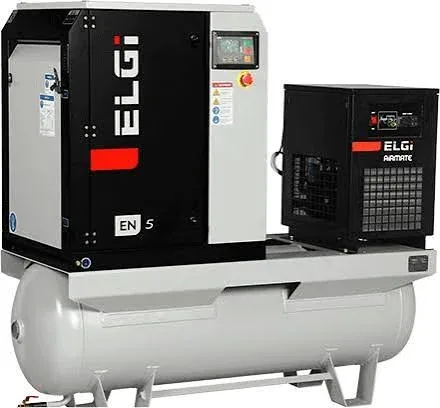
Manufacturer product images, shown to identify machines we sell, service and support. Brand names are trademarks of their owners.
Integrated package or separate dryer?
| Factor | Integrated package | Separate dryer |
|---|---|---|
| Space | Smallest footprint | More floor space and pipework |
| Installation | Quick, fewer connections | More work, but flexible layout |
| Dryer sizing | Matched to one compressor | Can be sized for several compressors or future growth |
| Redundancy | If the package stops, air and drying stop together | Dryer can serve a standby compressor |
| Dryer choice | Limited to the manufacturer’s options | Any type, PDP and brand |
| Heat and ventilation | Dryer heat adds to the enclosure and room heat | Dryer can be placed in a cooler location |
| Service | One visit covers both | Separate access, but each can be serviced independently |
| Best suited to | Single-compressor sites, small and medium plants | Multi-compressor plants, critical air, strict air quality |
Start with the air quality the process needs
Choose the dryer from the process requirement, not because one comes with the compressor. Work through these steps:
- List each air user and its air-quality need, using ISO 8573-1 classes for particles, water and oil.
- Set the PDP needed. Refrigerated (+3 °C) suits most general plant air where pipes stay above that temperature. Desiccant (−20 °C or −40 °C) is for instruments in cold areas, outdoor lines, some pharma and food duties, and processes sensitive to moisture.
- Decide on filtration: general-purpose, fine coalescing, activated carbon or sterile filters at the point of use.
- Check whether the integrated dryer can deliver that PDP at your FAD and pressure.
- Check that the dryer is rated for your highest inlet and ambient temperatures.
- Plan condensate drains and condensate treatment for oil-injected compressors.
Compressing air does not clean it. Atmospheric air contains water vapour and dust, and an oil-injected compressor adds traces of oil. The dryer removes water vapour; filters remove particles and oil aerosols. Both are needed for most process air.
Why rating conditions matter in Indian summers
Refrigerated dryer capacity is quoted at reference conditions, often 35 °C inlet temperature and 25 °C ambient, though this varies by manufacturer. In an Indian compressor room in May, ambient can be 45 °C or more, and air leaving the aftercooler is hotter still. Under these conditions, a dryer can lose much of its rated capacity and the PDP rises.
- Ask for the dryer’s correction factors for inlet temperature, ambient temperature and pressure.
- Check that the package is rated for your maximum ambient, often called high-ambient or tropical versions.
- Ventilate the room so the package draws cool air and its hot discharge air is ducted outside.
- Keep the dryer condenser and compressor coolers clean; dust is the most common cause of high dew point.
Water in the air lines in summer is usually a sign that the dryer is overloaded or running in conditions beyond its rating, not that it is broken.
Pressure loss, receivers and drains
Pressure loss. Every dryer and filter takes some pressure. Clogged filters take more. Since each extra bar costs about 7% more power, a high pressure drop forces the compressor to run at a higher set pressure. Change filters on schedule and check the pressure drop across the dryer and filters.
Receivers. An integrated package on a receiver helps with small systems, but a receiver’s size should be based on demand and control mode, not just what fits the package. Many plants also need a receiver downstream to buffer demand peaks.
Drains. The package will have drains on the moisture separator, dryer and filters. A failed drain floods the dryer and sends water into the lines.
Common problems with integrated packages
| Symptom | Possible causes | What we check |
|---|---|---|
| Water in air lines | Dryer overloaded, high ambient, dirty condenser, failed drain, dryer bypassed | Inlet and ambient temperatures, condenser, drains, bypass valve, PDP |
| Dryer tripping | High refrigerant pressure from dirty condenser or hot room, low refrigerant | Condenser, ventilation, refrigerant pressures |
| High pressure drop | Clogged filters, frozen evaporator, undersized dryer | Filter differential, dryer operation, sizing |
| Compressor running hot | Dryer heat adding to enclosure heat, blocked coolers, poor room ventilation | Coolers, ducting, room temperature |
| Oil in air | Separator element, scavenge line, missing or saturated filters | Separator, scavenge, filter condition |
Where integrated packages fit in Indian industry
Integrated packages are common where one compressor serves the whole site and the air quality needed is general plant air with a refrigerated dew point. Typical examples include:
- Engineering workshops, fabrication shops and machine shops running pneumatic tools and CNC machines.
- Automobile service centres and tyre shops.
- Packaging, printing and plastics units with modest air demand.
- Small food, garment and textile units, with suitable filtration added for the product-contact air.
- New production lines in industrial estates where floor space is tight and quick commissioning matters.
Larger pharmaceutical plants in and around Genome Valley, and bulk drug and formulation units across Telangana and Andhra Pradesh, more often use separate dryers. Their air systems usually have several compressors, standby equipment and validated air quality, so a dryer that can serve any running compressor is easier to justify.
Sizing checks before you buy
- Measure or estimate actual demand, including peaks, rather than copying the old compressor’s rating.
- Confirm the package FAD at your working pressure.
- Confirm the dryer’s rated flow at the same pressure and at your highest inlet and ambient temperatures.
- Check the total pressure drop across dryer and filters at full flow.
- Confirm electrical supply, cooling air and space for service access on all sides the manufacturer requires.
- Plan where future growth will come from: a second compressor will need either its own dryer or a shared separate one.
Service and maintenance
Service the compressor and dryer together:
- Compressor oil, oil filter, separator and air filter at the manufacturer’s intervals.
- Clean the dryer condenser and compressor coolers, more often in dusty sites.
- Test every drain and clean strainers.
- Change filter elements and record pressure drop.
- Measure PDP and compare it with the dryer’s rating.
- Check refrigerant pressures and the dryer’s control and alarms.
How Reddy Compressors helps
Reddy Compressors, at Tarnaka, Secunderabad, is an independent multi-brand specialist serving industry since 2002, not an authorised dealer of any brand. We have tie-ups with all major and reputed brands. For integrated compressor and dryer packages, we:
- Help you decide between an integrated package and a separate dryer, based on air quality, layout and redundancy.
- Sell new and used/refurbished packages from ELGi, Atlas Copco, Ingersoll Rand, KAESER, Chicago Pneumatic and other brands.
- Rent compressors and dryers from our own fleet when you need temporary air or cover during repairs.
- Service and repair compressors and dryers, on call or under AMC, through more than 20 service engineers and technicians across Telangana and Andhra Pradesh.
- Supply compressor and dryer spares identified from the nameplate, across India.
What to send us
- The air uses and the air quality or PDP needed.
- Required FAD and working pressure.
- Highest summer ambient in the compressor room and room layout photos.
- For an existing package: make, model, serial number and nameplate photo.
- Symptoms, such as water in lines, trips or high pressure drop.
Frequently asked questions
Is a compressor with a built-in dryer a good idea?
For a small or medium plant with one compressor and general air-quality needs, an integrated package is often a good choice: it saves space and installation work and the dryer is matched to the compressor. For plants with several compressors, strict air-quality requirements or a need for standby, a separate dryer usually gives more flexibility and better redundancy.
What dew point does an integrated dryer give?
Most integrated dryers are refrigerated and give a pressure dew point of about +3 °C under their rating conditions. Some packages offer desiccant dryers giving −20 °C or −40 °C. In hot Indian summers, a refrigerated dryer running beyond its rated inlet or ambient temperature will give a higher dew point, so check the correction factors for your conditions.
Why is there water in my air lines even with a built-in dryer?
Common causes are a dryer overloaded by hot inlet air or high room temperature, a dirty condenser, a failed drain, an open bypass valve, or pipework running colder than the dryer’s dew point. Check the drains first, then clean the condenser and improve ventilation. If the problem continues, measure the dew point and the dryer’s inlet and ambient temperatures.
Do I still need filters with an integrated dryer?
Usually yes. A dryer removes water vapour, but not oil aerosols or fine particles. Most process air needs at least a general-purpose filter before or after the dryer and a fine coalescing filter after it. Food, pharma and instrument air may also need activated carbon or sterile filters, chosen to meet the ISO 8573-1 class the process needs.
Can I add a dryer to my existing screw compressor package?
Yes. A separate dryer can be added downstream of any compressor, and sometimes a manufacturer’s integrated dryer kit can be fitted to an existing package. A separate dryer is often more practical, because it can be sized for your demand and placed in a cooler location. We check your FAD, pressure and air-quality needs first.
Who services integrated compressor dryer packages in Hyderabad?
Reddy Compressors, at Tarnaka in Secunderabad, services compressors and dryers of many brands as an independent multi-brand specialist. Our service teams cover Hyderabad, the rest of Telangana and Andhra Pradesh, and we supply spares across India. Call +91 99590 60718 or +91 92468 88812 with your package details and symptoms.
Related pages
Calculators and worked examples
These tools give indicative figures for screening, comparison and for preparing an enquiry. They run in your browser and send nothing. No prices or tariffs are assumed: enter your own to see costs. Efficiencies and other figures shown are example values: replace them with your own. Results are not a performance guarantee or a design certificate; final selection is confirmed by a service engineer against the machine data sheet and the site.
Dryer capacity correction
Apply one dryer model’s published correction factors to its rated capacity, find the margin against your design flow, and the minimum rated capacity that would meet it.
The worked example below shows the method with fixed numbers. Turn on JavaScript to change the inputs.
Worked example
Inputs
- Design flow (m³/min FAD): 15
- Rated capacity of the candidate dryer (m³/min): 17
- Pressure correction factor (from the data sheet): 0.96
- Inlet temperature correction factor: 0.72
- Ambient or cooling-water correction factor: 0.84
- Dew point correction factor (1 if not published): 1
- Margin you want to keep (%): 10
Result
- Product of factors: 0.581
- Corrected capacity: 9.87 m³/min (349 cfm)
- Margin against design flow: -34.2 %
- Assessment: Undersized at these conditions
- Minimum rated capacity (no margin): 25.83 m³/min
- Minimum rated capacity with your margin: 28.42 m³/min: choose the next catalogue size at or above this
- Condition reducing capacity most: Inlet temperature factor 0.72
Method. Corrected capacity = rated capacity × F(pressure) × F(inlet temperature) × F(ambient) × F(dew point). Margin (%) = (corrected capacity − design flow) ÷ design flow × 100. Required rated capacity = design flow ÷ product of factors (× (1 + your margin) if you keep one); choose the next catalogue size at or above it. Use the factors for the exact model and revision from its data sheet; enter 1 for a factor the maker does not publish. If the maker publishes a combined chart instead, enter its single factor and 1 for the rest.
What to take from it. A dryer that looks comfortably sized at rating conditions can be heavily overloaded on a summer afternoon. Recalculate after any change in pressure, inlet temperature, location or demand.
Technical content reviewed by D. Srinivas Reddy, Managing Partner and service engineer, Reddy Compressors. Last updated 17 October 2026. How our engineering content is reviewed.