
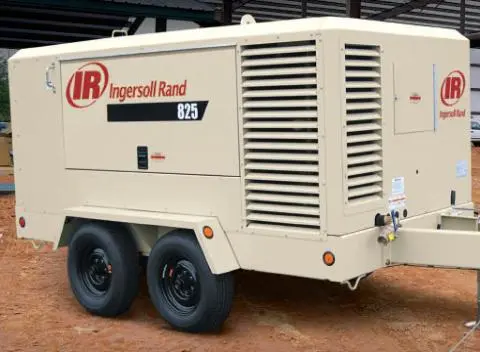
This page is our complete guide to the class. It explains how the machine works, how to pick the size and pressure, what to check before you buy or hire, how to set one up on site, how to keep it running through an Indian summer, and what goes wrong. Detailed pages for each size band and pressure class are linked throughout.
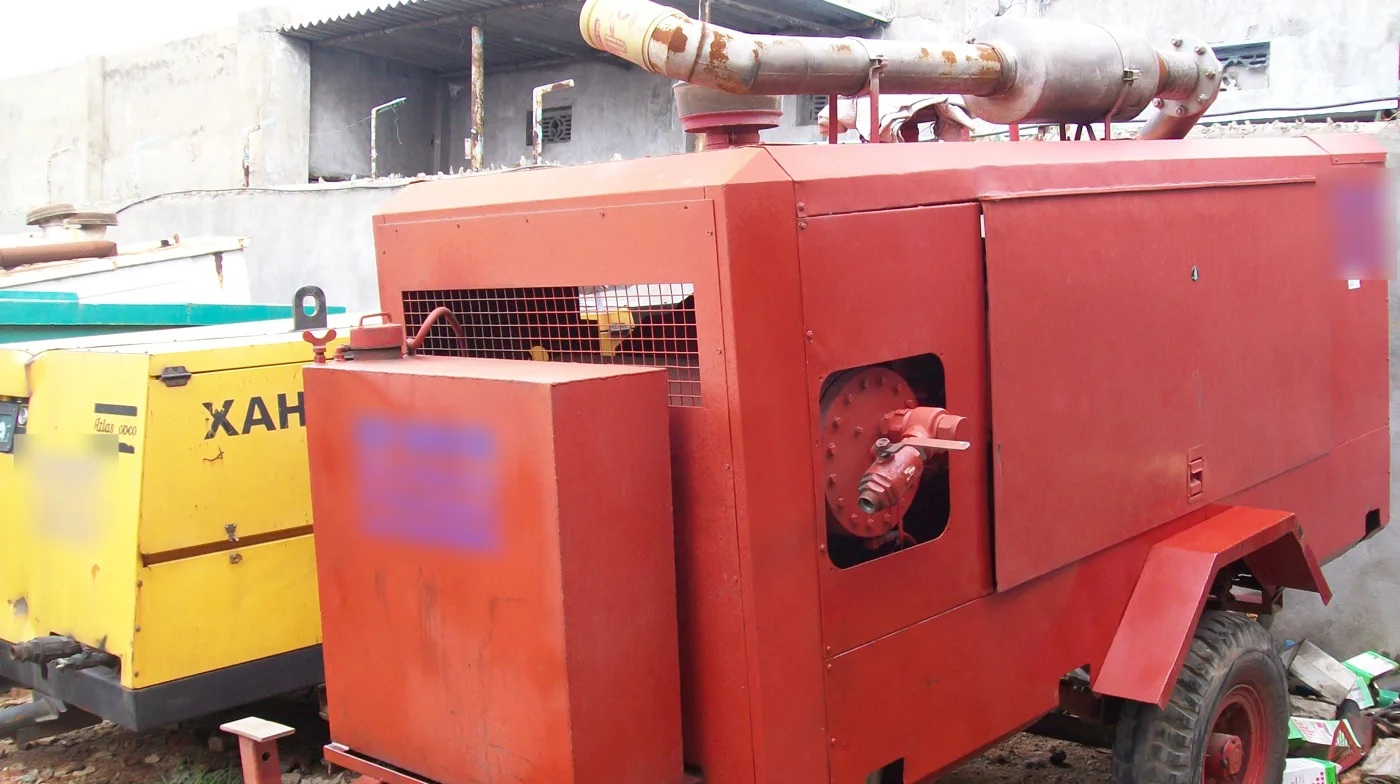
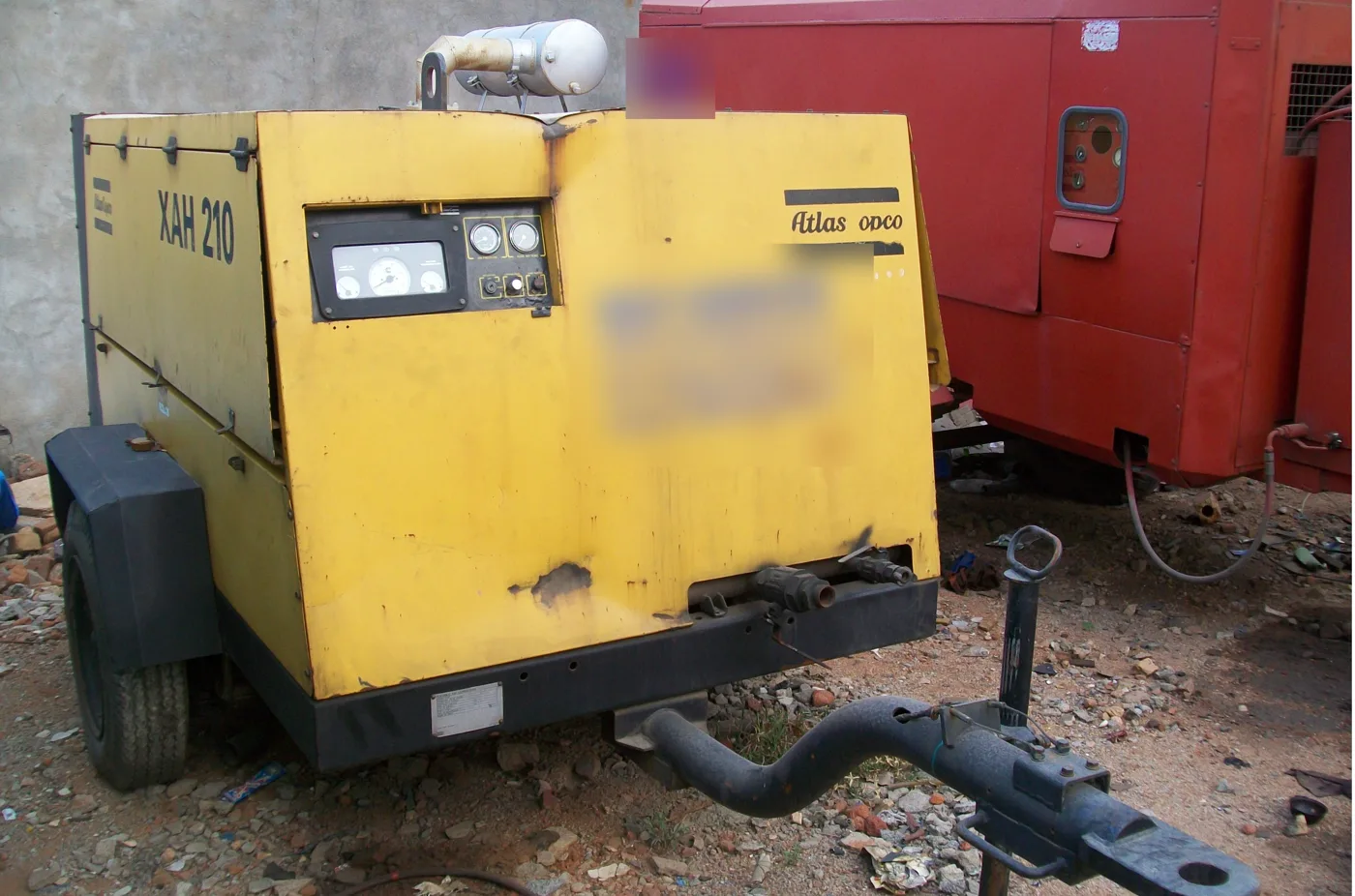
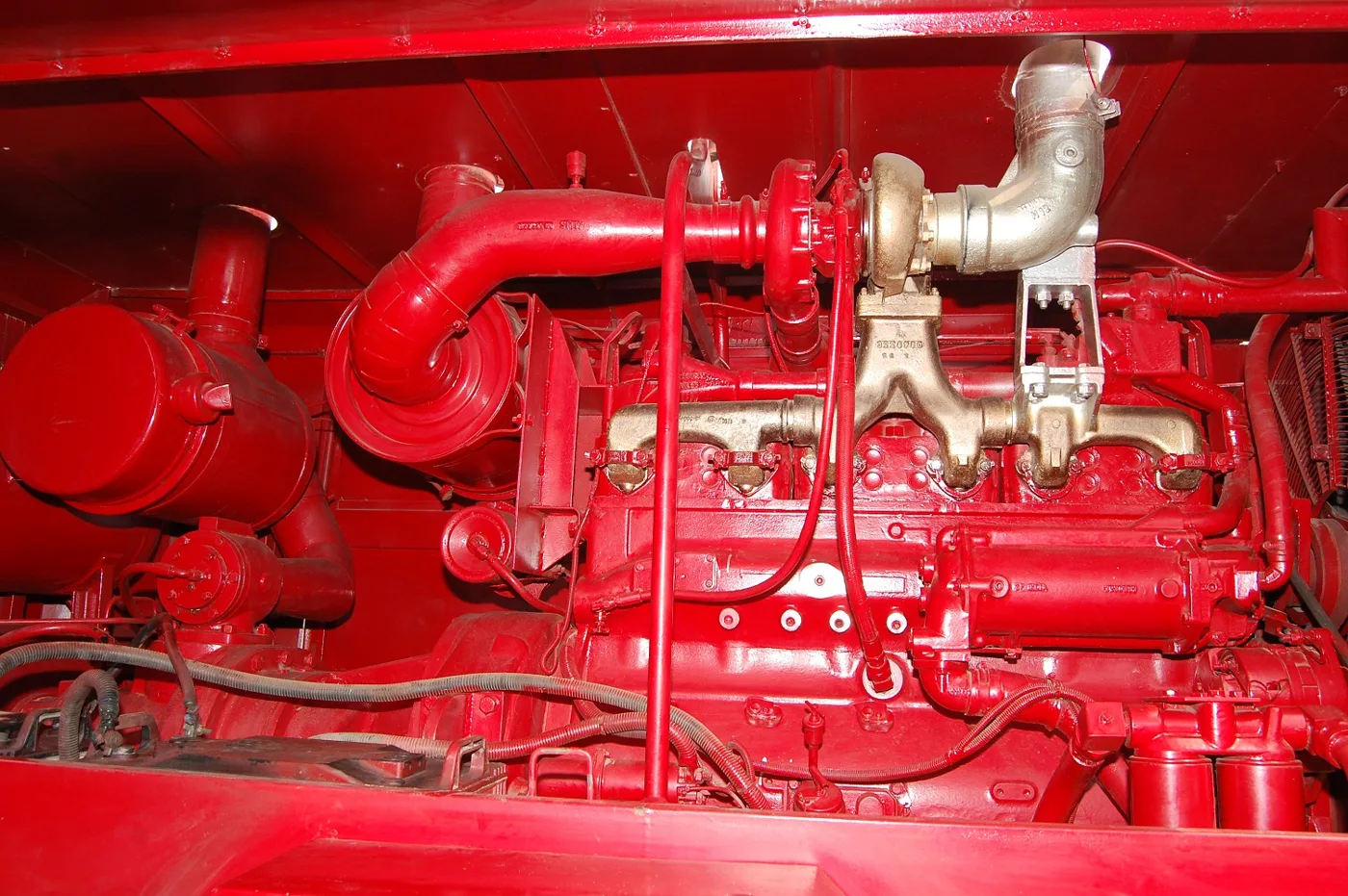
Photographs from Reddy Compressors’ own fleet and workshop.
How does a portable diesel compressor work?
Every diesel portable, whatever the badge on the canopy, is built from four systems that must be matched to each other. Understanding them makes it much easier to compare offers and diagnose problems.
The engine
A water-cooled diesel engine drives the airend directly, usually through a flexible coupling or a gearbox. The engine is sized for the air package at its rated pressure, with margin for high ambient temperature. A machine built for 10 bar normally carries a larger engine than a 7 bar machine of the same flow, because every extra bar of pressure needs more shaft power – roughly 7% more per bar as a rule of thumb. Engine condition (compression, injectors, air filtration, cooling) therefore sets the ceiling on what the airend can deliver.
The airend
Almost all modern portables in this range use a single-stage, oil-injected rotary screw airend. Two meshing rotors trap air and reduce its volume continuously. Oil is injected to seal the rotor clearances, lubricate the bearings and carry away the heat of compression. The air–oil mixture leaves the airend at a typical discharge temperature of about 75–95 °C and passes into the separator tank, where most oil drops out; a separator element removes the remaining mist before air leaves through the minimum-pressure valve to the service valves.
The cooling system
One cooling package handles three loads: engine coolant (radiator), compressor oil (oil cooler) and, on many machines, the compressed air itself (aftercooler). The coolers are usually stacked in a cool-box: a canopy design in which a single fan draws ambient air in through the sides and pushes it across the coolers and out of the top or rear. Cool-box design and core cleanliness decide whether a machine survives 40–45 °C afternoons, and hotter on open sites, without tripping.
The control system
Air demand on site changes constantly. The control system matches output to demand by modulating the intake (inlet) valve and dropping engine speed. As pressure rises towards the set point, the inlet valve closes progressively and the engine slows; when demand stops, the machine unloads and idles at low speed with the separator blown down to a lower pressure. Newer machines use electronic controllers that also manage start-up warm-up, display hours and fault codes, and may allow the working pressure to be selected within a range. Older machines use a pneumatic regulator and a speed-control cylinder; both work well when correctly adjusted.
For the detailed workings of each system see our pages on portable compressor controls, portable compressor cooling and portable compressor fuel systems.
The three size classes from 185 to 600 cfm
Flow is stated as free air delivery (FAD) – the volume of air drawn in at ambient conditions, in cubic feet per minute (cfm) or m³/min (1 m³/min ≈ 35.3 cfm). The range divides naturally into three classes. The boundaries are not rigid, but they match how tools, hoses and jobs group in practice.
| Class | Flow (FAD) | Typical pressure | Typical jobs | Tools usually supported |
|---|---|---|---|---|
| 185–250 cfm | ≈ 5.2–7.1 m³/min | 7 bar (101.5 psig); some 10 bar (145 psig) | Road and building repair, pipe and cable trenching, small fabrication sites, maintenance crews, small-scale blasting | 1–2 medium breakers, a small rock drill, one small blasting nozzle, grinders and impact wrenches |
| 250–400 cfm | ≈ 7.1–11.3 m³/min | 7–10 bar (101.5–145 psig) | General construction, plant maintenance and shutdowns, painting and coating contractors, standby plant air | 2–4 breakers, rock drills, one No. 5–6 blasting nozzle, multiple hand tools |
| 400–600 cfm | ≈ 11.3–17 m³/min | 7–14 bar (101.5–203.1 psig); some higher-pressure variants | Quarry and crawler drilling, large blasting jobs, pipeline testing and drying support, shutdown or standby plant air | Crawler drills, two No. 5 blasting nozzles, large manifolds feeding several crews |
Two points matter more than the table. First, a 185–250 cfm machine is not a borewell or DTH drilling compressor, even in soft ground; DTH work needs far higher flow and pressure, covered on our borewell compressor rentals and hire page. Second, the class is chosen from the sum of tools running together, not from the biggest single tool.
How to size the flow
- List every air tool or process, with the consumption the tool maker states at its working pressure.
- Decide which tools genuinely run at the same time, and for how long.
- Add those consumptions. Allow for tool wear and hose leakage – worn breakers and rock drills use noticeably more air than new ones.
- Add margin for site altitude and heat if the machine will run near its limits.
- Choose the class whose rated FAD at your working pressure covers the result, not the class whose maximum FAD does.
Our rule on this is simple: stop buying by cfm alone. Flow without its pressure, temperature and duty pattern tells you very little.
7, 10 or 14 bar: choosing the pressure
Most pneumatic hand tools – breakers, rock drills, grinders – are designed to work at about 6–6.5 bar at the tool. A 7 bar (101.5 psig) machine supplies them with a reasonable allowance for hose loss. Higher pressure is not “better air”; it costs fuel and engine power, and running a tool above its rating shortens its life.
| Pressure class | psig | Where it fits | What to watch |
|---|---|---|---|
| 7 bar | 100 | Breakers, rock drills, general construction tools, short hose runs | Pressure loss on long or undersized hoses; tools starving at the end of the line |
| 10 bar | 145 | Abrasive blasting (higher nozzle pressure means faster cleaning), long hose runs, pneumatic drilling with higher-pressure hammers | Less flow than a 7 bar machine on a similar engine; hoses and fittings must be rated |
| 14 bar | 203 | Quarry and crawler drilling, pipeline testing and drying, specialised hammers | Larger engine and higher fuel use; only worthwhile when the equipment actually needs it |
Many current machines allow the working pressure to be selected within a band. That is useful on hire fleets, but check the flow at each setting: as pressure is raised, available flow normally falls. For higher pressures see our high-pressure portable compressors page.
What to check when buying – new or used
We supply new machines from the major brands and used or reconditioned machines that we have inspected. In either case, these are the points to confirm before an order.
For a new machine
- Rated FAD at your working pressure, with the reference conditions stated.
- The maximum ambient temperature the package is rated for, and whether a high-ambient version exists.
- Engine make and model, and local availability of engine filters, belts and injectors.
- Air treatment fitted: aftercooler, moisture separator, filtration – or what must be added.
- Chassis type: road-tow with brakes and lights, site-tow, or skid for fixed or truck-mounted installation.
- Fuel tank size and the run time it represents on your duty, from the maker’s data.
- Controller features: hour meter, fault display, pressure selection, shutdown protection.
For a used machine
- Verified running hours, and whether the hour meter has ever been replaced.
- Airend condition: noise, bearing play, discharge temperature on load, oil carry-over.
- Engine condition: cold start, smoke, blow-by, oil pressure when hot, coolant leaks.
- Cooler cores: blocked or patched cores cause summer trips.
- Safety shutdowns tested, not just present.
- Pressure vessel (separator tank) condition and safety valve.
- A load test at rated pressure long enough to reach stable temperatures.
Our used compressor technical due diligence page explains each check in more detail, and current stock is on used compressors for sale.
Rent, buy new or buy used?
The right answer depends on running hours, job duration and how well you can maintain the machine yourself.
| Option | Best when | Main trade-off |
|---|---|---|
| Rent | Short or uncertain jobs, peaks, breakdown cover, a size you rarely need, or when you want maintenance and operators included | Highest cost per hour over a long period |
| Buy new | High annual hours over several years, long-term projects, need for the latest controls and full manufacturer support | Capital cost; you carry service and idle time |
| Buy used | Regular but moderate use, tight budgets, an in-house maintenance team | Condition varies; inspection and reconditioning matter more than price |
A useful test: if you would keep a machine busy for most of the year for several years, ownership usually makes sense; if it would sit idle between jobs, rent. Our rental versus ownership calculator sets out the comparison, and temporary air engineering covers what our rentals include.
Setting up a diesel portable on site
Towing and positioning
- Check the hitch type and height match the towing vehicle; check tyres, wheel nuts, brakes and lights before moving on public roads.
- Never tow with the machine running or with hoses attached.
- Park on firm, level ground; chock the wheels and lower the jockey wheel or prop stand.
- Keep the machine level. A tilted machine can mislead oil-level and coolant checks and starve the engine sump or separator.
- Leave clear space around the canopy so the cool-box can draw and discharge air freely, and turn the exhaust and cooling discharge away from people, other machines and walls.
Hoses and connections
- Size the hose for the flow and length: an undersized hose can lose a bar or more before air reaches the tool.
- Use hoses and couplings rated above the machine’s maximum pressure, with whip checks (safety cables) on every joint.
- Open service valves only after the hose is connected and secured, and close them and vent the hose before disconnecting.
- Use a manifold when feeding several tools, rather than long chains of couplings.
Aftercooler and moisture separator
Air leaving the separator tank is hot and saturated. As it cools in the hose, water condenses. For breakers this is a nuisance; for abrasive blasting and painting it is a defect – wet air causes clogged abrasive, flash rust and poor coating adhesion. An aftercooler followed by a moisture separator (with filtration where needed) removes most of the liquid water. See portable aftercoolers and portable moisture separators.
Fuel
- Use clean diesel to the engine maker’s specification, from a dedicated container or bowser.
- Refuel with the engine stopped, away from hot exhaust parts, and do not run the tank dry – air in the fuel system means bleeding and lost time.
- Drain water from the fuel pre-filter daily; site diesel stored in drums often carries water and sediment.
- Fuel use rises with load and pressure. Typical litres per hour depends on load, so plan from the maker’s data and your own logs rather than a single headline figure.
Running in high ambient heat and dust
Telangana and Andhra Pradesh summers regularly reach 40–45 °C, and above 45 °C on open sites in direct sun. Add dust from quarrying, earthworks or blasting, and the cooling system becomes the most common cause of trips.
- Know the rating. Every package has a maximum ambient temperature. A standard machine near its limit may shut down every afternoon; a high-ambient version has larger coolers and fan capacity.
- Keep the cores clean. Blow out radiator, oil-cooler and aftercooler cores from the clean side, daily in dusty conditions. A thin layer of dust and oil film is enough to raise discharge temperature.
- Shade, not enclosure. Shade from direct sun helps; placing the machine against a wall, inside a pit or under a low cover recirculates hot air and makes things worse.
- Air filters. Check the engine and compressor air-filter restriction indicators every shift; empty dust bowls and pre-cleaners. Do not knock elements against hard surfaces – it damages the media.
- Oil grade and level. Use the correct compressor oil and keep it at the right level; low oil is a direct route to high discharge temperature.
- Fan belts. Slack or glazed belts reduce fan speed exactly when it matters most.
Safety shutdowns and safe operation
A properly built diesel portable protects itself. The usual shutdowns are:
| Shutdown | What it protects | Common causes |
|---|---|---|
| High compressor discharge temperature | Airend, oil and separator | Blocked oil cooler, low oil, wrong oil, thermostatic valve fault, high ambient, blocked oil filter |
| Low engine oil pressure | Engine bearings | Low sump level, wrong oil, oil pump or sensor fault, worn engine |
| High engine coolant temperature | Engine | Blocked radiator, low coolant, slack fan belt, failed thermostat or water pump |
| Other protections (model-dependent) | Engine and package | Low fuel, overspeed, charging fault, air-filter restriction warnings |
Never bridge or bypass a shutdown to keep working. A trip is information; find the cause first. Basic safe-operation rules:
- Only trained people start, stop and adjust the machine; follow the maker’s manual for the unit on site.
- Never open the oil filler, separator or any pressurised part until the system is fully blown down and the machine stopped.
- Never point compressed air at people or use it to clean clothing or skin.
- Wear hearing protection near running machines and keep the canopy doors closed during operation.
- Keep exhaust away from confined spaces and work crews; diesel exhaust is hazardous.
- Do not use a standard portable to supply breathing air. Breathing air needs dedicated treatment and monitoring.
Service schedule on hire
On our hire jobs we service at every 300 running hours: engine oil and filter, compressor oil checks and change as the oil condition and maker’s schedule require, fuel filters, air-filter inspection or replacement, cooler cleaning, belt and hose checks, and a test of the shutdowns. Separator elements, compressor oil filters and full oil changes follow the maker’s longer intervals, adjusted for dust and heat. Daily checks are part of the operator’s routine.
- Daily / every shift: engine oil, coolant, compressor oil level, fuel and water drains, air-filter indicators, visible leaks, hoses and whip checks, cooler cleanliness.
- Every 300 h on hire: engine oil and filter, fuel filters, air-filter service, cooler cleaning, belts, safety-shutdown test, log review.
- Longer intervals per maker: compressor oil and filter, separator element, coolant, valves and regulator overhaul, airend and engine condition checks.
For your own machines, see portable compressor service, compressor AMC and preventive maintenance.
Common faults and where to look
| Symptom | Likely causes |
|---|---|
| Will not start or cranks slowly | Weak battery or connections, starter fault, air in fuel, blocked fuel filter, glow/heater system on cold mornings |
| Will not build pressure | Inlet valve not opening, regulator fault, open blow-down, large leak, minimum-pressure valve fault, worn tools taking more air than rated |
| Trips on high discharge temperature | Dirty oil cooler, low or wrong oil, thermostatic valve, blocked oil filter, recirculating hot air |
| Oil in the air line | Separator element failed, scavenge line blocked, oil level too high, running unloaded for long periods |
| Black smoke, low power | Restricted engine air filter, injector problems, overloading, fuel quality |
| Engine overheats | Blocked radiator, low coolant, fan belt slipping, thermostat or water pump failure |
| Water at the tool | No aftercooler or separator, drains not working, long hot hose runs |
Step-by-step diagnosis is on our diesel portable compressor troubleshooting and starting and charging diagnostics pages. Engine spares are covered on portable engine parts.
Our projects with diesel portables
These are jobs delivered by our team across Reddy Generators and Reddy Compressors, described factually without client names.
- Steel plant, Andhra Pradesh: a 450 cfm diesel portable on round-the-clock hire for a coating and corrosion-protection contractor, with our operators on 12-hour shifts, complete maintenance in our scope and an oil change and service every 300 hours.
- Power-plant project: two 450 cfm machines at 150 psig (10.3 bar) and one 400 cfm machine at 100 psig (6.9 bar) on hire for an engineering contractor, with operators able to run and troubleshoot them and servicing every 300 hours.
- Raichur, Karnataka: a 400 cfm compressor with a 25 kVA generator on rental for an infrastructure contractor.
- Lift irrigation project, Kurnool district, Andhra Pradesh: three 450 cfm compressors for an infrastructure contractor.
- Natural-gas development, Kakinada: a temporary power-and-air package for an oilfield-services contractor, including compressors from 750 to 1,100 cfm, generators, distribution, operators and a technician on site – showing how we scale beyond the 600 cfm class when a project needs it.
Estimating diesel consumption: from g/kWh to litres per hour
A diesel air compressor’s fuel use follows engine shaft load, not the cfm printed on the canopy. Four inputs are enough for a good estimate:
- shaft power at full delivery
- how far the controls reduce that power at part load
- the engine’s specific fuel consumption (SFC) in g/kWh at each load
- diesel density, about 0.835 kg/litre
The formula is: litres/hour = shaft kW × SFC (g/kWh) ÷ (density in kg/litre × 1,000).
SFC is lowest near rated load, typically about 210–225 g/kWh on a modern engine. It rises as load falls, because friction and pumping losses stay roughly constant. Take the maker’s fuel map or SFC curve where it is published, and use the figures below only as a starting point.
Worked example: 400 cfm at 7 bar on a ten-hour shift (illustrative)
- Flow = 400 ÷ 35.315 = 11.33 m³/min. Assuming a package specific power of 6.8 kW per m³/min at 7 bar, the full-load shaft power is 11.33 × 6.8 = 77.0 kW.
- Full load at 215 g/kWh: 77.0 × 215 ÷ 835 = 19.8 litres/hour.
- Part load and idle are shown in the table. Modulation does not cut power in proportion to air, so 50% air still needs about 62% of full power.
| Air demand | Shaft power (assumed) | SFC (assumed) | Fuel | Hours in shift | Litres |
|---|---|---|---|---|---|
| 100% | 77.0 kW | 215 g/kWh | 19.8 L/h | 3 | 59.5 |
| 75% | 61.6 kW | 222 g/kWh | 16.4 L/h | 3 | 49.1 |
| 50% | 47.8 kW | 240 g/kWh | 13.7 L/h | 2 | 27.4 |
| Unloaded idle | 19.3 kW | 300 g/kWh | 6.9 L/h | 2 | 13.8 |
| Shift total | 15.0 L/h average | 10 | 149.9 |
Two conclusions follow. First, an illustrative 150 litre tank lasts about one ten-hour shift at this duty, so plan refuelling for the start of each day rather than mid-afternoon. Second, two hours of idling burned about 14 litres and produced no air. Shutting down during long breaks, and choosing a machine that runs mostly loaded rather than a much larger one that idles, saves more than any driving technique. At ₹95/litre (assumed, illustrative), this shift costs 149.9 × 95 = about ₹14,240 in fuel. For pressures above 7 bar, add roughly 7% shaft power per bar, as explained above.
Diesel engine or electric motor portable compressor?
Electric portable and skid compressors exist in the same flow range. Where a stable supply of adequate capacity is within reach, they usually cost far less per hour to run. The deciding factors are the supply and the site, not the compressor itself.
| Site condition | Diesel engine portable | Electric portable |
|---|---|---|
| No mains supply, or supply far from the work | Clear choice | Needs a long, heavy cable run or a generator |
| Job moves daily (road, pipeline, drilling) | Tow and start in minutes | Re-cabling and an isolator at each location |
| Long stay at one spot with adequate supply | Highest running cost, plus fuel logistics | Lowest running cost, low noise, no exhaust |
| Indoors, tunnels, near air intakes | Needs exhaust extraction and CO monitoring | Preferred |
| Weak or fluctuating grid voltage | Unaffected | Low voltage raises motor current and causes trips. Check the supply under starting current |
| Maintenance on site | Engine and airend | Motor, starter and airend, with no engine to maintain |
Worked example: running cost per hour at full load (illustrative)
- Diesel portable: 19.8 L/h × ₹95/litre (assumed, illustrative) = about ₹1,880 per hour.
- Electric on mains: 77.0 kW shaft ÷ 0.94 motor efficiency = 81.9 kW input. At ₹9.00/kWh (assumed, illustrative), that is about ₹737 per hour. Expect a running current of about 130 A at 415 V and 0.88 power factor. The supply, cable and starter must be rated for this current, and the supply must also handle the starting current.
- Electric on a hired diesel generator: at about 0.27 litres per kWh generated, 81.9 kW needs about 22 litres/hour, roughly ₹2,100 per hour. That is more than the direct-drive diesel compressor, because fuel is converted to power twice. The generator also has to be oversized to start the motor.
The rule for the site is simple. Use electric where good mains supply is available, and use a diesel portable where it is not. Running an electric compressor from a generator is rarely the economical middle ground. For more detail, see diesel or electric.
Daily walk-round checks before starting
Most field failures give warning a day or two earlier. These checks take about ten minutes with the machine cold and level. They are the “daily checks” referred to in the service schedule above.
| Check | Acceptable | Why it matters |
|---|---|---|
| Engine oil level | Between marks, with no fuel smell and no milky colour | Fuel dilution or coolant in the oil means a leaking injector or failed gasket |
| Compressor oil sight glass | In the band when stopped | Low oil causes high discharge temperature trips. Rising oil points to condensate getting in |
| Coolant level | At the expansion tank mark, cold | Loss of coolant shows up first in a 45 °C afternoon trip |
| Cooler cores | Light visible through the core | Dust-packed fins are the most common cause of overheating |
| Air filter restriction indicator | Not in the red | Restriction cuts engine power and FAD, and a split element lets dust destroy both engine and airend |
| Fuel water separator | Drained until clean fuel appears | Water ruins injection equipment |
| Belts, hoses, clamps | No cracks, rubbing or weeping | A burst oil hose empties the airend in seconds |
| Separator vessel and safety valve | No corrosion, no damage, safety valve not gagged | This is a pressure vessel holding hot oil |
| Tyres, drawbar, lights, chains | Correct pressure, pins secured | Most towing incidents start at the coupling |
| After start: gauges and trips | Normal oil pressure, pressure rising and unloading at set point | Confirms the controls before the hoses go to the work |
Emissions, after-treatment and noise on site
Newer diesel compressors are built to tighter engine emission stages than older machines. Depending on the engine and stage, the exhaust may pass through an oxidation catalyst (DOC), a diesel particulate filter (DPF) or an SCR system that consumes urea solution (DEF). Read the emission label on the engine and the maker’s after-treatment instructions. The same compressor model can carry different engines in different markets.
Keeping a DPF engine running without forced regenerations
- Size the compressor so the engine works loaded. Long periods of idle or light load are what fill a DPF with soot.
- Do not shut down during an automatic regeneration. Let it finish, or the next one starts with a heavier soot load.
- Use the low-ash engine oil grade the engine maker specifies. Ash builds up permanently in a DPF, and soot burns off where ash does not.
- Use clean, current-grade low-sulphur diesel from a known source. Keep DEF in sealed containers, out of direct sun, and never top it up with water.
- During a parked regeneration, the exhaust and outlet run very hot. Keep the machine away from dry grass, fuel drums and cable reels.
Noise and placement
Canopy noise is usually quoted in dB(A) at 7 m. In open ground, noise from a point source falls by about 6 dB for each doubling of distance. A machine rated at 75 dB(A) at 7 m (illustrative) will therefore read about 63 dB(A) at 28 m and about 57 dB(A) at 56 m. National noise rules set ambient limits of 55 dB(A) by day and 45 dB(A) by night in residential areas. Night work near housing therefore needs distance, screening or a quieter machine, not just a closed canopy.
Keep the doors shut while running. Open doors break the canopy airflow path, so the machine both overheats and becomes louder. Point the exhaust and the hot cooling air away from the intake, from people and from building openings. Never place the machine in a trench, pit or basement, where exhaust gas and hot air collect and are drawn back in.
How Reddy Compressors helps
We are an independent multi-brand specialist based at Tarnaka, Secunderabad, serving industry since 2002. We sell, rent and service portable diesel compressors of ELGi, Atlas Copco, Ingersoll Rand, KAESER, Chicago Pneumatic, Doosan and other makes – we are not an authorised dealer of any brand, and we recommend from the job, not from a single catalogue. We have tie-ups with all major and reputed brands.
- Sales: brand-new machines, including supply to site for long-term projects, and inspected used or reconditioned machines.
- Rental: our own fleet of diesel portables and high-pressure units, with operators, hoses, aftercoolers and maintenance arranged to suit the job.
- Service: over 20 service engineers and technicians covering all of Telangana and Andhra Pradesh, for routine service, AMC, breakdowns and overhauls.
- Spares: engine and compressor parts identified from the machine’s make, model, serial number and nameplate, with fit confirmed before we quote, supplied across India.
Contact us at Srinilayam, 12-13-200, First Floor, Street No. 1, Tarnaka, Secunderabad 500017; phone +91 99590 60718 or +91 92468 88812; email reddycompressors@gmail.com.
What to send us
- Whether you want to buy new, buy used, rent, or get service or spares.
- The tools or process, how many run together, and the pressure they need.
- Site location, expected duration, daily running hours and shift pattern.
- Site conditions: heat, dust, altitude, access for towing.
- Hose lengths and any air-treatment need (blasting, painting).
- For service or spares: make, model, serial number, hours and a nameplate photo.
Frequently asked questions
What size diesel air compressor do I need for a jackhammer?
Add up the air consumption of every breaker that will run at the same time, using the tool maker’s figures, then allow for wear and hose loss. One or two medium breakers usually suit a 185–250 cfm machine at 7 bar. Three or four breakers, or breakers plus a rock drill, move you into the 250–400 cfm class. Send us the tool list and we will check the match before you hire or buy.
Is 7 bar or 10 bar better for a portable compressor?
Neither is better in general. Most breakers, rock drills and hand tools are designed for about 6–6.5 bar at the tool, so a 7 bar machine suits them. A 10 bar machine is worth it for abrasive blasting, long hose runs and higher-pressure hammers. Higher pressure costs roughly 7% more power per extra bar, so choose the lowest pressure your equipment genuinely needs.
Can a 185 cfm compressor be used for borewell drilling?
No. A 185–250 cfm machine is a construction and maintenance tool, not a drilling compressor. Borewell and DTH drilling typically needs about 600–1,500 cfm at 200–400 psig (around 14–28 bar), depending on hole size, depth and ground. Using an undersized machine leads to poor hole cleaning, slow progress and stuck bits. We rent and service proper borewell compressors for that work.
Why does my diesel compressor shut down in the afternoon?
Afternoon trips are usually high compressor discharge temperature or high engine coolant temperature, caused by heat and dust. Typical reasons are dirty cooler cores, low or wrong compressor oil, a slipping fan belt, a faulty thermostatic valve, or the machine parked where it breathes its own hot air. Clean the coolers, check oil and belts, and reposition the machine before suspecting anything bigger.
Should I rent or buy a portable diesel compressor?
Rent for short, uncertain or occasional jobs, for peaks, for breakdown cover, or when you want operators and maintenance included. Buy new when you will run the machine for high hours over several years. Buy used when use is regular but moderate and you have maintenance support. Compare total cost over the real job duration, including transport, fuel, service and idle time.
How often should a portable diesel compressor be serviced?
Follow the maker’s schedule for the exact machine, shortened for dusty and very hot sites. On our hire jobs we service at every 300 running hours, covering engine oil and filters, fuel filters, air filters, cooler cleaning, belts and a shutdown test. Operators also carry out daily checks of oil, coolant, drains, filters and hoses. Longer-interval items follow the maker’s hours.
Do I need an aftercooler for sandblasting with a diesel compressor?
For good blasting and coating results, yes. Air from a portable leaves hot and saturated, and water condenses as it cools in the hose. Wet air clogs abrasive, causes flash rust and harms coating adhesion. An aftercooler with a moisture separator, and filtration where the coating system needs it, removes most liquid water. Check whether the machine has one fitted or whether it must be added.
How much diesel does a diesel air compressor use per hour?
Fuel use follows engine load. Litres per hour = shaft kW × specific fuel consumption (g/kWh) ÷ (0.835 × 1,000). As an illustration, a 400 cfm, 7 bar diesel compressor needing about 77 kW at full delivery uses about 20 litres/hour fully loaded, about 14 litres/hour at half air demand and about 7 litres/hour idling. A typical mixed shift averages around 15 litres/hour. Use the maker’s fuel data for the actual engine, and add roughly 7% for each extra bar of pressure.
Is a diesel engine air compressor or an electric compressor cheaper to run?
On good mains supply, electric is usually much cheaper. In an illustrative full-load comparison at the same output, an electric machine costs about ₹737 per hour at ₹9/kWh, against about ₹1,880 per hour for diesel at ₹95/litre. The diesel compressor wins where there is no adequate supply, where the job moves often, or where cabling is impractical. Running an electric compressor from a diesel generator usually costs more than a direct diesel compressor, because the fuel is converted twice.
Why does my diesel compressor keep doing regenerations or losing power?
On engines with a diesel particulate filter (DPF), frequent regenerations usually mean the engine runs too lightly loaded or idles for long periods, so soot builds faster than it burns off. Other causes are interrupted regenerations, the wrong engine oil (high ash), poor fuel, or a restricted air filter. Size the machine to the real demand, shut down rather than idle through long breaks, let regenerations finish, and use the oil grade the engine maker specifies. Persistent power loss needs a diagnostic check.
Related pages
Field guide
Diesel portable compressors: The engineering behind site air
A diesel portable compressor carries its own prime mover to where the air is needed. That energy independence is why it works on remote drilling sites, moving highway projects, quarries away from fixed power and advancing pipeline spreads.
The chain from fuel to work
Two intermeshing rotors trap air and shrink its volume. In an oil-injected machine the oil lubricates, seals and cools, then is removed in the separator and returned. Oil management is therefore central to reliability.
Pressure and flow are different jobs
Pressure enables the work; flow sustains it. A breaker needs pressure for impact, but too little flow makes pressure collapse when it starts consuming air. A DTH hammer needs pressure for percussion and a large flow to lift cuttings up the annulus. High pressure does not mean high flow, and high flow does not mean the right machine. Specify both, at the point of useful work.
The starting sum is the total of the tool flows multiplied by an allowance for leakage and margin, and the compressor pressure must cover the tool pressure plus every loss on the way. Use the demand and pipe-sizing calculators for a worked figure.
Pressure drop is the hidden loss
Long or narrow hoses, restrictive couplings, dirty filters and poor manifolds all consume pressure. The tempting fix is to raise discharge pressure, which raises fuel use, heat and engine load. Reducing resistance is usually cheaper than making pressure you then throw away.
Conditions in the field
- Altitude and heat. Thin air and hot ambient conditions reduce intake density, engine output and cooling capacity, so catalogue figures overstate site performance.
- Dust. Mining and quarry duty needs proper intake filtration; restriction adds loss and wears components.
- Air quality. Tools tolerate air that instruments, coating or food processes cannot. Oil-free machines are a separate class, and oil-free does not by itself mean clean air at the application.
Cost is more than the price tag
Lifecycle cost combines purchase, fuel, maintenance, consumables, transport, downtime and overhaul, less resale value. On heavily used diesel machines fuel often dominates. Compare cost per operating hour and, where it applies, per metre drilled or per productive tool hour, using the fuel and ownership calculators with your own prices.
Rent or own
Rent when demand is temporary or varies by project, when an occasional high-pressure machine is needed, when you must preserve capital, or when a failed unit needs an emergency replacement. Own when utilisation stays high and you can support the maintenance. See our rental and selection enquiry.
Where the technology is heading
- Electric portable units suit factories, tunnels, urban work and sites with dependable supply, but a large compressor needs large electrical capacity that remote sites often lack.
- Battery units are attractive for small, intermittent duty; energy density limits large continuous machines, so diesel and hybrid will stay for remote high-flow drilling.
- Telematics monitor hours, temperatures, pressure, fuel, battery, fault codes, position and service intervals, moving maintenance from hours-based to condition-based.
- Pressure management avoids making 14 bar when the job needs 10, saving fuel.
The right energy source depends on duty cycle, location and infrastructure; no one option replaces the others everywhere.
Calculators and worked examples
These tools give indicative figures for screening, comparison and for preparing an enquiry. They run in your browser and send nothing. No prices or tariffs are assumed: enter your own to see costs. Efficiencies and other figures shown are example values: replace them with your own. Results are not a performance guarantee or a design certificate; final selection is confirmed by a service engineer against the machine data sheet and the site.
Compressed air demand estimate
Add up the air your tools and processes use, apply duty and simultaneity, then add leakage and growth allowances to reach a capacity to enquire about.
The worked example below shows the method with fixed numbers. Turn on JavaScript to change the inputs.
Worked example
Inputs
- Unit for the air each tool uses: L/s
- Group A: number of tools: 6
- Group A: free air each (in the unit above): 4
- Group A: duty (%): 40
- Group B: number of tools: 2
- Group B: free air each (in the unit above): 15
- Group B: duty (%): 60
- Group C: number of tools: 1
- Group C: free air each (in the unit above): 40
- Group C: duty (%): 80
- Simultaneity of all tools (%): 65
- Leakage allowance (%): 15
- Growth allowance (%): 10
Result
- Connected demand: 94 L/s = 199 cfm
- Average demand (duty-weighted): 59.6 L/s = 126 cfm
- Simultaneous peak: 61.1 L/s = 129 cfm
- Design basis (higher of average and peak): 61.1 L/s = 129 cfm
- Design capacity with allowances: 77.29 L/s = 4.64 m³/min = 163.8 cfm
Method. Average demand = Σ(number × air per tool × duty). Peak = Σ(number × air per tool) × simultaneity. The peak can never be lower than the average, so the design basis is the higher of the two. Design capacity = design basis × (1 + leakage) × (1 + growth).
What to take from it. Leakage and growth allowances move the answer as much as any single tool. Where you can, replace catalogue figures with measured ones.
Technical content reviewed by D. Srinivas Reddy, Managing Partner and service engineer, Reddy Compressors. Last updated 7 November 2026. How our engineering content is reviewed.
Rental versus ownership
Find the point at which owning a compressor costs less than hiring one for the same duty.
The worked example below shows the method with fixed numbers. Turn on JavaScript to change the inputs.
Worked example
Inputs
- Months of need: 18
Result
- Result: Enter your own prices above (purchase price and monthly hire charge are needed; no prices are assumed)
Method. Rental total = monthly hire × months + fuel/power. Ownership total = purchase price + running cost × months + service. Break-even month = (purchase) ÷ (monthly hire + monthly rental running − monthly ownership running). All prices are entered by you; none is a quotation.
What to take from it. The answer depends on how long the need really lasts. Below the break-even hire is cheaper; beyond it ownership usually is.