
This page looks at the class in detail: who actually needs it, what it will and will not run, how to choose between 7 bar and 10 bar versions, what the towable chassis means on Indian sites, and when hiring beats buying. For the wider picture of engines, airends, controls and cooling across all sizes, see our main guide to diesel portable compressors.
Who needs a 185–250 cfm compressor?
The class sits between the compact machines used by small workshops and the 250–400 cfm units that run a full construction crew. It suits contractors and maintenance teams with a defined, moderate air demand that moves from place to place.
- Civil and building contractors breaking concrete, chasing walls, trimming piles or demolishing slabs with one or two breakers.
- Road and municipal crews cutting asphalt, breaking kerbs and tamping backfill.
- Utility and telecom contractors who need portable air for duct cleaning, pipe work or cable-blowing equipment that specifies a flow in this range.
- Plant maintenance teams in steel, cement, power and process plants who need air at a location the plant network does not reach, or during a shutdown.
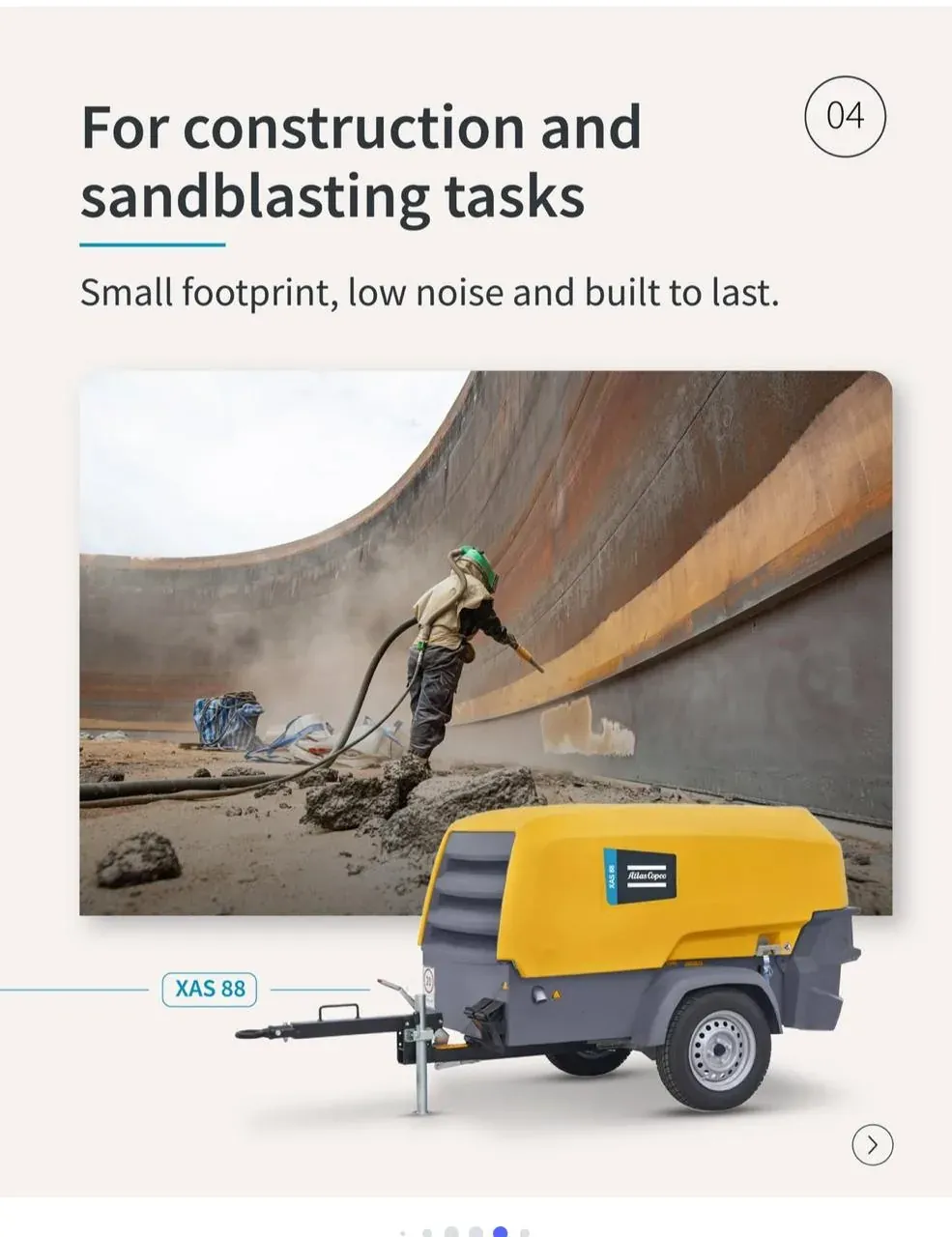
- Small blasting and painting contractors working with a single small nozzle on structural steel, tanks or pipe spools.
- Quarry and stone works using a hand-held rock drill for secondary breaking or plug-and-feather splitting.
- Standby duty for a small factory compressor of similar output during a breakdown or overhaul.
The common thread is a demand that one engine-driven machine can meet with some margin, without the weight, fuel use and towing requirements of a 400 cfm or larger unit.
How the class is built
Almost every machine in this band is an oil-injected rotary screw airend driven by a diesel engine, mounted in a sound-attenuated canopy on a single-axle towable chassis. The main elements are the same as larger portables, scaled down:
- Engine – a three- or four-cylinder diesel, usually water-cooled. The engine must have reserve power for the rated pressure; a 10 bar version needs noticeably more shaft power than a 7 bar version of the same flow, roughly 7% more power for each extra bar.
- Airend and separator – the screw element compresses air with injected oil; the separator tank and element remove the oil before the service valves. A healthy oil-injected screw normally discharges at about 75–95 °C.
- Control – a pneumatic or electronic regulator throttles the inlet and slows the engine as demand falls, then unloads at full pressure. This is why a 185–250 cfm unit can idle on light load and recover quickly when a breaker starts.
- Cooling – a combined oil cooler and engine radiator in a cool-box with a single fan. In a Telangana or Andhra Pradesh summer, with 40–45 °C ambient and above 45 °C on open sites, clean cores and intact canopy seals decide whether the machine runs all afternoon or trips.
- Safety shutdowns – high discharge temperature, low engine oil pressure and high coolant temperature are standard; many machines also stop on low fuel or a separator fault.
Some units have an optional aftercooler and moisture separator, which matters for blasting and painting. Controls and cooling are covered in more depth on our portable compressor controls and portable compressor cooling pages.
What tools will it run? Worked examples
The only reliable way to size a portable compressor is to add up the air the tools need at their working pressure, then add allowances for wear, hose losses and the tools that run at the same time. Tool consumption figures below are typical ranges for common equipment at about 6–7 bar; the tool maker’s data sheet always takes priority.
| Tool or duty | Typical air demand | Fits 185–250 cfm? |
|---|---|---|
| Pneumatic breaker (20–40 kg class) | typically 85–145 cfm at about 7 bar (101.5 psig) | One or two, depending on tool size |
| Hand-held rock drill (jack hammer) | typically 85–145 cfm at about 7–10 bar (101.5–145 psig) | One drill, with margin for a blow pipe |
| Abrasive blasting, No. 4 (1/4 in, 6 mm) nozzle at 100 psig | about 130–140 cfm new | Yes, with margin for nozzle wear |
| Abrasive blasting, No. 5 (5/16 in, 8 mm) nozzle at 100 psig | about 195–210 cfm new | Marginal; better on 250–400 cfm |
| No. 6 nozzle or two nozzles | about 280–300 cfm or more | No – move to 250–400 cfm |
| DTH borewell or crawler drilling | 600 cfm and above at 14–28 bar | No – a different class entirely |
Example 1: two breakers on a slab demolition
A contractor plans two 25 kg breakers, each rated at about 90 cfm, at the lower end of the typical 85–145 cfm range. Two tools give 180 cfm. Allow around 10–15% for tool wear and hose leakage, giving roughly 200–210 cfm. A 185 cfm machine is too tight; a 210–250 cfm unit at 7 bar covers this, and a 250 cfm unit gives headroom if a third operator occasionally uses a blow gun or a small chipping hammer.
Example 2: a rock drill in a stone quarry
One hand-held rock drill at about 110 cfm plus a flushing blow pipe gives around 120–130 cfm. A 185 cfm compressor is a sensible choice. Adding a second drill pushes the total near 250 cfm, which is the top of the band; the honest recommendation there is often a 250–400 cfm machine rather than running a 250 cfm unit flat out all day.
Example 3: blasting a tank with a No. 5 nozzle
A new No. 5 nozzle at 100 psig takes roughly 195–210 cfm. Nozzles wear quickly with copper slag or garnet; as the bore opens by one size the demand rises towards the No. 6 figure. Add the pressure drop through the pot and hose, and a 185–250 cfm compressor is marginal. A unit from the 250–400 cfm class with an aftercooler and moisture separator is the safer class choice for steady nozzle pressure.
Example 4: cable-blowing and duct work
Fibre cable-blowing machines for standard duct often specify a flow range that starts near 185 cfm and a working pressure above 7 bar, depending on duct and cable size. In that case a 10 bar version of this class is needed, and the blowing machine maker’s figures for the specific duct should be confirmed before the compressor is reserved.
Should I choose 7 bar or 10 bar?
Most machines in this band are rated at 7 bar (101.5 psig), and some are offered at 10 bar (145 psig). The choice should come from the tool, not from a belief that more pressure is always better.
| Point | 7 bar (101.5 psig) | 10 bar (145 psig) |
|---|---|---|
| Typical tools | Breakers, rock drills, blasting, air tools | Cable blowing, some pipe testing and long hose runs |
| Engine load for the same flow | Lower | Higher – roughly 7% more power per extra bar |
| Fuel use | Lower at the same air delivery | Higher at the same air delivery |
| Flow at rated pressure | Full rated flow | Often a lower flow figure on the same frame size |
| Tool life | Matches most tool ratings | Over-pressure shortens tool life unless regulated |
Running a 6–7 bar breaker from a 10 bar machine does not make it hit harder for long; it wears seals and retainers faster and wastes fuel. If one site needs both, a variable-pressure machine or a regulator at the tool is the sensible answer. See our pages on 7 bar portable compressors and 10 bar portable compressors.
What does the towable chassis mean on site?
Machines in this class are usually built on a single-axle chassis with a towbar, jockey wheel, parking brake and lifting eye. That makes them easy to move between work fronts, but it also brings responsibilities:
- Tow only within the speed and towbar limits stated on the machine; many site chassis are not designed for highway speeds.
- Check tyre pressure, wheel nuts, lights and the safety chain before each move.
- Park on level, firm ground with the brake on and wheels chocked; a tilted machine can affect oil level readings and separator performance.
- Keep at least a metre of clear space around the canopy so the cooling air path is not blocked by stockpiles or walls.
- Use the lifting eye only with a rated sling and with the fuel tank in a safe state for lifting.
- Skid-mounted versions, without wheels, suit fixed points in plants or truck mounting.
Should I rent or buy a 185–250 cfm compressor?
The decision depends mostly on running hours and on whether you have the people to look after a diesel machine.
| Situation | Usually better | Why |
|---|---|---|
| Short job, a few days to a few months | Rent | No capital, no idle machine after the job |
| Breakdown or shutdown cover | Rent | Air within the outage window without buying spare capacity |
| Continuous use across many projects | Buy new | High utilisation spreads the cost and the fleet is yours |
| Steady but moderate use, tight budget | Buy used or reconditioned | Lower entry cost if the airend and engine are properly inspected |
| Uncertain demand | Rent first | Measure the real duty before committing to a size |
Hiring also hands the routine servicing to us. On our hire jobs we change oil and service machines every 300 running hours. Our rental versus ownership calculator helps with the numbers, and the temporary air engineering centre explains how hires are planned.
Common mistakes with this class
- Sizing on the brochure flow alone. The rated flow is free air delivery at a stated pressure. Ask for the figure at your working pressure.
- Ignoring nozzle and tool wear. A worn blasting nozzle or breaker can take far more air than the new-tool figure.
- Long, narrow hoses. A 30 m run of small-bore hose can drop pressure enough that a breaker slows down. Use the correct bore and keep runs short; see air hoses and rig connections.
- Treating it as a drilling compressor. DTH borewell work needs 600 cfm and above at much higher pressure.
- Running at 10 bar for 7 bar tools. It costs fuel and wears tools.
- Blocking the cooling air in summer. Dust-choked radiators and parked-against-a-wall machines trip on high temperature at the hottest part of the day.
- Wet air for blasting or painting. Without an aftercooler and separator, condensate reaches the abrasive and the coating.
- Skipping the 300-hour service on long hires. Oil and filter condition decide airend life.
How Reddy Compressors helps
Reddy Compressors sells, rents and services diesel portable compressors of ELGi, Atlas Copco, Ingersoll Rand, KAESER, Chicago Pneumatic, Doosan and other makes as an independent multi-brand specialist, not as an authorised dealer of any brand. Brand names belong to their owners.
- We size the class from your tools and duty, and tell you plainly when 185–250 cfm is too small or larger than you need.
- Rental from our own fleet of diesel portables, with hoses and, where needed, aftercoolers and moisture separators for blasting work.
- New compressors for long-term projects, and used or reconditioned machines after inspection.
- Service, breakdown repair and overhaul by our team of more than 20 service engineers and technicians, covering the whole of Telangana and Andhra Pradesh; see portable compressor service.
- Spare parts identified from the make, model, serial number and nameplate photo, with fit confirmed before we quote, supplied across India.
Our office is at Srinilayam, 12-13-200, First Floor, Street No. 1, Tarnaka, Secunderabad 500017. Call +91 99590 60718 or +91 92468 88812, or email reddycompressors@gmail.com.
What to send us
- The tools you will run, their make and model, and how many work at the same time.
- Working pressure required at the tool, and hose length and size.
- Site location, ambient conditions and how the machine will be moved.
- Duration of the job and expected running hours per day.
- For blasting or painting: nozzle size, abrasive and whether dry air is needed.
- For service or spares: make, model, serial number and a nameplate photo.
Frequently asked questions
How many breakers can a 185 cfm compressor run?
Typically one or two. Breakers use about 85–145 cfm each at about 7 bar (101.5 psig), so two smaller breakers fit with only a small margin for hose leakage and tool wear, while with larger breakers it is safer to plan one tool, or step up to 250 cfm. Always check the breaker maker’s air consumption figure at its working pressure before deciding.
Can a 250 cfm compressor be used for borewell drilling?
No. DTH borewell drilling usually needs around 600 to 1,500 cfm at 200 to 400 psig, which is about 14 to 28 bar. A 250 cfm machine at 7 or 10 bar cannot lift cuttings or drive a DTH hammer at a useful rate in most ground. It suits breakers, hand-held rock drills and small blasting work instead.
Is a 185 cfm compressor enough for sandblasting?
It is enough for one small nozzle. A new No. 4 nozzle at 100 psig typically uses about 130–140 cfm and a No. 5 about 195–210 cfm. As nozzles wear, the demand rises, so this class suits a No. 4 and is marginal on a No. 5. A No. 5 fits the 250–400 cfm class; one No. 6 needs about 375–450 cfm.
What is the difference between a 7 bar and a 10 bar portable compressor?
A 7 bar (101.5 psig) machine suits most breakers, rock drills and blasting. A 10 bar (145 psig) machine is for jobs that need higher pressure, such as fibre cable blowing or long hose runs. The 10 bar version uses more engine power and fuel for the same flow, roughly 7% more power per extra bar.
Should I rent or buy a 185–250 cfm diesel compressor?
Rent when the job lasts from a few days to a few months, when you need breakdown cover, or when the true demand is uncertain. Buy, new or used, when the machine will run regularly across many projects and you can look after servicing. Hire also includes routine servicing; on our hire jobs that is every 300 running hours.
How much diesel does a 185–250 cfm compressor use?
Fuel use depends mainly on load, pressure and engine condition rather than on the frame size alone. A machine idling between breaker bursts uses far less than one running continuously at full flow. A 10 bar unit uses more than a 7 bar unit for the same air. Ask for the fuel curve of the specific model and estimate from your duty cycle.
Related pages
Calculators and worked examples
These tools give indicative figures for screening, comparison and for preparing an enquiry. They run in your browser and send nothing. No prices or tariffs are assumed: enter your own to see costs. Efficiencies and other figures shown are example values: replace them with your own. Results are not a performance guarantee or a design certificate; final selection is confirmed by a service engineer against the machine data sheet and the site.
Compressed air demand estimate
Add up the air your tools and processes use, apply duty and simultaneity, then add leakage and growth allowances to reach a capacity to enquire about.
The worked example below shows the method with fixed numbers. Turn on JavaScript to change the inputs.
Worked example
Inputs
- Unit for the air each tool uses: L/s
- Group A: number of tools: 6
- Group A: free air each (in the unit above): 4
- Group A: duty (%): 40
- Group B: number of tools: 2
- Group B: free air each (in the unit above): 15
- Group B: duty (%): 60
- Group C: number of tools: 1
- Group C: free air each (in the unit above): 40
- Group C: duty (%): 80
- Simultaneity of all tools (%): 65
- Leakage allowance (%): 15
- Growth allowance (%): 10
Result
- Connected demand: 94 L/s = 199 cfm
- Average demand (duty-weighted): 59.6 L/s = 126 cfm
- Simultaneous peak: 61.1 L/s = 129 cfm
- Design basis (higher of average and peak): 61.1 L/s = 129 cfm
- Design capacity with allowances: 77.29 L/s = 4.64 m³/min = 163.8 cfm
Method. Average demand = Σ(number × air per tool × duty). Peak = Σ(number × air per tool) × simultaneity. The peak can never be lower than the average, so the design basis is the higher of the two. Design capacity = design basis × (1 + leakage) × (1 + growth).
What to take from it. Leakage and growth allowances move the answer as much as any single tool. Where you can, replace catalogue figures with measured ones.
Technical content reviewed by D. Srinivas Reddy, Managing Partner and service engineer, Reddy Compressors. Last updated 17 October 2026. How our engineering content is reviewed.
Abrasive blasting air demand
Estimate the air a blast nozzle takes, so the compressor and hose can be chosen to hold pressure at the nozzle.
The worked example below shows the method with fixed numbers. Turn on JavaScript to change the inputs.
Worked example
Inputs
- Nozzle bore (mm): 8
- Pressure at the nozzle (bar g): 7
- Discharge coefficient: 0.9
- Number of nozzles: 1
- Allowance for pot, hose and leaks (%): 10
Result
- Air demand, new nozzle: 4.69 m³/min = 166 cfm
- Nozzle number (bore in 1/16 inch): 5
- Air demand when worn one size (1/16 in larger bore): 6.74 m³/min = 238 cfm: size the compressor for this, then replace the nozzle
Method. Nozzle air treated as orifice flow at the nozzle pressure: free air = Cd × A × choked mass flow ÷ ρ₀. Venturi nozzles with an effective Cd near 0.9 are typical; use the supplier value. Add flow for the pot and for leaks. Nozzle numbers are the bore in sixteenths of an inch (No. 6 = 3/8 in = 9.5 mm). A nozzle wears larger in use, so size the compressor for the nozzle worn one size and replace it at that point.
What to take from it. A worn nozzle passes more air for less work. Check bore wear and keep the pressure at the nozzle, not at the compressor.