
How a pneumatic breaker uses air
A hand-held pneumatic breaker, often called a jackhammer or paving breaker, has a piston that compressed air drives up and down inside the cylinder. A valve switches air to each side in turn, so the piston strikes the shank of the steel (point, chisel or spade) many times a minute. Blow energy and blow rate both fall when inlet pressure falls. A breaker that is rated at 6.2 bar (89.9 psig) and supplied with 4.5 bar does not just run slower: it hits noticeably softer, and progress on concrete or rock drops far more than the pressure figure suggests.
Air consumption is set by the breaker model and its working pressure. Heavier breakers generally use more air, but silenced and vibration-reduced versions of the same weight class can differ. Read the breaker’s own data, including the pressure at which consumption is quoted.
How many breakers can my compressor run?
As a first planning step, divide the compressor’s free air delivery (FAD) by the breaker’s consumption and allow a margin of 15–25% for hose losses, leaks, wear and hot-weather derating. The table uses typical industry figures only.
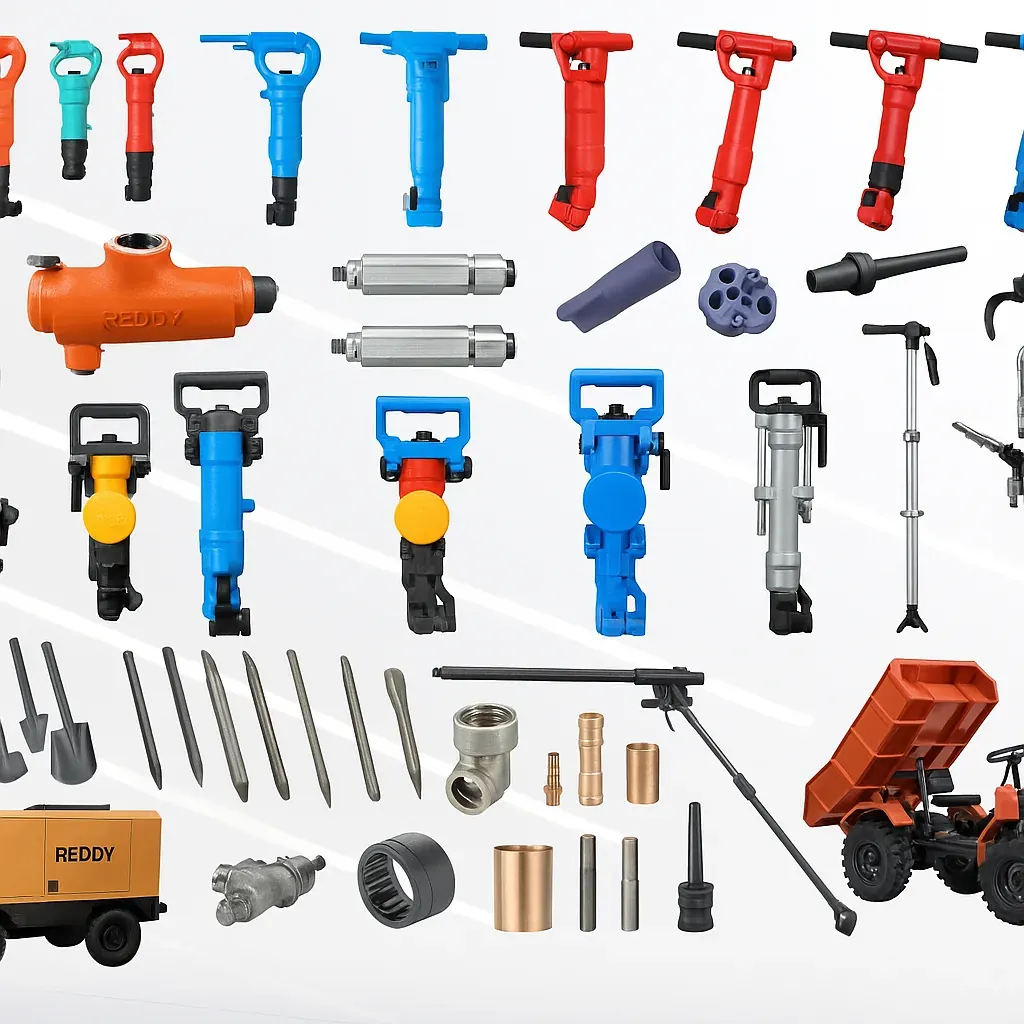
| Breaker class (typical) | Typical consumption (breakers at about 7 bar, 101.5 psig) | 185–250 cfm portable | 250–400 cfm portable | 400–600 cfm portable |
|---|---|---|---|---|
| Light chipping and demolition hammers, under 10 kg | Depends on hammer; see maker’s data | By model | By model | By model |
| Medium breakers, about 15–20 kg | Typically 85–145 cfm (by tool size) | 1–2 breakers | 2–4 breakers | 3–6 breakers |
| Heavy breakers, about 25–30 kg and above | Typically 85–145 cfm (by tool size) | 1–2 breakers | 2–4 breakers | 3–6 breakers |
| Hand-held rock drills (run at about 7–10 bar, 100–145 psig) | Typically 85–145 cfm | 1–2 drills | 2–4 drills | 3–6 drills |
These numbers are a starting point. The real answer depends on the exact tool model, how many tools actually run at the same time, the hose layout and the site temperature. If the breakers work in a steady gang, size for all of them running together. If they work in short bursts, a little less margin may be acceptable, but never plan on the compressor’s peak figure alone.
Pressure at the breaker, not at the compressor
The compressor gauge tells you what the compressor is making, not what the breaker gets. Losses build up through the service valve, the main hose, any manifold, the line lubricator, couplings and the whip hose to the tool.
- Measure pressure at the breaker inlet while it is working against material, not after the trigger is released.
- Measure at the compressor outlet and at the manifold during the same event.
- If the compressor outlet holds pressure but the tool inlet is low, the problem is in the hose route.
- If the compressor outlet itself falls, the compressor is over-demanded or not delivering its rated FAD.
- Correct the cause; raising compressor pressure above the breaker’s maximum inlet rating can damage the tool and hoses.
Hose sizing in practice
- Typical practice for one medium or heavy breaker is a 19 mm (3/4 inch) hose up to about 15–20 metres.
- For longer runs or two or more breakers, use a 25 mm (1 inch) or larger main hose to a manifold, with short 19 mm whips to each breaker.
- Avoid long runs of 12–13 mm (1/2 inch) hose; they are a common reason breakers feel weak on an otherwise large compressor.
- Use claw couplings with locking pins and safety whip-check cables on every joint; a hose that parts under pressure whips violently.
- Check the inlet thread on the breaker does not set your hose bore; the hose should be sized from flow and length.
Lubrication and moisture: the hidden causes of breaker failure
Most hand-held breakers depend on oil carried in the air to lubricate the piston and valve. Without it, wear accelerates and the tool can seize. With too much water in the air, oil is washed out and internal parts rust between shifts.
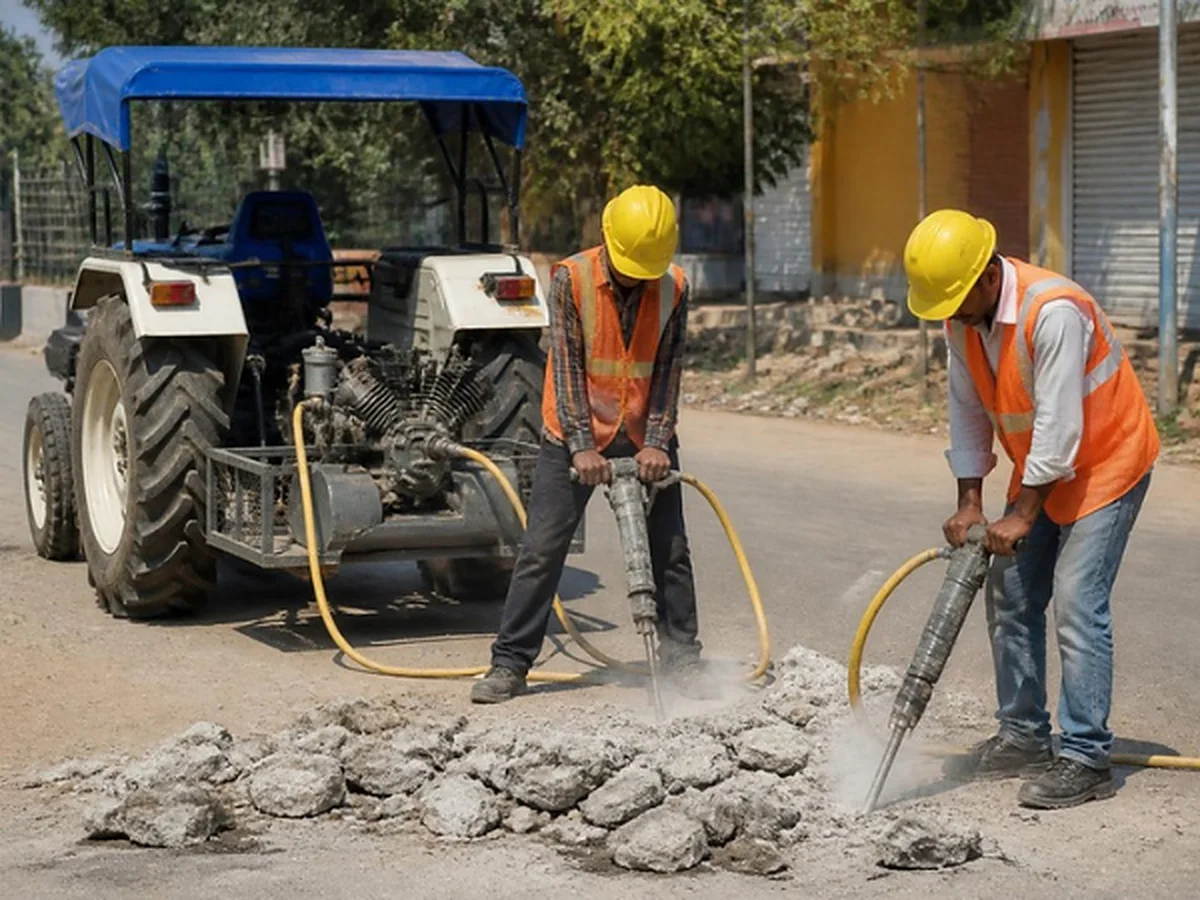
- Fit an in-line lubricator close to the breaker, filled with the tool maker’s recommended rock-drill or breaker oil, and check it every shift.
- Do not put compressor oil, engine oil or diesel in the lubricator.
- Drain water from the hose and manifold at the start and end of each shift.
- On hot, humid days a portable compressor puts a lot of water into the line. An aftercooler and moisture separator reduce it, which helps tools and is essential if the same compressor also serves blasting or painting.
- Exhaust icing at the breaker can occur when wet air expands, even in warm weather; drier air reduces it.
- At the end of the job, pour a little tool oil into the inlet and run briefly before storage.
Diesel portable or electric compressor for breakers?
Most breaking work is done with diesel portable compressors because the workfront moves: road cuts, pipeline trenches, building demolition, foundation chipping, plant maintenance and quarry secondary breaking. Electric compressors suit fixed locations with power available, such as a long-running maintenance bay inside a plant, or indoor and enclosed areas where diesel exhaust is not acceptable.
| Site situation | Typical choice | Why |
|---|---|---|
| Road and utility cuts, moving daily | 185–250 cfm diesel portable | Easy to tow; one or two breakers |
| Demolition, foundation and pile-head chipping | 250–400 cfm diesel portable | Gang of breakers plus chipping hammers |
| Quarry secondary breaking, rock drills | 400–600 cfm diesel portable | Heavy tools and drills together |
| Plant shutdown, refractory and kiln work | Diesel portable or electric | Depends on access, ventilation and power |
| Tractor-based rural work | Tractor-mounted piston compressor, 100–140 cfm | One breaker or small rock drill |
Common complaints and their usual causes
| Complaint | Likely cause | First check |
|---|---|---|
| Breaker hits weakly | Low pressure at inlet, long or small hose, too many tools | Gauge at the breaker while working |
| Breaker stalls or will not start | Dry tool, rust inside, sticking valve | Lubricator level, water in hose |
| Compressor cannot hold pressure | Demand exceeds FAD, worn airend, inlet valve fault, dirty air filter | Count tools running; compressor service history |
| Compressor trips in the afternoon | High discharge or coolant temperature in hot ambient, blocked coolers | Cooler cleanliness, placement, dust |
| Water and oil spray from the breaker exhaust | Over-lubrication or wet air | Lubricator setting, drains, separator |
A normal oil-injected screw compressor runs with a discharge temperature of roughly 75–95 °C. On Indian summer sites, where ambient reaches 40–45 °C and above 45 °C on open sites, coolers fouled with dust push it towards the high-temperature shutdown. Park the compressor upwind of dust and cutting work, with space around the cooling air inlet and outlet.
Safety boundaries
Adequate air does not make a breaking job safe on its own. Service clearance, structural approval for demolition, dust suppression, hearing and vibration protection, and operator training remain the responsibility of the contractor and site engineer. On the air side, keep to the breaker’s maximum inlet pressure, use whip-checks and pinned couplings, close the service valve and vent the hose before changing tools or couplings, and never point a live hose at anyone.
How Reddy Compressors helps
Reddy Compressors has served industry since 2002 from Tarnaka, Secunderabad. As an independent multi-brand specialist we:
- Rent diesel and electric compressors from our own fleet, 50–2,000 cfm and 2–30 bar, with air hoses, manifolds and moisture separators to suit the number of breakers.
- Sell new and used or refurbished portable compressors from ELGi, Atlas Copco, Ingersoll Rand, KAESER, Chicago Pneumatic, Doosan and others; we are not an authorised dealer of any brand. We have tie-ups with all major and reputed brands. For long-term projects we can supply brand-new compressors to site.
- Help you match compressor size, hose bore and layout to your breakers and rock drills.
- Service and repair portable compressors through our team of more than 20 service engineers and technicians across Telangana and Andhra Pradesh; on hire jobs we change oil and service every 300 running hours.
- Supply compressor spare parts identified from the nameplate, serial number or old part, with fit confirmed before quoting, across India.
What to send us
- Breaker and rock-drill make, model and quantity, and how many work at the same time.
- Type of work: demolition, road cuts, trenching, quarry, plant maintenance.
- Hose length from compressor to the workfront.
- Diesel or electric preference and whether site power is available.
- Working hours per day, duration and site location.
- For an existing compressor: make, model, serial number and the problem you see.
Frequently asked questions
How many jackhammers can a 185 cfm compressor run?
Typically one heavy or medium breaker. Two medium breakers fit only if each uses about 80 cfm or less, so check the exact models. A heavy 25–30 kg breaker typically uses 85–145 cfm at about 7 bar (101.5 psig), and you need a margin for hose losses and leaks. Check each tool’s rated consumption and keep hoses short and of adequate bore, or choose a 250–400 cfm unit for more tools.
What air pressure does a pneumatic breaker need?
Most hand-held breakers are rated at about 6–7 bar (87–101.5 psig) at the tool inlet while working. Below that, blow energy falls quickly and progress drops. Do not exceed the maximum inlet pressure stated by the breaker maker. Measure pressure at the breaker while it is actually breaking, not at the compressor or with the trigger released.
Why is my breaker weak even with a big compressor?
The most common reason is pressure loss in the hose route: a long or small-bore hose, restrictive couplings, or a clogged lubricator or manifold. Lack of lubrication and water in the air also reduce performance. Measure pressure at the breaker inlet while working and compare it with the compressor outlet to locate the loss.
What hose size should I use for a jackhammer?
A 19 mm (3/4 inch) hose is common for one medium or heavy breaker over short distances. For longer runs or several breakers, use a 25 mm (1 inch) or larger main hose to a manifold with short 19 mm whips. Avoid long lengths of 12–13 mm hose, and fit whip-check safety cables at every coupling.
Do pneumatic breakers need oil in the air line?
Yes, most do. Fit an in-line lubricator near the breaker and fill it with the tool maker’s recommended breaker or rock-drill oil, then check it every shift. Running a breaker dry causes rapid wear and seizure. Do not use compressor oil, engine oil or diesel, and drain water from hoses regularly so it does not wash the oil out.
Can I hire a compressor with breakers in Hyderabad?
We hire diesel and electric compressors with hoses, manifolds and moisture separators, sized for the number and type of breakers you will run, across Telangana and Andhra Pradesh and further where feasible. Tell us the breaker models, how many work together, hose length and duration, and we will propose a suitable compressor and hose package.
Related pages
Calculators and worked examples
These tools give indicative figures for screening, comparison and for preparing an enquiry. They run in your browser and send nothing. No prices or tariffs are assumed: enter your own to see costs. Efficiencies and other figures shown are example values: replace them with your own. Results are not a performance guarantee or a design certificate; final selection is confirmed by a service engineer against the machine data sheet and the site.
How many breakers or rock drills a compressor can run
Divide a compressor’s FAD by the tool’s air consumption with a margin for hose losses, leaks, wear and hot-weather derating; or, for a wanted number of tools, find the FAD and the portable class needed.
The worked example below shows the method with fixed numbers. Turn on JavaScript to change the inputs.
Worked example
Inputs
- Flow unit: cfm
- Compressor FAD at working pressure (unit above): 185
- Air consumption per tool at its rated pressure (unit above): 85
- Margin for hoses, leaks, wear and hot weather (%): 15
- Number of tools you want to run together (0 to skip): 2
Result
- Air per tool with margin: 97.7 cfm = 2.77 m³/min
- Tools this compressor can run: 1 with 87.3 cfm left over
- FAD needed for 2 tools: 195.5 cfm = 5.54 m³/min: 185–250 cfm class (this compressor is short by 10.5 cfm)
- Hose guide: 25 mm main + 19 mm whips main hose to a manifold, short whips to each tool
Method. Air per tool with margin = rated consumption × (1 + margin ÷ 100); the page suggests 15–25%. Tools supported = whole number of FAD ÷ air per tool with margin. FAD needed for n tools = n × consumption × (1 + margin). Portable classes: 185–250 cfm, 250–400 cfm, 400–600 cfm (5.2–7.1, 7.1–11.3, 11.3–17 m³/min). Use the maker’s consumption at the pressure the tool really receives; consumption rises with inlet pressure. Hose guide: 19 mm (3/4 in) for one tool up to about 15–20 m; a 25 mm (1 in) or larger main hose to a manifold with short 19 mm whips for longer runs or two or more tools.
What to take from it. Plan on the FAD the compressor really delivers on a hot site, with margin, and measure pressure at the tool while it works; a weak breaker on a big compressor usually points at the hose.
Technical content reviewed by D. Srinivas Reddy, Managing Partner and service engineer, Reddy Compressors. Last updated 7 November 2026. How our engineering content is reviewed.
Pipe pressure drop and sizing
Check the pressure drop and air velocity in a compressed-air line, or find the smallest bore that keeps the drop within a target.
The worked example below shows the method with fixed numbers. Turn on JavaScript to change the inputs.
Worked example
Inputs
- Flow (m³/min free air): 12
- Inlet pressure (bar g): 7
- Pipe length (m): 150
- Inside diameter (mm): 80
- Roughness (mm): 0.046
- Fittings allowance (% extra length): 30
- Air temperature (°C): 30
- Target pressure drop (bar): 0.1
Result
- Pressure drop: 0.059 bar (0.839% of the inlet gauge pressure)
- Air velocity: 5.22 m/s
- Reynolds number: 2,06,066
- Smallest bore for the target drop: 73 mm inside diameter
- Velocity check: Within the common rule-of-thumb range for mains (roughly up to 15–20 m/s)
Method. Darcy–Weisbach: ΔP = f × (L/D) × ρv²/2, with the friction factor f from the Swamee–Jain relation and air density taken at mean line pressure. Fittings are allowed for as extra equivalent length. Typical commercial steel roughness is about 0.046 mm.
What to take from it. Pressure drop varies roughly with the fifth power of the bore at constant flow, so a larger main is a cheap way to hold pressure.