
We supply new and used/refurbished compressors, hire machines from our own rental fleet of 50–2,000 cfm at 2–30 bar, and service, repair and overhaul compressors with spare parts identified from the machine and confirmed for fit. For long-term projects we can supply brand-new machines to site. Our team of more than 20 service engineers and technicians covers the whole of Telangana and Andhra Pradesh, and we supply equipment, rentals and spares across India.
Brand names and trademarks belong to their respective owners. Reddy Compressors is an independent multi-brand specialist and is not an authorised distributor, dealer or service partner of any brand. We have tie-ups with all major and reputed brands.
Why a multi-brand specialist?
Very few plants in India run a single make of compressor. A typical compressor house has a screw machine bought ten years ago, a newer variable-speed unit, a piston compressor kept for standby and perhaps a portable diesel machine for maintenance work. Each came from a different supplier with a different service contract, a different parts catalogue and a different reporting style.
That fragmentation costs money. Nobody looks at the system as a whole, so machines fight each other on pressure, the most efficient unit is not always the one carrying the base load, and spares are bought in a panic when something fails. A multi-brand specialist can look after the whole compressor house under one plan, compare machines honestly and recommend what to keep, overhaul or replace without a sales target for one brand.
- One plan: service schedules, parts planning and records for every machine, whatever the make.
- Neutral advice: we sell several brands, so we can size and select against your duty rather than a product list.
- System view: compressors, dryers, filters, receivers and piping looked at together, because most air problems sit between machines, not inside one.
- Continuity: when a machine fails, temporary air from our own fleet keeps production running while we repair it.
Brands we sell, rent and service
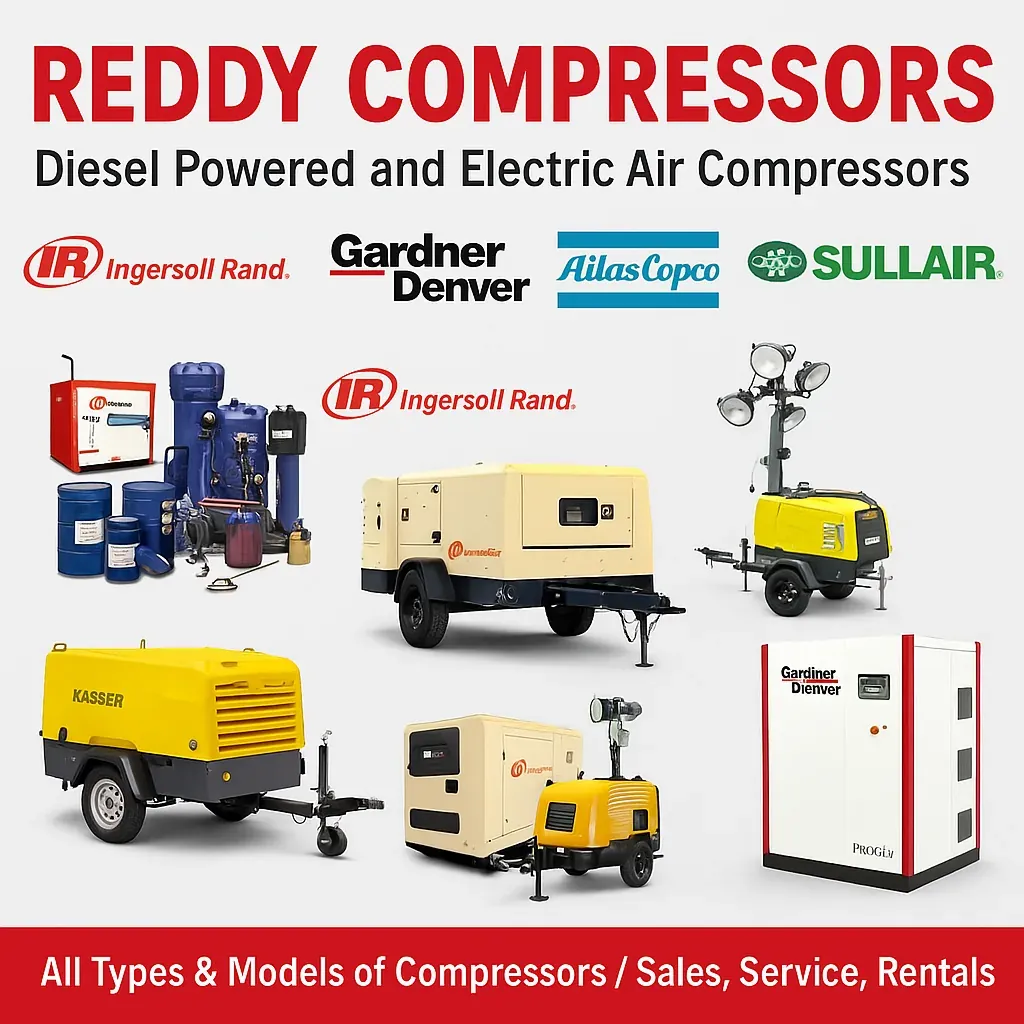
For each make, this page explains the machine families we usually see, common faults, the parts we supply and how we identify them.
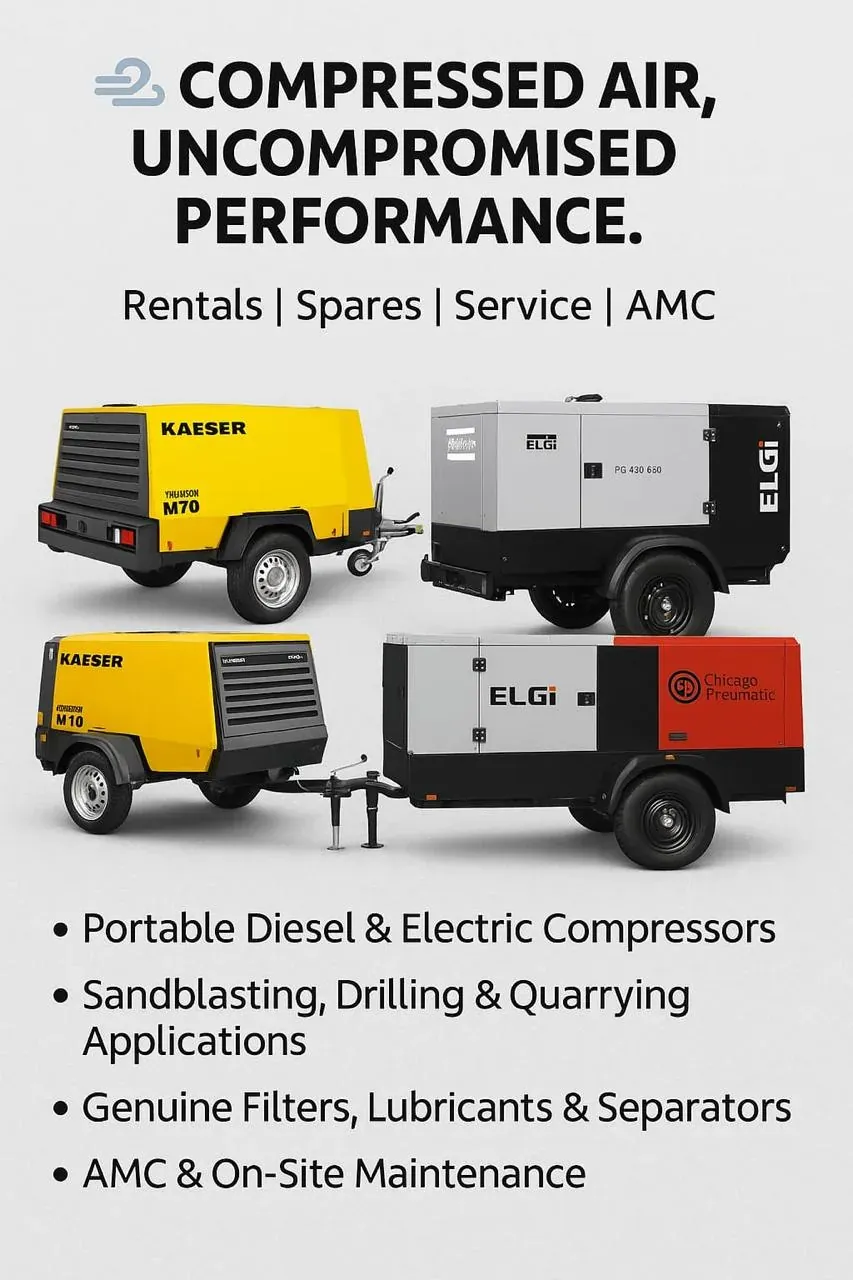
- ELGi: oil-injected and oil-free screw, piston and portable diesel compressors, including high-pressure borewell machines.
- Atlas Copco: oil-injected and oil-free screw, variable speed, piston, portable diesel and air treatment.
- Ingersoll Rand: piston, oil-injected and oil-free screw and portable compressors.
- KAESER: rotary screw compressors, dryers, blowers and portable compressors.
- Chicago Pneumatic: rotary screw, piston and portable compressors.
- Sullair: stationary rotary screw and portable diesel compressors.
- Doosan: portable diesel compressors, including high-pressure units.
- Kirloskar: reciprocating and screw air compressors.
- Bobcat: portable diesel compressors.
- Gardner Denver: rotary screw and piston compressors.
We also work on many other makes. If your brand is not listed, send us the nameplate and we will tell you honestly whether we can support it.
Machine types we handle, by brand
The table shows the machine types we commonly sell, rent, service and supply parts for under each brand, in general terms as the brands are publicly known. It is not a product catalogue; we work from your nameplate and the machine itself.
| Brand | Oil-injected screw | Oil-free screw | Piston | Portable diesel | Notes |
|---|---|---|---|---|---|
| ELGi | Yes | Yes | Yes | Yes | Widely used on borewell rigs and in small industry |
| Atlas Copco | Yes | Yes | Yes | Yes | Fixed and variable speed; dryers and filters |
| Ingersoll Rand | Yes | Yes | Yes | Older units (now Doosan/Bobcat) | Long-standing piston population in India |
| KAESER | Yes | Selected | Selected | Yes | Screw compressors, dryers, blowers |
| Chicago Pneumatic | Yes | Selected | Yes | Yes | Workshop and site duties |
| Sullair | Yes | Selected | No | Yes | Portable and stationary screw |
| Doosan | No | No | No | Yes | Portable, including high pressure |
| Kirloskar | Yes | Selected | Yes | No | Common in Indian industry and workshops |
| Bobcat | No | No | No | Yes | Portable diesel compressors |
| Gardner Denver | Yes | Selected | Yes | Selected | Industrial screw and piston |
| Others | Other makes on request | Send the nameplate first | |||
“Selected” means the brand offers or has offered such machines but we see them less often; we confirm support case by case from the nameplate.
What we do for every brand
| Service | What it covers |
|---|---|
| Sales, new | Machines selected against measured demand, pressure and air quality; brand-new machines for long-term projects |
| Sales, used and refurbished | Checked machines where a suitable unit is available; see used compressors for sale |
| Rental | Own fleet, 50–2,000 cfm, 2–30 bar (29–435.1 psig), diesel and electric, oil-injected and oil-free; see rental engineering |
| Service & AMC | Planned visits, consumables, readings and written records under a compressor AMC |
| Breakdown repair | Fault diagnosis, controller and sensor faults, valve, cooler and drive work |
| Overhaul | Airend, engine and component overhaul, or an honest recommendation to replace |
| Spare parts | Filters, separators, lubricants, kits, valves, sensors, coolers and engine parts, matched from the machine; see spare parts |
| Air audits | Demand, pressure, leakage and air-quality checks across a mixed fleet |
How we choose between brands for a new machine
Because we are not tied to one manufacturer, selection starts with your duty, not the brochure. A compressor bought on cfm alone is often the wrong machine.
- Measure the demand: actual flow over a full production cycle, peak and minimum, not the sum of tool ratings.
- Set the real pressure: the pressure the furthest critical user needs plus treatment and piping losses. Each extra bar costs roughly 7% more power on a typical screw.
- Define air quality: the ISO 8573-1 class your process needs for particles, water and oil, and whether oil-free compression is justified.
- Choose the technology: oil-injected or oil-free screw, piston, fixed or variable speed, electric or diesel. Our technology comparison sets out the trade-offs.
- Compare lifecycle cost: energy usually outweighs purchase price over a machine’s life, so specific power at your operating point matters more than the list price.
- Check local support: parts availability, serviceability and how the machine copes with dust and summer ambient of 40–45 °C, and above 45 °C on open sites, in Telangana and Andhra Pradesh.
Genuine or compatible parts?
Original manufacturer parts give certainty of fit and specification and are the safer choice for airend components, oil-free elements, seals and anything still under warranty. Quality compatible parts can be sensible for filters, separators and wear items on older machines, provided they match the original in rating, dimensions and pressure.
We always tell you which one we are quoting, and we never present a compatible part as original. Parts are identified from the make, model, serial number, nameplate photo or the old part, and fit is confirmed before we quote. Read how we verify compatibility.
Mixed fleets: getting machines to work together
When several brands share one header, their controllers do not naturally cooperate. Each machine runs to its own pressure band, and the result is often two machines part-loaded, one cycling constantly, and system pressure set higher than needed to compensate.
- Assign a base-load machine, ideally the most efficient at full load, and a trim machine, ideally variable speed.
- Stagger pressure bands so machines load in a planned order, or use a sequencer that can talk to different brands.
- Size receivers so the trim machine is not forced into short cycling.
- Fix leaks before adding capacity; leakage is often the largest single user on a site.
- Keep standby machines exercised and serviced, so they actually start when needed.
For rotary screw machines of any brand, our rotary screw service page explains the method, and for piston machines see reciprocating compressor service.
Temporary air when any brand fails
A failed compressor stops production regardless of the badge on it. Our own rental fleet includes diesel portables, electric machines, high-pressure units and oil-free options, with hoses, aftercoolers, moisture separators and dryers where the duty needs them. We size hire machines against your actual demand and pressure, and on hire jobs we service every 300 running hours. See rental air for compressor breakdown.
Finding the right spare part for any make
Most wrong-part orders start with a model name alone. Two machines sold under the same model name can carry different airends, motors, coolers or controllers depending on build year, pressure variant and market. The serial number, not the model name, decides which parts list applies.
Part-number formats differ from maker to maker. Some use long purely numeric codes, others use alphanumeric codes with a prefix for the product family and a suffix for revision or kit content. Numbers are also superseded: an older number may be replaced by a newer one that fits the same machine, or by a kit that includes extra gaskets and O-rings. Treat any number taken from an old invoice or a worn label as a starting point, then confirm it against the nameplate and the physical part.
What to read before ordering
- Nameplate: make, model, serial number, rated pressure, year of manufacture and motor kW.
- Controller: running hours, loaded hours and software version if the screen shows it.
- The old part: any number moulded, printed or stamped on it, plus a photograph with a tape measure in frame.
| Part | Identify by | Dimensions and features to confirm | Risk if mismatched |
|---|---|---|---|
| Oil filter (spin-on) | Serial number and old filter marking | Thread size and pitch, gasket OD and ID, height, bypass valve setting, burst rating | Bypass opens too early or too late; leaks at the gasket; collapse at cold start |
| Separator element | Serial number, receiver type | Spin-on or internal element, flange OD, length, design pressure, anti-static path, scavenge tube length | Oil carry-over; static discharge; element collapse at high differential pressure |
| Air intake filter | Housing model | OD, ID, length, end-cap seal type, filtration grade | Dust bypass into the airend; early bearing and rotor wear |
| Valve kits (inlet, minimum pressure, thermostatic) | Valve body marking and machine serial | Body size, spring rating, thermostat opening temperature, seal material | Failure to load, slow pressure build, high or low oil temperature |
| Belts and couplings | Belt section and length printed on the belt; coupling type | Section, pitch length, number of belts; coupling bore and keyway | Slip, overheating, misalignment, bearing damage |
| Sensors and solenoids | Label on the device; controller model | Range, output signal, thread, coil voltage (AC or DC) | False trips, no start, wrong readings on the controller |
For a structured way to send this information, use the spare parts identification enquiry or the find my part page.
Compressor oil by type: what to use and how long it lasts
Compressor oil cools the airend, seals the rotor clearances and lubricates the bearings. In an oil-injected screw it circulates at a rate many times its own volume every hour and runs hot, so its base stock decides how long it survives. The table gives typical ranges; the maker’s manual and the oil’s own data sheet always govern.
| Oil type | Typical use | Typical change interval in an oil-injected screw | Points to note |
|---|---|---|---|
| Mineral | Piston compressors; older or lightly loaded screws | 1,000 to 2,000 h (piston: often 500 to 1,000 h) | Lowest cost; varnish forms quickly above about 90 °C oil-out temperature |
| Semi-synthetic | General-duty screws | 3,000 to 4,000 h | Blend of mineral and synthetic base; a middle path on cost and life |
| PAO synthetic | Screws in hot rooms or on continuous duty | 4,000 to 8,000 h | Better oxidation resistance and lower volatility; usually compatible with mineral oil, but flush before changing over |
| Ester or polyglycol based | Machines whose maker specifies them | As specified, often at the long end | Some are not compatible with mineral or PAO oils or with certain seals; never mix without the maker’s confirmation |
| Food-grade (H1-registered) | Food, beverage, pharmaceutical and packaging plants | 2,000 to 6,000 h, depending on base stock | Suitable only for incidental food contact; it does not make an oil-injected machine oil-free |
Why heat shortens oil life: a worked example
A widely used rule of thumb is that oil life roughly halves for every 10 °C rise in sustained operating temperature. Take a PAO oil rated for 8,000 h at normal oil-out temperature. If a blocked cooler and a 45 °C summer compressor room push the oil 10 °C hotter for the whole season, expected life falls to about 8,000 ÷ 2 = 4,000 h. A 5 °C rise gives about 8,000 ÷ √2 ≈ 5,660 h. Cleaning the cooler and ventilating the room protects the oil more cheaply than buying a longer-life grade.
Why the oil must match the make’s specification
- Viscosity grade: most oil-injected screws use ISO VG 32 or 46, some use 68; piston machines usually need heavier grades. The wrong grade changes sealing, oil temperature and bearing film thickness.
- Additives and seals: a non-specified chemistry can attack seals, foam in the separator or leave varnish on the thermostatic and minimum pressure valves.
- Warranty: new and refurbished machine warranties commonly exclude damage from non-specified or mixed oil. Keep the oil invoice and record the type and hours at each change.
- Changeover: when moving to a different oil family, drain hot, change the oil filter and, where the maker advises, flush. Mixed residues can gel.
Oil analysis at each service turns a fixed interval into a condition-based one. See compressor lubricants.
Service intervals by machine type
The table below sets out typical intervals for common machine types regardless of make. Intervals are in running hours unless stated, and a dusty, hot or humid site shortens them. Where the maker’s manual differs, the manual governs, particularly while a warranty is running.
| Machine type | Daily and weekly checks | Routine service | Major work (condition-based) |
|---|---|---|---|
| Oil-injected screw | Oil level, drains, discharge temperature, pressure | Air filter about 2,000 h (inspect at 500 h on dusty sites); oil filter 2,000 to 4,000 h; separator 4,000 to 8,000 h; oil per type | Airend bearing and seal overhaul, commonly in the range of 24,000 to 40,000 h |
| Oil-free screw | Stage temperatures and pressures, drains | Inlet filter 2,000 to 4,000 h; gearbox oil and filter 4,000 to 8,000 h | Compression element inspection or exchange, often around 40,000 h |
| Lubricated piston | Crankcase oil level, belt tension, receiver drain | Oil 500 to 1,000 h; valve inspection 1,000 to 2,000 h | Rings, bearings and cylinder check, 4,000 to 8,000 h |
| Portable diesel screw | Engine oil, coolant, fuel water separator, compressor oil | Engine oil and fuel filters 250 to 500 h; compressor service as for oil-injected screw | Engine top overhaul and airend overhaul by condition |
| Centrifugal | Vibration, stage temperatures, oil pressure | Lube oil and filters about 8,000 h or annually; inlet filters by differential pressure | Impeller, seal and bearing inspection by vibration trend |
| Refrigerated dryer | Pressure dew point, drain operation | Condenser cleaning every 1 to 3 months on dusty sites | Refrigerant circuit check annually |
| Desiccant dryer | Pressure dew point, purge cycle | Pre- and after-filters 4,000 to 8,000 h or by differential pressure; valve service annually | Desiccant replacement, typically every 3 to 5 years |
For a fleet that mixes several makes, put all machines on one service calendar by running hours. One plan with clear records works better than several plans with different formats; see compressor AMC.
Authorised dealer or independent multi-brand support
Both routes have a place. The right choice depends on the age of the machine, the warranty position and how many makes the plant runs. The comparison below is general, not a judgement on any company.
| Factor | Authorised dealer of one make | Independent multi-brand specialist |
|---|---|---|
| New-machine warranty claims | Handled directly with the maker | The maker’s warranty terms decide whether independent service is acceptable; check before the first service |
| Factory software and bulletins | Direct access for that make | Varies by make and model |
| Mixed fleets | Covers its own make; other makes need other providers | One provider, one report format and one service calendar across makes |
| Parts | Genuine parts for that make | Genuine or quality compatible parts, which should be stated on every quotation |
| New-machine advice | Chosen from one product range | Compared across several makes on measured demand and lifecycle cost |
A practical pattern many plants follow: use the maker’s channel while a new machine’s warranty requires it, then choose service on capability, records and parts transparency once warranty ends. Whichever route you take, ask for readings on every visit report and keep the history with the machine, not with the provider.
How Reddy Compressors helps
We act as one independent team for the whole life of your compressors, across every brand on site: selection and supply of new and used machines, rental, planned service and AMC, breakdown repair, overhaul, air audits and spare parts. Our more than 20 service engineers and technicians cover the whole of Telangana and Andhra Pradesh, and we supply compressors, rentals and spares across India, with project-based site support where feasible.
Our office is at Srinilayam, 12-13-200, First Floor, Street No. 1, Tarnaka, Secunderabad 500017. Call +91 99590 60718 or +91 92468 88812, WhatsApp +91 99590 60718, or email reddycompressors@gmail.com.
What to send us
- Brand, model and serial number, ideally a nameplate photo for each machine
- Running hours and any controller alarm history
- Working pressure, duty and required air quality
- What you need: new or used machine, rental, service, AMC, repair or parts
- Photos of the old part with any part number visible
- Site location and access details
Frequently asked questions
Are you an authorised dealer for any compressor brand?
No. Reddy Compressors is an independent multi-brand specialist and is not an authorised distributor, dealer or service partner of any brand. We sell, rent and service compressors of ELGi, Atlas Copco, Ingersoll Rand, KAESER, Chicago Pneumatic, Sullair, Doosan, Kirloskar, Bobcat and many others, and supply spares while telling you clearly whether each part is original or compatible.
Can one company service compressors of different brands?
Yes. The fundamentals of screw, piston and portable compressors are shared across brands: intake filtration, lubrication, cooling, separation, valves and controls. What differs is part numbering, controller logic and certain design details. We work from the nameplate and the machine, keep records for every unit, and put a mixed compressor house under one service plan.
Which compressor brand is best for my plant?
There is no single best brand; there is a best machine for your duty. Demand pattern, pressure, air quality, ambient conditions, energy cost and local parts support decide the choice. Because we sell several brands, we measure the duty first and then compare suitable machines on lifecycle cost rather than list price.
Do you sell used compressors of these brands?
Yes, where a suitable machine is available. Used and refurbished compressors can make sense for standby duty, short projects or tight budgets. We check the machine’s condition and tell you what has been done to it.
Can you rent a compressor while my machine is being repaired?
Yes. Our own rental fleet covers 50–2,000 cfm at 2–30 bar in diesel and electric versions, including oil-free options for sensitive duties. We match the hire machine to your demand and pressure and supply hoses and air treatment where needed, so production can continue while your compressor is repaired or overhauled.
Do you supply compressor spare parts outside Telangana?
Yes. Service teams cover the whole of Telangana and Andhra Pradesh, and we supply compressors, rentals and spare parts across India. Parts are identified from the make, model, serial number, nameplate photo or old part, and fit is confirmed before we quote, so the right item reaches your site the first time.
Where can I buy ELGi, Atlas Copco, Ingersoll Rand, KAESER or other compressor spares in Hyderabad?
Reddy Compressors supplies spare parts for all major makes, including ELGi, Atlas Copco, Ingersoll Rand, KAESER, Chicago Pneumatic, Gardner Denver, Sullair and others, as an independent multi-brand specialist with tie-ups with major brands. To get the right part first time, send the nameplate photograph showing model and serial number, the running hours and a photograph of the old part. Every quotation should state whether the part is genuine or quality compatible. Parts can be dispatched across India once the part and fit are confirmed.
Which compressor oil should I use in my screw compressor?
Use the oil type and viscosity grade the maker specifies for that model, usually ISO VG 32 or 46 for oil-injected screws. Mineral oil typically lasts 1,000 to 2,000 hours, semi-synthetic 3,000 to 4,000 hours and PAO synthetic 4,000 to 8,000 hours, but heat shortens all of them. Do not mix oil families without confirmation, because some ester and polyglycol oils are not compatible with mineral or PAO oils. Non-specified oil can also void a warranty, so keep the oil invoice.
Is there an independent service near me for ELGi, Atlas Copco, Ingersoll Rand, KAESER and other compressors?
Yes. Reddy Compressors, an independent multi-brand specialist, services compressors of all major makes, including ELGi, Atlas Copco, Ingersoll Rand, KAESER and Chicago Pneumatic, across Telangana, Andhra Pradesh and districts within about 300 km of Hyderabad, with more than 20 service engineers and technicians. An independent provider suits mixed fleets and machines out of warranty. While a new machine is under warranty, check the maker’s warranty terms first, because some require service by their own network. Send the make, model, serial number, running hours and the fault or service due to get the visit planned.
How do I know if a compatible compressor part is good enough?
Compare it with the original on every dimension that matters: thread, gasket size, length, bypass valve setting and filtration grade for filters, and design pressure and anti-static path for separators. A good compatible part matches these exactly and comes from a traceable source. Avoid compatible parts on machines still under warranty unless the warranty terms allow them. After fitting, record differential pressures at the next visit; a filter or separator that loads up much faster than the original is a warning sign.
Related pages
Technical content reviewed by D. Srinivas Reddy, Managing Partner and service engineer, Reddy Compressors. Last updated 7 November 2026. How our engineering content is reviewed.