
Industrial compressed-air engineering begins with the process that consumes the air. The correct system must deliver the required useful flow, pressure and quality through the actual production cycle, including starts, peaks, cleaning and abnormal conditions. A compressor model, motor rating or industry label cannot establish those requirements on its own.
This centre connects application requirements with equipment selection, treatment, distribution, controls, maintenance and temporary supply. It helps a production manager explain the duty, an engineer identify the governing constraints and a buyer compare solutions on an equivalent basis. The industry guides that follow develop the specific priorities of manufacturing, automotive, food and beverage, pharmaceutical, electronics, textile, cement, steel, chemical and water operations.
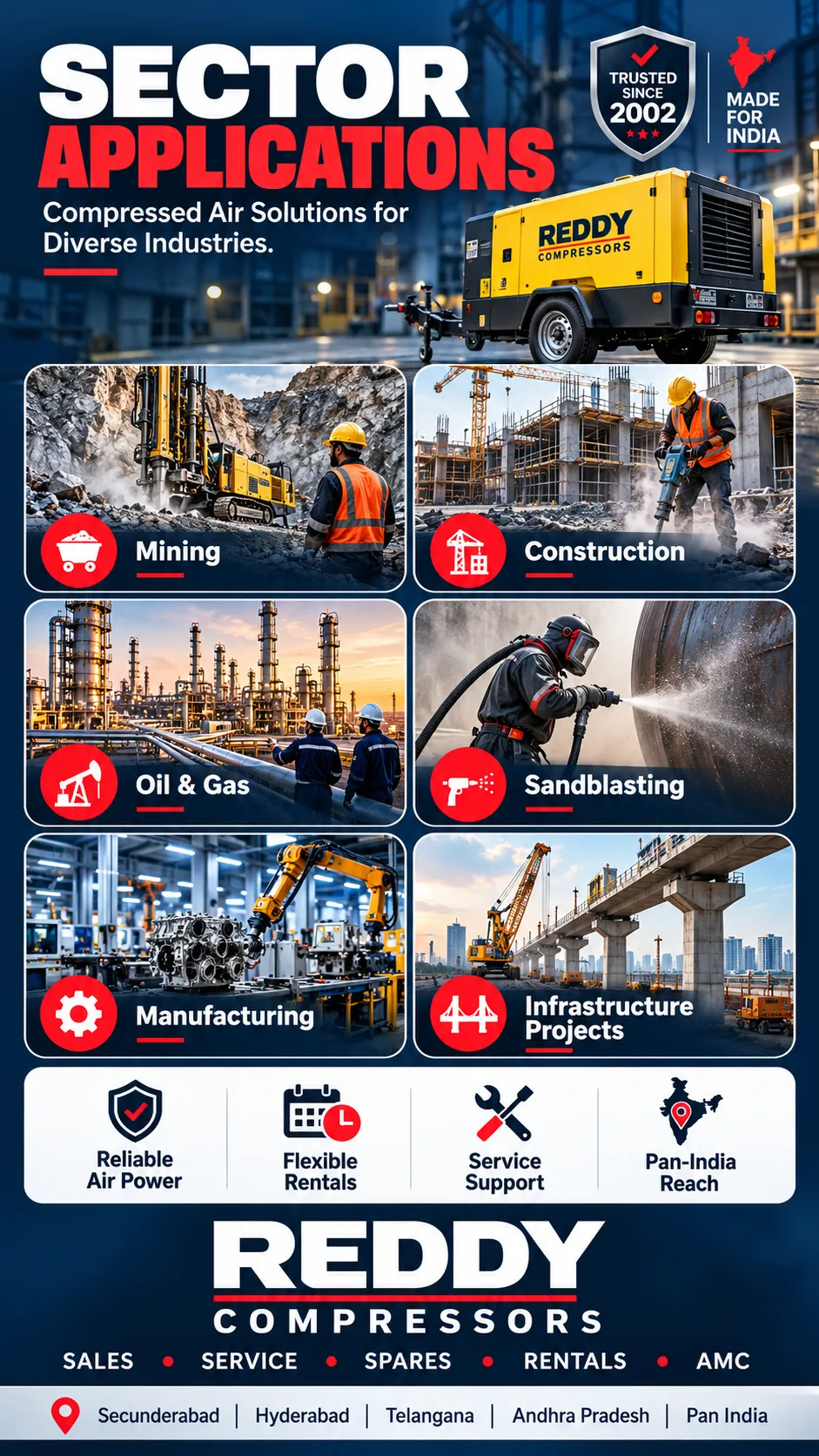
Reddy Compressors supports compressed-air requirements from its Secunderabad and Hyderabad base, with Telangana and Andhra Pradesh as priority markets and wider project support subject to scope and availability. The starting point for an application enquiry is the production requirement and the evidence behind it. This guide provides a selection framework; it does not assign a universal pressure, air-quality class or standby arrangement to an entire industry.
01 Translate production needs into an air duty
Identify what the air actually does. It may move an actuator, power a tool, clean a surface, convey material, support an analytical instrument or contact a product. Each function has different consequences if pressure falls, moisture appears or supply stops. Record these functions before grouping equipment into a common header.

For every significant user, establish its minimum operating pressure, flow requirement and reference basis, duty cycle, simultaneous operation and quality requirement. Add the consequences of interruption and the conditions required for recovery. A machine that stops safely and restarts immediately has a different continuity requirement from a process that loses an entire batch after a brief disturbance.
The supplied industrial source places pressure, flow and air quality at the centre of selection, together with duty, environment and lifecycle cost. It is a navigation and decision centre; detailed sector pages should develop their own process evidence rather than repeat a generic compressor description under a different industry name.
02 Distinguish plant air instrument air and process air
Plant air commonly serves tools, machinery and general production functions. Instrument air supports devices such as pneumatic controls and actuators. Process air performs a role within the manufacturing process and may contact the product or its contact surfaces. These descriptions help organise the enquiry, but they do not replace a specification.
CAGI's compressed-air resources use plant, instrument and process air as broad application categories. The practical requirement still depends on the equipment and process owner. An instrument in a protected indoor location may have different moisture and reliability needs from an exposed critical actuator. A process-air branch can require additional contamination controls that are irrelevant to a maintenance tool.
Keep breathing air, medical air and specialist life-support applications outside ordinary industrial assumptions. Do not infer suitability from an oil-free label or from the installation serving another sensitive process. Identify the applicable specialist requirements, evidence and competent oversight separately. The centre should guide readers toward the correct engineering boundary rather than suggest that one clean-air package is suitable for every use.
03 Build the application register
Create a register that connects each air user to a production function. Record the equipment identity, location, supplier requirement, operating pressure, flow basis, quality specification, operating schedule and consequence of loss. Distinguish measured inputs from manufacturer data, estimates and information still to be confirmed.
Include users that are easy to miss: cleaning guns, maintenance connections, intermittent purge cycles, packaging changeovers and equipment operating outside the main shift. Identify which loads are mutually exclusive and which can coincide. A register that only lists the largest production machines can understate startup or maintenance demand.
Register field | Question it answers | Evidence to seek |
|---|---|---|
Process function | Why is compressed air used here | Equipment and production description |
Delivered duty | What flow and pressure are needed | Measured profile or verified equipment data |
Quality boundary | What contamination can the process tolerate | Process specification and sampling point |
Time pattern | When do loads overlap | Production schedule and synchronised logging |
Criticality | What happens if supply is lost | Operations and process-risk assessment |
Recovery requirement | What is needed before restart | Approved restart procedure and tests |
The register should remain usable after commissioning. Update it when equipment changes, production expands or a quality requirement is revised. A capacity calculation based on an obsolete user list cannot reliably support later expansion decisions.
04 Calculate simultaneous demand without hiding peaks
Adding every equipment maximum can overstate normal duty, while multiplying the entire plant by one arbitrary diversity factor can miss a critical coincident event. Build demand scenarios from the actual production sequence. Evaluate normal operation, planned simultaneous peaks, startup and the essential operating condition after a failure.
Consider a hypothetical line with two tools each using 2 m³/min during operation, a packaging machine using 3 m³/min and continuous controls using 1 m³/min. When both tools and packaging operate together, demand is 8 m³/min. If each tool operates half the time, the time-average demand may be lower, but the simultaneous peak remains 8 m³/min when their operation overlaps.
A cleaning station drawing another 4 m³/min changes the total to 12 m³/min if it runs during that peak. If operations can reliably schedule cleaning separately, it may not define the same simultaneous duty. Document that operating constraint. The resulting capacity decision is only valid while the production schedule supporting it remains in force.
05 Separate sustained demand from short events
A brief high-flow event and a sustained high-flow duty require different responses. Suitable storage may support a short event, while a long deficit needs additional generation or a changed process. Measure the duration, recurrence and acceptable pressure variation rather than describing every fluctuation as a need for a larger compressor.
Suppose a process needs 18 m³/min for thirty seconds while available generation is 14 m³/min. The deficit is 4 × 30 ÷ 60 = 2 reference m³. Under an ideal constant-temperature screening assumption, a 2 m³ receiver across a usable 1 bar pressure difference at a 1 bara reference pressure would release approximately that amount. Actual selection requires consideration of temperature, restrictions, controls and the minimum pressure at the user.
If demand then falls to 12 m³/min, the 2 m³/min generation surplus would ideally recharge that volume in one minute. A repeat event sooner than recovery can progressively reduce pressure. The event sequence therefore matters as much as its maximum flow. The same four-unit flow deficit sustained for an hour would require 240 reference m³, showing why storage is not an indefinite substitute for generation.
06 Establish pressure at the process
Pressure should be specified and measured where it affects the equipment. A stable compressor-room gauge does not prove that a distant user receives sufficient pressure during simultaneous demand. Compare pressure at the source, after treatment and at the critical branch under the relevant production condition.
For a hypothetical user needing 6 barg, evaluated losses of 0.3 bar through treatment, 0.45 bar through distribution and 0.15 bar at local equipment total 0.9 bar. The upstream operating requirement is therefore 6.9 barg under those assumptions, before any separately justified control allowance. If the distribution route changes or filters load, the budget needs reassessment.
Avoid raising the entire station pressure to support one poorly supplied user without investigating the cause. A restricted coupling or undersized hose can create a local problem. A genuinely higher-pressure process may merit a separate supply or booster arrangement. Each alternative needs a complete evaluation of capacity, quality, component ratings, control and cost; a pressure increase is not a universal repair.
07 Specify quality from process consequences
Identify particles, water and oil requirements separately, and address other contaminants when the process requires it. Specify where quality applies and how it will be demonstrated. ISO 8573-1 defines compressed-air purity classes for particles, water and oil; it does not select the correct class for every industrial application automatically.
An industry label alone cannot establish the specification. Food packaging, a pneumatic cylinder outside the product zone and direct product-contact air can have different requirements within the same facility. The process owner should define acceptable contamination based on the application, equipment requirements and relevant quality system. Record the basis rather than assigning a single class to every outlet.
An oil-free compressor does not prove complete delivered-air purity after the air passes through treatment, receivers and distribution. Likewise, a particulate filter cannot establish the moisture requirement. Select a treatment train that addresses the specified contaminants and operating conditions, then establish the sampling and monitoring plan. Claims about sterile, medical or breathing-air suitability require separate evidence and should never be inferred from general industrial purity terminology.
08 Match treatment capacity to the real environment
Treatment equipment must be suitable for actual inlet temperature, pressure, flow and surrounding conditions. A nominal dryer capacity at one rating condition may not remain available at another. Use the manufacturer's selection method and confirmed factors rather than applying a general allowance to every model.
As an illustrative selection exercise, a nominal 25 m³/min dryer with applicable capacity factors of 0.8 and 0.9 would provide 18 m³/min if the manufacturer's method calls for multiplying those factors. It would not cover a 20 m³/min duty. The example demonstrates the need to state rating conditions; the factors are hypothetical and cannot be reused for an unidentified dryer.
Include treatment consumption in the generation balance. If 18 m³/min is needed after a dryer that consumes an assumed 10% of supply, gross generation would be 20 m³/min before other losses. Define where condensate is collected and who maintains drains and filters. The treatment arrangement must remain effective through the duty cycle, not only during an initial low-load demonstration.
09 Choose the station architecture from the profile
Evaluate compressor technologies and configurations against pressure, demand range, operating hours, environment and maintainability. The supplied source discusses reciprocating, rotary screw, scroll, centrifugal and portable arrangements, while noting that a VSD is not automatically the most efficient answer for every duty. Use verified performance and operating limits for the shortlisted equipment.
A station can combine stable base-load machines with a suitable trim machine, but its capacity ranges must fit the demand profile. Check minimum output, sequencing transitions, unloaded operation and the ability to stop unnecessary equipment. Several individually efficient machines can form an inefficient station if their controllers compete or leave excess capacity unloaded.
Consider central and local generation as alternatives. A central station can simplify some support activities, while a local supply can address a distinct pressure or quality duty. Compare the complete installations, including distribution losses, treatment, maintenance access and failure dependencies. Avoid choosing the architecture solely from the number of compressors or a claim that one technology is universally superior.
10 Design continuity around consequence
Classify users by the consequence of lost pressure or quality. Identify which loads must continue, which can pause and which must move to a safe state. Define the allowable interruption and the conditions for restart. The resulting continuity requirement may differ between departments sharing the same header.
Suppose three machines each deliver 10 m³/min of useful air and normal demand is 24 m³/min. Total capacity is 30 m³/min, but losing one leaves 20 m³/min. The station does not maintain full normal duty after that failure. If an approved essential-load plan needs 18 m³/min, the surviving supply may be sufficient in steady state, subject to pressure, quality and transition performance.
Evaluate common treatment, electricity, cooling, controls and distribution. A spare compressor does not protect against every shared failure. Where instrument air performs a safety-related function, the process safety team must determine the required architecture and evidence. A general equipment supplier's capacity calculation cannot replace that process-specific assessment.
11 Manufacturing and automotive applications
General manufacturing combines production machinery, tools, handling equipment, packaging and maintenance users. Demand often changes with shifts, product mix and automation cycles. The engineering task is to establish simultaneity, control short events and preserve pressure at the production equipment while managing idle-period consumption.
Automotive facilities can combine assembly, body-shop operations, surface preparation, coating interfaces and workshop work. A branch serving a quality-sensitive finishing process may need a different contamination boundary from a pneumatic tool circuit. Separate those requirements in the register, and investigate whether a pressure disturbance or quality excursion can affect production acceptance.
For both sectors, connect air data with production state. A higher total flow may reflect more accepted output, an additional shift or a defect. Measure enough context to distinguish these causes. Compare improvements under similar output and product conditions, and avoid promising savings from machine replacement before the station and end-use behaviour have been assessed.
12 Food and beverage applications
Food and beverage compressed-air requirements depend on where the air is used and whether it can contact ingredients, product, packaging or product-contact surfaces. Identify direct and indirect exposure routes, the process owner's contamination controls and the evidence required for acceptance. General utility air and product-contact air should not be treated as identical duties.
The treatment arrangement is only part of that assessment. Downstream materials, maintenance practices, condensate, sampling locations and temporary connections can affect the delivered condition. Document changes to hoses or filters where they alter the controlled boundary. Do not equate a compressor's oil-free designation with completion of the facility's food-safety assessment.
Product safety specifications and validation remain process-specific. A credible enquiry should identify the application and required evidence rather than asking only for a “food-grade compressor,” a phrase that does not define useful flow, pressure, contamination limits or the complete supply arrangement.
13 Pharmaceutical and electronics applications
Pharmaceutical facilities may require documented utility specifications, controlled changes and evidence that the installed supply meets the intended process use. Distinguish general pneumatic services from air connected to a product or controlled process. Identify sampling, acceptance, monitoring and record requirements through the responsible quality and engineering teams.
Electronics and semiconductor operations can have sensitive contamination and continuity requirements, but the exact compressed-air duty depends on the process and equipment. Distinguish compressed dry air from separately specified gases and other utilities. Confirm equipment-vendor limits and the actual point of use before selecting central or local treatment.
For both sectors, avoid unsupported claims of universal purity, zero contamination or regulatory compliance. Record the required specification, the evidence that supports it and the conditions under which it was demonstrated. Temporary supply, component replacement and distribution modifications should be evaluated for their effect on the controlled utility boundary before being treated as equivalent to the original installation.
14 Textile applications
Textile demand can vary with the production technology, active machines, fabric programme and operating speed. Air-jet applications may create sustained high demand, while other equipment uses air intermittently for control, cleaning or handling. Build the duty from the actual installed equipment rather than transferring consumption figures from a different production line.
Pressure stability and distribution can influence machine performance. Compare generation pressure with the pressure available at the affected equipment during the relevant production cycle. Where performance deteriorates on a distant branch, investigate the route, restrictions and simultaneous demand before increasing the whole station pressure.
Useful operating evidence includes active machine count, production rate, flow, power and pressure. A fall in kWh after fewer machines run is not an energy-efficiency result by itself. Use an appropriate production measure alongside energy per delivered air volume, and retain product-mix context when comparing periods.
15 Cement and steel applications
Cement facilities can combine dusty intake conditions, exposed distribution, pneumatic controls and material-handling duties. Separate compressed-air requirements from lower-pressure blower or conveying requirements and obtain the actual process data. Environmental conditions can affect filtration, cooling and maintenance accessibility.
Steel and metal-processing facilities may include continuous processes, intermittent tools, instrumentation and equipment exposed to heat or contamination. A utility interruption may affect an entire production sequence rather than one machine. Identify critical users, access for maintenance and the consequences of changing the supply arrangement during production.
In both sectors, harsh surroundings should influence equipment placement and maintenance planning. A larger compressor does not correct a fouled cooler, restricted intake or deteriorated distribution system. Compare operating trends and inspect the actual constraint. Selection should reflect the plant's duty and environment, with verified site conditions rather than broad statements that a package is suitable for every heavy-industry application.
16 Chemical and water applications
Chemical and process-industry facilities may distinguish service air from instrument air and other process utilities. The required safe response to air loss, contamination or pressure change belongs within the process-specific risk assessment. Equipment placement and suitability can also depend on the environment in which it operates.
Water and wastewater facilities can use compressed air for pneumatic actuation, instrumentation and maintenance, while aeration may involve a different pressure and flow regime served by blowers. Keep those duties separate in the enquiry. A compressor selected for plant air should not automatically be proposed as an aeration solution, or vice versa.
For either sector, consider unattended operation, remote locations and recovery after utility interruption. Define alarm ownership and the people who can respond. A remote signal showing pressure loss does not restore supply. Match maintenance access and contingency arrangements to the plant's actual operating model and the consequence of a missed response.
17 Connect the industry pages through a common method
The industry series should help readers move from a sector description to a specific engineering decision. Each page should identify representative users, the data needed for sizing, the relevant quality boundaries, continuity questions and practical verification. Differences in process requirements should drive the content rather than changes in marketing language alone.
Controlled page | Industry focus | Main application distinction |
|---|---|---|
Manufacturing | Mixed loads and shift-dependent demand | |
Automotive | Assembly and finishing interfaces | |
Food and beverage | Product and packaging exposure | |
Pharmaceutical | Process requirements and documented evidence | |
Electronics and semiconductor | Equipment-specific contamination boundaries | |
Textile | Production-dependent demand and pressure stability | |
Cement | Dust exposure and utility distinctions | |
Steel and metal processing | Harsh conditions and production continuity | |
Chemical and process industry | Instrument and service-air boundaries | |
Water and wastewater | Actuation duties versus aeration requirements |
These are the next controlled destinations in this series, not a claim that all their expanded articles are already complete. Preserve earlier authored industry content by title and engineering intent during website integration. Where an existing page overlaps, reconcile its unique material and approved route rather than silently replacing it because a new numerical identity exists.
18 Measure performance in production terms
Useful performance measures include critical-user pressure compliance, required quality, delivered flow, energy or fuel input, availability and accepted production output. Define the measurement boundary so results can be compared. A machine-only energy figure and a station figure including dryers and cooling should not be placed on the same leaderboard without adjustment.
Suppose one period uses 1,200 kWh to deliver 12,000 reference m³ and another uses 1,350 kWh to deliver 15,000 reference m³. Energy per air volume changes from 0.100 to 0.090 kWh per reference m³, a 10% reduction in that ratio. Total energy still rises by 150 kWh. If pressure, quality, production and other conditions differ, the ratio alone does not establish the cause of improvement.
Add a production indicator where useful. At 10,000 accepted units, 1,200 kWh represents 0.12 kWh per unit; at 15,000 accepted units, 1,350 kWh represents 0.09 kWh per unit. Neither comparison should conceal rejects, a changed product mix or an altered duty. Exclude savings from project conclusions unless supported by measurements and a defensible baseline.
19 Plan lifecycle support and temporary supply
Maintenance should reflect the equipment, environment, operating hours and consequences of failure. Define inspection access, consumables, critical spares and the evidence used to confirm restored performance. A completed service task is useful evidence of work performed, but it does not automatically prove that capacity, quality and efficiency have returned to the required condition.
Temporary air can support shutdowns, breakdowns, seasonal demand, equipment trials and expansion. Define its useful contribution after treatment and confirm how it connects to the operating plant. A rental unit required for a peak is not automatically spare capacity for a simultaneous failure.
For growth, compare staged permanent expansion with temporary support while demand is verified. Retain space, access and utility provisions where justified, but avoid buying capacity solely from an untested forecast. Reassess the station when production changes. The most suitable lifecycle arrangement combines the required service level with measurable operating performance and maintainable equipment.
20 Prepare an industry specific engineering enquiry
Provide the process description, user register, measured demand profile, required point-of-use pressure, quality specification and operating schedule. Include site conditions, utility availability, existing equipment, distribution constraints and the consequence of interruption. Identify the project objective: new capacity, quality improvement, reliability, expansion, temporary support or a measured cost reduction.
Watch
A short explainer on this topic
Slide-by-slide engineering explainers from Reddy Compressors. More in the video library.
Ask for the design basis, proposed architecture, treatment duty, pressure budget, control strategy and acceptance evidence. Compare alternatives on the same delivered duty and service level. For uncertain inputs, request an assessment or measurement plan instead of turning an estimate into a fixed commitment. Confirm the implementation scope and responsibilities before scheduling work.
Reddy Compressors can use this information to develop a project-specific equipment and service enquiry. Final selection, availability, mobilisation and commercial commitments depend on the confirmed scope. The purpose of this centre is to help customers describe the application accurately and move to the relevant industry and engineering guides with the right questions already identified.
21 Frequently asked questions
Can one compressor specification serve every industry
No. Even within one factory, different users can need different flow, pressure, quality and continuity. Begin with the process functions and simultaneous demand, then select the equipment and treatment arrangement. An industry label helps organise the discussion but cannot replace a documented application requirement.
Should the entire plant use the strictest air quality requirement
Not automatically. Evaluate whether a common treatment system or separate treatment for particular branches best meets the requirements. Include reliability, maintenance, distribution contamination and lifecycle cost. Any separation must preserve the required quality at the relevant users and avoid unintended cross-connections or unsupported purity claims.
Is low pressure proof that the compressor is undersized
No. A low-pressure event may result from insufficient generation, a short demand peak, restrictive treatment or distribution, or control behaviour. Measure pressure and flow at relevant locations during the event. Correct the identified constraint and verify the result before purchasing additional capacity or increasing station pressure.
Does an oil free compressor guarantee process quality
No. Delivered quality depends on the complete supply path, including intake conditions, treatment, receivers, distribution and point-of-use equipment. Define the contaminants and limits relevant to the process, and obtain suitable evidence at the specified location. Oil-free technology is one selection consideration, not a substitute for the process specification.
How much standby capacity does an industrial plant need
The required standby arrangement depends on essential demand, the consequence and tolerated duration of interruption, and the failures being considered. Calculate surviving useful capacity after the relevant outage and include shared utilities and treatment. A spare machine may help, but continuity must be demonstrated at system level.
What information should be sent for an application review
Send the production process, air-user list, demand timing, flow basis, required pressure and quality, site conditions, existing installation and outage consequences. Include measurements where available and label estimates. State the intended project result so the proposed assessment or equipment scope addresses a specific need.