
Why a portable compressor needs a different service approach
A portable compressor is not a stationary compressor on wheels. It works outdoors, often in dust, heat and rain, and it is moved between sites on a trailer or a truck. It runs from its own diesel engine, so a fault on the engine side stops the air just as surely as a fault in the airend.
Most portable site compressors, typically 100 to 600 cfm, and the larger high-pressure drilling packages above that range, use an oil-injected rotary screw airend. That means the compressor side needs the same care as a stationary screw compressor: the right oil, a working separator, a healthy thermostatic valve and clean coolers. The engine side needs everything a diesel generator or tractor engine needs. Both share one radiator and oil-cooler stack, one fan and one enclosure, so dust or a slipping belt affects both at once.
Field duty adds its own risks: rough transport loosens fittings, operators change between shifts, fuel comes from different sources, and the machine may run 24 hours a day on an urgent job. Service has to be planned around that reality.
Engine side: what we check
The diesel engine is usually the part of the package that operators neglect, because the compressor is what they are hired to run. We check it as carefully as the airend.
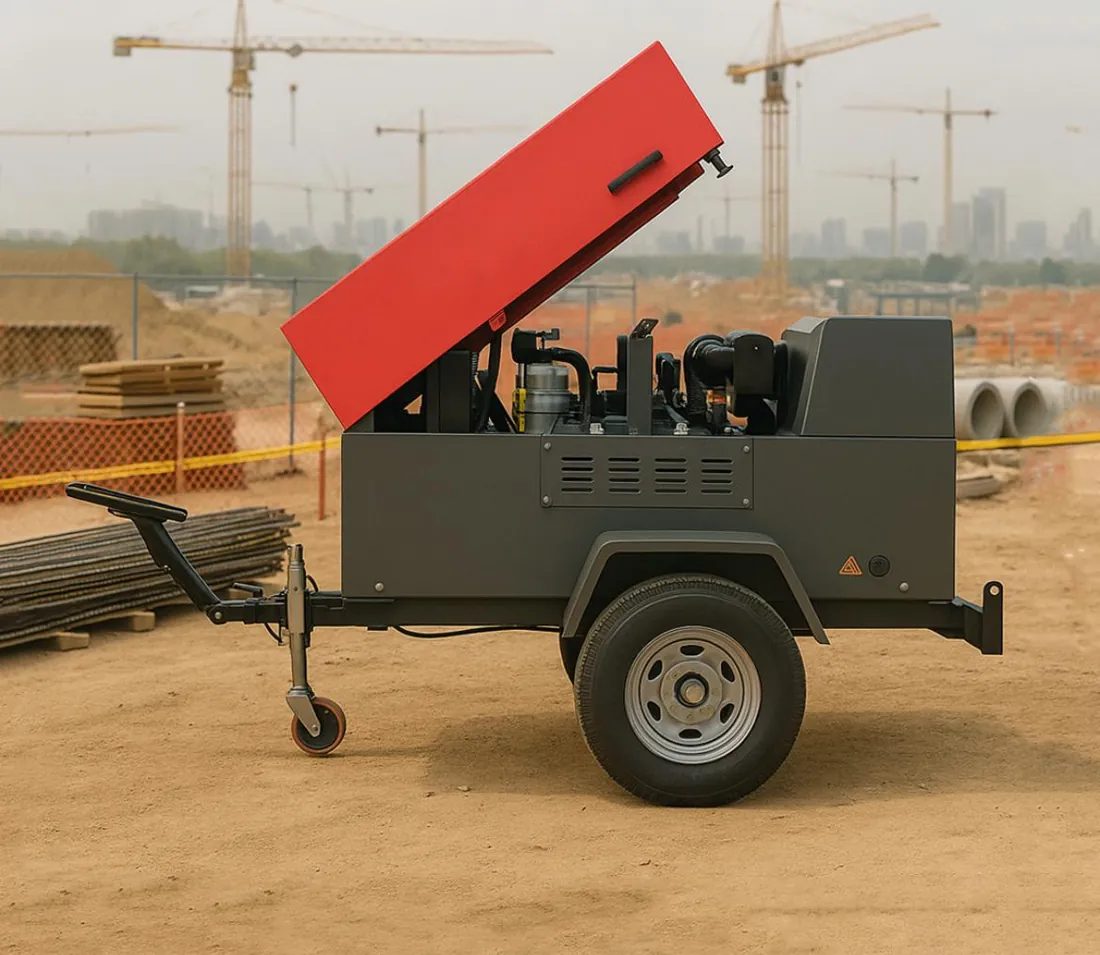
- Engine oil and filter. Level, condition, leaks and change interval. Diesel soot and dust both shorten oil life.
- Air intake. Engine air filter element, safety element, restriction indicator, hose clamps and any cracked ducting that lets unfiltered air in.
- Fuel system. Primary and secondary fuel filters, water separator bowl, fuel lines, tank cap and vent.
- Cooling. Coolant level and concentration, radiator core cleanliness, hoses, fan and fan belt.
- Electrical. Battery condition and terminals, charging alternator output, starter, wiring harness and engine protection switches for oil pressure and coolant temperature.
- Exhaust and turbocharger. Leaks, smoke colour, turbo oil leaks and abnormal noise.
Engine settings and service intervals come from the engine manufacturer’s data for that engine, not from the compressor’s book alone. We record both sets of hours where the machine has separate meters.
Compressor side: what we check
The airend side of a portable screw compressor fails in the same ways as a stationary one, usually faster because of heat and dust.
- Compressor oil level, grade and condition, and the oil filter
- Air/oil separator element and the scavenge line that returns oil from the separator
- Minimum-pressure valve, blowdown valve and safety valve
- Inlet valve and the regulation system that matches engine speed to air demand
- Thermostatic valve and oil cooler, so the airend runs at normal temperature, typically about 75–95 °C discharge on an oil-injected screw
- Compressor air filter and its restriction indicator
- Service valves, outlet manifold and any aftercooler or water separator fitted for site air
For the detail of screw airend service, separators and oil, see our rotary screw service and oil separator pages. Here we focus on what is different in the field.
Dust, heat and the cooling stack
On Indian construction sites, quarries and borewell jobs, dust is the biggest enemy of a portable compressor. It enters through two routes: the air filters, and the cooling air that the fan draws through the radiator and oil cooler.
A clogged cooler stack is the most common reason a portable compressor shuts down on high temperature in the afternoon. The engine coolant runs hot, the compressor oil runs hot, and the machine trips on whichever protection switch acts first. In a Telangana or Andhra Pradesh summer, with ambient air above 40 °C, there is very little margin left.
- Park the machine with its cooling air inlet away from the dust source and the prevailing wind, and away from walls that would make it breathe its own hot exhaust air.
- Check the air filter restriction indicators every shift on dusty work, and clean or change elements when they show restriction, not at a fixed date.
- Blow out the radiator and oil cooler from the clean side, using low-pressure air, and never use high-pressure water that bends fins.
- Check that all enclosure doors and seals are closed while running, because the cooling airflow is designed around a closed canopy.
- Look for oil film on the coolers, which traps dust quickly and points to a leak that needs repair.
Fuel quality and fuel handling on site
Diesel engines on portable compressors are sensitive to dirty and wet fuel. Fuel bought in drums, stored in open containers or decanted with dirty funnels carries dust and water straight into the injection system.
- Drain the water separator bowl at the start of every shift and whenever the warning light shows.
- Refuel from clean, closed containers or a proper bowser, through a filter if possible.
- Keep the tank reasonably full at the end of the day to reduce condensation overnight.
- Do not let the tank run dry. Air in the fuel system means bleeding the system before the engine will restart, and running dry can pull sediment from the bottom of the tank.
- Replace fuel filters at the interval, and earlier if the engine loses power at full load.
Our rental guide on fuel supply and refuelling explains how we plan fuel on longer hire jobs.
Hoses, couplings and site air safety
A portable compressor typically works at around 7 bar, and many high-pressure machines for drilling work at 10–35 bar. A failed hose at these pressures can whip violently and injure people. Hose and coupling checks are part of every visit.
| Item | What we look for | Action |
|---|---|---|
| Air hoses | Cuts, abrasion, bulges, crushing from vehicles, hose rated below the machine’s pressure | Replace damaged hose; do not tape or patch |
| Couplings and claw fittings | Worn lugs, missing seals, missing locking pins | Replace worn parts; fit locking pins |
| Whip restraints | Missing or loose safety cables across joints | Fit restraints at every coupling |
| Outlet valves | Leaks, stiff operation, damaged handles | Repair or replace before the next job |
| Hose routing | Hoses across roads, sharp edges, hot exhaust | Re-route, protect with ramps or sleeves |
Always close the outlet valve and vent the hose before disconnecting it. Never point a hose at a person or use it to clean clothing or skin.
Transport, running gear and the frame
Portable compressors take shocks that stationary machines never see. Every move loosens something. We check:
- tyres, wheel nuts, wheel bearings, axle and suspension on trailer-mounted machines;
- drawbar, towing eye, jockey wheel, parking brake and road lights where fitted;
- lifting eye and frame for cracks, and the mounts that carry the engine and airend;
- enclosure panels, hinges and latches; and
- loose pipes, clamps and wiring that have rubbed through after transport.
After every relocation, the machine should be set level on firm ground, with the parking brake on and the wheels chocked, before it is started.
Hire-fleet discipline: service by running hours
A portable compressor on hire is serviced by running hours, not by calendar date. A machine running round the clock on an urgent job can reach its service interval in under two weeks. If nobody is tracking hours, the service is missed.
On our own hire jobs we service every 300 running hours, with an oil change and full servicing at that point. On one round-the-clock coating job at a steel plant in Andhra Pradesh, we hired out a 450 cfm diesel compressor with operators on 12-hour shifts and kept the full maintenance, including the 300-hour oil change and breakdown support, in our own scope.
Good fleet discipline on any portable machine includes:
- A daily log of engine hours, fuel added, pressures, temperatures and any warnings.
- Shift-start checks by the operator: engine oil, compressor oil, coolant, fuel water separator, air filter indicators, hoses and leaks.
- Planned service visits booked ahead from the hour log, with filters and oil ready.
- A record of every part changed and every fault found, kept with the machine.
- A handover check when the machine moves to a new site or new operators.
How Reddy Compressors helps
We are an independent multi-brand compressor specialist at Tarnaka, Secunderabad, working with industry since 2002. We service portable diesel compressors from Atlas Copco, Ingersoll Rand, ELGi, Doosan, Chicago Pneumatic, Sullair and other makes, covering both the engine and the compressor sides of the package.
Our service teams cover the whole of Telangana and Andhra Pradesh. We supply compressors, rentals and spare parts across India, and provide project-based site support elsewhere where it is feasible. We can carry out field servicing on site, breakdown repair, filter and oil kits, separator and valve work, and hose and coupling replacement. We also hire out diesel and electric compressors from 50 to 2,000 cfm and 2 to 30 bar, with operators and maintenance where the job needs them.
Parts are identified from the machine’s make, model, serial number, nameplate photo or the old part, and we confirm fit before quoting.
What to send us
- Compressor make, model and serial number, with a photo of the nameplate
- Engine make and model, and the current hour meter reading
- Working pressure and the job the machine is doing
- The fault or service needed, with photos of warning lights or gauges
- Site location, access details and site contact
- Date of the last service and the parts changed, if known
Frequently asked questions
How often should a portable diesel compressor be serviced?
Service is based on running hours, using the compressor and engine manufacturers’ intervals for that machine. On our own hire jobs we change the oil and carry out full servicing every 300 running hours. Dusty, hot sites need more frequent air filter attention. Daily operator checks of oil, coolant, fuel water separator and filter indicators are essential between visits.
Watch
A short explainer on this topic
Slide-by-slide engineering explainers from Reddy Compressors. More in the video library.
Why does my portable compressor shut down on high temperature?
The usual cause is a radiator and oil cooler stack blocked with dust or oil film, which stops the fan from removing heat. Low coolant, a slipping fan belt, low compressor oil, a faulty thermostatic valve or open enclosure doors can also cause it. Parking the machine where it draws in its own hot air, or facing a dust source, makes the problem much worse in summer.
Why is my diesel compressor losing power and pressure?
On the engine side, check for blocked fuel filters, water in the fuel, a dirty engine air filter or a turbocharger problem, because a weak engine cannot hold full speed. On the compressor side, check the compressor air filter, inlet valve, regulation system and air leaks in hoses and couplings. If the engine runs at full speed but the air is low, the cause is on the compressor side.
What should an operator check before starting a portable compressor?
Before each shift, check the engine oil, compressor oil and coolant levels, drain the fuel water separator, check both air filter restriction indicators and look for leaks under the machine. Inspect hoses, couplings and whip restraints, make sure the outlet valves are closed, and confirm the machine is level, braked and chocked. Record the hour meter reading in the log.
Can you service a portable compressor on our site?
Yes. Our service teams work across Telangana and Andhra Pradesh, and most routine servicing, filter and oil changes, separator work and hose repairs can be done on site. Larger repairs, such as airend or engine overhaul, may need the machine brought to a workshop. Send us the make, model, hours, fault and site location and we will plan the visit.
What causes water in the fuel of a diesel compressor?
Water usually comes from contaminated fuel supplies, open drums or containers left in the rain, and condensation inside a tank left part-full overnight. It collects in the water separator bowl, which should be drained every shift. If it is not drained, water reaches the injection pump and injectors, causing poor running, power loss and costly damage.
Related pages
Technical content reviewed by D. Srinivas Reddy, Managing Partner and service engineer, Reddy Compressors. Last updated 17 October 2026. How our engineering content is reviewed.