
Where the heat comes from
Nearly all the energy a diesel engine puts into compressing air ends up as heat. In an oil-injected screw compressor, most of that heat is carried away by the oil injected into the airend. The engine adds its own heat through its coolant, charge air and exhaust. A portable package must reject all of this heat through its coolers into the surrounding air, continuously, in whatever conditions the site offers.
A typical diesel portable package contains several heat exchangers, depending on design:
| Cooler | What it cools | What happens if it fails |
|---|---|---|
| Compressor oil cooler | Oil returning to the airend | High discharge temperature, oil degradation, shutdown |
| Engine radiator | Engine coolant | High coolant temperature, engine damage, shutdown |
| Charge-air cooler (intercooler) | Turbocharged engine intake air | Power loss, high exhaust temperature, smoke |
| Fuel cooler (some engines) | Return fuel | Power loss on hot days |
| Air aftercooler (if fitted) | Delivered compressed air | Hot, wet air downstream |
Engine coolant temperature, compressor oil temperature and compressed-air outlet temperature are different measurements. A high reading in one does not mean the others are at fault, so identify the right circuit first. Cooling of the delivered air for downstream use is covered on our portable aftercoolers page.
How the cool box works
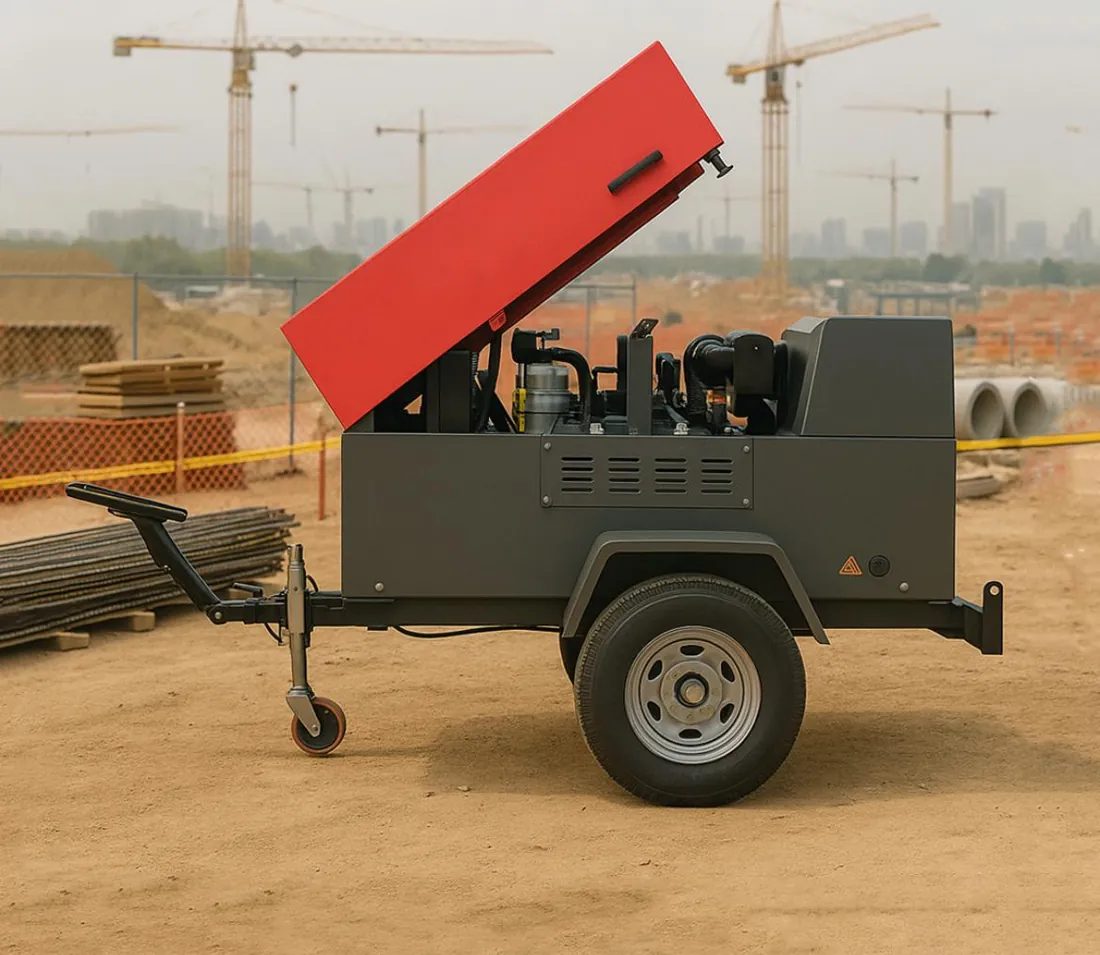
Most portables use a single engine-driven or electric fan that pulls or pushes ambient air through a stack of coolers inside an enclosed cool box. The enclosure guides airflow and reduces noise. The design depends on air entering through set openings, passing through every core, and leaving through the exhaust grille without short-circuiting.
- A thermostatic valve on the oil circuit lets cold oil bypass the cooler during warm-up, then sends it through the cooler once it reaches working temperature.
- The engine thermostat does the same for the coolant circuit.
- Canopy doors, seals and baffles are part of the cooling system. Running with doors open can reduce cooling, not improve it, because air takes the easy path around the cores.
Ambient temperature limits
Every machine has a maximum ambient temperature in its documentation, often with a separate figure for high-ambient versions. Ask for the limit for the exact model and configuration being offered. A brochure statement that a compressor is “suitable for hot climates” is not a limit.
In Telangana and Andhra Pradesh, shade temperatures of 45 °C are common in April and May, and the air around a machine standing on dark rock, tar or concrete in direct sun is hotter still. Inside a pit, a trench, beside a wall or in a tunnel, the machine may be breathing air that is several degrees above the local ambient. Add altitude for sites in hilly areas, which reduces cooling air density and engine power.
When a machine is close to its limit, protection systems start to act: discharge temperature rises towards the shutdown point, and electronic engines may derate power. The result is lost air, not just a warning lamp.
Siting the machine for good cooling
- Park on firm, level ground, with the cooling inlet facing the prevailing wind where possible.
- Keep at least the clearance the manual specifies around inlets and outlets; as a practical rule, never place the hot-air exhaust facing a wall, a container or another machine.
- Do not park two machines so one draws in the other’s exhaust.
- Keep the machine out of dust plumes from drilling, blasting, crushing or vehicle movement, and upwind of them where you can.
- Provide shade without enclosing the machine: an open canopy overhead is better than screens around it.
- In tunnels, basements and enclosed sites, plan ventilation for both the cooling air and the engine exhaust.
Dust: the main cooling enemy on Indian sites
Dust is the most common cause of overheating on portable compressors in India. Borewell drilling, quarrying, road works, blasting and dry red soil all load the fins of the coolers. Oil mist or fuel spills make dust stick, forming a mat that blocks airflow. The rise in temperature is gradual, so it is often noticed only when the machine trips.
- Inspect cooler faces daily on dusty sites.
- Blow out with compressed air from the clean side, against the normal airflow direction, with the machine stopped.
- Where oil and dust have formed a crust, wash with a suitable degreaser and low-pressure water; high-pressure jets bend fins.
- Check that the sandwich between stacked coolers is clean too, not only the outer face.
- Service the engine air filter and pre-cleaner more often in dusty work.
Cooling-system maintenance
| Item | What to check | Why it matters |
|---|---|---|
| Cooler cores | Dust, oil film, bent fins, leaks | Blocked cores are the main cause of high temperature |
| Compressor oil | Level, grade, condition and change interval | Low or degraded oil carries less heat and lubricates poorly |
| Thermostatic valve | Opening temperature and free movement | A stuck valve bypasses the cooler |
| Engine coolant | Level, mixture, leaks, hoses | Correct coolant protects against overheating and corrosion |
| Fan and drive | Belt tension, fan blades, bearings, shroud | Slipping belts and damaged fans cut airflow |
| Canopy seals and baffles | Missing seals, damaged panels | Air bypasses the cores |
| Temperature sensors | Readings against a reference, wiring | Faulty sensors cause false trips or hide real problems |
On our hire jobs, oil change and servicing are done every 300 running hours, with cooler cleaning more often where the site is dusty.
Planning for high-ambient summer duty
Before a machine goes to a hot site, compare the documented ambient limit with the real conditions it will face, including sun on the canopy and heat reflected from rock or concrete. Where the margin is thin, a machine with a higher-ambient rating, a larger frame running below its full rating, or a shift pattern that avoids the hottest afternoon hours may be more reliable than pushing a standard unit. Plan cooler cleaning into the daily routine, keep spare coolant and the correct grade of compressor oil on site, and make sure operators know which reading to watch and when to call for help. For round-the-clock work, schedule servicing so that it does not fall in the hottest part of the day.
Signs of a cooling problem
- Discharge temperature rising day by day under similar load and ambient.
- High-temperature warnings in the afternoon that clear at night.
- Engine power loss or derating messages on hot days.
- Oil carry-over increasing as the oil runs hotter and thinner.
- Coolant loss, steam or a sweet smell near the radiator.
- The machine running hot only after it has been moved to a new position.
The opposite problem also exists: a machine that runs too cool, for example lightly loaded for long periods with a faulty thermostatic valve, can collect condensed water in its oil, which shortens oil and bearing life.
How Reddy Compressors helps
Reddy Compressors, based at Tarnaka, Secunderabad, sells, rents and services portable compressors of ELGi, Atlas Copco, Ingersoll Rand, KAESER, Chicago Pneumatic, Doosan and other brands, as an independent multi-brand specialist rather than an authorised dealer.
- We consider site heat, dust and layout when we propose a machine, and advise on siting at mobilisation.
- Our rental fleet of 50–2,000 cfm at 2–30 bar includes machines for hard summer duty, with servicing every 300 running hours on hire.
- Our team of more than 20 service engineers and technicians cleans and restores coolers, replaces thermostatic valves, sensors, fans and hoses, and diagnoses overheating across Telangana and Andhra Pradesh.
- We supply cooling-system spares, identified from the machine’s make, model, serial number and nameplate, with fit confirmed before quoting.
- Machines, rentals and spares are supplied across India.
What to send us
- Compressor make, model, serial number and nameplate photo.
- Which temperature is high (discharge, engine coolant or other) and the reading or message shown.
- Ambient temperature, time of day and whether the machine is in sun or shade.
- Photos of the machine’s position and the cooler faces.
- Working pressure, load pattern and hours since the last service.
- For a new supply or hire: site location, duty, expected ambient and dust conditions.
Frequently asked questions
What is the normal operating temperature of a portable screw compressor?
On an oil-injected rotary screw compressor, discharge temperature is typically about 75–95 °C under normal load. Engine coolant temperature is a separate reading, usually shown on its own gauge. The exact normal values and shutdown points depend on the model, so check the manual. A steady rise over several days under similar conditions usually means the coolers are loading with dust or the oil needs attention.
Why does my diesel compressor overheat in summer?
In summer the cooling air is hotter, so the coolers have less margin. Add dust on the fins, direct sun on a dark surface, hot exhaust air recirculating, or parking close to a wall, and the machine reaches its shutdown limit. Clean the coolers, check oil and coolant levels, keep canopy doors closed and seals in place, and reposition the machine so it draws cool, clean air.
How do I clean a compressor oil cooler on site?
Stop the machine and let it cool. Blow compressed air through the core from the clean side, against the normal airflow, to push dust out the way it came in. If oil has bound the dust, use a suitable degreaser and rinse with low-pressure water, taking care not to bend the fins. Clean between stacked coolers as well, then check for leaks before restarting.
Should I open the canopy doors to keep the compressor cool?
Usually not. The canopy, seals and baffles are designed to force air through every cooler core. With doors open, much of the air takes the easy route around the coolers, and cooling can get worse. Keep doors closed during operation unless the manual says otherwise. Improve cooling instead by cleaning cores, siting the machine well and providing overhead shade.
What maximum ambient temperature can a portable compressor handle?
It depends on the model and configuration. Standard and high-ambient versions of the same machine can have different limits, and options such as aftercoolers may change them. Ask for the documented limit for the exact machine offered. Remember that the air around a machine in direct sun, in a pit or near a wall can be well above the local shade temperature.
Can a compressor run too cold?
Yes. If a compressor runs lightly loaded for long periods, or its thermostatic valve sticks open so oil always goes through the cooler, the oil may not get hot enough to drive off water vapour that condenses inside the separator tank. Water in the oil shortens oil life, harms bearings and can cause corrosion. A correctly working thermostatic valve and sensible loading prevent this.
Related pages
Technical content reviewed by D. Srinivas Reddy, Managing Partner and service engineer, Reddy Compressors. Last updated 17 October 2026. How our engineering content is reviewed.