
This page covers the 250–400 cfm class in depth. For the whole family of diesel portables, from compact 185 cfm units to large 600 cfm machines, start at our diesel portable compressors guide.
What counts as a medium portable compressor?
“Medium” is a working description, not a standard. Across the portable cluster on this site we use three consistent bands so that a site engineer can move between pages without the numbers changing:
| Class | Free air delivery | Typical pressure | Typical work |
|---|---|---|---|
| Compact | 185–250 cfm (≈5.2–7.1 m³/min) | 7 bar (101.5 psig), some 10 bar | One or two breakers, a small rock drill, a small blasting nozzle |
| Medium (this page) | 250–400 cfm (≈7.1–11.3 m³/min) | 7–10 bar (101.5–145 psig) | Two to four breakers, rock drills, No. 5 nozzle (No. 6 at 375–400 cfm), construction, plant maintenance, standby |
| Large | 400–600 cfm (≈11.3–17 m³/min) | 7–14 bar (101.5–203.1 psig), some higher | Crawler and quarry drilling, one No. 6–7 blasting nozzle, pipeline work, shutdown plant air |
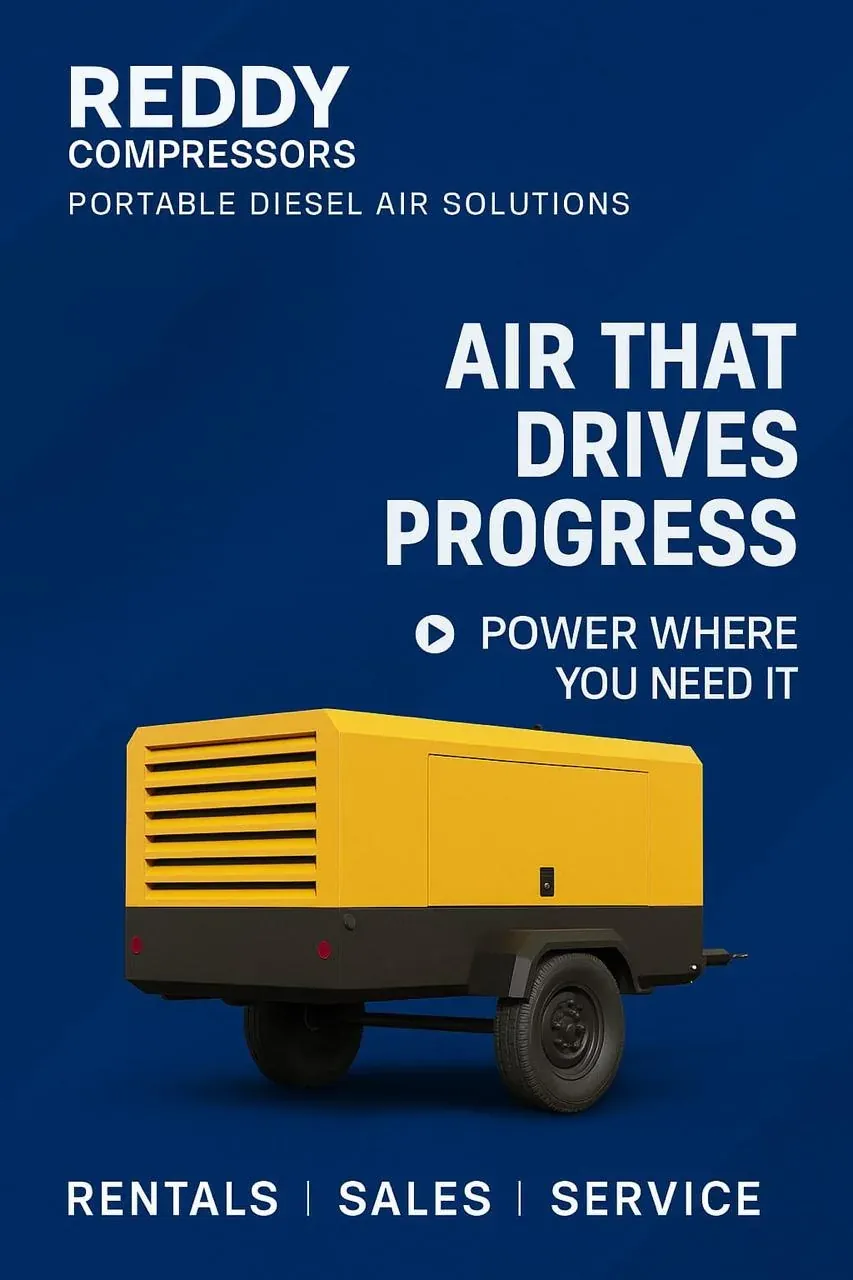
A medium machine is usually a single-axle or twin-axle trailer with a water-cooled diesel engine driving an oil-injected rotary screw airend through a direct coupling. The canopy is a sound-attenuated “cool box” that draws air over the oil cooler, engine radiator and, where fitted, an aftercooler. Many machines in this class are dual-pressure or variable-pressure: the operator can select 7 bar for tools or 10 bar for a drill or a longer hose run, at a lower flow. Treat the brochure flow and the brochure maximum pressure as two separate points, never as a pair.
Where the 250–400 cfm class earns its place
The class is popular because one machine covers most of the jobs a civil, mechanical or maintenance contractor meets in a month.
- Building and road construction: concrete breaking, chipping, demolition of foundations, trench work, scabbling and air for tampers and vibrators.
- Multiple breakers: two to four hand-held breakers or pick hammers running together on a road cut, canal lining or plant-floor demolition.
- Hand-held rock drills: drilling blast holes and anchor holes in rock cuts, channels and foundations with jackhammer-type drills and air-leg drills.
- Abrasive blasting: one No. 5 nozzle, or one No. 6 on a 375–400 cfm machine, for surface preparation on steel structures, tanks and pipe spools before coating.
- Plant maintenance and shutdowns: air for impact wrenches, grinders, needle scalers and pneumatic hoists when the plant’s own system is isolated.
- Plant standby: temporary air while a fixed screw compressor is under overhaul or breakdown repair, or while an air system is being extended.
What this class is not for: DTH borewell drilling. Down-the-hole hammers for water wells need far more flow and pressure – the separate 600–1,500 cfm class at 200–400 psig (13.8–27.6 bar). Equally, if a No. 6 nozzle must run with other tools, or a crawler drill is needed, step up to the large class.
How to size a medium portable: the method
Sizing is arithmetic on the tools, not a guess at a category. Use this sequence.
- List every air tool and its rated consumption at its working pressure, from the tool plate or manual. Note whether it runs continuously (blasting nozzle, rock drill in a drilling cycle) or intermittently (breaker, impact wrench).
- Decide how many tools truly run at the same time. Ask the site supervisor, not the purchase order. Four breakers on site does not always mean four breakers working together.
- Apply a usage factor for intermittent tools where the crew genuinely pauses; use no factor for blasting or continuous drilling.
- Add allowances: typically 10–15% for tool wear and leakage at couplings, and more if hoses are long, old or of small bore.
- Check pressure at the tool, not at the compressor. Add the pressure drop of the hose run to the tool’s working pressure and confirm the compressor can deliver the required flow at that discharge pressure.
- Allow for site conditions: high ambient temperature (40–45 °C in an Andhra Pradesh or Telangana summer, and above 45 °C on open sites), dust and altitude reduce margin. A machine running at the edge of its rating in May will trip on high discharge temperature.
- Pick the nearest machine above the result, then check fuel tank size against the shift length and the access route against the trailer size.
Worked sizing examples
The figures below are typical values used for planning. Always replace them with the consumption stated for your actual tools.
Example 1: three breakers on a road-widening job
Three medium hand-held breakers; breakers typically use 85–145 cfm each at about 7 bar (101.5 psig), so take about 100 cfm each. If all three work together: 3 × 100 = 300 cfm. Add about 15% for wear and coupling leaks: about 345 cfm. With 30 m of hose per breaker and summer heat, a 375–400 cfm machine at 7 bar gives a sensible margin. A 300 cfm machine would work in cool weather with new tools, but would sit at full load all day.
Example 2: one No. 6 blasting nozzle
A No. 6 nozzle (3/8 in, about 9.5 mm bore) typically consumes around 280–300 cfm at 100 psig (6.9 bar) when new. Nozzles wear quickly, and a worn bore can pass 30–50% more air before it is replaced. Add the blast pot, the operator’s breathing-air supply if it comes from the same machine, hose losses and an aftercooler pressure drop, and a 375–450 cfm machine is the realistic choice, so a 375–400 cfm unit sits at the top of this class. A No. 5 nozzle (5/16 in), typically around 195–210 cfm new, fits a 250–400 cfm machine. Use our abrasive blasting air demand calculator for your own nozzle and pressure.
Example 3: two rock drills plus a breaker
Two hand-held rock drills at about 110 cfm each plus one breaker at about 100 cfm (both within the typical 85–145 cfm per tool): roughly 320 cfm when all three run. With a 15% allowance this reaches about 370 cfm, so a 400 cfm machine at 7 bar is right. If the drill manufacturer asks for higher pressure for faster penetration, check the flow the machine actually delivers at that higher setting.
Example 4: standby air for a factory
A plant with a 37 kW fixed screw compressor (typically delivering around 200–230 cfm at 7 bar) needs temporary cover during an airend overhaul. A 250–300 cfm portable at 7–8 bar covers it, provided the plant line pressure and air quality are respected: portable discharge air is hot and wet, so an aftercooler, separator and sometimes a refrigerated dryer are needed before it enters a plant header.
Pressure: 7 bar or 10 bar?
Most construction tools are rated at 6–7 bar (87–101.5 psig). A 10 bar (145 psig) setting helps when hoses are long, when a rock drill penetrates faster with higher pressure, or when the duty is a test or purge at a stated pressure. The trade-off is flow and fuel: raising discharge pressure reduces the free air a given engine and airend can deliver, and raises fuel use per cubic metre of air. As a rule of thumb, every extra bar takes about 7% more power for the same flow. Do not run a 10 bar machine at 10 bar just because it can; set it to what the tool and hose actually need. Our 10 bar portable compressors page goes deeper.
What the machine has to survive on an Indian site
- High ambient heat: canopy air temperature can be well above shade temperature on a black-top road. Ask whether the machine is designed for high-ambient operation and keep the cool box clean. Normal oil-injected screw discharge is about 75–95 °C; persistent readings above that are a warning.
- Dust: crushing, demolition and quarry dust choke engine and compressor air filters and pack radiator fins. Pre-cleaners, daily filter checks and weekly cooler blow-down are not optional.
- Safety shutdowns: high compressor discharge temperature, low engine oil pressure and high engine coolant temperature must all work. Never bridge a shutdown to finish a shift.
- Fuel quality: water and dirt in site diesel cause injector and pump trouble. Use the water separator and drain it daily. Fuel use per hour depends heavily on load and pressure, so log it rather than assume it.
- Moisture: one 300 cfm machine on a humid day can produce many litres of condensate per shift. For blasting and painting, fit an aftercooler and moisture separator.
- Towing and positioning: check tow-hitch type, tyre and brake condition and level standing ground. Park upwind of dust and exhaust, away from the blasting area.
Comparing options inside the class
| Choice | Suits | Watch for |
|---|---|---|
| 250–300 cfm, 7 bar | Two or three breakers, a No. 5 nozzle, small plant standby | Little margin in summer or with worn tools |
| 300–375 cfm, 7–10 bar | Three or four breakers, rock drills, mixed tool sites | Confirm flow at the higher pressure setting |
| 375–400 cfm, 7–10 bar | One No. 6 nozzle (little wear margin), two rock drills plus breaker | Bigger trailer and fuel tank; check access |
| Fitted aftercooler | Blasting, painting, plant air feed | Extra pressure drop; drain the separator |
Narrower band pages: 250–300 cfm, 300–375 cfm and 375–450 cfm.
Rent, buy new or buy used?
Rent when the job is a defined period, when the duty is uncertain or when the machine would otherwise stand idle between contracts. Rental also moves servicing and breakdown risk away from the site. Buy new when the machine will work most days of the year for several years. A used or reconditioned machine fits a contractor who has mechanics, accepts a fuller inspection at purchase and wants a lower capital cost. Hours, airend condition, engine blow-by, cooler cleanliness and safety-shutdown function matter more than paint. See our rental engineering hub for how hire is set up.
Recent example from our own work: in February 2026 we supplied a 400 cfm diesel compressor with a 25 kVA DG set on rental to an infrastructure contractor at Raichur in Karnataka – a typical pairing where one site needs both tool air and power for lighting and small equipment.
Servicing a medium portable on hire
On our hire jobs the machine is serviced every 300 running hours: oil change and full servicing, filters checked or changed against condition. Daily checks belong to the operator: engine oil, coolant, compressor oil level, fuel water separator, air filter indicator, belts and hoses, and a walk-round for leaks. For faults on site, see diesel portable compressor troubleshooting.
How Reddy Compressors helps
We are an independent, multi-brand compressed-air business at Tarnaka, Secunderabad, serving industry since 2002. We sell, rent and service portable diesel compressors from ELGi, Atlas Copco, Ingersoll Rand, KAESER, Chicago Pneumatic, Doosan and others; we are not an authorised dealer of any brand. We have tie-ups with all major and reputed brands. Our own rental fleet includes diesel portables in this class, and for long-term projects we can supply brand-new machines to site.
- Sizing from your tool list and work sequence, with the pressure at the tool checked.
- Rental with operators where needed, servicing every 300 running hours, and breakdown support.
- New and used machine supply, with an inspection report for used units.
- Service, overhaul and spare parts identified from the nameplate, with fit confirmed before quoting.
- More than 20 service engineers and technicians covering all of Telangana and Andhra Pradesh; machines and spares supplied across India.
Call +91 99590 60718 or +91 92468 88812, WhatsApp +91 99590 60718, or email reddycompressors@gmail.com.
What to send us
- The tools: type, number and rated air consumption, and how many run together.
- Working pressure at the tool and the hose length and size.
- Site location, access route and whether the machine must be towed on site.
- Duty: hours per day, days per week and total period.
- Air quality needs (blasting, painting, plant feed) and whether a generator is also required.
- For service or spares: make, model, serial number, nameplate photo and running hours.
Frequently asked questions
What size compressor do I need for three jackhammers?
Breakers typically use 85–145 cfm each at about 7 bar (101.5 psig), so three running together need about 255–435 cfm. Add 10–15% for wear and coupling leaks, plus margin for long hoses and summer heat. For smaller breakers a 375–400 cfm machine at 7 bar is usually the sensible choice; for heavy ones, step up to the 400–600 cfm class. Check the actual consumption on your breakers’ plates.
Can a 375 cfm compressor run a No. 6 sandblasting nozzle?
Yes, but with little margin. A new No. 6 nozzle typically uses around 280–300 cfm at 100 psig, rising sharply as the bore wears. With the blast pot, hose losses, an aftercooler and a breathing-air supply, one No. 6 usually needs a 375–450 cfm machine. Replace nozzles before wear pushes demand beyond what the compressor can deliver at blasting pressure.
Is a 400 cfm compressor enough for borewell drilling?
Not for normal DTH borewell drilling. Water-well DTH hammers need much higher flow and pressure, typically 600–1,500 cfm at 200–400 psig (13.8–27.6 bar), to drive the hammer and lift cuttings from depth. A 400 cfm machine suits hand-held rock drills, breakers and blasting. For borewell work, look at a dedicated high-pressure drilling compressor instead.
Should I choose 7 bar or 10 bar for a construction compressor?
Choose by the tools. Most breakers, chippers and impact tools are rated at 6–7 bar, so 7 bar is normal. A 10 bar capability helps with long hose runs, some rock drills and pressure-stated tests. Running higher pressure than needed costs flow and fuel; about 7% more power is needed for each extra bar. A dual-pressure machine lets you set what the job needs.
How often should a diesel portable compressor be serviced?
Follow the maker’s schedule as the baseline. On our own hire jobs, machines are serviced every 300 running hours with an oil change and full servicing, and filters are checked against condition. In heavy dust, air filters and coolers need much more frequent attention. Operators should do daily checks of oil, coolant, fuel water separator, filter indicators, belts and hoses.
Is it better to rent or buy a 300 cfm diesel compressor?
Rent if the work is project-based, the duty is uncertain or the machine would stand idle between contracts; hire also covers servicing and breakdown support. Buy new if it will work most days for several years. A used machine suits contractors with their own mechanics who inspect carefully before purchase. Compare total cost over the expected period, not the monthly figure alone.
Related pages
Calculators and worked examples
These tools give indicative figures for screening, comparison and for preparing an enquiry. They run in your browser and send nothing. No prices or tariffs are assumed: enter your own to see costs. Efficiencies and other figures shown are example values: replace them with your own. Results are not a performance guarantee or a design certificate; final selection is confirmed by a service engineer against the machine data sheet and the site.
Compressed air demand estimate
Add up the air your tools and processes use, apply duty and simultaneity, then add leakage and growth allowances to reach a capacity to enquire about.
The worked example below shows the method with fixed numbers. Turn on JavaScript to change the inputs.
Worked example
Inputs
- Unit for the air each tool uses: L/s
- Group A: number of tools: 6
- Group A: free air each (in the unit above): 4
- Group A: duty (%): 40
- Group B: number of tools: 2
- Group B: free air each (in the unit above): 15
- Group B: duty (%): 60
- Group C: number of tools: 1
- Group C: free air each (in the unit above): 40
- Group C: duty (%): 80
- Simultaneity of all tools (%): 65
- Leakage allowance (%): 15
- Growth allowance (%): 10
Result
- Connected demand: 94 L/s = 199 cfm
- Average demand (duty-weighted): 59.6 L/s = 126 cfm
- Simultaneous peak: 61.1 L/s = 129 cfm
- Design basis (higher of average and peak): 61.1 L/s = 129 cfm
- Design capacity with allowances: 77.29 L/s = 4.64 m³/min = 163.8 cfm
Method. Average demand = Σ(number × air per tool × duty). Peak = Σ(number × air per tool) × simultaneity. The peak can never be lower than the average, so the design basis is the higher of the two. Design capacity = design basis × (1 + leakage) × (1 + growth).
What to take from it. Leakage and growth allowances move the answer as much as any single tool. Where you can, replace catalogue figures with measured ones.
Technical content reviewed by D. Srinivas Reddy, Managing Partner and service engineer, Reddy Compressors. Last updated 17 October 2026. How our engineering content is reviewed.
Abrasive blasting air demand
Estimate the air a blast nozzle takes, so the compressor and hose can be chosen to hold pressure at the nozzle.
The worked example below shows the method with fixed numbers. Turn on JavaScript to change the inputs.
Worked example
Inputs
- Nozzle bore (mm): 8
- Pressure at the nozzle (bar g): 7
- Discharge coefficient: 0.9
- Number of nozzles: 1
- Allowance for pot, hose and leaks (%): 10
Result
- Air demand, new nozzle: 4.69 m³/min = 166 cfm
- Nozzle number (bore in 1/16 inch): 5
- Air demand when worn one size (1/16 in larger bore): 6.74 m³/min = 238 cfm: size the compressor for this, then replace the nozzle
Method. Nozzle air treated as orifice flow at the nozzle pressure: free air = Cd × A × choked mass flow ÷ ρ₀. Venturi nozzles with an effective Cd near 0.9 are typical; use the supplier value. Add flow for the pot and for leaks. Nozzle numbers are the bore in sixteenths of an inch (No. 6 = 3/8 in = 9.5 mm). A nozzle wears larger in use, so size the compressor for the nozzle worn one size and replace it at that point.
What to take from it. A worn nozzle passes more air for less work. Check bore wear and keep the pressure at the nozzle, not at the compressor.