
How does a fixed-speed screw compressor control its output?
The motor of a fixed-speed compressor turns at its rated speed whenever it runs, set by the supply frequency and the number of motor poles. The airend therefore always has the same displacement. To match changing demand, the controller does not change speed. It changes state:
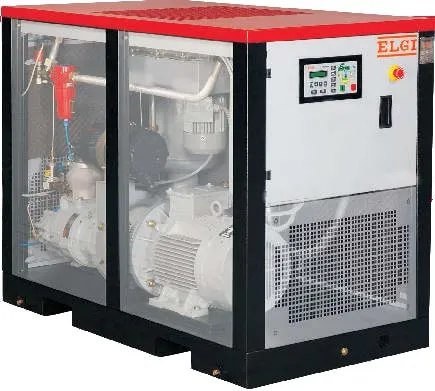
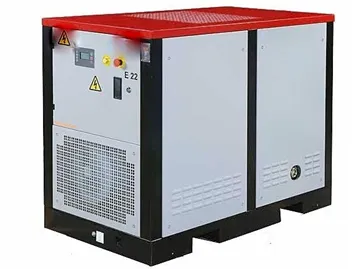
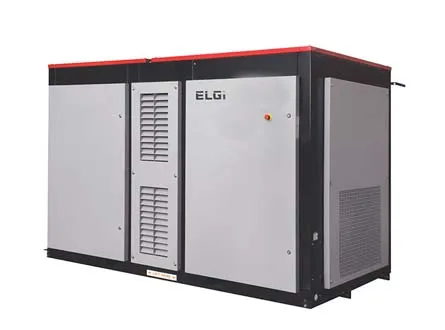
Representative images of machine types we sell, service and rent. Models and capacities are confirmed against your duty.
- Demand rises and header pressure falls to the load set point.
- The inlet valve opens fully and the compressor delivers its rated free air delivery (FAD).
- Pressure rises to the unload set point.
- The inlet valve closes, the separator vessel blows down to a lower pressure and the machine runs unloaded.
- If pressure falls again, it reloads. If it stays above the load point for the run-on time, the motor stops and waits in automatic standby.
Some fixed-speed designs also offer modulation, where the inlet valve partly closes to reduce output while running loaded. Modulation keeps pressure steadier but power falls much less than air output, so it is inefficient at low loads. Many controllers combine modes and switch automatically.
Is fixed speed old technology?
No. Fixed-speed screw compressors are simple, robust and lower in purchase cost than an equivalent VSD machine. At full load, a good fixed-speed machine can have specific power as good as or better than a VSD machine of similar size, because there are no inverter losses. Where demand is steady and high, there is little for a VSD to save.
The weakness of fixed speed is part load. An unloaded compressor still draws a significant fraction of its full-load power while producing no air, depending on the design and blowdown arrangement. So the question is not whether fixed speed is good or bad, but how many of its running hours are loaded.
- Fixed speed fits well when the machine is loaded for most of its running time.
- It fits as a base-load unit in a multi-compressor room.
- It suits sites with poor power quality where an inverter would need extra protection.
- It fits poorly as the only machine in a plant whose demand swings widely across the day.
Fixed speed or VSD: how to decide
| Factor | Fixed speed | VSD |
|---|---|---|
| Output control | Load/unload, sometimes modulation | Motor speed varies within a range |
| Best duty | Steady, high demand; base load | Variable demand; trim duty |
| Full-load efficiency | Good; no inverter losses | Good; small inverter losses |
| Part-load efficiency | Poor when unloaded for long periods | Good within the speed range; drops below minimum speed |
| Pressure band | Wider, set by load and unload points | Narrow, held close to a set point |
| Purchase cost | Lower | Higher |
| Electrical considerations | Starting current; star-delta or soft start | Harmonics, drive cooling, supply quality |
| Typical faults | Inlet valve, solenoid, blowdown valve, contactors | Inverter faults, cooling, parameters, sensors |
The deciding data is the demand profile. If logging shows that the plant uses close to the compressor’s capacity for most of each shift, fixed speed is usually the economic choice. If demand regularly drops to half or less, a VSD trim machine or a smaller fixed-speed unit to cover low-demand periods may pay back. Our VSD rotary screw compressors page covers the other side of this comparison.
Reading the controller: loaded hours tell the story
Every modern controller shows total running hours and loaded hours. Dividing loaded hours by running hours gives the loaded fraction, a quick indicator of how well the machine is matched to the plant.
- High loaded fraction: the machine is working productively; fixed speed suits it.
- Moderate loaded fraction: look at receiver size, pressure band and whether another machine is sharing the load badly.
- Low loaded fraction: the machine is oversized, running alongside too many others, or covering a lot of leakage. Investigate before buying anything new.
Also watch the number of motor starts per hour. Manufacturers limit starts to protect the motor and starter. Frequent starts usually mean the receiver is too small or the band too narrow for the demand pattern.
Base load, trim and the role of fixed speed
In a plant with several compressors, fixed-speed machines are best used to carry the steady part of demand. They run fully loaded for long periods, which is where they are most efficient. A VSD compressor, or a smaller fixed-speed machine, then follows the changing part of demand.
- Log demand to find the steady minimum and the variable band.
- Choose fixed-speed base-load capacity to cover the steady part without frequent unloading.
- Choose trim capacity to cover the variation, with enough range to bridge the step when a base-load machine starts or stops.
- Keep one machine on standby for critical processes.
- Use a sequencer to run the room on one narrow header pressure band.
See rotary screw compressor controls and sequencing for how roles and bands are set.
Storage and pressure settings
An air receiver gives a fixed-speed compressor time. With adequate storage, the machine loads and unloads less often, runs longer cycles and holds pressure better during short peaks. With too little storage, it cycles rapidly, starts the motor too often and the pressure swings across the whole band.
Pressure settings matter just as much. The unload point should be no higher than the plant needs, because each extra bar costs about 7% more power and increases leakage. A wide band saves cycles but raises average pressure. The best result usually comes from enough storage to allow a moderate band at the lowest workable pressure. See air receiver tank sizing.
Common faults on fixed-speed screw compressors
| Symptom | Likely cause | What we check |
|---|---|---|
| Will not load | Inlet valve stuck, solenoid fault, control air or pressure sensor fault | Inlet valve, solenoid, sensor reading, controller output |
| Will not unload, safety valve lifts | Inlet valve not closing, faulty pressure switch or transducer | Valve, sensor, set points, safety valve condition |
| Rapid load/unload cycling | Small receiver, narrow band, sensor in wrong place | Storage, band, sensor location |
| Oil carry-over after unloading | Blowdown too fast, separator issue, oil level high | Blowdown valve, separator, oil level |
| Motor tripping at start | Starter fault, low voltage, machine starting against pressure | Star-delta timer, contactors, supply, blowdown |
| High unloaded hours | Oversizing, too many machines running, leaks | Demand profile, sequence, leak survey |
The inlet valve, blowdown valve and starter work harder on a fixed-speed machine than on a VSD, because every load cycle uses them. Keeping these in good condition is central to reliability. Our rotary screw service page covers the full service scope.
Electrical supply and starting
Fixed-speed compressors are usually started star-delta, by soft starter or, on small units, direct on line. In many Indian industrial estates, supply voltage varies and can dip during the day. Low voltage at start increases current and can trip the motor or wear contactors. Practical points:
- Check supply voltage at the compressor terminals during starting, not just at the main board.
- Keep contactors, timers and overload relays in good condition.
- Ensure the separator has blown down before a restart, so the motor does not start against pressure.
- Protect against phase loss and reversal.
- Where a DG set supplies the compressor, size it for the starting current; our sister business Reddy Generators, under the same management, can advise.
How Reddy Compressors helps
Reddy Compressors, at Tarnaka, Secunderabad, has served industry since 2002. We are an independent multi-brand specialist, not an authorised dealer of any manufacturer. We have tie-ups with all major and reputed brands. We sell new and used/refurbished fixed-speed screw compressors, rent them from our own fleet and service machines of ELGi, Atlas Copco, Ingersoll Rand, KAESER, Chicago Pneumatic and other brands.
- Advice on whether fixed speed, VSD or a mix suits your demand profile.
- Reading controller hours, set points and start counts to spot oversizing and control problems.
- Inlet valve, blowdown valve, solenoid, sensor and starter repairs.
- Used/refurbished fixed-speed machines as a cost-effective base-load option where they suit the duty.
- Rental compressors to cover breakdowns, peaks or trials before a purchase.
- Spare parts identified from the nameplate and confirmed for fit before quoting.
Our more than 20 service engineers and technicians cover all of Telangana and Andhra Pradesh, and we supply equipment, rentals and spares across India. Call +91 99590 60718 or +91 92468 88812, or email reddycompressors@gmail.com.
What to send us
- Make, model, serial number and a nameplate photo.
- Rated FAD and working pressure, with load and unload set points.
- Total and loaded hours from the controller.
- Receiver size and position.
- Typical demand pattern across shifts.
- Any fault codes or symptoms.
Frequently asked questions
Is a fixed-speed screw compressor less efficient than a VSD compressor?
Not always. At full load a good fixed-speed compressor can be as efficient as a VSD machine, because it has no inverter losses. It loses out at part load, when it runs unloaded and draws power without producing air. If your demand is steady and the machine stays loaded most of the time, fixed speed is often the better economic choice.
How do I know if my fixed-speed compressor is oversized?
Compare loaded hours with total running hours on the controller. A low loaded fraction, frequent unloading or many motor starts per hour suggest the machine is larger than the demand, or that leakage and control settings need attention. Logging pressure and power for a typical week gives a clear picture before you decide on a smaller or VSD machine.
What does unloaded running mean on a screw compressor?
Unloaded running means the motor is turning but the inlet valve is closed, so the compressor delivers no air to the plant. The separator vessel blows down to a lower pressure to reduce power, but the machine still draws a significant share of its full-load power. After a run-on time, the controller stops the motor if demand does not return.
Can I use a fixed-speed and a VSD compressor together?
Yes, and this is often the best arrangement. Fixed-speed machines carry the steady base load fully loaded, while the VSD compressor trims to follow changing demand. Size the VSD so its speed range covers the step between base-load machines, and use a sequencer to hold one narrow header pressure band so the machines do not fight each other.
Why does my compressor keep loading and unloading every few seconds?
Rapid cycling usually means there is too little receiver storage, the pressure band is very narrow, or the pressure sensor sits where it sees sharp local swings. A leaking inlet or blowdown valve can also cause it. Check storage volume, set points and sensor position first. Rapid cycling wears valves and contactors and wastes energy.
Is a used fixed-speed screw compressor a good buy?
It can be, if it suits your duty and its condition is verified. Check running hours, service history, airend noise and vibration, oil and separator condition, and the controller and starter. A used fixed-speed machine can work well as a base-load or standby unit. We supply used/refurbished machines and test-run each one under load before you buy.
Related pages
Technical content reviewed by D. Srinivas Reddy, Managing Partner and service engineer, Reddy Compressors. Last updated 17 October 2026. How our engineering content is reviewed.