
An oil-free screw proposal needs a documented compressor configuration, a defined operating duty and a practical installation plan. Start with the actual package being offered. A technology label does not establish its stage arrangement, cooling system, control range, maintenance requirements or performance at your operating pressure.
This page covers the machine and its operating envelope. For contamination requirements, downstream treatment and acceptance at the process, use Specifying Process Air from Oil-Free Screw Systems.
Establish the mechanical identity
Record the manufacturer, model, configuration and document revision. Ask the supplier to identify the compression arrangement and describe what its oil-free designation covers. Do not infer internal materials, rotor coatings, sealing arrangements or lubrication boundaries from the product-family name. Those details belong in the model documentation.
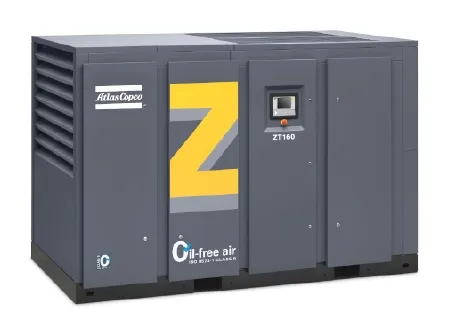
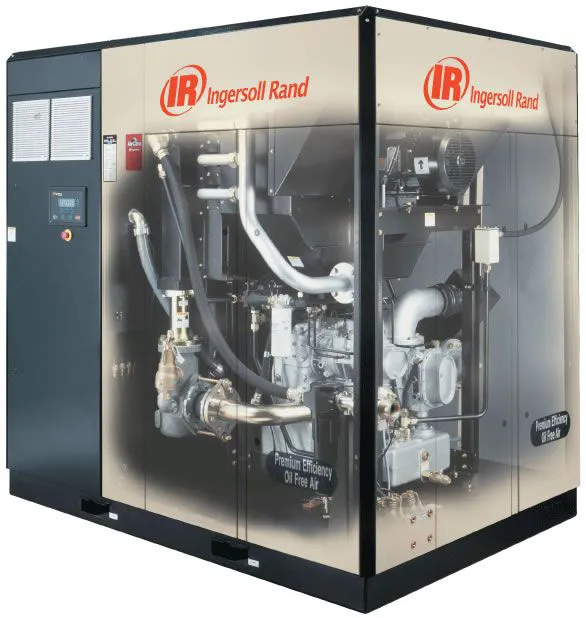
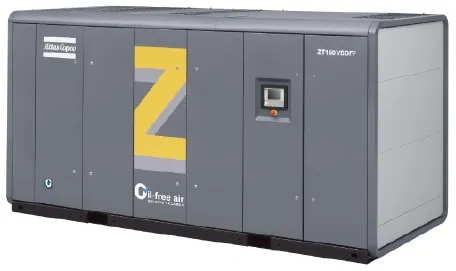
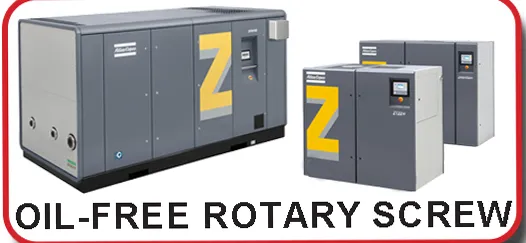
Representative images of machine types we sell, service and rent. Models and capacities are confirmed against your duty.
The review should distinguish the compression element from the complete package. Obtain information on the drive, cooling equipment, controls and auxiliary systems as well as the airend. Where a proposal is unclear, record an open technical question rather than assuming that two packages are equivalent.
Compare performance at the required duty
Put delivered airflow, operating pressure and stated reference conditions beside one another. A motor rating alone is not a capacity comparison. Ask what the quoted power value includes and whether the proposed package will be compared at the same operating conditions as the alternative.
Use the site's demand record to identify minimum, normal and peak operation. Separate a short peak from a load that must be supplied for a full shift. The purpose is to assess the proposed package against the actual operating pattern, not to select the largest catalogue rating.
Package question | Evidence to request | Decision it supports |
|---|---|---|
What air can it deliver? | Model performance data at the required pressure | Capacity comparison |
Under what conditions? | Reference conditions and applicable corrections | Site suitability |
What power boundary is used? | Definition of package and auxiliary input | Comparable energy assessment |
How does it respond to changing demand? | Control description and operating range | Fit with the demand profile |
What limits apply? | Manufacturer operating restrictions | Acceptable duty envelope |
Review stages, controls and cooling separately
Do not use oil-free as a shortcut for single-stage, multi-stage, air-cooled or water-cooled. Record each variable from the selected model. Compare fixed-speed, variable-speed or other available control arrangements using the actual duty and manufacturer data.
Where several machines will operate together, include the sequencing arrangement and the intended role of each unit. Avoid evaluating one compressor in isolation from the rest of the plant. A proposed standby arrangement also needs a defined continuity requirement and an operating plan.
Cooling deserves an installation review of its own. Identify the required utilities, environmental limits, access and interfaces from the package documentation. Verify that the site can provide them before treating the equipment selection as complete.
Check maintainability before order
Obtain the maintenance schedule for the actual package. Identify the tasks, access spaces, consumables, specialist tools and planned service interruptions. Do not transfer an oil-injected machine's maintenance schedule to an oil-free model merely because both use screw compression.
Ask how the operating team will record pressure, temperature, running hours, alarms and other available condition information. Monitoring requirements should lead to a maintenance or operating decision; a long list of signals is not itself a reliability plan.
Close the interface with process-air engineering
The compressor-package review and the process-air review should exchange requirements. The package reviewer needs the required flow, pressure and operating profile. The process reviewer needs documented machine characteristics and the proposed treatment interfaces. Neither review should imply that the compressor label alone proves the final air condition.
Before ordering, assemble a comparison record containing the duty sheet, selected model documents, performance basis, control arrangement, cooling requirements, maintenance plan and unresolved exceptions. Keep commercial availability and service responsibility separate from the technical comparison.
Request a package review
Provide the proposed model, operating pressure, airflow requirement, working hours, demand profile and installation information. The review can then identify which package questions are supported by documents and which still need supplier clarification.
Oil-free is a technology decision
Oil-free rotary screw compressors should not be treated as:
“A normal screw compressor with the oil removed.”
Oil-free screw compressors use a fundamentally different compression arrangement from oil-injected systems and should be treated as a separate technology-selection pathway where air-quality or process requirements justify it.
The correct selection question is not:
“Do we want an oil-free compressor?”
“What contamination risk and air-quality condition does the process actually require?”
Only then should oil-free rotary screw technology be evaluated.
START WITH THE PROCESS—not THE COMPRESSOR LABEL
The existing Reddy Compressors architecture repeatedly defines air quality from the process backwards.
It instead classifies compressed-air use as:
- Non-Product-Contact Utility Air
- Indirect Process Air
- Direct Product / Packaging Contact
- with progressively different contamination-risk considerations
- That same philosophy governs oil-free compressor selection
Before specifying technology, define:
- Where the air goes
- What it contacts
- What contaminants matter
- What acceptance criteria apply
The air-quality decision chain
Clearly:
COMPRESSOR TECHNOLOGY ALONE DOES NOT DETERMINE FINAL POINT-OF-USE AIR QUALITY.
What oil-free rotary screw should mean on
It should not automatically become a claim of:
- Food Compliance
- Pharmaceutical Compliance
- FDA Compliance
- GMP Compliance
- Sterile Air
- Zero Contamination
- Guaranteed Point-of-Use Purity
- Those are wider process or compliance claims requiring their own evidence
01 — the compression architecture is different
What the current source does establish is:
- oil-free screw compression is fundamentally different from oil-injected screw compression;
- it should be treated as a separate technology decision;
- selection should be driven by air-quality or process requirements.
Model-specific internal architecture should be added later only from verified manufacturer documentation.
02 — air quality is the starting point
Oil-free selection becomes relevant when the customer has a genuine reason to reduce contamination risk associated with the compression process.
These are specifically identified as relevant customer-requirement parameters in the Reddy Compressors air-quality evidence framework.
So the technology decision should begin with measurable requirements.
03 — utility air, instrument air & process air are different conversations
The distinction:
- Air supporting instrumentation and controls
- Air that may interact directly or indirectly with manufacturing or product
- These categories can require materially different specifications
- Oil-free technology may be relevant to some of those applications
- It should not automatically be assumed necessary for all of them
04 — food & beverage applications
Against the broad statement:
“Food plants must always use clean, dry, oil-free air.”
Instead, it requires the application to be classified by how compressed air interacts with the process.
Non-Contact Utility Air
Air used by ordinary actuators or mechanical equipment without product contact.
Air affecting packaging or production environment.
Direct Product / Packaging Contact
Applications requiring more demanding contamination-risk review.
The plant's engineering, quality and regulatory requirements should define the appropriate specification.
05 — pharmaceutical & chemical applications
The distinction:
- Utility Air
- Instrument Air
- Process Air
within chemical and pharmaceutical facilities and states that these may require materially different air-quality requirements.
Potential specification areas can include:
- - particles
- - water
- - oil
- - dew point
- - microbiological risk where relevant
- - point-of-use condition
- The site quality or process team should define acceptance criteria
Oil-free compressor selection can then be evaluated against that documented requirement.
Paint-quality air can be sensitive to:
- Moisture
- Oil
- Particles
- Pressure Stability
DO NOT ASSUME AN “OIL-FREE COMPRESSOR” ALONE GUARANTEES PAINT-QUALITY AIR.
This is a powerful general lesson.
Compressor technology is one layer.
The complete air path still matters.
07 — cnc & machine tools
Instead, the machine manufacturer's compressed-air requirement should define the treatment strategy.
The engineering requirement remains specific to the equipment and process.
08 — the complete air-quality chain
The air-quality chain as:
The final specification should be established where the air actually reaches or contacts the process.
Oil-free does not remove the need for drying
Atmospheric air contains water vapour.
Compression does not eliminate it.
When compressed air cools, moisture can condense.
The Reddy Compressors treatment architecture specifically identifies potential consequences such as:
- - corrosion
- - water in tools
- - instrumentation problems
- - process contamination
- - product-quality issues
Therefore oil-free compression does not remove the need to evaluate:
- Aftercooling
- Moisture Separation
- Drainage
- Drying
Oil-free does not remove the need for filtration
Atmospheric air also contains particulates and other contaminants depending on the environment.
Filtration may target:
- - particulates
- - liquid contamination
- - aerosols
- - fine downstream contamination
The specific treatment train should therefore follow the point-of-use requirement.
09 — point-of-use air quality
A common mistake is to define air quality only at compressor discharge.
In practice:
AIR QUALITY SHOULD BE DEFINED AT THE POINT OF USE.
That is because pipework, storage, downstream equipment and environmental conditions can all influence what finally reaches the process.
Compressor technology is important
- Point-of-use verification is more important
- 10 — air-quality claims require air-quality evidence
The Reddy Compressors evidence framework is particularly strict on this issue.
The older source contained a food-processing claim involving “ISO-certified oil-free” equipment and broader contamination/compliance results.
Those outcomes should remain unpublished because the supplied evidence does not establish them.
That creates a critical rule:
Oil-free technology ≠ verified process compliance
11 — how air-quality results should be verified
Possible evidence such as:
- Dew-Point Measurements
- Particle Testing
- Oil-Content Testing
- Laboratory Reports
- Filter Records
- Differential-Pressure Records
- Customer Quality Records
and states that the measurement method and sampling location should be identified.
So a credible oil-free project case study should show:
Requirement
→ SYSTEM
→ MEASUREMENT
→ RESULT
Oil-free compressor installed → “compliant.”
12 — compliance language must remain controlled
Against automatically publishing:
merely because compressed-air equipment has been installed.
A more defensible statement is:
“The compressed-air system was configured against the customer's documented air-quality requirement.”
Then, if a recognised class or result is genuinely measured and verified, publish the:
- Specification
- Measurement Method
- Testing Body
- Date
- Sampling Point
- where available and approved
13 — flow still matters
Air quality does not replace basic compressor sizing.
Oil-free rotary screw selection still requires:
Oil-free is not a substitute for correct sizing
14 — pressure still matters
The actual process requires a minimum usable pressure.
Pressure may be lost across:
- Aftercoolers
- Dryers
- Filters
- Valves
- Piping
- Fittings
- Hoses
- Regulators
The system should therefore be designed backwards from point-of-use pressure rather than simply specifying a higher compressor discharge pressure.
This principle applies equally to oil-free and oil-injected systems.
15 — demand profile still matters
An oil-free compressor may serve:
- - stable base demand
- - variable process demand
- - shift-based demand
- - continuous production
- - multiple departments
The control architecture should therefore consider:
- Minimum Demand
- Average Demand
- Peak Demand
- Operating Hours
- Future Demand
- Criticality
- Oil-free technology does not eliminate the need for demand analysis
16 — fixed speed or VSD?
Oil-free technology and control technology are separate decisions.
A plant can still need to determine whether the demand profile is better suited to:
Multiple-Compressors with Base / Trim Sequencing
The source philosophy remains:
The demand curve should drive the control decision
No universal VSD savings percentage should be applied.
17 — single or multiple compressors?
Where air quality is critical, reliability may be as important as purity.
The review should ask:
- What happens if one compressor stops?
- Can essential production continue?
- Is standby capacity required?
- Is redundant treatment required?
- Can temporary air meet the same air-quality requirement?
- Is maintenance possible without process interruption?
The required level of redundancy depends on process consequence.
18 — redundancy in sensitive processes
Instrument air can become production-critical and that possible system architecture may involve:
- Redundant Compressors
- Redundant Treatment
- Receivers
- Pressure Monitoring
- Alarms
- Backup Strategy
Oil-free technology should be designed inside a reliability architecture where the process requires it.
19 — temporary air & continuity
If an oil-free compressed-air system is critical to production, temporary replacement cannot be planned only by:
The temporary system may also need to meet the required:
- Air Quality
- Treatment
- Connection Cleanliness
- Distribution Conditions
- This makes oil-free continuity planning a complete system problem
- Oil-free rotary screw equipment still depends on appropriate installation
- Ventilation
- Cooling
- Electrical Infrastructure
- Foundation
- Piping
- Service Access
- Treatment Layout
- Receiver Arrangement
- Drainage
The broader rotary architecture states that compressor rooms are part of the machine's operating environment and that poor ventilation can compromise otherwise capable equipment.
Air-quality technology does not make installation discipline optional.
Larger rotary screw installations can use air-cooled or water-cooled arrangements depending on manufacturer and design and that cooling architecture should be evaluated using model-specific performance information.
22 — single-stage vs multi-stage
Screw compressors may use single-stage or multi-stage arrangements depending on manufacturer, pressure and application and warns against assuming that more stages are always better.
For oil-free rotary screw systems, final stage architecture must therefore be treated as model-specific.
The comparison should be based on verified:
- FAD
- Pressure
- Specific Power
- Cooling
- Maintenance
- Lifecycle Cost
- rather than stage count alone
- Air-quality requirements can justify more complex compressed-air architecture
- That makes energy review important
- Specific Power
- Working Pressure
- Demand Profile
- Control Range
- Operating Hours
- Treatment Pressure Drop
- Cooling Requirement
- Lifecycle Cost
- But do not compromise required air quality merely to minimise energy use
The correct objective is:
Required air quality + required reliability + lowest practical system burden
24 — filter & dryer pressure drop
Air treatment is essential where the process requires it.
But restricted treatment equipment can create energy penalties.
Restricted filters can increase pressure loss and should be monitored according to manufacturer recommendations, differential pressure, operating condition and contamination load.
Air-quality control and energy management must be engineered together
Oil-free does not mean maintenance-free.
The wider rotary screw service architecture states that rotary compressor reliability depends on disciplined management of:
- Clean Inlet Air
- Cooling
- Controls
- Mechanical Transmission
- Electrical Operation
- with exact service requirements remaining manufacturer- and model-specific
Where supported by the actual compressor, useful operating information can include:
- Pressure
- Temperature
- Motor Current / Power
- Operating Hours
- Service Hours
- Alarms
- VSD Speed
- Network Status
- The purpose is not to display more numbers
It is to recognise developing operating changes and improve maintenance decisions.
27 — air-quality monitoring
For contamination-sensitive processes, compressor monitoring alone may not be enough.
The evidence framework indicates that system verification may require appropriate:
- - dew-point measurement
- - particle testing
- - oil-content testing
- - laboratory or customer quality records
- are related but different activities
Even if the compressor and treatment package perform correctly, the distribution network remains part of the final air-quality chain.
Pipework condition, storage and downstream contamination therefore matter.
Point-of-use results cannot be inferred from compressor technology alone.
29 — OIL-FREE vs OIL-INJECTED
The correct comparison is not:
The correct comparison is:
Which compression architecture, together with the required treatment system, best matches the process requirement?
Oil-injected technology may be appropriate for many general industrial duties.
Oil-free technology may be justified where the documented process requirement makes compression-side contamination control materially important.
30 — no automatic industry rules
The process requirement comes first.
31 — selection information to provide
For an oil-free rotary screw enquiry, provide where possible:
What does the air contact?
At point of use.
Documented Air-Quality Requirement
Particles • Water • Oil • Dew Point • Other process criteria.
Current technology and model.
Piping arrangement and point of use.
What happens if air is lost?
Ambient, ventilation, utilities and location.
If the process specification is not yet defined, that is the first gap to resolve.
32 — what must be verified before order
Before final equipment selection, verify:
- Manufacturer
- Model
- Compression Architecture
- Rated FAD
- Working Pressure
- Control Type
- Cooling Arrangement
- Electrical Requirements
- Installation Requirements
- Treatment Requirements
- Current Availability
- Manufacturer Documentation
If a specific air-quality or compliance claim is important, verify the corresponding documentation separately.
34 — case-study standard for oil-free systems
When Reddy Compressors eventually publishes an oil-free air-quality case study, the evidence should define:
How did air interact with the process?
What air-quality criteria applied?
What compressor and treatment system existed?
What equipment/system changed?
What was measured and where?
What result can actually be demonstrated?
The oil-free selection gate
Before recommending oil-free rotary screw technology, ask:
Application
What exactly does the compressed air do?
Contact
Does the air contact product, packaging, instrumentation or sensitive process equipment?
Air quality
What specification has the customer defined?
FLOW
What FAD is required?
Pressure
What pressure must reach the point of use?
DUTY
How many operating hours and what demand profile?
Treatment
What drying and filtration remain required?
Distribution
Can downstream piping preserve the required condition?
Reliability
What happens if the system becomes unavailable?
Verification
How will point-of-use air quality be confirmed?
Compliance
What documentation or external validation is required?
Only after these questions are resolved should a final machine be selected.
Oil-free rotary screw in one line
Use oil-free technology when the process requirement justifies the different compression architecture
Then engineer and verify the complete air-quality system to the point of use
Oil-free is not the end of the air-quality conversation
It is one decision inside a larger chain:
Compressor technology alone does not determine final point-of-use air quality.
Compressed air. engineered for uptime
- Define the process
- Define the air quality
- Select the technology
- Engineer the treatment
- Protect the distribution
- Verify at the point of use
- Primary CTA
Discuss an Oil-Free Compressed-Air Requirement
Secondary CTAs
Compare Oil-Free vs Oil-Injected
Discuss Air Treatment
Review Process-Air Requirements
Request Rotary Screw Selection
Explore Air-Quality Engineering