
How each technology compresses air
Both are positive-displacement machines: they trap a volume of air and reduce it.
A reciprocating compressor uses a piston moving in a cylinder, driven by a crankshaft. Suction and delivery valves open and close each stroke. Air is delivered in pulses, and each stage handles a limited pressure ratio, so higher pressures use two, three or four stages with intercooling. See how a reciprocating compressor works.
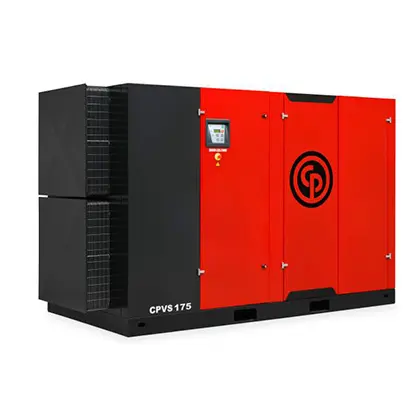
A rotary screw compressor uses two meshing helical rotors in a casing. Air is drawn in at one end, trapped between the lobes and squeezed as the pockets move along the rotors. In oil-injected machines, oil cools, seals and lubricates the compression, so heat is removed as it is made and the machine can run loaded continuously. Delivery is smooth, without pulsation. See how rotary screw compression works.
Side-by-side comparison
| Factor | Reciprocating (piston) | Rotary screw (oil-injected) |
|---|---|---|
| Duty | Intermittent; manufacturer limits on loaded time and starts per hour | Designed for continuous loaded running |
| Typical capacity range | Small to medium for plant air; large in process and high-pressure duty | Medium to very large plant air |
| Pressure | About 7–12 bar common; multi-stage up to 30–40 bar and beyond | Mostly about 7–13 bar; special high-pressure screws higher |
| Delivery | Pulsating; needs receiver | Smooth, steady |
| Discharge temperature | Higher per stage; intercooling and aftercooling matter | Typically about 75–95 °C before the aftercooler |
| Noise and vibration | Higher; foundation and guarding needed | Lower; usually enclosed package |
| Part-load control | Start-stop or unloading | Load-unload, modulation or variable speed |
| Purchase cost | Lower at small sizes | Higher at small sizes; competitive at larger sizes |
| Maintenance | Valves, rings, packing, bearings, belts; simple and repairable locally | Oil, oil filter, separator, air filter at intervals; airend overhaul much later in life |
| Oil carry-over | Rises as rings wear | Low with a healthy separator |
These are typical characteristics. Individual models vary, so compare actual machines from their data.
Duty cycle: the most important difference
Duty cycle is the share of time the compressor runs loaded. Piston compressors build heat in the cylinders and valves with every stroke, and many small and medium units are designed for intermittent use. Running them loaded for most of the shift raises temperatures, carbons valves, increases oil carry-over and shortens ring and valve life.
A screw compressor removes compression heat continuously through its oil system and cooler, so it is happiest loaded for long periods. It is less suited to very low use with frequent short runs, where it may not reach normal oil temperature and moisture can condense in the oil.
A simple test: log how many hours a day the plant actually needs air and how much of that time the compressor is loaded. If the answer is most of the shift, a screw compressor is usually the stronger candidate. If the compressor sits idle for long periods with short bursts of demand, a piston machine is often enough.
Pressure: where pistons still lead
For general plant air at about 7–10 bar (101.5–145 psig), both technologies work. Above that, the picture changes:
- 10–13 bar (145–188.5 psig) – two-stage pistons and higher-pressure screws both available.
- 15–40 bar (217.6–580.2 psig) – multi-stage piston compressors and boosters dominate, for example PET blowing, testing, engine starting air and some process duties. See high-pressure reciprocating compressors.
- Portable high-pressure drilling air – here, two-stage oil-injected screws on diesel packages are standard, for example borewell compressors at 200–400 psig (13.8–27.6 bar).
Energy and lifecycle cost
Over a typical service life, electricity usually costs far more than the compressor itself. Compare like with like using specific power: input kW per m³/min of free air delivery (FAD) at the same pressure and reference conditions. A cheaper machine that uses more kWh per m³ can cost more within a short period of running.
Points to weigh:
- Part-load efficiency. A fixed-speed screw running unloaded for long periods still draws significant power. Variable-speed drives or a smaller trim machine help with variable demand.
- Wear and performance decline. A piston compressor’s FAD falls as valves and rings wear; a screw compressor holds output well until airend wear or separator problems appear.
- Pressure setting. About 7% more power is needed for each extra bar. Both technologies benefit equally from lower, stable pressure.
- Heat recovery. Oil-injected screws make heat recovery for hot water straightforward. See heat-recovery screw systems.
- Maintenance cost. Piston parts are inexpensive and repairs are simple; screw service parts are routine, but an airend overhaul is a major item later in life.
Our lifecycle cost comparison calculator sets out the method using kWh, running hours and service items.
Air quality and treatment
Oil-injected screw compressors and oil-lubricated pistons both put some oil into the air, and both produce water. A healthy screw separator keeps oil carry-over low and stable. In a piston compressor, carry-over increases as rings and liners wear, so filters load faster later in life.
Both normally need an aftercooler, separator, refrigerated or desiccant dryer and filtration matched to the application. Where oil must be excluded, oil-free versions exist in both families: oil-free pistons for small and high-pressure duties and dry or water-injected screws for larger plant air. See our oil-free compressors hub.
How to choose: a practical method
- Measure or estimate demand. FAD needed at the point of use, average and peak, with how long peaks last.
- Set pressure. Required pressure at the user plus losses through treatment and pipework.
- Define duty. Hours per day, days per week and how much of that time the compressor would be loaded.
- Check air quality. Required ISO 8573-1 classes, or simply dry and filtered.
- Compare candidates. FAD and input power at your pressure, from manufacturer data, for both technologies where they fit.
- Estimate lifecycle cost. Energy at your expected load, service items, overhaul expectations and standby needs.
- Consider site factors. Space, noise, foundation, ventilation, summer heat and local service support.
Typical choices by application
| Application | Usual choice | Why |
|---|---|---|
| Garage or small workshop, a few hours a day | Reciprocating | Intermittent demand, low cost, simple service |
| Factory plant air, one to three shifts | Rotary screw | Continuous duty, steady pressure, efficiency |
| PET final blow, 25–40 bar | Multi-stage piston or booster | High pressure |
| Tyre shops, dental, labs | Small piston, often oil-free | Low flow, intermittent |
| Construction, borewell, sandblasting | Portable diesel screw | Mobility, continuous loaded duty |
| Rural and farm work | Tractor-mounted piston | PTO drive, simple, robust |
A mixed plant often runs both: screw compressors for base load and a piston machine for a separate high-pressure or occasional duty. Indian site conditions also matter. Summer ambient temperatures of 40–45 °C in Telangana and Andhra Pradesh push air-cooled piston compressors in small, poorly ventilated rooms close to their limits, while enclosed screw packages need clean cooler cores and good room airflow to avoid high-temperature trips. Dust from nearby roads and construction loads inlet filters on both types, so filter checks should be more frequent in dry months.
How Reddy Compressors helps
We are an independent multi-brand compressed-air specialist at Tarnaka, Secunderabad, working with industry since 2002. Because we sell, rent and service both piston and screw compressors, our advice is neutral. We:
- Assess your demand, pressure and duty and compare both technologies against them.
- Sell new and used/refurbished machines from ELGi, Atlas Copco, Ingersoll Rand, KAESER, Chicago Pneumatic and other brands. We are not an authorised dealer of any brand. We have tie-ups with all major and reputed brands.
- Service both types through more than 20 service engineers and technicians, with AMC options. See our rotary screw service and reciprocating service pages.
- Rent compressors from our own fleet, 50–2,000 cfm at 2–30 bar, diesel and electric, for trials, breakdowns and projects.
- Supply spare parts identified from the nameplate, model and serial number, with fit confirmed before quoting.
Our service teams cover all of Telangana and Andhra Pradesh, and we supply across India. Call +91 99590 60718 or +91 92468 88812.
What to send us
- What the air is used for and required pressure at the users
- Estimated or measured demand, or a list of tools and machines
- Working hours and shift pattern
- Air-quality requirement, if any
- Nameplate photos of existing compressors
- Space, power supply and site conditions
Frequently asked questions
Which is better, a screw compressor or a piston compressor?
Neither is better in every case. Screw compressors suit continuous demand over long hours, with smooth delivery and lower noise. Piston compressors suit intermittent use, small capacities and high pressures, with lower purchase cost and simple maintenance. Compare free air delivery and power at your pressure, plus duty cycle and lifecycle cost, to decide.
Is a screw compressor more energy efficient than a piston compressor?
For continuous plant air, a well-matched screw compressor usually offers good specific power and holds it over time, while worn piston machines lose output. But a screw running unloaded for long periods wastes energy. The fair comparison is kW per m³/min of free air delivery at the same pressure, under your real load pattern.
Can a piston compressor run continuously?
Some heavy-duty, two-stage and water-cooled piston compressors are built for long running, but many small and medium units are designed for intermittent duty, with limits on loaded time and starts per hour. Running them loaded all shift raises temperatures and wear. Check the manufacturer’s duty rating before using a piston machine for continuous demand.
When should I replace my piston compressor with a screw compressor?
Consider it when demand has grown so the piston machine runs loaded most of the time, when valve and ring repairs are frequent, when oil carry-over is rising, or when noise and heat are problems. Measure demand and compare running costs first, because a leak fix or added storage sometimes solves the problem without replacement.
Why are piston compressors used for high pressure?
Each piston stage can be designed for a moderate pressure ratio and cooled between stages, so three or four stages reach 30–40 bar (435.1–580.2 psig) and more, efficiently and robustly. That is why PET blowing, testing and engine starting air often use multi-stage pistons or boosters, while general plant air at about 7–10 bar suits screws.
Are screw compressors more expensive to maintain?
Routine screw maintenance, covering oil, filters and separator at set intervals, is straightforward. Piston maintenance involves valves, rings and belts more often, but parts are inexpensive. A screw airend overhaul is a significant cost later in life. Over the long term, energy use usually matters more than the maintenance difference between the two.
Related pages
Field guide
Screw or piston? Choose by duty, not by price
The question is not which technology is better but which one gives the best reliability, energy cost and lifecycle value for your duty. Judge it on air demand, duty cycle, pressure, energy use, maintenance and total cost of ownership, not on the purchase price alone.
| Factor | Rotary screw | Piston (reciprocating) |
|---|---|---|
| Airflow | Continuous, non-pulsating | Pulsating, needs a receiver to smooth it |
| Duty | Built for continuous, 24-hour running | Best for intermittent demand |
| Energy | Efficient under continuous load | Reasonable for occasional running |
| Noise and vibration | Lower | Higher |
| Maintenance | Less frequent, fewer moving parts | More frequent, but simple and easy to repair |
| Pressure | Mainly 7 to 13 bar standard packages; higher with special machines | Reaches high pressures, multi-stage up to 40 bar and beyond |
| Capital cost | Higher | Lower |
| Lifecycle cost | Lower for long, continuous industrial use | Lower for low utilisation |
A quick match
| Application | Usual starting point |
|---|---|
| Small workshop, garage, tyre shop, fabrication | Piston |
| Manufacturing, textiles, steel, cement, continuous process | Rotary screw |
| Pharma, food, electronics, hospitals | Oil-free (screw, scroll or piston) with the right treatment |
| Sandblasting, construction, mining, drilling, roads, remote sites | Portable diesel screw |
| Very large steady flow (petrochemical, power) | Centrifugal |
Treat the table as a place to start. Your measured demand profile, pressure and hours decide.
Do not stop at the machine
Either technology performs well only with the rest of the system around it: intake filter, aftercooler, moisture separator, receiver, dryer, precision filters, sound piping and condition monitoring. Size the system with the demand calculator and compare running cost with the specific power calculator.
Technical content reviewed by D. Srinivas Reddy, Managing Partner and service engineer, Reddy Compressors. Last updated 17 October 2026. How our engineering content is reviewed.