
What a DTH drilling compressor has to do
A DTH compressor powers a percussive hammer working at the bottom of the hole and then uses the same air to blow cuttings back to the surface. It has to hold high pressure against hose and pipe losses and water standing in the hole, deliver enough flow to keep a large annulus clean, and do it for long hours in heat and dust, often far from a workshop.
That combination is what separates a drilling compressor from a general site compressor. A 7 bar (101.5 psig) construction machine that runs breakers well cannot drive a DTH hammer at depth. Drilling compressors are built around high-pressure airends, robust cooling, heavy-duty intake filtration and controls that protect the machine when it is pushed hard.
DTH compressor classes we supply
| Class | Typical flow | Pressure | Typical work |
|---|---|---|---|
| Medium-pressure drilling | 400–600 cfm | Up to about 14 bar (203.1 psig) | Crawler drills, quarry and foundation holes, shallow DTH |
| Borewell standard | 600–1,200 cfm | 14–21 bar (203.1–304.6 psig) | Agricultural, domestic and industrial borewells |
| Borewell deep | 1,000–1,500 cfm | 20.7–27.6 bar (300–400 psig) | Deep and wet borewells, larger diameters |
| Special high pressure | To suit duty | Up to about 35 bar (507.6 psig) | Very deep or very wet holes |
These are the classes we work in, not one manufacturer’s model range. We match a class and then the specific machine to your rig, hammer and depth.
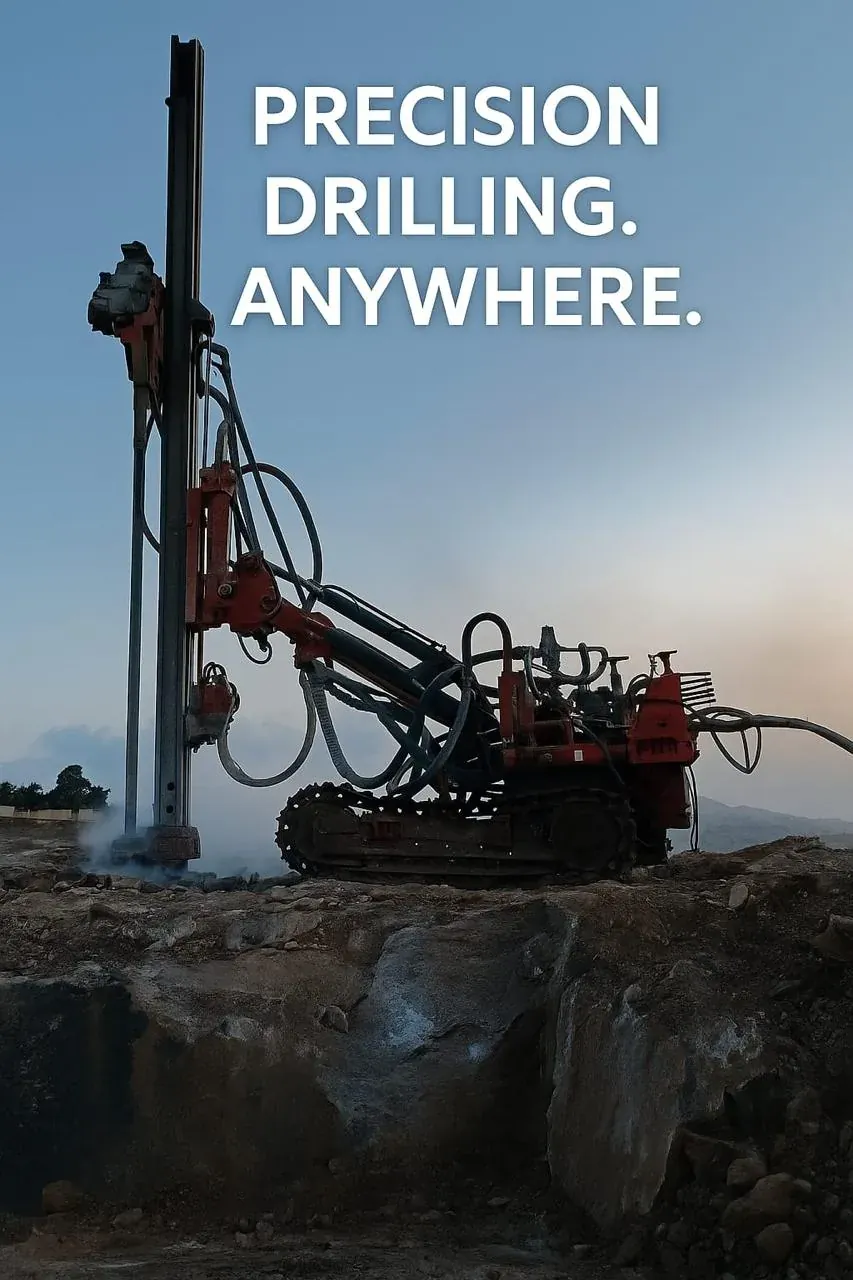
Where DTH compressors are used
- Borewells for agriculture, homes and industry. The largest use in Telangana and Andhra Pradesh, where many farms, housing projects and factories rely on groundwater from hard-rock aquifers.
- Government water projects. Drinking-water and irrigation borewells drilled by contractors under public schemes.
- Quarrying and mining. Blast-hole drilling on benches with crawler DTH rigs.
- Foundations and geotechnical work. Micropiles, anchors and investigation holes in rock.
- Infrastructure. Rock drilling for roads, irrigation canals, lift irrigation schemes and pipeline crossings.
- Geothermal and earth-energy holes. Where these are drilled, the duty is similar to deep borewells.
New, used and hired DTH compressors
New compressors. We sell new high-pressure compressors from ELGi, Atlas Copco, Ingersoll Rand, KAESER, Chicago Pneumatic, Doosan and other makers as an independent multi-brand supplier. We are not an authorised dealer of any of these brands; we help you choose the class and model on its merits and supply it. We have tie-ups with all major and reputed brands.
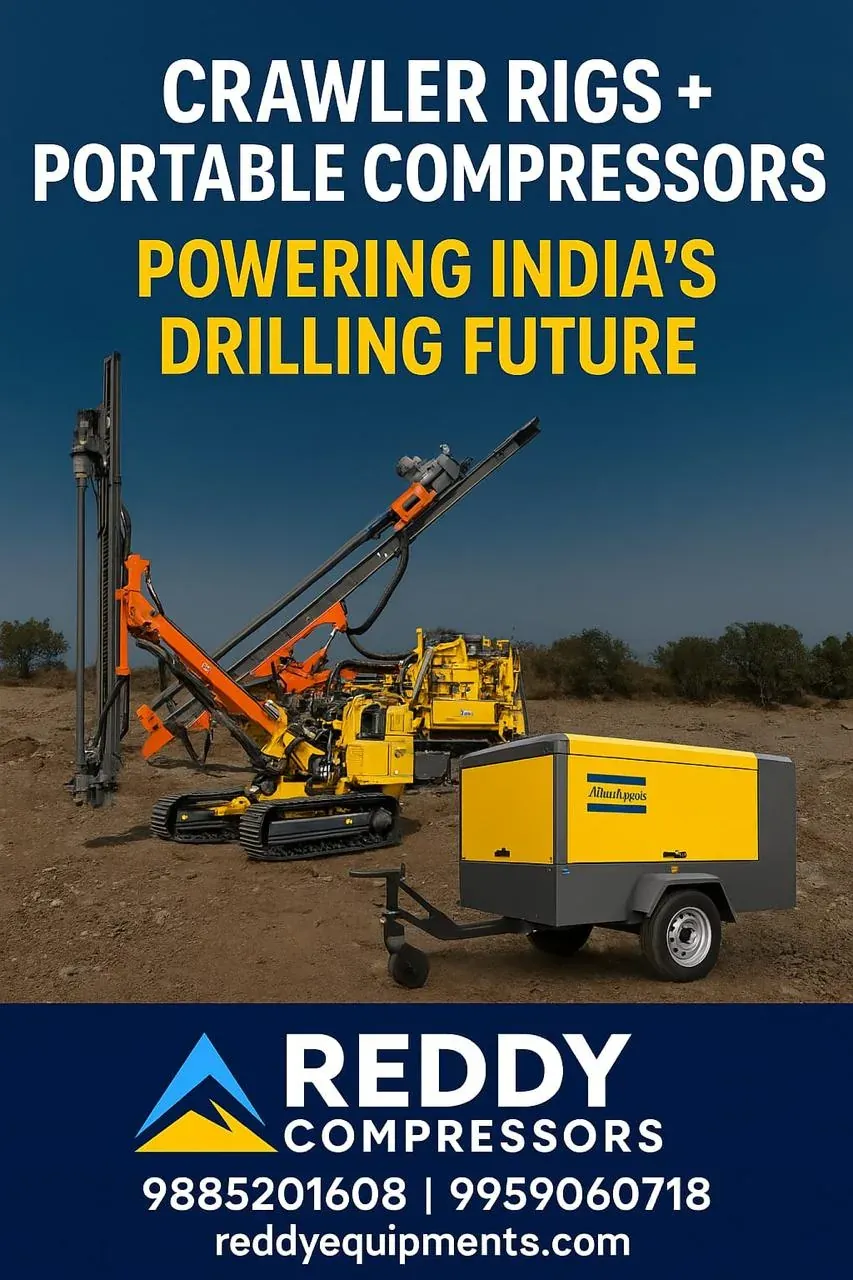
Used and refurbished compressors. For many rig owners a checked used machine is the sensible route. We inspect the airend, engine, coolers, separator, controls and safety shutdowns, and test delivery under load, so you know what you are buying.
Rentals. We hire high-pressure compressors from our own fleet for seasonal peaks, short contracts, trial work in a deeper band, or while your own machine is under repair. Our rental range overall covers 50–2,000 cfm at 2–30 bar, diesel and electric. On hire jobs we service the machine every 300 running hours, including the oil change.
Large temporary high-pressure packages are part of our experience. For an international oilfield-services contractor on a natural-gas development at Kakinada, our team supplied and commissioned compressors including three rated 1,100 cfm at 300 psig, with operators and a technician on site.
Service and repair of DTH compressors
Drilling compressors work at their limits, so they need disciplined maintenance. A typical service visit from our engineers covers:
- Recording hours, pressures, temperatures and any fault history.
- Changing compressor oil, oil filter and, at the due interval, the separator element.
- Replacing or cleaning air filter elements and checking the intake for dust bypass.
- Cleaning the oil cooler, aftercooler and engine radiator of dust and mud.
- Checking the minimum-pressure valve, safety valve, unloader and pressure regulation.
- Testing safety shutdowns for high discharge temperature, low engine oil pressure and high coolant temperature.
- Servicing the engine: oil, fuel filters, water separator, belts and hoses.
- Checking delivery against the rated figure and reporting what needs attention.
For breakdowns we diagnose on site where possible and arrange airend or engine overhaul where needed, including specialist processes through trusted workshops. Our over 20 service engineers and technicians cover the whole of Telangana and Andhra Pradesh.
Common DTH compressor faults
| Symptom | Likely causes | First checks |
|---|---|---|
| High discharge temperature trip | Dusty cooler, low oil, wrong oil, thermostatic valve fault, high ambient | Clean cooler, check oil level and grade, test valve |
| Cannot reach rated pressure | Worn airend, intake restriction, regulator fault, leaks | Air filter, regulation settings, leak check |
| Oil in delivered air | Failed separator, blocked scavenge line, overfilled oil | Separator pressure drop, scavenge line, oil level |
| Engine loses power | Fuel contamination, blocked filters, air intake restriction | Fuel filters and water separator, engine air filter |
| Frequent safety-valve lifting | Regulation fault, set point too high, faulty valve | Regulation system, valve rating and condition |
Our troubleshooting and diagnostics pages go deeper into each of these.
Hoses, lubricators and accessories
A compressor is only as good as the line that connects it to the rig. We can supply high-pressure delivery hoses rated for drilling pressures, with suitable couplings and whip checks, along with line lubricators for the hammer and the valves and fittings to suit your rig inlet. An undersized or perished hose wastes pressure before the air reaches the swivel and can be dangerous at borewell pressures, so we check hose rating against the compressor’s maximum working pressure whenever we supply or service a package.
Spare parts for DTH compressors
We supply spares for all major brands: air, oil and fuel filters, separator elements, compressor oil, thermostatic and minimum-pressure valves, unloader and regulator parts, safety valves, hoses, belts, sensors and engine parts. We identify parts from the machine itself, using make, model, serial number, a nameplate photo or the old part, and confirm fit before quoting. We can supply genuine or named aftermarket parts, and the quote states which you are getting.
Choosing between new, used and hire
| Your situation | Usual best option | Why |
|---|---|---|
| Rig drilling most of the year in one depth band | New compressor | Full service life and predictable running for steady work |
| Proven duty, limited budget | Checked used or refurbished compressor | Lower capital outlay with known condition after inspection |
| Seasonal peak or short contract | Hire | No capital tied up when the work ends |
| Own machine under repair | Hire as breakdown cover | Keeps the rig drilling while the repair is done |
| Occasional deeper or wetter jobs | Hire a higher-pressure class for those jobs | Avoids buying a larger machine for rare work |
Looking after a DTH compressor between services
- Check compressor oil level and engine oil level before every shift.
- Drain water from the fuel water separator daily on dusty or humid sites.
- Inspect the air filter restriction indicator and clean or change elements as needed.
- Blow or wash dust from coolers and radiator whenever it builds up, especially in summer.
- Look for oil or air leaks at hoses and couplings, and check that safety shutdowns have not been bypassed.
- Keep a simple log of hours, pressures and temperatures so changes show early.
These checks take minutes and prevent most of the high-temperature trips and lost drilling days we see in the field.
Preparing a DTH compressor for a new drilling season
Before the busy season, a short pre-season check avoids breakdowns at the worst moment. We recommend an oil and filter change if the interval is near, a separator pressure-drop check, cooler cleaning, a test of all safety shutdowns, a hose and coupling inspection, and a delivery check against the rated figure. Engine belts, batteries and fuel system deserve the same attention. Our engineers can carry out this check at your yard or on site anywhere in Telangana and Andhra Pradesh.
Worked example: hose size and pressure at the rig
At drilling pressures the air is dense, so hose losses are smaller than many expect, but hose size still matters on long runs. Using a standard pressure-drop relationship for 800 cfm at about 25 bar:
| Hose bore | 30 m run | 60 m run |
|---|---|---|
| 1½ in (38 mm) | About 0.4 bar | About 0.8 bar |
| 2 in (50 mm) | About 0.1 bar | About 0.2 bar |
Each coupling, the swivel and any lubricator add further losses, and a partly collapsed or kinked hose adds far more. On a deep wet hole where the hammer is already short of pressure because of the water column, the difference between 0.2 and 0.8 bar can decide whether the hammer keeps cutting. Keep the compressor close to the rig, use the larger bore for long runs, and replace hoses with damaged linings or crushed sections.
A daily rig air check
- Hoses, couplings and whip checks inspected before pressurising.
- Line lubricator filled with rock drill oil and feeding.
- Compressor oil, coolant and fuel levels checked; radiator and cooler blown clean.
- Discharge pressure and temperatures noted at full load after an hour.
- Any new noise, leak or alarm reported before the next hole.
Air by hole size and water depth: a cfm and psig ready reckoner
Two numbers decide a DTH compressor: flow to clean the hole and pressure to drive the hammer against the water standing above it. These tables give first figures for the common borewell sizes in Telangana and Andhra Pradesh. They are a starting point for a conversation, not a substitute for the hammer maker’s consumption chart.
Flow: set by the annulus
| Hole and drill pipe | Annulus area | Dry-hole minimum flow at 3,000–5,000 ft/min uphole | Practical machine class with margin |
|---|---|---|---|
| 4.5 in hole, 3.5 in pipe | π ÷ 4 × (4.5² − 3.5²) = about 6.3 in² (0.044 ft²) | About 130–220 cfm | About 275–330 cfm |
| 6.5 in hole, 4.5 in pipe | π ÷ 4 × (6.5² − 4.5²) = about 17.3 in² (0.120 ft²) | About 360–600 cfm | About 750–900 cfm |
| 8 in hole, 4.5 in pipe | π ÷ 4 × (8² − 4.5²) = about 34.4 in² (0.239 ft²) | About 720–1,190 cfm | About 1,500–1,800 cfm |
The last column adds 25–50% to the upper dry-hole figure for water inflow, a deeper hole and engine derating in April and May. Notice how fast the annulus grows: going from a 6.5 in to an 8 in bit roughly doubles the air needed to lift the cuttings.
Pressure: set by the water above the hammer
| Standing water above the hammer | Back pressure from the water | Pressure needed at the rig for a hammer wanting 17–20 bar g |
|---|---|---|
| None (dry hole) | Nil | 17–20 bar g (246.6–290.1 psig) |
| 100 ft (30.5 m) | About 3 bar | 20–23 bar g (290.1–333.6 psig) |
| 200 ft (61.0 m) | About 6 bar | 23–26 bar g (333.6–377.1 psig) |
| 300 ft (91.4 m) | About 9 bar | 26–29 bar g (377.1–420.6 psig) |
Water adds about 1 bar for every 10 m (about 3 bar for every 100 ft) it stands above the hammer, and hose, swivel and drill-string losses come on top of the figures in the last column. Once the answer passes about 25 bar g (362.6 psig), most single machines run out of pressure and a booster, up to 35 bar g (507.6 psig), is the usual answer. Heat matters too: at 45 °C each cubic metre of intake air carries about 7.9% less mass than at 20 °C, and at Hyderabad’s altitude of about 540 m the air is already about 6% thinner than at sea level. Send us the hole size, hammer, depth and water level and we will run this working for your rig and season.
How Reddy Compressors helps
We have been serving industry since 2002 from our office at Tarnaka, Secunderabad. For DTH drilling we supply all types, all brands and all models of borewell compressors, new and used, on hire, with service and spare parts. Our service teams cover Telangana and Andhra Pradesh, and we supply compressors, rentals and spares across India, with site support on projects elsewhere where feasible. Because we are multi-brand and independent, one call covers a mixed fleet.
What to send us
- Whether you need a new, used or hired compressor, service, or spares
- Rig and hammer make and model, bit sizes and typical depths
- Existing compressor make, model, serial number and nameplate photo
- Hours run and the fault or symptom, if it is a repair
- Site location and access
Watch
A short explainer on this topic
Slide-by-slide engineering explainers from Reddy Compressors. More in the video library.
Frequently asked questions
Where can I buy a DTH compressor in Hyderabad?
Reddy Compressors at Tarnaka, Secunderabad, sells new and used DTH and borewell compressors of all major brands, including ELGi, Atlas Copco, Ingersoll Rand, KAESER, Chicago Pneumatic and Doosan, as an independent multi-brand supplier. We also hire, service and supply spares across Telangana and Andhra Pradesh, and supply machines across India.
Do you rent borewell compressors?
Yes. We hire high-pressure compressors from our own fleet for borewell and DTH work, for seasonal peaks, short contracts or while your own machine is under repair. On hire jobs we service the compressor every 300 running hours, including the oil change. Send us the pressure, flow and location you need.
How often should a DTH compressor be serviced?
Follow the manufacturer’s schedule, shortened for dusty and hot conditions. On our own hire machines working on site we change oil and service every 300 running hours. Air filters may need cleaning or changing more often on dusty drilling sites, and coolers should be cleaned whenever dust builds up.
Why does my borewell compressor trip on high temperature?
The most common causes are coolers blocked with dust or mud, low or wrong oil, a faulty thermostatic valve and very high ambient temperature. Running continuously at maximum pressure in summer heat adds load. Clean the coolers and check the oil first; if it persists, have the valve and airend checked.
Do you service all brands of DTH compressors?
Yes. We service ELGi, Atlas Copco, Ingersoll Rand, KAESER, Chicago Pneumatic, Doosan, Sullair and many other makes as an independent multi-brand specialist. We are not an authorised dealer of these brands, but we identify parts from the nameplate and machine and confirm fit before supply.
Can you supply DTH compressors outside Telangana and Andhra Pradesh?
Yes. We supply new and used compressors, rentals and spare parts across India, and provide site support on projects elsewhere where it is feasible. Our service teams are based in Secunderabad and regularly cover the whole of Telangana and Andhra Pradesh.
Related pages
Technical content reviewed by D. Srinivas Reddy, Managing Partner and service engineer, Reddy Compressors. Last updated 17 October 2026. How our engineering content is reviewed.