
A tractor-mounted compressor is a tractor, a drive, a reciprocating pump, a receiver, hoses and a tool working as one system. Most failures come from a mismatch or from a neglected basic: wrong PTO speed, a blocked filter, a dry lubricator, a narrow hose. This page covers upkeep, faults and safety. For selection and matching, see tractor and PTO-driven compressors.
Maintenance routine
| When | Do |
|---|---|
| Daily | Check compressor oil level; inspect belts and the PTO coupling; drain the receiver; clean the intake filter; look for air leaks; inspect hoses and couplings; check the airline lubricator; watch temperature and vibration |
| Weekly | Tighten mounting bolts; check pulley alignment and belt tension; clean cooling fins; check the pressure gauge; inspect receiver supports and hose abrasion; examine guards |
| Monthly | Inspect valves; check piston blow-by; examine oil for contamination; test unloading; verify delivered air and pressure; test the emergency stop; check the tool lubrication rate; inspect the receiver internally where permitted |
| Overhaul | Piston rings, liners, suction and delivery valves, valve plates, gaskets, bearings, oil seals, rod bushes, belts and couplings, pressure switch and non-return valve |
Two lubrication systems
The compressor crankcase and the pneumatic tool are separate. The crankcase needs the right oil at the right level. A rock drill or breaker usually needs oil mist from an airline lubricator. Too little oil wears the tool fast; too much leaves carbon deposits and oil mist. An empty lubricator can ruin a rock drill.
Faults and likely causes
| Problem | Check |
|---|---|
| Low pressure | Blocked intake filter, leaking valves, worn rings, slipping belt, low PTO speed, hose leaks, open drain, tool using more air than the pump delivers |
| Overheating | Poor cooling airflow, dirty fins, low oil or wrong grade, excess pressure, valve restriction, running beyond the duty rating |
| Oil carry-over | Overfilled crankcase, worn rings, wrong oil, high temperature, blocked separator where fitted |
| High vibration | Misaligned PTO shaft, damaged universal joint, loose mounts, uneven belt tension, bent pulley, bearing damage, unbalanced flywheel |
| Weak rock drill | Not enough air, hose pressure drop, water in the line, empty lubricator, wrong oil, worn drill parts, blocked flushing tube, low pressure at the tool |
Pressure at the tool, not at the receiver, tells you what the tool really gets. Check hose size and length first; see air hoses and rig connections.
Moisture
Compressed air carries water. Left in the receiver and hose it causes corrosion, freezing in cold weather, diluted tool oil and erratic tool action. Use the receiver drain, a moisture separator and low-point drains, and empty them on a routine. Isolate pressure before opening any drain.
The receiver is a pressure vessel
It needs a relief valve, gauge, drain, non-return valve and sound supports, and its working pressure should be marked. Do not weld or modify a receiver casually, and do not use a corroded or unverified one.
Safety rules
- Never run with exposed belts or PTO shafts
- Never repair a hose or open a coupling under pressure
- Never exceed the rated compressor speed
- Never point compressed air at a person
- Never run on unstable or steep ground without proper controls
- Keep loose clothing away from rotating parts
- Use a safety whip check or locking coupling where a hose could whip
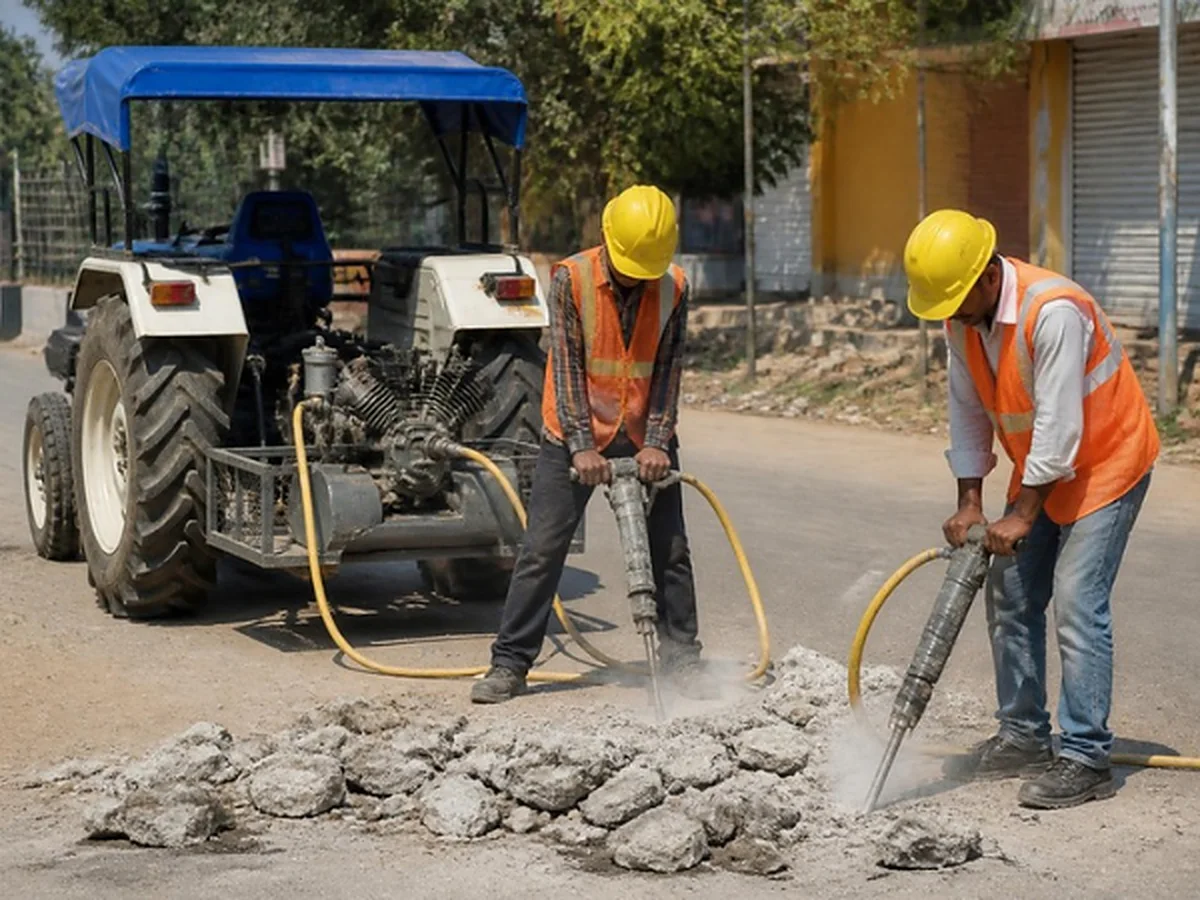
Operators should wear a helmet, eye and hearing protection, dust protection, gloves, safety footwear and high-visibility clothing.
Limits to remember
A tractor compressor is not a substitute for a screw compressor on every job. Air capacity is moderate, long continuous work heats a reciprocating pump, and the whole system stops when the tractor is down. It should not be chosen for deep borewell drilling just because it is tractor-mounted; deep DTH work needs much more pressure and flow. See DTH compressor selection and stationary vs portable screw compressors.
Reddy Compressors supplies, services and overhauls tractor-mounted and other portable compressors. Send your tractor model, PTO details and tool list for a matched recommendation.