
Why receiver safety matters
Compressed air stores energy. A receiver of a few thousand litres at 7–10 bar (101.5–145 psig) holds enough to cause a violent rupture if the shell fails. Unlike a water-filled hydraulic test, a pneumatic failure releases that energy in an instant, throwing fragments and causing serious injury and damage.
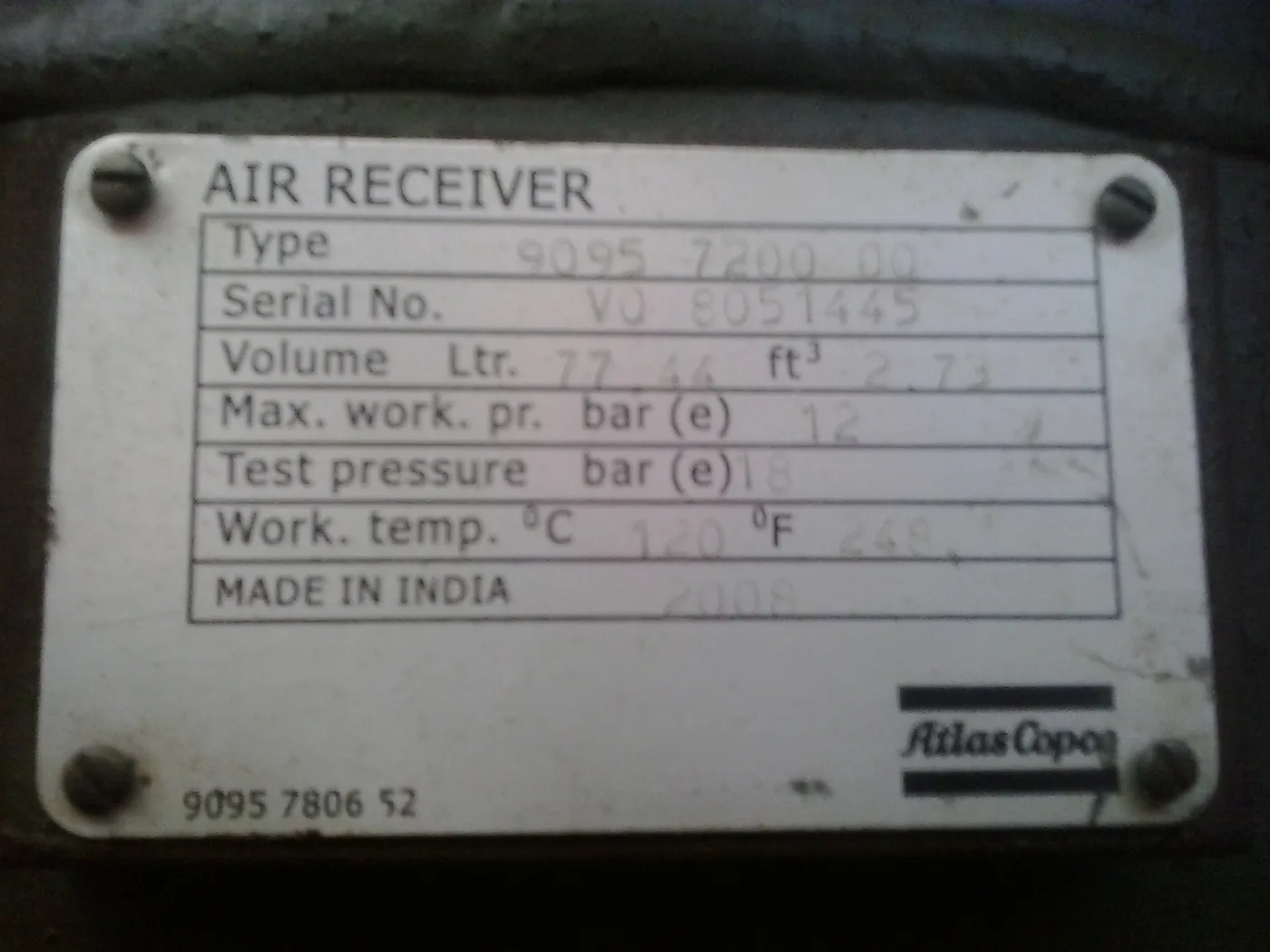
Photographs from Reddy Compressors’ own fleet and workshop.
Most receiver failures come from three causes, and all three are preventable:
- Internal corrosion from condensate left in the bottom of the vessel, thinning the wall.
- A missing, wrongly set, undersized, isolated or seized safety valve.
- Operation above the rated pressure, often after a higher-pressure compressor has been connected to an old receiver.
Daily and weekly checks
- Drain condensate at least daily on manual drains, or check that the automatic drain is actually discharging. Water left in a receiver corrodes the bottom and reduces its capacity.
- Check the pressure gauge reads normally and never above the design pressure on the nameplate.
- Look for leaks, dents, bulges and rust on the shell, welds, supports and connections.
- Confirm the safety valve is in place, not plugged, painted over or tied down, and has no isolating valve between it and the receiver.
- Check the drain line is clear and goes to an oil-water separator, not to an open floor drain.
In the Indian monsoon the amount of condensate rises sharply, and a receiver that was fine in winter can fill with water in weeks if the drain fails.
The safety valve: the last line of defence
Every receiver needs a safety (pressure-relief) valve that can discharge the full output of all the compressors feeding it, set at or below the receiver’s design pressure.
- The valve must not be isolated from the receiver by a closed valve.
- It must be of a capacity matched to the compressors. When a larger compressor is added, the valve must be rechecked.
- Test-lift it periodically where its design allows, and have it re-tested, re-set or replaced at the interval required.
- Never adjust, plug or remove a safety valve to stop it lifting. If it lifts, find out why pressure is rising – a failed pressure switch, a faulty unloader or controller, or a blocked line.
- Replace it with a valve of the correct set pressure and capacity, from documented supply.
A safety valve that has not been tested for years may be seized solid. It then gives false confidence while offering no protection.
Periodic inspection and testing
Receivers should be examined internally and externally by a competent person, and hydrostatically tested, at the intervals required by the factory and pressure-vessel rules that apply to your site and by your insurer. In India this typically falls under the applicable state factory rules; your factory inspector or competent person will confirm the requirement for your premises. An inspection typically covers the following.
| Item | What is checked | Why it matters |
|---|---|---|
| Nameplate and documents | Design pressure, test pressure, year, manufacturer, design code, test certificate | Without traceable data the safe working pressure cannot be confirmed |
| Internal surfaces | Corrosion, pitting, especially at the bottom and around the drain | Condensate corrosion is the most common cause of wall loss |
| Wall thickness | Ultrasonic measurement at suspect and representative points | Compared with the minimum required for the working pressure |
| Welds and nozzles | Cracks, corrosion, distortion | Stress concentrations where failures start |
| Supports and foundations | Corrosion at legs and saddles, cracked bases, vibration | A failed support can overload connections |
| Fittings | Safety valve, gauge, drain, inspection opening | Correct function and settings |
| Hydrostatic test | Pressure test with water at the required test pressure | Confirms the shell can hold its rating; water stores far less energy than air if it fails |
Keep a record of each inspection, the readings, any findings and the next due date. Never pressure-test a receiver with air in place of water.
When should a receiver be replaced?
- Wall thickness is below the minimum allowed for its working pressure.
- Pitting or cracking that the inspector cannot accept.
- No nameplate or traceable design data.
- Repairs by welding or drilling of unknown quality.
- The system pressure has been raised above its rating.
- Visible bulging, distortion or fire damage.
Old receivers without documents are a common risk on second-hand and long-running sites. If there is any doubt, take the receiver out of service until it is assessed. Derating a receiver to a lower pressure is sometimes possible, but only on a competent person’s assessment, with the safety valve reset accordingly.
Safe working practice around receivers
- Isolate the compressors and lock off before any work on the receiver or its connections.
- Vent the receiver fully to atmosphere and confirm zero pressure on a working gauge.
- Do not rely on a closed valve alone; stored air can leak past.
- Before internal entry, follow confined-space procedures, ventilate and test the atmosphere.
- Do not weld, drill or modify a receiver without approved design and inspection.
- Re-pressurise slowly after work and check for leaks.
Your site’s permit-to-work system governs these steps. Our engineers work within it.
Oil and condensate
Condensate from oil-lubricated compressors contains oil. Route it to an oil-water separator rather than the drain, and keep the receiver’s drain line clear so it does not back up. Zero-air-loss drains avoid wasting compressed air through timed valves that open whether there is water or not, and they make daily draining reliable.
Common receiver risks on Indian sites
- Second-hand receivers bought without documents.
- Higher-pressure compressors connected to older, lower-rated tanks.
- Receivers placed outdoors without drainage or protection, corroding from the outside.
- Manual drains that nobody opens during busy shifts.
- Safety valves painted over during plant painting.
Receivers on portable and rental compressors
Portable diesel compressors usually have a separator tank that acts as a small pressure vessel, and site jobs often add a separate receiver for tools or blasting. These vessels move between sites, get knocked during transport and work in dust and rain, so they need the same attention: a working safety valve, a clear drain, sound fittings and a visible nameplate. On our own hire fleet, these checks form part of the routine service carried out every 300 running hours. When hiring, ask that any receiver supplied comes with its documents, and do not connect a rental compressor to a site receiver of lower rating than the compressor’s maximum pressure.
Keeping receiver records
A simple receiver register prevents most problems. For each vessel, record its identification number, location, volume, design and test pressure, manufacturer, year, safety valve set pressure and capacity, last inspection and hydrostatic test dates, wall-thickness readings, findings and the next due date. Attach photos of the nameplate. When compressors are changed, update the register and recheck the safety valve. Inspectors and insurers ask for this information, and a complete register makes inspections faster and decisions clearer.
How Reddy Compressors helps
Reddy Compressors, based at Tarnaka in Secunderabad, supports receiver safety for plants across Telangana and Andhra Pradesh, and supplies receivers and parts across India. As an independent multi-brand specialist, we work with systems built around ELGi, Atlas Copco, Ingersoll Rand, KAESER, Chicago Pneumatic, Sullair, Doosan, Kirloskar and other compressors.
- We supply replacement receivers with nameplates and test documents.
- We check receivers, safety valves and drains as part of routine service and AMC visits.
- We help arrange inspection support with your competent person, and prepare the receiver for internal examination.
- We review whether existing receivers are correctly rated when compressors are changed or added.
What to send us
- A photo of the receiver nameplate and any test certificate.
- Receiver volume, design pressure and the maximum pressure of the compressors feeding it.
- Photos of the safety valve, gauge and drain.
- Date of the last inspection and hydrostatic test.
- Any concern: corrosion, leaks, safety valve lifting, water in the air.
Frequently asked questions
How often should an air receiver be inspected?
The legal interval depends on the factory and pressure-vessel rules that apply to your site and on your insurer, so confirm it with your competent person or factory inspector. In addition, receivers should be checked daily for drainage and gauge reading, and visually for leaks and corrosion every week. Safety valves and drains should be checked at every compressor service, with records kept of each examination.
Why does my receiver safety valve keep lifting?
Because pressure is reaching the valve’s set point. Usual causes are a faulty pressure switch or controller setting, an inlet or unloader valve that does not unload, a blocked line downstream, or a higher-pressure compressor connected to a lower-rated receiver. A weak or damaged safety valve can also lift early. Never plug or adjust the valve; find and fix the cause, and replace the valve if faulty.
How often should I drain my air receiver?
At least daily on manual drains, and more often in the monsoon or on heavily loaded systems. Better still, fit an automatic zero-air-loss drain and check daily that it is discharging. Water left in the receiver corrodes the bottom, reduces storage and passes into the distribution. Route oily condensate to an oil-water separator, not an open drain.
Can I use an old receiver without a nameplate?
It is not advisable. Without a nameplate or traceable design data, the safe working pressure cannot be confirmed, and an inspector may not accept it. If you have such a receiver, take it out of service until a competent person assesses it. In most cases replacing it with a documented receiver is the safer and simpler option.
What is hydrostatic testing of an air receiver?
Hydrostatic testing fills the receiver with water and raises it to a test pressure above its working pressure, as required by the applicable rules, to confirm that it can hold its rating without leaking or deforming. Water is used because it stores very little energy under pressure, so a failure during the test is far less dangerous than with air.
What size safety valve does an air receiver need?
The valve must be set at or below the receiver’s design pressure and must be able to discharge the full output of all compressors feeding the receiver without pressure rising beyond the permitted limit. When compressors are upgraded or added, the safety valve capacity must be rechecked. We supply valves matched to both set pressure and flow.
Related pages
Technical content reviewed by D. Srinivas Reddy, Managing Partner and service engineer, Reddy Compressors. Last updated 17 October 2026. How our engineering content is reviewed.