
A reciprocating compressor is serviceable
That does not mean it is maintenance-free
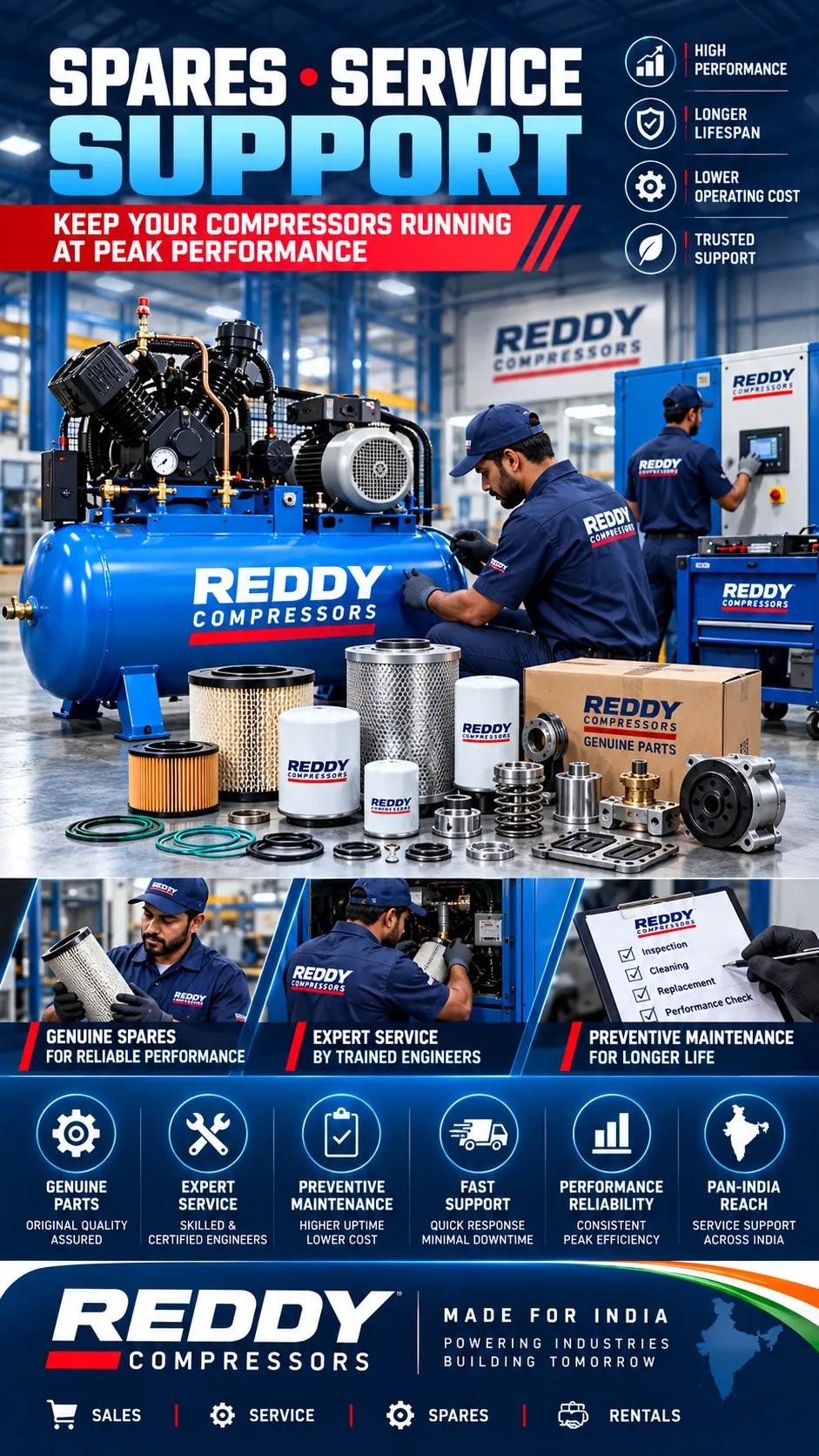
Reciprocating compressor maintenance areas including:

- Valves
- Rings
- Cylinders
- Bearings
- Lubrication
- Drive
- Pressure Controls
The wider reciprocating lifecycle section adds wear/service items that may include, depending on design:
- Piston Rings
- Valves
- Cylinders / Liners
- Bearings
- Belts
- Gaskets
- Filters
- Lubricant-System Components
Serviceability is an advantage only when maintenance is disciplined
Maintenance should follow the machine
Not a generic website interval.
Directly:
Maintenance must be model-specific
Service intervals can depend on:
- Manufacturer
- Model
- Operating Hours
- Lubricant
- Ambient Conditions
- Dust
- Temperature
- Duty
- Service History
- Manufacturer schedules remain the primary reference
- for every reciprocating compressor
The maintenance equation
Maintenance should become more informed as machine history grows.
01 — preventive maintenance starts before failure
Preventive maintenance as:
Maintenance performed before the failure has a chance to choose the timing
It explains that preventive maintenance shifts intervention into a planned operating window rather than waiting for an uncontrolled breakdown.
That is the right service philosophy.
02 — maintenance is a lifecycle process
The wider Reddy service architecture follows:
The objective is not merely to complete a service visit.
It is to understand the machine's condition and determine the appropriate next action.
03 — four levels of service
Level 1 — routine
Inspection and scheduled consumable/service work.
Level 2 — condition correction
Addressing wear, leakage, cooling problems, pressure loss or abnormal operation.
Level 3 — failure repair
Diagnosing and correcting a specific breakdown or fault.
Level 4 — major restoration
Compressor rebuilding or major component repair/replacement.
Different problems require different intervention levels.
04 — do not turn every service call into an overhaul
A machine requiring:
Routine Inspection
should not automatically receive:
Major Internal Rebuilding.
Likewise, a compressor with major internal wear should not be treated as though an oil change alone closes the problem.
Diagnosis should determine intervention level.
05 — service should create information
A valuable service visit can leave behind:
- Machine Identification
- Operating-Hour Record
- Pressure
- Temperature
- Alarm History
- Visible Condition
- Replaced Components
- Recommendations
- Next Service Requirement
Over time:
Better history → better decisions
06 — machine identification comes first
Before service, record where available:
- Manufacturer
- Model
- Serial Number
- Motor / Engine Details Where Relevant
- Existing Service History
- Operating Hours
This helps ensure that parts, lubricant, intervals and service procedures are applied to the correct machine.
07 — operating hours matter
Calendar time alone is not enough.
Two identical compressors can have very different maintenance exposure if one operates occasionally while the other runs every day.
08 — duty cycle matters
Reciprocating equipment can have manufacturer-specific limits involving:
- Loaded Operating Time
- Cooling
- Starts per Hour
- Discharge Temperature
- Pressure
- Environmental Conditions
Forcing intermittent-duty reciprocating equipment into sustained industrial service can contribute to:
- Thermal Stress
- Accelerated Wear
- Increased Maintenance
- Shorter Component Life
- Maintenance cannot compensate indefinitely for incorrect duty
09 — if the duty is wrong, fix the application match
Do not assume that increasingly frequent maintenance is always the correct response.
If the machine is fundamentally mismatched to:
- Operating Hours
- Continuous Load
- Pressure
or:
Production Requirement,
the better lifecycle decision may eventually involve resizing or changing technology.
10 — environment changes maintenance needs
This includes:
- Ambient Conditions
- Dust
- Temperature
- among factors that influence maintenance intervals
A compressor in:
Clean Indoor Service
and one in:
- Dusty / Hot Industrial Service
- should not automatically receive identical maintenance assumptions
11 — air intake
Routine inspection may include:
Filter condition
- Restriction
- CONTAMINATION.
Intake condition directly affects machine operating condition.
Do not wait for severe restriction before inspection becomes relevant.
12 — filter intervals must remain model & condition-specific
The source provides no universal reciprocating air-filter replacement interval.
as a universal rule.
Use:
- Manufacturer Guidance
- Operating Environment
- Observed Condition
- Service History
13 — lubrication
Routine service may include review of:
- Lubricant Level
- Leakage
- Condition
- Scheduled Replacement
For oil-lubricated reciprocating compressors, lubrication is part of the machine's lifecycle condition.
14 — do not select or replace lubricant by guesswork
Compressor lubricant selection should follow:
Manufacturer requirements + verified technical compatibility
Viscosity grade alone is not enough.
15 — cooling
Routine maintenance may include inspection of:
- Coolers
- Radiator Surfaces
- Airflow
- Fans
- Ventilation
- depending on equipment
For reciprocating machines, cooling condition should be considered alongside:
- Duty
- Discharge Temperature
- Ambient Conditions
16 — high temperature requires diagnosis
Do not automatically assume:
“High temperature = dirty cooler.”
Possible causes can differ by actual compressor architecture and condition.
The correct approach remains:
Symptom
→ CONDITION
→ MEASUREMENT
→ ISOLATION
→ ROOT CAUSE
→ CORRECTIVE ACTION
→ VERIFICATION.
17 — drive system
Routine inspection may include:
- Belts
- Couplings
- Alignment
- Transmission Condition
- where applicable
- But reciprocating designs differ
- Do not assume every machine has the same drive architecture
18 — belt service must be model-specific
It does not provide universal:
- Tension Values
- Deflection Values
- Replacement Hours
or:
- Alignment Tolerances
- Those remain manufacturer-specific
19 — electrical condition
Routine inspection may include, within the appropriate work scope:
- Connections
- Contactors
- Protection
- Visible Electrical Condition
- Electrical work requires appropriate competence and site procedures
20 — pressure controls
Control review may include:
- Pressure Settings
- Alarm History
- Controller Status
- depending on the machine
Do not change settings simply because pressure appears low without diagnosing the system.
21 — valves
Reciprocating compressor maintenance can involve valve condition.
But it does not provide generic valve-clearance, plate-thickness or replacement criteria.
Those remain equipment-specific.
22 — piston rings
Piston rings are identified as reciprocating wear/reconditioning components.
Wear assessment requires actual inspection and manufacturer limits.
23 — cylinders / liners
Key points:
Cylinders / Liners
as reciprocating wear components and cylinder condition as part of repair-versus-replace evaluation.
This supports a condition-based maintenance approach.
24 — pistons
Those must come from verified manufacturer data.
25 — bearings
Bearings are repeatedly identified as reciprocating maintenance/reconditioning items.
Do not infer bearing condition from operating hours alone.
Inspection and evidence matter.
26 — connecting components & crankshaft-related inspection
Reciprocating reconditioning may involve:
Connecting Components
and:
Crankshaft-Related Inspection.
This should be the limit of generic website detail unless model-specific overhaul data are available.
Do not invent crankshaft tolerances or bearing clearances.
27 — gaskets & seals
This includes:
Gaskets
and:
- Seals
- among reciprocating service/reconditioning items
Replacement should follow actual machine condition and verified parts compatibility.
28 — LEAKS
General-condition inspection can include:
LEAKS.
But the type matters.
Possible issues may involve:
- Compressed-Air Leakage
- Lubricant Leakage
- or other actual machine conditions
- Diagnose before replacing components
29 — NOISE
Noise is a symptom.
It is not a diagnosis.
Do not automatically conclude:
- Bearing Failure
- Valve Failure
- or any single component fault without inspection
30 — vibration
The maintenance framework also includes unusual vibration and vibration tracking where appropriate.
31 — pressure
Operating data should include:
Discharge pressure
where available.
A changing pressure pattern can help indicate developing system or machine issues.
But low pressure does not automatically prove internal compressor wear.
The downstream system must also be considered.
32 — temperature
Operating data should also include:
DISCHARGE TEMPERATURE.
Trend information can be more valuable than one isolated reading.
Actual temperature limits remain model-specific.
33 — operating data is part of maintenance
Recording where available:
- Operating Hours
- Loaded Hours
- Unloaded Hours
- Discharge Pressure
- Discharge Temperature
- Alarm History
- Service Hours
- Maintenance becomes more useful when conditions can be compared over time
34 — trend, do not only snapshot
A single measurement tells you one moment.
A maintenance history can show:
- Change
- Deterioration
- Repeated Events
- Service Effects
and:
- Recurring Symptoms
- That supports more informed decisions
35 — alarm history matters
Repeatedly clearing alarms without recording them can erase useful diagnostic information.
36 — do not reset first
In practice:
Do not reset first
Capture:
- Alarm
- Time
- Pressure
- Temperature
- Load Condition
- Recent Maintenance
- Environmental Condition
- Repeated resets can erase valuable diagnostic information
37 — diagnostics should begin with the symptom
The source's troubleshooting doctrine is:
Maintenance should not become blind parts replacement.
38 — low pressure
If a reciprocating compressor is reported as producing low pressure, investigate:
- Demand
- Leakage
- Controls
- Treatment Restriction
- Distribution Loss
- Compressor Condition
- where relevant
39 — high temperature
If discharge temperature is abnormal:
Capture the condition first
Review:
- Load Condition
- Ambient Environment
- Cooling Condition
- Lubrication Where Applicable
- Recent Service
- Alarm History
- according to the actual compressor design
- Do not infer one universal cause
40 — excessive cycling
Frequent starts/stops can relate to:
- Receiver Volume
- Leakage
- Pressure Band
- Compressor Sizing
- Demand Behaviour
- Controller Settings
- depending on the system
41 — oil consumption / carryover
Where applicable to the compressor design, investigate using equipment-specific procedures.
among other design-specific factors.
42 — preventive maintenance cannot guarantee zero downtime
Explicit:
Even a well-maintained machine can fail.
Preventive maintenance reduces avoidable risk but does not eliminate every failure mechanism.
Therefore Reddy Compressors should never sell maintenance as:
“Guaranteed zero downtime.”
43 — the defensible maintenance position
The source's preferred wording is:
DISCIPLINED MAINTENANCE INTENDED TO IDENTIFY DETERIORATION EARLY, PRESERVE OPERATING CONDITION AND REDUCE AVOIDABLE BREAKDOWN RISK.
44 — there is no universal “quarterly compressor service”
The broader maintenance framework says this directly.
A programme should consider:
- Manufacturer Requirements
- Operating Hours
- Environment
- Condition
- Criticality
45 — operator observations can support maintenance
Where appropriate, the source recommends observing:
- Pressure
- Temperature
- Leaks
- Lubricant Level
- Condensate
- Alarm Status
- Unusual Noise
- Unusual Vibration
- Operators should observe and report
- Repairs should remain within competent scope
46 — planned service items
Depending on equipment, the maintenance framework lists:
- Air Filters
- Oil Filters
- Separators
- Lubricants
- Belts
- Drains
- Valves
- Coolers
- Electrical Components
- Control Systems
For reciprocating compressors, use only the items actually present in the machine.
Do not imply every piston compressor has separators or oil filters.
47 — condition indicators
The broader maintenance framework says maintenance can become more intelligent by tracking:
- Filter Differential Pressure
- Separator Differential Pressure
- Discharge Temperature
- Motor Load
- Vibration Where Appropriate
- Alarm Frequency
- Lubricant Condition Where Analysed
- Again, use only indicators relevant to the actual machine
48 — maintenance priority should reflect consequence
The source provides a useful risk concept:
MAINTENANCE PRIORITY ∝ PROBABILITY OF FAILURE × CONSEQUENCE OF FAILURE.
A lightly used backup compressor and a single compressor supporting critical production may deserve different maintenance strategies.
49 — criticality changes the service plan
Ask:
What Happens if This Compressor Stops?
If the answer is:
Minor Inconvenience
the maintenance strategy may differ from a machine whose failure stops production.
Do not use identical maintenance planning for every asset merely because they are the same technology.
50 — AMC should be a technical scope
In practice:
AN AMC SHOULD BE A TECHNICAL SCOPE—not JUST AN ANNUAL INVOICE.
A professional maintenance agreement should define:
- Assets
- Responsibilities
- Service Frequency
- Labour
- Consumables
- Parts
- Breakdown Arrangements
- Travel / Site Conditions
- Reporting
- Exclusions
51 — AMC frequency can be calendar, hours or condition-triggered
Note:
- Calendar-Based
- Operating-Hour-Based
or:
- Condition-Triggered
- maintenance frequency where applicable
This is a stronger framework than promising “four visits per year” without understanding utilisation.
52 — no guaranteed response time without sla
The website should not promise:
- Technician Arrival Within Fixed Hours
- 24/7 Attendance
- Automatic Engineer Allocation
- Live Tracking
- Specific Part Availability
- unless contractual/operational systems genuinely support those commitments
53 — breakdown continuity
Whether Temporary Rental Air May Be Required.
The immediate decision can be:
Repair
or:
Temporary air
or:
BOTH
54 — field diagnosis can matter
Compressor behaviour can be influenced by:
- Ambient Conditions
- Ventilation
- Pipework
- Electrical Supply
- Other Compressors
- Dryers
- Filters
- Process Demand
- Therefore some problems cannot be understood fully on a workshop bench
- The site matters
55 — on-site service scope
Depending on actual work scope, field service can include:
- Equipment Inspection
- Scheduled Maintenance
- Troubleshooting
- Pressure Checks
- Temperature Checks
- Leakage Observations
- Filter / Dryer Condition
- Controller Review
- Installation Inspection
- Minor Corrective Work
- Post-Repair Commissioning
- Exact capability should still be confirmed against the machine and task
56 — arrive with information
Before service attendance, the source recommends providing:
- Make
- Model
- Serial Number
- Fault / Alarm
- Photographs
- Operating Pressure
- Operating Hours
- Location
- Recent Maintenance History
- Good information improves preparation and shortens the route to diagnosis
57 — when overhaul may be considered
Possible triggers including:
- Declining Performance
- Abnormal Mechanical Noise
- Bearing Condition
- Oil Carryover
- Repeated Failures
- High Operating Hours
- Loss of Compression Efficiency
- Major Internal Wear
- Engine / Compressor Condition
- Planned Lifecycle Intervention
But it immediately adds:
High hours alone do not prove that a rebuild is required
Inspection matters.
58 — overhaul is controlled restoration
In practice:
Overhaul is not repainting
A credible overhaul should make clear:
- What Was Inspected
- What Was Measured
- What Was Replaced
- What Was Verified
59 — structured overhaul process
Note:
01 — identify
Confirm equipment and serial information.
02 — pre-inspection
Document external condition and known faults.
03 — disassemble
Open systematically.
04 — CLEAN
Remove contamination sufficiently for inspection.
05 — inspect & measure
Evaluate relevant wear surfaces/components.
06 — classify
Reuse / repair / machine / replace.
07 — reassemble
Use correct procedures/components and manufacturer data where available.
08 — TEST
Verify appropriate operating condition.
09 — document
Record work performed.
60 — reciprocating reconditioning scope
Reconditioning may involve:
- Valves
- Rings
- Pistons
- Cylinders
- Bearings
- Connecting Components
- Crankshaft-Related Inspection
- Gaskets & Seals
- Actual scope depends on design, condition and manufacturer information
61 — do not call a cosmetic refresh an overhaul
Painting the frame, washing the compressor and changing consumables does not by itself establish:
Overhaul
62 — repair or replace?
Do not decide from age alone.
63 — age is not the decision
Directly:
DO NOT DECIDE BASED PURELY ON EQUIPMENT AGE.
A newer compressor can be badly matched or badly maintained.
An older compressor may remain economically serviceable.
The decision should follow condition and lifecycle logic.
64 — OVERHAUL vs REPLACEMENT
Compare:
- Overhaul Cost
- Equipment Age
- Condition
- Efficiency
- Parts Availability
- Reliability Requirement
- Replacement Lead Time
- Future Utilisation
Overhaul should have:
An economic and technical reason
65 — pressure-vessel condition must not be ignored
For tank-mounted reciprocating systems, the receiver is part of the asset.
Repairing the compressor does not automatically establish receiver condition.
66 — parts availability affects lifecycle value
A mechanically repairable compressor may still be a poor lifecycle candidate if:
Correct Parts Cannot Be Reliably Identified
or:
Required Components Are Unavailable.
67 — parts should be traceable
For reciprocating parts such as:
- Rings
- Valves
- Gaskets
- Bearings
- Cylinder / Liner Components
- Pressure Switches
- the site should identify the exact compressor before supply
Match by:
- Manufacturer
- Model
- Serial Number
- Part Number
- Equipment Documentation
- rather than physical appearance alone
68 — maintenance after repair
A repair should not close with:
“Machine started.”
It should close with:
Verification
Where appropriate, verify:
- Operating Condition
- Pressure
- Temperature
- Visible Leakage
- Control Behaviour
- and the original symptom
- The service philosophy specifically places verification after repair
69 — document what changed
A strong service record should document:
- Observed Condition
- Work Performed
- Components Replaced
- Measurements Where Applicable
- Recommendations
- Next Service Requirement
- That turns disconnected visits into a usable maintenance history
Disciplined risk management
Not:
Failure elimination
Even a maintained compressor can fail.
That is both technically credible and commercially stronger.
71 — customer service data to request
For preventive maintenance:
- Manufacturer
- Model
- Serial Number
- Operating Hours
- Current Pressure
- Recent Service Date
- Service History
- Lubricant if Applicable
- Operating Environment
- Daily Operating Hours
- Known Leaks / Noise / Temperature Issues
- Photographs / Nameplate
For a breakdown:
- Fault / Symptom
- Alarm Code / Display
- Pressure
- Temperature
- Operating Hours
- What Happened Before the Trip
- Recent Maintenance
- Photos / Video Where Useful
Do not reset repeatedly before recording useful evidence where safe and practical.
72 — reciprocating maintenance gate
Before closing a service job, ask:
Is the machine correctly identified?
Manufacturer, model, serial.
What does the manufacturer require?
Use actual schedule/data.
What is the operating duty?
Hours and loaded behaviour matter.
What does the condition show?
Inspect, do not assume.
What operating data are available?
Pressure, temperature, hours, alarms.
Are we treating the root cause?
Not merely the symptom.
Were the correct parts used?
Verify compatibility.
Was the work tested?
Repair must be followed by verification.
Does the machine still suit the duty?
Maintenance cannot fix fundamental misapplication.
Should it be repaired, overhauled or replaced?
Use lifecycle evidence.
Reciprocating maintenance in one line
Maintain the actual machine according to its manufacturer, operating hours, duty, environment, condition and service history
Then use operating data, inspection and root-cause diagnosis to decide whether to maintain, repair, overhaul or replace
Closing
- Good maintenance does not start with a part
- It starts with condition
The maintenance path is:
Identify
- Inspect
- Record
- Maintain
- Monitor
- Diagnose
- Repair
- Verify
- Document
- Improve
- Rebuild or replace when justified
It also states that maintenance intervals must remain model-specific and depend on manufacturer, model, operating hours, lubricant, environment, dust, temperature, duty and service history.
And it sets the correct promise boundary:
Preventive maintenance reduces avoidable risk
- IT DOES NOT GUARANTEE ZERO DOWNTIME.
- Reddy compressors
- Compressed air. engineered for uptime
- Identify the machine
- Follow the manufacturer
- Respect the duty
- Record operating data
- Inspect condition
- Diagnose root cause
- Use verified parts
- Test after repair
- Document the work
- Make lifecycle decisions from evidence
- Primary CTA
Request Reciprocating Compressor Service
Secondary CTAs
Request Preventive Maintenance
Discuss an AMC / Planned Maintenance Scope
Request Breakdown Diagnostics
Request Reciprocating Compressor Overhaul
Submit Make / Model / Serial for Parts Identification