
Two-stage compression is an engineering architecture
It is not a quality rating.
It is not automatically more industrial.
It is not automatically more efficient.
It is not automatically the correct compressor.
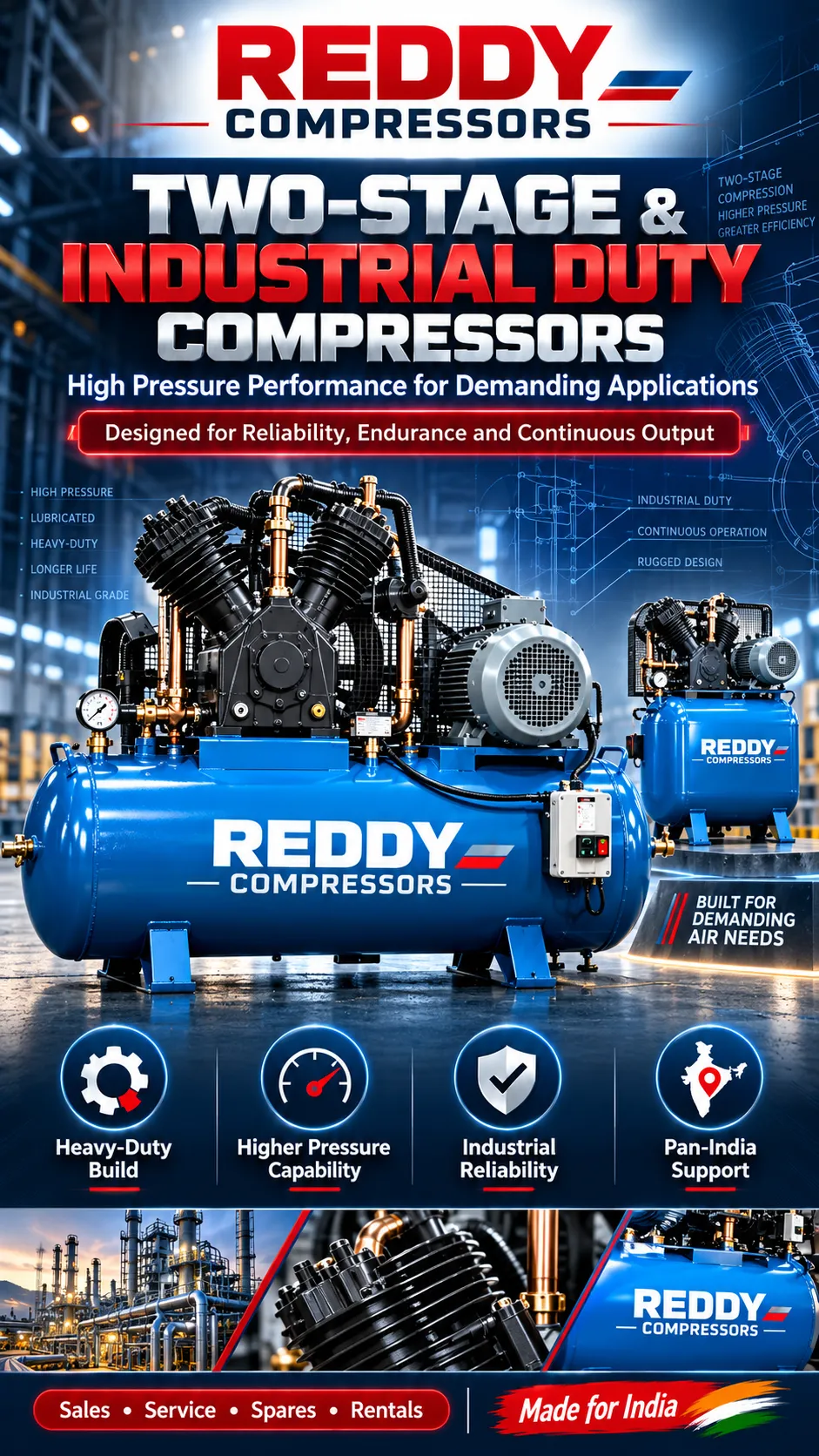
The supplied Reddy Compressors master addresses this directly:
More stages do not automatically mean “better.”
It states that the correct single-stage or two-stage reciprocating architecture depends on:
- Required Operating Pressure
- Airflow
- Duty
What is a two-stage reciprocating compressor?
Conceptually:
Across brands
Models we supply and service
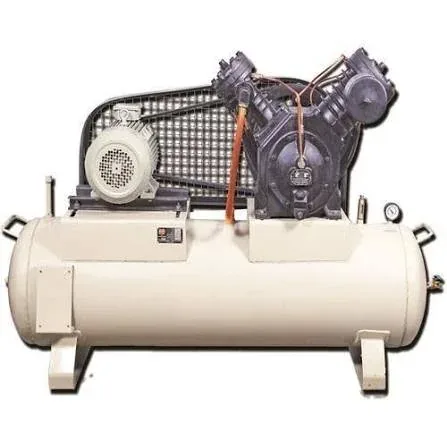
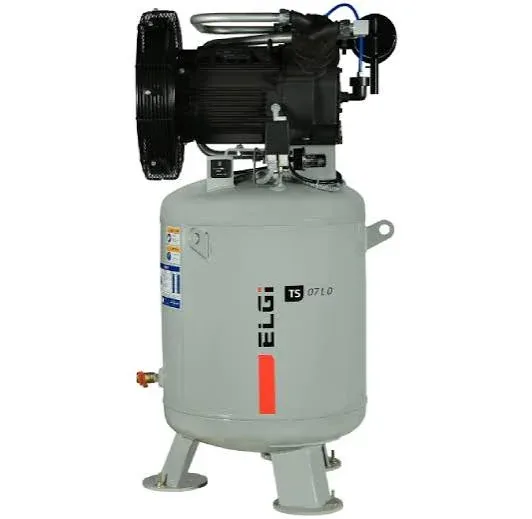
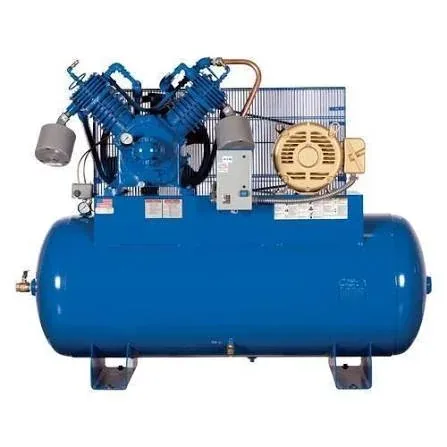
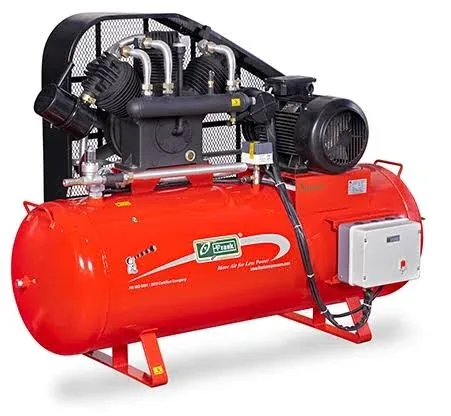
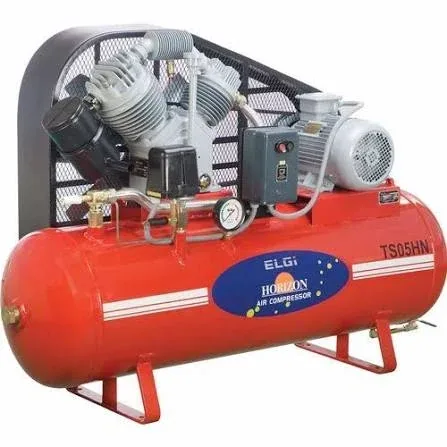
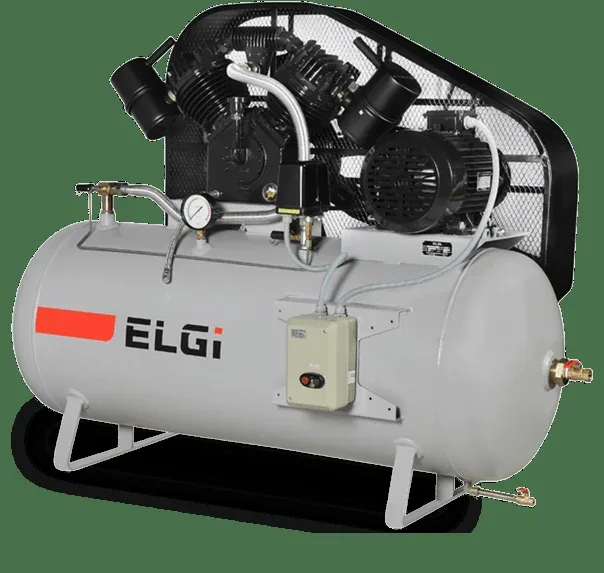
Manufacturer product images, shown to identify machines we sell, service and support. Brand names are trademarks of their owners.
The number of stages is one part of the selection.
Not the whole selection.
01 — first compression stage
In the conceptual architecture, atmospheric air first enters the:
LOW-PRESSURE STAGE.
This first stage begins the compression process before air proceeds through the intermediate cooling path and on to further compression.
• temperature.
Those details remain manufacturer/model-specific.
02 — intercooling
Between stages, the source describes:
INTERCOOLING.
This is one of the defining engineering features of the source's two-stage reciprocating explanation.
Compression raises temperature.
Cooling between stages can improve how the next compression stage receives the air.
03 — why intercooling matters
Cooling between stages can:
- Reduce Temperature Entering the Next Stage
- Reduce the Work Associated With Subsequent Compression
- Support Thermal Management
This is an important technical advantage of staged reciprocating compression where the design and duty justify it.
“Two-stage saves x% energy.”
No such universal percentage is supported.
04 — second compression stage
After intercooling, the source's conceptual sequence sends the air to:
High-pressure stage
↓
FINAL DISCHARGE.
The second stage raises the air further toward the final required discharge condition.
Again, exact stage pressure and design remain machine-specific.
05 — why divide compression between stages?
In practice:
DIVIDING COMPRESSION BETWEEN STAGES CAN BE ADVANTAGEOUS WHERE PRESSURE REQUIREMENTS JUSTIFY THE ARCHITECTURE.
This is the correct wording.
Not:
“Two stages are always better.”
Not:
“Two stages are always more efficient.”
The application must justify the architecture.
07 — no universal “two-stage pressure range”
before publication or quotation.
08 — two-stage does not automatically mean high pressure
Two-stage architecture may support duties where pressure requirements justify staged compression.
But the term “high pressure” is itself application-dependent.
Two-stage architecture
and:
High-pressure application
09 — FAD still matters
A compressor can achieve the required pressure and still be unsuitable if it cannot supply the required airflow.
Therefore:
Pressure + FAD + duty
must be evaluated together.
Customers should compare useful Free Air Delivery under stated conditions rather than theoretical displacement alone.
10 — FAD matters more than swept volume for practical selection
A piston compressor may be advertised with several airflow figures.
Asking:
What Does the Airflow Number Represent?
At What Pressure?
According to What Test / Reference Basis?
Is It Displacement or Delivered Air?
That same discipline is essential when comparing two-stage equipment.
11 — MOTOR HP / kW DOES NOT COMPLETE THE SELECTION
A larger motor rating does not automatically establish:
- Higher Useful FAD
- Correct Pressure
- Correct Duty
- Correct Lifecycle Performance
- The actual compressor must be compared at the required operating condition
12 — duty cycle remains critical
Even though a machine uses two-stage compression, it still has manufacturer-specific operating limits.
Potential limits relating to:
- Loaded Operating Time
- Cooling
- Starts per Hour
- Discharge Temperature
- Pressure
- Environmental Conditions
Therefore:
Two-stage ≠ automatic continuous-duty approval
The actual model documentation controls.
13 — do not assume two-stage can run 24/7
Some applications may require continuous operation.
Some two-stage reciprocating compressors may or may not suit that duty depending on their design.
So:
Continuous-duty capability = model-specific verification item
14 — when rotary screw may deserve comparison
Where plant demand is:
- High
- Continuous
- Predictable
- Present Across Multiple Shifts
- Rotary screw may often deserve consideration
Two-stage reciprocating is always the best choice for heavy industrial duty
Technology should follow the actual operating profile.
15 — TWO-STAGE vs SINGLE-STAGE
The correct comparison is:
Selection Area | Single Stage | Two Stage |
|---|---|---|
Compression path | Inlet to final discharge in one stage | Compression divided between two stages |
Intercooling | Not the two-stage arrangement | Present where design provides it |
Pressure suitability | Application/model-specific | Application/model-specific |
FAD | Verify actual machine | Verify actual machine |
Duty | Verify model limits | Verify model limits |
Maintenance | Model-specific | Model-specific |
Lifecycle cost | Compare | Compare |
There is no universal winner.
16 — do not select two-stage because “two-stage is industrial”
A more professional decision is:
What pressure?
What flow?
What duty?
What does the manufacturer permit?
Then select the architecture.
17 — cooling is part of the two-stage story
Because compression raises air temperature, thermal management matters.
But the complete machine may also use an additional manufacturer-defined cooling arrangement.
18 — AIR-COOLED vs WATER-COOLED IS A SEPARATE DIMENSION
Reciprocating architecture can vary by cooling arrangement.
Therefore:
Two stage ≠ air cooled
and:
Two stage ≠ water cooled
19 — intercooling does not replace final system cooling / treatment
Intercooling exists between compression stages.
The downstream compressed-air system may still need:
- Aftercooling
- Moisture Separation
- Drying
- Filtration
- Storage
- depending on the actual application
- Stage cooling and process air treatment are separate functions
20 — receiver-mounted two-stage compressors
Where an actual two-stage compressor is offered on a receiver, the receiver-mounted architecture can provide:
- Compact Installation
- Integrated Storage
- Simplified Small-System Layout
- Buffering for Intermittent Demand
- But the receiver still has to be evaluated against the duty
21 — included receiver ≠ ideal receiver for every application
This explicitly.
Therefore two-stage package selection should consider:
- Compressor Capacity
- Demand Rate
- Pressure Band
- Peak Duration
- Starts per Hour
- instead of choosing the tank size simply because it is included
22 — base-mounted two-stage systems
A two-stage reciprocating compressor may also exist as a base-mounted configuration where verified.
Separate receiver arrangements may provide flexibility where:
- Larger Storage Is Required
- Existing Storage Is Available
- Plant Layout Separates Compression and Storage
- Multiple Compressors Feed Common Storage
- Custom Installation Is Required
23 — receiver storage & cycling
Receiver storage can help absorb short demand periods and reduce excessive start-stop behaviour where correctly applied.
But receiver size interacts with:
- Compressor Capacity
- Control Band
- Demand Rate
- Allowable Pressure Change
- Starts Per Hour
- So receiver sizing remains a system decision
24 — larger receiver does not automatically mean more efficient
Against this assumption.
A receiver may improve buffering.
It does not eliminate:
- • undersizing
- • leakage
- • wrong pressure settings
- • unsuitable duty cycle
25 — workshops & maintenance facilities
Workshops and maintenance facilities as clear piston-compressor applications where:
- Tools Operate Intermittently
- Receiver Storage Buffers Peaks
- The Compressor Is Not Continuously Loaded
A two-stage machine may deserve evaluation if its pressure and duty fit those requirements.
But two-stage should not be selected merely because the workshop is “industrial.”
26 — sugar & rice mills
Reciprocating compressor applications in mills including:
- Pneumatic Controls
- Workshop Maintenance
- Packaging Equipment
- Actuators
- Utility Functions
Selection should consider:
- Seasonal Operating Intensity
- Dust
- Ambient Temperature
- Maintenance Capability
- Operating Hours
A two-stage architecture is justified only if the pressure, flow and duty require it.
27 — food processing
Reciprocating equipment can support suitable mechanical or utility duties.
Therefore:
Two-stage ≠ food-grade air
Air treatment must be selected from the actual contact and contamination requirement.
28 — cement
Some intermittent support or maintenance applications may suit reciprocating compressors while continuous high-volume plant air may need another architecture.
Again:
Application first. technology second
29 — higher-pressure duties
Multi-stage reciprocating technology can be suitable for certain pressure requirements beyond conventional plant air.
Two-stage architecture may be part of that technology spectrum.
for two-stage equipment.
30 — PET / booster / process-gas boundary
Some high-pressure or specialist applications involve dedicated reciprocating technologies.
Later pages separately cover:
Therefore:
A standard two-stage air compressor should not be assumed suitable for specialist pressure or gas duty
31 — lubrication is separate from stage count
Two-stage reciprocating equipment may have different lubrication architectures depending on actual design.
Stage count does not determine:
Oil-lubricated
or:
Oil-free
32 — air quality is also separate
Two-stage compression can change the mechanical compression pathway.
It does not by itself define:
- Particles
- Water
- Oil
- Pressure Dew Point
- Product-Contact Suitability
- The process defines the treatment requirement
33 — installation
Reciprocating installation requirements including:
- Firm Foundation
- Adequate Ventilation
- Service Clearance
- Correct Electrical Protection
- Suitable Piping
- Condensate Management
- Safe Pressure Relief
- Accessible Isolation
- Two-stage architecture does not remove any of these requirements
34 — thermal management
A two-stage compressor should be installed where:
- Cooling Can Function Correctly
- Ventilation Is Adequate
- Hot Air Is Managed
- Service Access Is Available
- according to manufacturer requirements
- Do not invent them
35 — starts per hour
Manufacturers may specify starting-frequency limits.
Excessive cycling can place unnecessary stress on:
- Motors
- Contactors
- Pressure Switches
- Drive Components
If cycling is excessive, investigate:
- Receiver Capacity
- Leakage
- Pressure Settings
- Compressor Sizing
- Demand Behaviour
36 — maintenance
Two-stage architecture creates a machine with components that must be maintained according to the actual design.
Reciprocating service areas can include, depending on machine:
- Piston Rings
- Valves
- Valve Plates
- Gaskets
- Bearings
- Cylinders / Liners
- Connecting-Rod Components
- Filters
- Pressure Switches
Exact service intervals and stage-specific procedures remain manufacturer-specific.
37 — intercooler condition
It does not provide a maintenance checklist or cleaning interval for every intercooler.
Intercooling performance should be maintained according to the actual equipment requirements
• cleaning method.
38 — serviceability
Reciprocating equipment can offer serviceability advantages in suitable applications, but that depends on:
- Parts Availability
- Machine Design
- Technical Capability
- Service Access
A two-stage configuration should not be described as universally easier or harder to repair.
39 — lifecycle economics
Compressor lifecycle economics should consider:
- Purchase
- Energy
- Maintenance
- Repairs
- Downtime
- Air Treatment
- Installation
- Residual Value
The right question is not:
“Is two-stage more expensive?”
It is:
“Does this verified machine deliver the required air at acceptable lifecycle cost?”
40 — two-stage is not an energy-savings claim
But that does not permit a universal claim such as:
- “Two-stage saves 10%.”
- Complete-machine performance and operating conditions must be verified
41 — model data required before publication
For every two-stage reciprocating model, verify:
- Manufacturer
- Exact Model
- Motor kW / HP
- FAD
- Working Pressure
- Number of Cylinders
- Two-Stage Architecture
- Intercooling Arrangement
- Lubrication Type
- Cooling Type
- Drive Type
- Motor / Engine Configuration
- Receiver Configuration
- Receiver Volume Where Applicable
- Control Method
- Duty Limit
- Dimensions
- Weight
- Electrical Requirement
- Service Requirements
- Current Availability
- No specification should be inferred from another product in the family
42 — customer data to request
For two-stage reciprocating compressor selection, request:
- Application
- Required FAD / CFM
- Required Point-of-Use Pressure
- Required Compressor Discharge Pressure if Known
- Number of Simultaneous Users
- Operating Hours
- Expected Duty Cycle
- Peak-Demand Duration
- Receiver Requirement
- Power Supply
- Installation Environment
- Air-Quality Requirement
- Future Requirement
- This follows the source's general reciprocating selection inputs
43 — two-stage selection gate
Before specifying the compressor, ask:
Why two stages?
Is the pressure/duty requirement actually driving the architecture?
What FAD is required?
Use delivered air.
What pressure is required?
Start at the application.
What pressure is lost downstream?
Do not compensate blindly.
What is the duty cycle?
Model limits matter.
How is intercooling provided?
Verify the actual design.
What cooling does the complete machine require?
Model-specific.
What receiver storage is required?
Define its purpose.
How often will the machine cycle?
Review starting limits.
What air quality does the process need?
Stage count does not define treatment.
Can the machine be maintained?
Review service access and parts support.
What does the lifecycle case show?
Then select.
Two-stage reciprocating in one line
A two-stage reciprocating compressor divides compression between two stages, with intercooling where provided by the design
And should be selected when the required pressure, FAD and duty justify that architecture
Closing
Two stages should have an engineering reason
Not a marketing reason.
A correct two-stage reciprocating system requires:
The right pressure
- The right FAD
- The right duty cycle
- The right intercooling
- The right cooling
- The right receiver
- The right air quality
- The right installation
- The right maintenance strategy
It also explicitly says the architecture should be selected from pressure, airflow and duty rather than assuming that more stages are automatically better.
Reddy compressors
- Compressed air. engineered for uptime
- Define the pressure
- Verify the FAD
- Understand the duty
- Verify the stage architecture
- Manage the heat
- Size the storage
- Engineer the installation
- Verify the actual model
- Primary CTA
Request a Two-Stage Reciprocating Compressor Selection
Secondary CTAs
Compare Single Stage vs Two Stage
Discuss Higher-Pressure Requirements
Review Receiver Requirements
Compare Reciprocating vs Rotary Screw
Request Reciprocating Compressor Service