
Base-mounted is a system-architecture decision
A reciprocating compressor does not always need to be supplied as a compressor mounted directly over an air receiver.
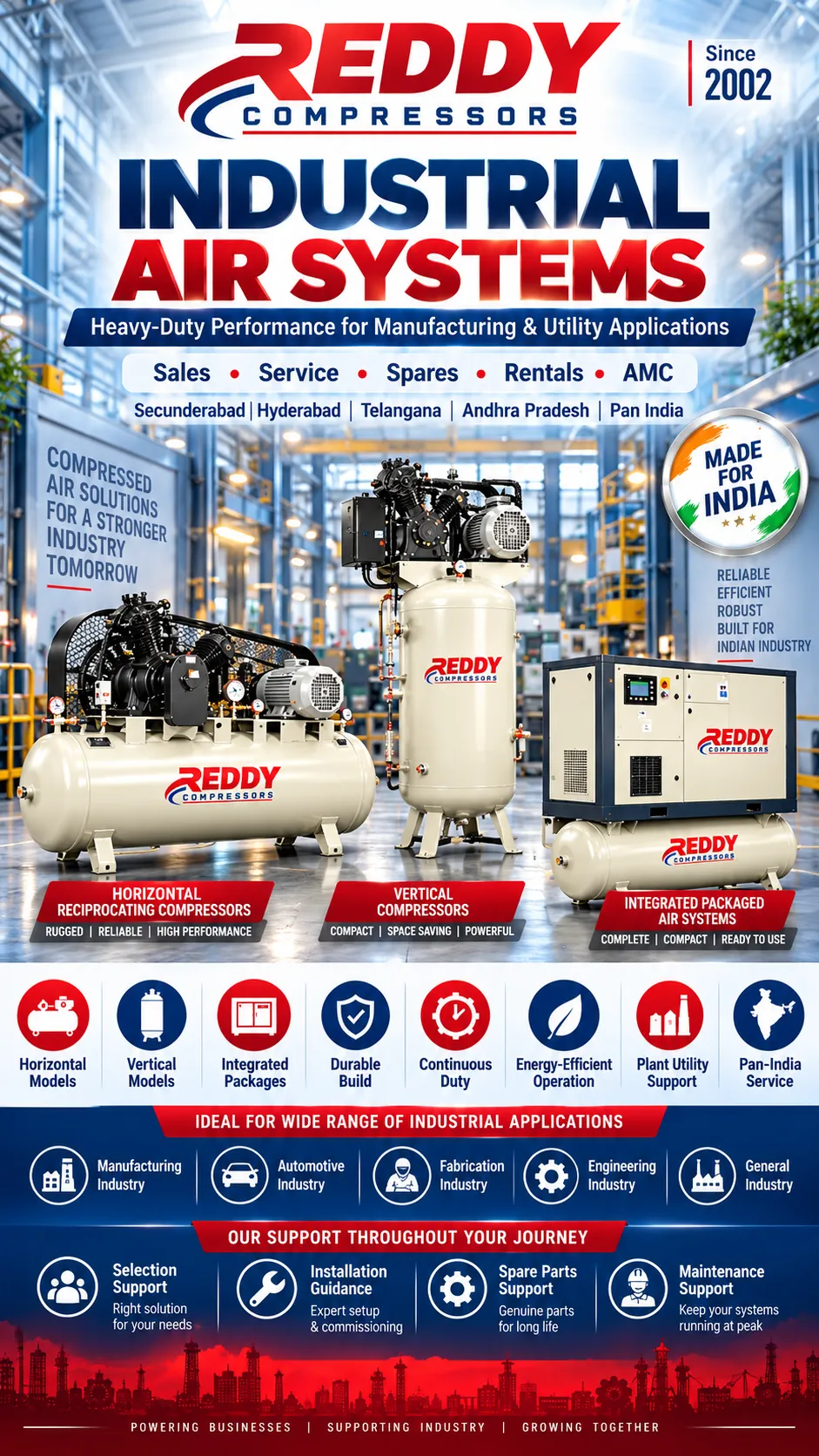
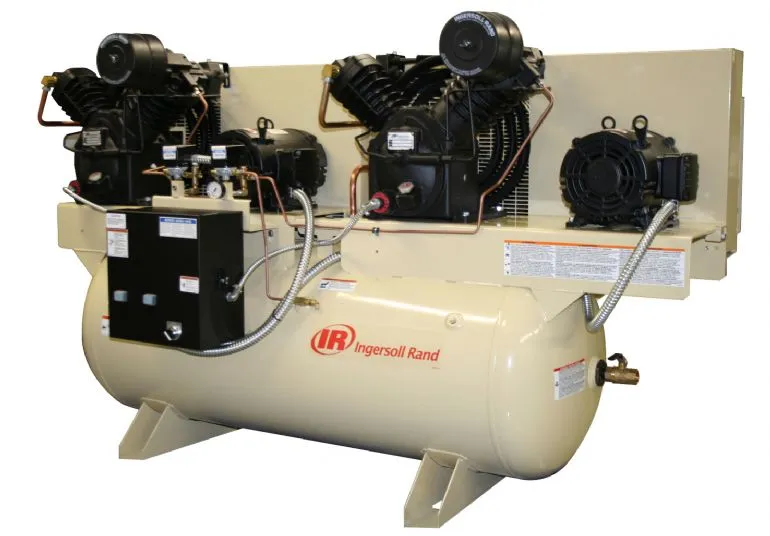
Representative images of machine types we sell, service and rent. Models and capacities are confirmed against your duty.
The distinction:
Receiver-mounted packages
from:
BASE-MOUNTED / SEPARATE-RECEIVER SYSTEMS.
A base-mounted reciprocating compressor can be connected to a separate receiver and downstream compressed-air system.
Across brands
Models we supply and service
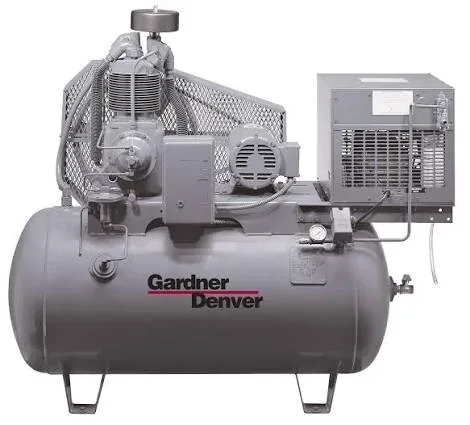
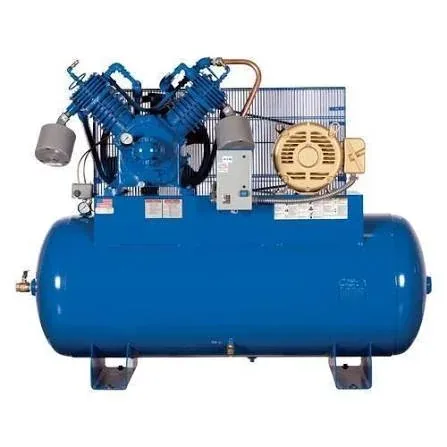
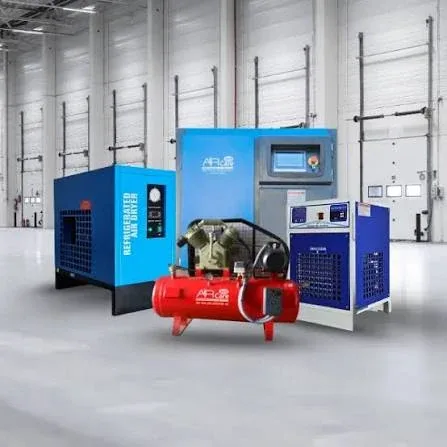
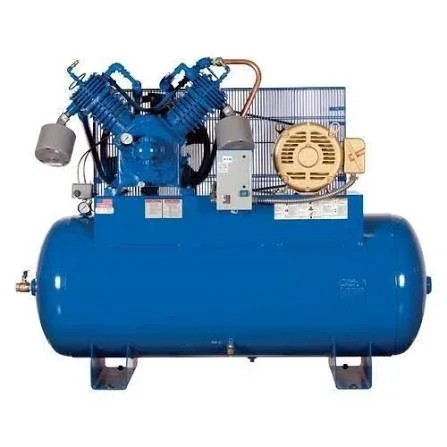
Manufacturer product images, shown to identify machines we sell, service and support. Brand names are trademarks of their owners.
This architecture can provide flexibility when:
- Larger Storage Is Required
- An Existing Receiver Is Available
- Plant Layout Separates Compression and Storage
- Multiple Compressors Feed Common Storage
- Installation Requires a Customised Arrangement
Base-mounted does not mean “compressor only” in the engineering sense
It may mean the compressor itself is supplied without an integral receiver.
But the complete installation can still require:
- Receiver Storage
- Pressure Controls
- Piping
- Drainage
- Air Treatment
- Electrical Supply
- Ventilation
- Isolation
- Safety Devices
- Distribution
- depending on the actual system
So:
Base-mounted ≠ complete system
It is one part of a deliberately configured compressed-air architecture.
The system equation
The compressor base should be selected as part of the system.
Not in isolation.
01 — start with the air duty
Before deciding whether a reciprocating compressor should be:
Base-mounted
or:
Receiver-mounted
establish:
- Application
- Required FAD / CFM
- Operating Pressure
- Number of Users
- Operating Hours
- Expected Duty Cycle
- Receiver Requirement
- Power Supply
- Installation Environment
- Air-Quality Requirement
- These are the selection inputs for reciprocating compressors
02 — base-mounted is not a capacity class
A base-mounted piston compressor is not automatically:
- Larger
- More Powerful
- Higher Pressure
- Higher FAD
- than a receiver-mounted compressor
- Mounting architecture and compressor capacity are different variables
Actual performance must still be verified from:
FAD + pressure + duty
03 — FAD remains more important than swept volume
Piston compressors may be described using several airflow figures and that customers should distinguish:
Theoretical displacement
from:
Useful delivered airflow
The practical comparison should use the appropriate Free Air Delivery under stated conditions.
Base mounting does not change that.
04 — never select a base-mounted compressor by motor HP alone
A statement such as:
“We need a 10 HP base-mounted compressor”
does not define the requirement.
The actual engineering question is:
How much FAD?
At what pressure?
For how long?
Then determine whether a base-mounted arrangement fits the plant layout and storage strategy.
05 — why choose base-mounted architecture?
A separate-receiver arrangement may provide flexibility when:
Larger storage is required
- An existing receiver is available
- Compression and storage are physically separated
- Multiple compressors feed common storage
- A CUSTOMISED INSTALLATION IS REQUIRED.
These are real system reasons.
Not just packaging preferences.
06 — larger storage requirements
A factory-supplied receiver under a compact compressor package may not provide the storage volume required by every application.
Where greater system storage is justified, a separate receiver can provide design flexibility.
But:
Larger storage must still have a purpose
A larger receiver does not automatically make a compressor more efficient.
07 — existing receiver
A site may already have a receiver that could potentially form part of a revised compressor installation.
However:
Existing ≠ automatically suitable
Before reuse, verify as applicable:
- Pressure Rating
- Condition
- Volume
- Connection Arrangement
- Safety / Inspection Status
- Compatibility With the New System
- according to applicable documentation and requirements
08 — do not reuse a receiver only because it is already there
A legacy receiver may be:
- • too small
- • too large for the intended control objective
- • incorrectly rated
- • poorly located
- • unsuitable in condition
- • configured incorrectly for the new system
Therefore:
REUSE SHOULD BE VERIFIED—not ASSUMED
09 — separating compression & storage
This can become useful where the plant layout requires:
Compressor in One Location
and:
- Receiver in Another Appropriate Location
- within a properly engineered system
- Those remain project-specific
10 — multiple compressors feeding common storage
This is one of the most important reasons to consider base-mounted architecture.
A separate receiver arrangement can support a system where:
MULTIPLE COMPRESSORS FEED COMMON STORAGE.
That opens possibilities for:
- Duty Sharing
- Standby Capacity
- Maintenance Flexibility
- Demand Variation Management
- depending on the actual system
11 — common storage does not automatically create good control
Several compressors feeding one receiver still require proper:
- Pressure Controls
- Start / Stop Logic
- Duty Assignment
- Protection
- Demand Matching
- The receiver is only one system component
- A common tank cannot automatically coordinate machines
12 — multiple reciprocating compressors require role definition
Where several piston compressors share storage, ask:
Which Machine Starts First?
When Does the Second Machine Start?
Which Unit Is Standby?
How Are Operating Hours Managed?
What Happens During Maintenance?
Therefore control architecture should be designed around the actual equipment and demand.
13 — customised installations
A custom arrangement may be relevant where the project needs a specific combination of:
- Compressor
- Receiver
- Dryer
- Filters
- Distribution
- Controls
- Access
- Layout
- But each element should have a defined engineering purpose
14 — BASE-MOUNTED vs TANK-MOUNTED
A useful comparison is:
Decision Area | Base-Mounted | Tank-Mounted |
|---|---|---|
Receiver | Separate | Integrated beneath/with compressor |
Storage flexibility | Higher potential | Package-defined |
Existing receiver reuse | Possible where verified | Usually not the central architecture |
Multi-compressor common storage | Strong potential | Less inherently flexible |
Compact package | Depends on system | Often strong |
Custom layout | Strong potential | More package-defined |
FAD | Verify actual compressor | Verify actual compressor |
Duty | Verify model | Verify model |
Neither architecture is universally better.
The system decides.
15 — receiver storage is still not capacity
Whether the receiver is separate or integrated, the governing rule remains:
Storage is not capacity
If average plant demand continuously exceeds compressor capacity, the receiver eventually empties toward system pressure.
So:
Separate receiver ≠ extra compressor capacity
16 — what the receiver can do
Assist Moisture Separation Under Appropriate Conditions.
These functions remain valid whether storage is integrated or separate.
17 — what the receiver cannot do
It cannot:
- Permanently Compensate for Insufficient Compressor Capacity
- Repair Major Pressure Drop
- Eliminate Leakage
- Create Airflow Indefinitely
18 — receiver sizing
Useful sizing inputs:
- Compressor Capacity
- System Pressure
- Minimum Acceptable Pressure
- Peak Demand
- Duration of Peak Demand
- Control Strategy
- Required Buffer Time
- These variables should guide separate-receiver selection
19 — storage should have a purpose
In practice:
THE RECEIVER SHOULD HAVE A DEFINED PURPOSE.
That purpose might be:
- Short-Peak Buffering
- Pressure Stability
- Control Support
- Treated-Air Storage
- but it should be clear
20 — WET RECEIVER vs DRY RECEIVER
Separate-receiver architecture can make storage location a deliberate system decision.
The distinction:
Wet receiver
Usually upstream of final drying, potentially buffering compressor output and supporting bulk moisture management.
Dry receiver
Downstream of treatment where appropriately designed, providing stored treated air.
Some systems may use both.
21 — base-mounted architecture can support purposeful storage location
This is one of its strongest system advantages.
Because the receiver is not physically locked underneath the compressor package, the design can potentially place storage where it best supports the operating objective.
But:
Location should be engineered
Do not move the receiver arbitrarily without considering piping, pressure, drainage, safety and service requirements.
22 — receiver storage & cycling
Receiver size interacts with:
- Compressor Capacity
- Pressure Switch / Control Band
- Demand Rate
- Allowable Pressure Change
- Starts per Hour
A base-mounted compressor with separate storage therefore requires the compressor and receiver to be selected together.
23 — starts per hour
Manufacturers may specify starting-frequency limits.
Excessive cycling can place stress on:
- Motors
- Contactors
- Pressure Switches
- Drive Components
- The receiver and control strategy can influence that behaviour
24 — if cycling is excessive, investigate
Checking:
- Receiver Capacity
- Leakage
- Pressure Settings
- Compressor Sizing
- Demand Behaviour
Do not assume the answer is simply:
Install a bigger receiver
25 — duty cycle remains a compressor limit
A base-mounted configuration does not alter the basic reciprocating duty-cycle rule.
Operating limits may involve:
- Loaded Operating Time
- Cooling
- Starts per Hour
- Discharge Temperature
- Pressure
- Environmental Conditions
Therefore:
Base-mounted ≠ continuous-duty
Verify the actual machine.
26 — one large receiver does not turn a small piston compressor into a large plant-air system
The receiver stores air.
The compressor determines sustained generation.
If sustained demand exceeds FAD:
Storage eventually runs out
That is true regardless of receiver volume.
27 — base-mounted does not define stage count
The compressor may be:
- Single Stage
- Two Stage
or:
- Multi-Stage
- where actual manufacturer design confirms it
- Mounting architecture is separate from compression-stage architecture
28 — base-mounted does not define lubrication
Similarly:
Base-mounted ≠ oil-lubricated
- Base-mounted ≠ oil-free
- 29 — base-mounted does not define cooling
The compressor may use:
Air Cooling
or:
- Water Cooling
- where verified
- Mounting architecture does not determine thermal architecture
30 — base-mounted does not automatically mean large
A base-mounted compressor may be chosen because of:
- Storage Strategy
- Existing Infrastructure
- Custom Layout
- rather than sheer compressor size
“Base-mounted = large industrial.”
31 — installation requires firm support
Note:
FIRM FOUNDATION.
A base-mounted compressor should therefore be installed according to actual manufacturer support/foundation requirements.
Do not infer anchoring details from another model.
32 — ventilation
Note:
ADEQUATE VENTILATION.
A separate receiver may give layout flexibility.
It does not remove the compressor's cooling requirement.
33 — service clearance
Base-mounted architecture can be advantageous where layout is custom designed, but that freedom should be used to preserve:
Service clearance
A custom installation should improve maintainability—not bury the machine behind piping.
34 — electrical protection
Correct electrical protection remains part of installation.
Receiver separation does not change the need for:
- Appropriate Electrical Supply
- Isolation
- Protection
- according to actual equipment requirements
35 — suitable piping
Base-mounted architecture may require more deliberate interconnection between:
Compressor
and:
Separate receiver / downstream system
Do not let custom piping become an unnecessary pressure restriction.
36 — piping should preserve useful pressure
The complete Reddy system philosophy remains:
From compressor room to point of use
If the compressor generates adequate pressure but excessive restriction exists between compressor, receiver and plant header, the user may still experience low pressure.
The layout should be evaluated as a complete flow path.
37 — condensate management
Separate receiver architecture can create additional condensate-management points.
Note:
CONDENSATE MANAGEMENT.
Actual drain configuration must follow the equipment/system design.
38 — air treatment
A base-mounted compressor may connect to:
- Aftercooling
- Moisture Separation
- Dryers
- Filtration
- Wet or Dry Receivers
- depending on the point-of-use requirement
- Mounting type does not determine air quality
39 — air quality is a system property
Whether the compressor is tank-mounted or base-mounted, process air quality still depends on:
- Compressor Technology
- Treatment
- Storage
- Distribution
- Point-of-Use Conditions
- The complete system must be designed backwards from the application
40 — receivers are pressure vessels
When a base-mounted compressor uses a separate receiver, that receiver must still be treated as a pressure vessel.
In practice:
- Installation
- Inspection
- Pressure Rating
- Relief Protection
- Regulatory Requirements
- should follow applicable rules and manufacturer documentation
- Never exceed rated working pressure
41 — existing receiver condition matters
If a base-mounted compressor is installed onto an existing receiver system, verify the receiver's suitability rather than assuming it is acceptable because it previously operated with another compressor.
Consider as applicable:
- Pressure Rating
- Condition
- Documentation
- Relief Protection
- Drainage
- Inspection Status
- according to applicable requirements
42 — new compressor pressure should not exceed receiver limits
A replacement compressor may have a different pressure capability from the old machine.
That does not permit the receiver to be operated beyond its rating.
The complete system pressure boundary must be verified.
43 — multiple compressors + common receiver
But a common receiver alone does not create:
- Automatic Sequencing
- Perfect Load Sharing
- Redundancy
- Energy Optimisation
- These require proper control and system design
44 — multiple compressors can support flexibility
Depending on actual equipment and demand, a multi-compressor arrangement may help with:
- Maintenance Windows
- Standby Strategy
- Demand Variation
- Staged Capacity
- The actual duty decides
45 — base-mounted as backup / secondary capacity
Suitably designed piston equipment may serve as backup or secondary capacity in certain installations.
A base-mounted machine could potentially fit such an architecture where:
- FAD
- Pressure
- Duty
- Control
- Storage
- all match the contingency requirement
46 — temporary / emergency connection planning
Where compressed air is production-critical, a custom base-mounted installation can potentially make room for planned temporary connections.
Any such feature must be project-engineered.
47 — repair / replace & existing system value
- The compressor
- The receiver
can be evaluated as distinct assets.
An ageing compressor may require replacement while a suitable receiver potentially remains serviceable—or vice versa.
But each asset must be independently assessed.
48 — do not replace everything automatically
The broader lifecycle approach says repair/replace decisions should consider condition, parts availability, cost and required reliability rather than age alone.
For a base-mounted installation, this allows more deliberate component-by-component lifecycle decisions.
49 — serviceability
Reciprocating compressors can contain wear components including:
- Piston Rings
- Valves
- Cylinders / Liners
- Bearings
- Belts
- Gaskets
- Filters
- Lubricant-System Components
- depending on design
A custom base-mounted installation should preserve service access to these components.
50 — custom piping should not block maintenance
Because base-mounted systems provide layout flexibility, poor piping design can become a self-created service problem.
Do not route permanent system components where they prevent:
- Cylinder Work
- Valve Access
- Belt / Drive Service
- Motor Removal
- Routine Inspection
- according to the actual machine
51 — lifecycle economics
Base-mounted architecture can shift project cost between:
Compressor Package
and:
Separate Receiver / Piping / Controls / Treatment / Installation.
Therefore compare the full installed lifecycle cost—not only compressor purchase price.
Consider:
- Purchase
- Receiver / Storage
- Piping
- Controls
- Electrical
- Treatment
- Maintenance
- Repairs
- Downtime Exposure
- Expansion Flexibility
- where applicable
52 — flexibility has value only if the plant uses it
A customised base-mounted system may offer greater architecture flexibility.
But unnecessary complexity can also increase:
- Installation Effort
- Components
- Maintenance Points
- Project Cost
Therefore:
Use custom architecture where there is a real operating reason
53 — model data required before product publication
For each base-mounted reciprocating compressor, verify:
- Manufacturer
- Exact Model
- Motor kW / HP
- FAD
- Working Pressure
- Number of Stages
- Cylinder Configuration
- Lubrication Type
- Cooling Type
- Drive Type
- Motor / Engine
- Control Method
- Duty Limit
- Base / Foundation Requirements
- Separate Receiver Requirement
- Recommended / Permissible Connection Requirements Where Published
- Dimensions
- Weight
- Electrical Requirement
- Service Requirements
- Current Availability
If paired with a receiver, separately verify:
- Receiver Volume
- Working Pressure
- Pressure-Vessel Documentation
- Relief Protection
- Condition / Inspection Requirements
54 — customer data to request
For a base-mounted reciprocating enquiry, collect:
- Application
- Required FAD / CFM
- Required Pressure
- Operating Hours / Day
- Expected Duty Cycle
- Number of Users
- Peak Demand / Duration
- Existing Compressor
- Existing Receiver
- Receiver Volume
- Receiver Pressure Rating
- Number of Compressors
- Common Header / Storage Details
- Power Supply
- Room Layout
- Ventilation
- Air-Quality Requirement
- Future Expansion
- Reliability / Standby Requirement
- Photographs / Nameplates of Existing Equipment
- This enables the compressor and storage architecture to be designed together
55 — base-mounted selection gate
Before selecting this architecture, ask:
Why base-mounted?
Larger storage? Existing receiver? Multiple compressors? Custom layout?
What FAD is required?
Verify useful delivered airflow.
What pressure is required?
Start with the process.
What is the duty cycle?
The mount does not change compressor limits.
What storage is required?
Give the receiver a purpose.
Is an existing receiver being reused?
Verify its rating and condition.
Are multiple compressors feeding common storage?
Define controls and machine roles.
Is piping correct?
Avoid unnecessary restriction.
Is ventilation adequate?
Cooling still matters.
Is service access preserved?
Custom design should improve maintainability.
Is the receiver safe and correctly rated?
Pressure-vessel requirements remain controlling.
What air quality is required?
Treat the air according to the process.
Only then should base-mounted architecture be selected.
Base-mounted reciprocating in one line
A base-mounted reciprocating compressor separates air generation from integrated storage
Giving the system design more flexibility when receiver capacity, existing infrastructure, multiple compressors or custom layout justify it
Closing
Separate the compressor from the receiver when there is a real system reason
Base-mounted architecture can support:
Larger storage
- Existing receivers
- Custom layout
- Multiple compressors
- Common storage
- More flexible system integration
But flexibility does not remove the need to verify:
FAD
- Pressure
- Duty cycle
- Storage purpose
- Receiver condition
- Controls
- Piping
- Ventilation
- Safety
- Air quality
- Maintainability
And the storage rule remains unchanged:
A RECEIVER STORES AIR. IT DOES NOT CREATE COMPRESSOR CAPACITY.
Reddy compressors
- Compressed air. engineered for uptime
- Define the duty
- Verify the FAD
- Define the pressure
- Design the storage
- Verify the receiver
- Engineer the piping
- Coordinate multiple machines where required
- Install for serviceability
- Manage the complete lifecycle
- Primary CTA
Request a Base-Mounted Reciprocating Compressor System Assessment
Secondary CTAs
Compare Base-Mounted vs Tank-Mounted
Review Existing Receiver Suitability
Review Multi-Compressor Common Storage
Request Receiver Sizing
Request Reciprocating Compressor Service