
What is a tank-mounted reciprocating compressor?
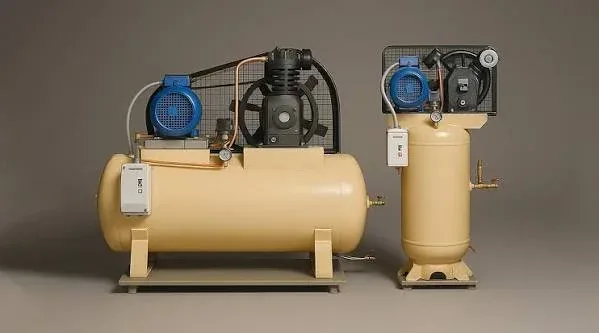
In a tank-mounted package the compressor pump, drive and controls sit on a cradle welded or bolted to a horizontal or vertical air receiver. The receiver acts as the base, the storage vessel and, in many cases, the first point where condensate settles out. The package arrives with a pressure switch, safety valve, pressure gauge, drain valve, non-return valve and often a belt guard and starter.
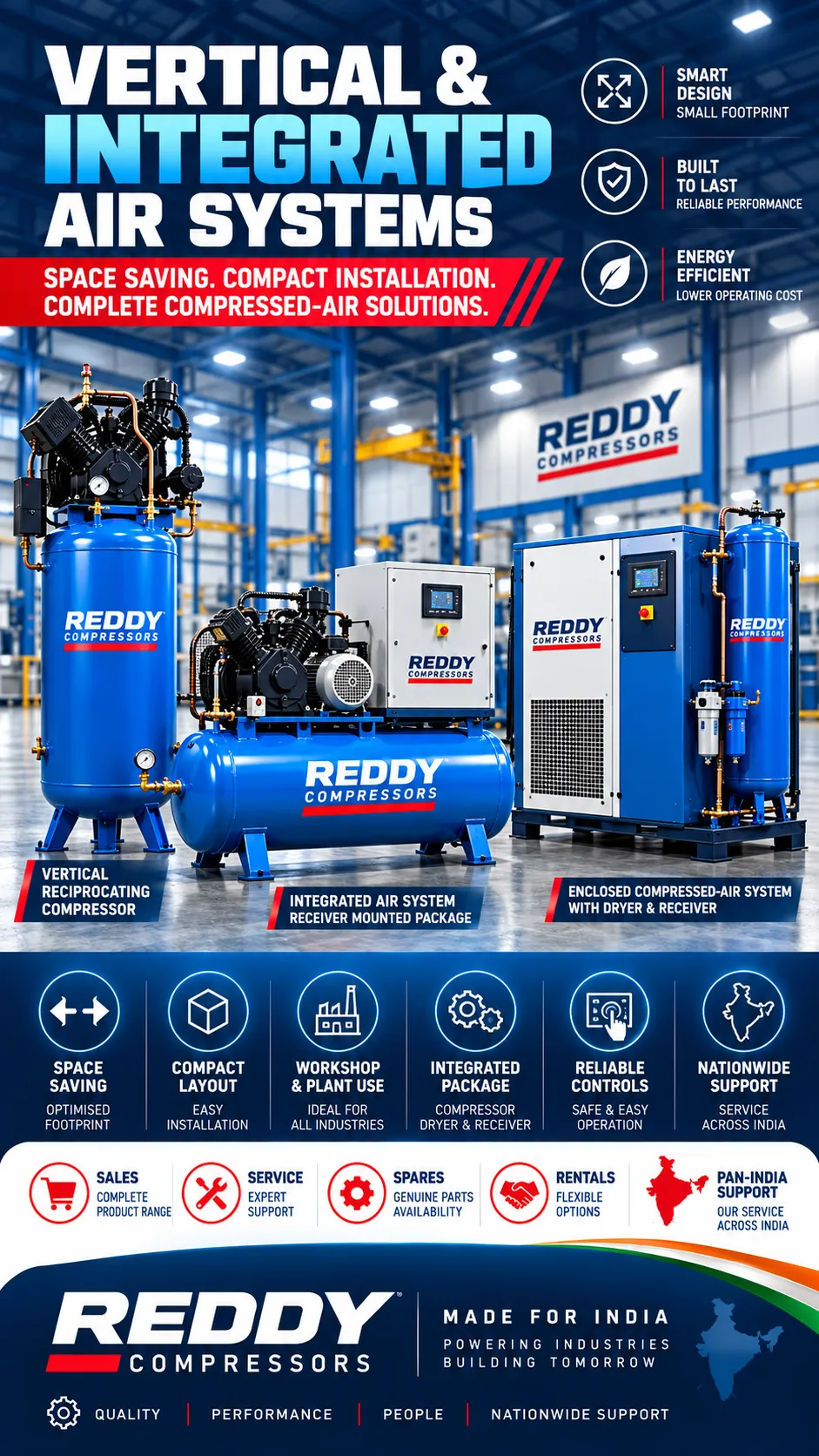
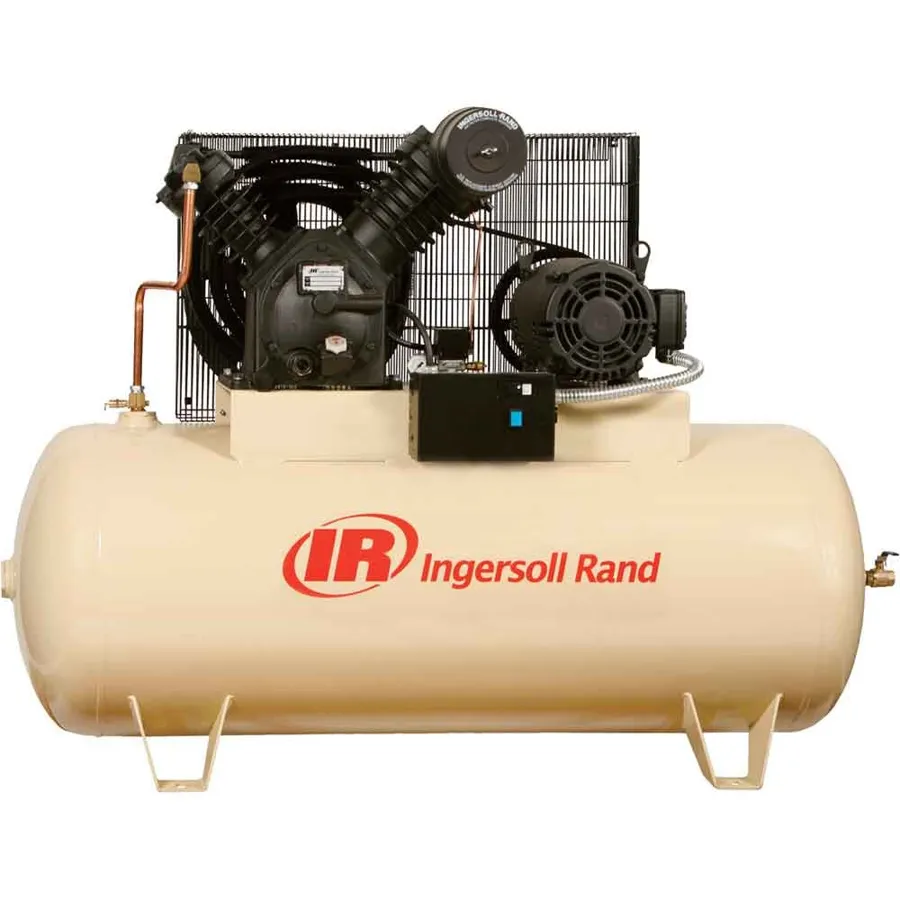
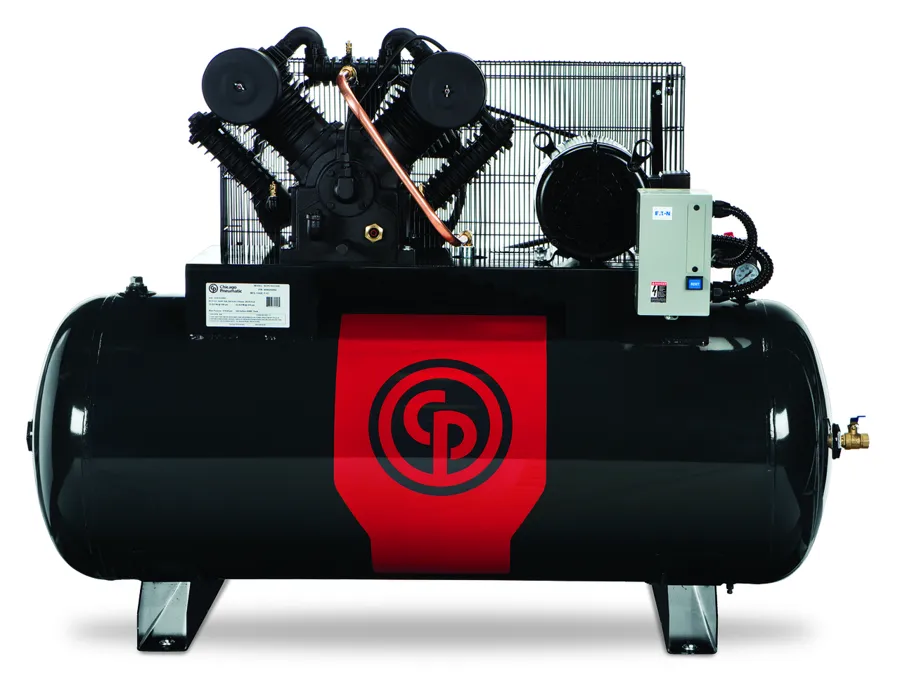
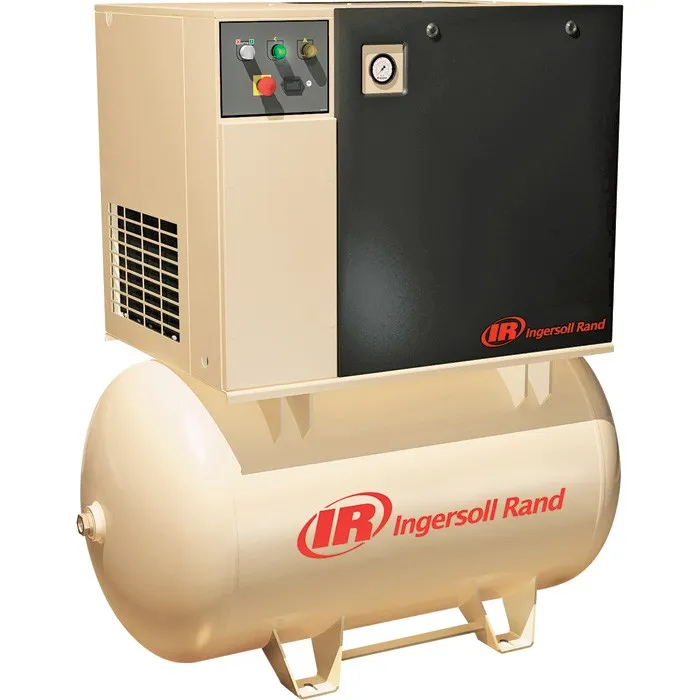
Representative images of machine types we sell, service and rent. Models and capacities are confirmed against your duty.
The alternative is a base-mounted arrangement, where the compressor sits on its own skid or foundation and pipes to a separate receiver. Base-mounted layouts give more freedom in receiver size and position and are common for larger or continuous-duty machines. See base-mounted reciprocating compressors for that layout.
Tank-mounted packages come in single-stage and two-stage forms, with electric motors or, for portable and rural use, small petrol or diesel engines. Most are belt-driven, with the flywheel doubling as a cooling fan for the cylinders and intercooler.
Why the tank matters, and what it cannot do
The receiver does useful work:
- Buffers peaks. Short bursts, such as an impact wrench or a blow gun, draw from stored air before the compressor needs to start.
- Reduces starts. With enough stored volume between the cut-in and cut-out pressures, the motor starts fewer times per hour. Piston compressors have a limit on starts and on loaded running time, so this protects the motor and the pump.
- Cools and separates. Air slows down in the vessel, cools a little and drops some water and oil, which collect at the drain.
- Damps pulsation. A piston delivers air in pulses; the receiver evens these out before the air reaches tools.
What a tank cannot do is create capacity. If average demand over a period exceeds the compressor’s free air delivery (FAD) at working pressure, pressure will fall no matter how big the tank is. A larger tank only delays the moment. That is the most common mistake we see in small plants: a bigger receiver bought to fix a compressor that is simply too small or worn.
Typical configurations and where they fit
| Configuration | Typical pressure | Typical use | Notes |
|---|---|---|---|
| Single-stage, small tank | Up to about 8–10 bar (116–145 psig) | Tyre inflation, blow guns, light tools, small workshops | Short duty; watch running time and temperature |
| Two-stage, medium tank | About 10–12 bar (145–174 psig) | Garages, fabrication shops, body shops, small factories | Intercooler improves efficiency and duty |
| Two-stage, large tank | About 10–12 bar (145–174 psig) | Multi-bay service centres, maintenance workshops | Better start control; heavier for the floor |
| Engine-driven, tank-mounted | About 7–10 bar (101.5–145 psig) | Sites with no power, rural and farm work | Exhaust, fuel storage and ventilation to be planned |
| Oil-free piston, tank-mounted | About 7–10 bar (101.5–145 psig) | Dental, laboratory, small food and packaging users | Lower capacity per kW; still needs drying and filtration |
The tank size on a package is chosen by the manufacturer to give a reasonable start frequency for general use. It may be right for your work, or it may not. A tyre shop with long idle periods and a fabrication shop with three grinders running at once need very different storage.
Across brands
Models we supply and service
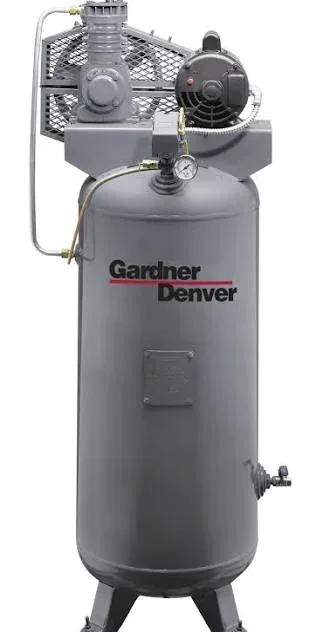
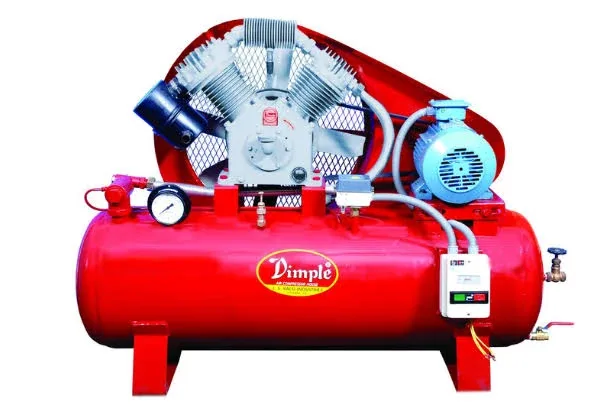
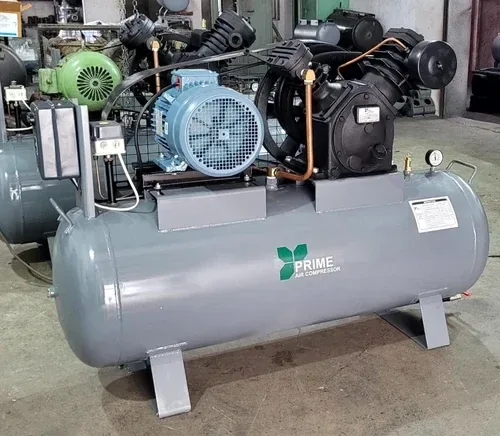
Manufacturer product images, shown to identify machines we sell, service and support. Brand names are trademarks of their owners.
How to select a tank-mounted package
- List the users. Each tool or process, its air consumption at working pressure and how many run at the same time. Tool makers publish consumption in cfm or litres per minute.
- Estimate real demand. Combine the tools with their actual usage pattern across a shift. Do not just add every tool’s rating, and do not guess a diversity factor without watching the work.
- Set the pressure. Required tool pressure plus losses in hose, couplings, filter-regulator and piping. Most air tools need about 6–6.5 bar at the tool, so a 10–12 bar two-stage package gives a comfortable margin for a stored-air band.
- Compare FAD, not displacement. Piston compressors are often quoted with piston displacement, which is always higher than FAD. Ask for FAD at your working pressure.
- Check duty. If the compressor would be loaded most of the shift, a larger machine, a base-mounted unit or a rotary screw compressor may be better. Our rotary screw vs reciprocating comparison explains the trade-off.
- Size storage for the peak. Use the peak demand, its duration and the pressure band you can tolerate. Add a separate receiver near a heavy user if needed; our receiver sizing page shows the method.
- Plan the location. Ventilation, ambient temperature, floor strength, access for belt and valve service, a drain point, and noise for nearby staff.
Displacement vs FAD: reading the specification
Small piston compressor brochures sometimes headline the swept volume of the cylinders, calculated from bore, stroke and speed. That is piston displacement. The air actually delivered at the outlet, after clearance volume re-expansion, valve losses, heating of the inlet air and leakage past rings, is free air delivery. On small single-stage machines FAD at working pressure can be noticeably below displacement; the gap widens as the machine wears.
Always compare packages at the same working pressure and the same reference conditions. If one supplier quotes displacement and another quotes FAD, the comparison is meaningless.
Receiver safety and inspection
The tank on a package is a pressure vessel and must be treated as one. Points to check:
- A nameplate with design pressure, test pressure, year of manufacture and maker.
- A correctly set safety valve of adequate capacity, never plugged, adjusted upward or removed.
- A working drain, used daily or fitted with an automatic drain. Water left in the tank corrodes it from inside.
- No welding, drilling or repairs to the shell by anyone other than a competent pressure-vessel repairer.
- Periodic internal and external inspection, and any statutory inspection that applies to your installation.
Internal corrosion in a neglected receiver is not visible from outside. A tank that has been run for years without draining should be inspected before it is trusted. Our page on air receiver inspection and safety covers this in more detail.
Common faults on tank-mounted compressors
| Symptom | Likely causes | First checks |
|---|---|---|
| Compressor runs almost continuously | Demand above FAD, leaks, worn valves or rings, clogged inlet filter | Leak check with tools off, pump-up time test, valve inspection |
| Frequent starting and stopping | Pressure switch band too narrow, small tank for the duty, leaking non-return valve | Switch setting, unloader operation, non-return valve |
| Water at the tools | Tank not drained, no aftercooler or dryer, hot humid weather | Drain routine, add separator, filter or dryer |
| Oil in the air or high oil use | Worn rings, wrong oil grade, overfilling, blocked breather | Oil level and grade, crankcase breather, ring wear |
| Motor tripping or not starting under pressure | Unloader or pressure-switch unloading valve faulty, low voltage, overheating | Unloader function, supply voltage, starter and overload setting |
| Overheating in summer | Poor ventilation, dirty cylinder fins, belt slip, long loaded running | Room airflow, fin cleaning, belt tension, duty pattern |
In Indian summers, with ambient temperatures of 40–45 °C, and above 45 °C on open sites, in many parts of Telangana and Andhra Pradesh, small air-cooled packages placed in corners or sheds are pushed hard. Good ventilation and clean fins make a big difference. Routine care is covered on our reciprocating compressor maintenance page.
How Reddy Compressors helps
We are an independent multi-brand compressed-air specialist based at Tarnaka, Secunderabad, working with industry since 2002. For tank-mounted piston compressors we:
- Help you work out real demand and pressure before you buy, so the package suits the work.
- Sell new and used/refurbished tank-mounted and base-mounted piston compressors from ELGi, Atlas Copco, Ingersoll Rand, KAESER, Chicago Pneumatic and other brands. We are not an authorised dealer of any brand. We have tie-ups with all major and reputed brands.
- Service and repair pumps, valves, rings, unloaders, pressure switches, motors and drains, with more than 20 service engineers and technicians.
- Supply spare parts identified from the make, model, serial number and nameplate, with fit confirmed before quoting.
- Add separate receivers, dryers and filters where the package alone is not enough.
- Rent compressors when a workshop machine breaks down or demand outgrows it.
Our service teams cover all of Telangana and Andhra Pradesh, and we supply equipment and spares across India. Call +91 99590 60718 or +91 92468 88812.
What to send us
- Nameplate photos of the compressor, motor and tank
- List of tools or processes, with their air consumption if known
- Working pressure needed at the tools
- Hours of use per day and how many tools run together
- Installation photos showing ventilation and space
- Any symptoms: long running, water, oil, noise or tripping
Frequently asked questions
What size tank do I need for my air compressor?
Tank size depends on peak demand, how long the peak lasts, the compressor’s free air delivery and the pressure band you can accept between cut-in and cut-out. A bigger tank reduces starts and handles short bursts, but it cannot supply sustained demand above the compressor’s capacity. Size the compressor first, then the storage.
Is a bigger tank better on a piston compressor?
Up to a point. More storage means fewer motor starts and better handling of short peaks, which helps piston compressors with start and duty limits. Beyond that, extra volume only adds cost, floor load and pump-up time. If pressure keeps falling during normal work, the compressor is too small or worn, and a larger tank will not fix it.
What is the difference between tank-mounted and base-mounted compressors?
A tank-mounted compressor has the pump and motor mounted on the air receiver as one package, saving space and installation work. A base-mounted compressor sits on its own skid or foundation and pipes to a separate receiver, allowing any tank size or position. Base-mounted layouts usually suit larger machines and longer duty.
Why does my tank-mounted compressor run all the time?
Continuous running usually means demand is higher than the compressor’s real output, leaks are consuming air, or the pump is worn. Test by shutting all tools and watching whether pressure holds. A long pump-up time from empty points to worn valves or rings. A blocked inlet filter or slipping belt also reduces output.
How often should I drain my compressor tank?
Drain manually at least once every working day, and more often in humid monsoon weather or on long shifts. An automatic drain is a sensible upgrade. Water left in the receiver corrodes the shell from inside, reduces storage volume and carries over to tools, so regular draining protects both the vessel and the equipment.
Can a tank-mounted compressor run a full shift?
Many can, if the compressor is sized so it runs loaded for only part of each cycle and the room is well ventilated. Piston compressors have manufacturer limits on loaded running time and starts per hour. If your demand keeps the machine loaded almost all the time, a larger two-stage unit or a rotary screw compressor is usually a better choice.
Related pages
Technical content reviewed by D. Srinivas Reddy, Managing Partner and service engineer, Reddy Compressors. Last updated 17 October 2026. How our engineering content is reviewed.