
A portable compressor’s cooling arrangement must suit the environment in which the machine will work. Heat, dust, nearby equipment and temporary barriers can all affect that environment. A unit selected for the required air duty still needs an appropriate location and maintenance plan to operate within its documented limits.
Cooling should therefore be considered before mobilisation, alongside pressure, airflow and the working schedule. The useful questions are practical: where will cooling air enter, where will heated air leave, what contamination will reach the machine, and how will the equipment be inspected and serviced?
Reddy Compressors welcomes enquiries that include site conditions and the intended operating duty. Provide the proposed location, expected environment and available equipment information so that cooling requirements can be considered within the supply or service assessment.
Identify which cooling function is being discussed
A portable package can contain several heat exchangers serving different purposes. Depending on its design, these may support the engine, compressor fluid, compressed-air stages or delivered-air treatment. The layout and combination are specific to the equipment.
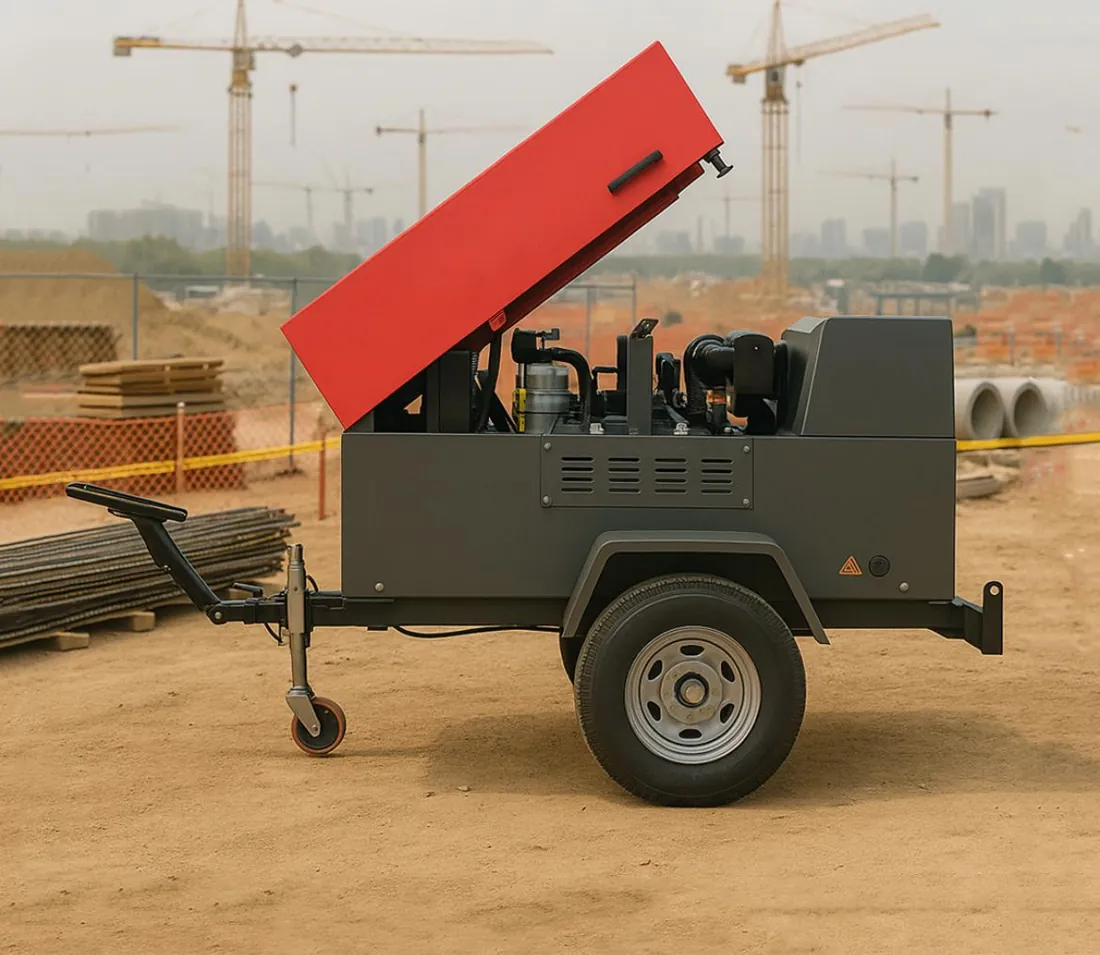
Start by identifying the relevant component in the manufacturer’s documentation. An engine coolant temperature, compressor lubricant temperature and compressed-air outlet temperature describe different conditions. A concern about one should not automatically be treated as a fault in another.
This page addresses the machine’s ability to reject heat in field service. Cooling the delivered compressed air for downstream use is a separate aftercooler and treatment question. A machine operating within its own temperature limits has not thereby demonstrated that its outlet air meets a process temperature or moisture specification.
Keep both requirements visible in the enquiry, but ask for separate evidence supporting each.
Establish the permitted site conditions
Request the operating ambient range for the exact model and configuration being offered. Ask whether the proposed duty, altitude or fitted options introduce additional restrictions or require a manufacturer assessment.
A general statement that a compressor is suitable for hot climates does not establish its suitability for the actual job. Nor does an upper ambient limit, by itself, explain whether the required air delivery remains available under every condition within that range.
The supplier’s response should identify the applicable documentation and any performance adjustment required for the site. Do not apply a general percentage reduction or borrow a limit from a similar-looking machine.
For project planning, distinguish expected weather from conditions at the equipment. A weather forecast describes a wider area. A compressor positioned beside another machine’s hot-air discharge or within a restricted enclosure may experience a different local environment.
Record where and how any site temperature observations were made. The equipment specialist can then decide whether those observations are suitable for comparison with the manufacturer’s stated limits.
Follow the cooling-air path through the proposed location
Use the machine layout to identify cooling-air entry and discharge areas. Assess the surroundings with the compressor in its intended operating position, including nearby walls, vehicles, temporary structures and other equipment.
The review should consider whether the inlet has an adequate supply of suitable air and whether heated discharge air can leave without being drawn back into the cooling path. A location that fits the machine’s transport dimensions may still be unsuitable for operation.
Site feature | Question for the placement review |
|---|---|
Wall or temporary barrier | Does it obstruct an inlet or discharge path? |
Adjacent compressor or generator | Can its heated discharge affect the proposed machine? |
Vehicle body or equipment deck | Has the installed arrangement been assessed for cooling? |
Stored materials | Could the working area change after mobilisation? |
Roof or weather shelter | Does it alter ventilation or retain heated air? |
Service approach | Can authorised personnel reach the cooling components as required? |
Clearances and airflow requirements must come from the equipment information and site assessment. There is no universal separation distance appropriate to every portable compressor and arrangement.
Preserve the designed canopy arrangement
The canopy is more than a cover. On some portable machines, its panels and doors help establish the intended cooling-air route. Operating with doors open can disturb that route and allow hot air to recirculate.
Follow the specified operating position of doors, panels and guards. Do not treat an open panel as a general solution to a rising temperature indication. If the machine runs abnormally with its enclosure in the required condition, the cause needs investigation.
The same principle applies to proposed modifications. Additional mesh, improvised covers, acoustic screens or attached ducting can change the conditions around the package. Submit the actual proposal for assessment before installation rather than assuming it improves protection without affecting cooling.
For equipment mounted on a vehicle or incorporated into a larger package, obtain confirmation that the complete installed arrangement is acceptable. Approval of the compressor as a standalone machine does not establish suitability of every surrounding structure.
Describe dust exposure precisely
Dust is not a single operating condition. A road beside the machine, active drilling, material handling and occasional windblown debris may create different exposure patterns. Describe the source, proximity and periods of greatest contamination in the site brief.
Deposits on cooler surfaces can impair heat transfer. The compressor’s air-intake filtration and the cleanliness of its cooling surfaces are separate inspection subjects; servicing one does not prove the other is satisfactory.
Ask for a maintenance approach suited to the actual equipment and exposure. Include the access needed to inspect the cooling pack and the arrangements for cleaning when required. A planned service visit should not be the only opportunity to recognise a developing obstruction.
Avoid adding unapproved filter material or fine mesh over an opening as a site-made dust solution. If additional protection is needed, ask the manufacturer or qualified equipment specialist to assess an appropriate option and its effect on airflow.
Keep coolant and lubricant requirements equipment-specific
Where the package uses engine coolant or circulating compressor fluid, obtain the correct specifications and inspection instructions. The fluids may serve different circuits and require different products, checks and maintenance actions.
Do not select a replacement fluid from colour, appearance or a general description such as compressor oil. Use the specification approved for the actual unit and conditions. Any proposed substitution or mixture needs appropriate technical confirmation.
For a hired or transferred machine, request available service records and clarification of the fluids already in use. If the history is uncertain, refer it for assessment rather than assuming compatibility.
Inspection and replenishment must follow the applicable safe method. Hot or pressurised systems can release fluid and cause injury. Do not open a hot radiator cap or carry out fluid work on running equipment. The specific preparation, cooling and isolation requirements belong in the machine’s maintenance instructions.
Plan cooler inspection and cleaning without inventing an interval
The required inspection and cleaning frequency depends on the equipment instructions and operating environment. A service interval from one model or a general maintenance article should not be applied across an entire portable fleet.
Ask the responsible maintenance provider to identify what is inspected, how condition is recorded and what triggers further attention. Include contamination, visible damage and the condition of associated components within the equipment-specific inspection scope.
Cleaning methods also require care. The approved technique must suit the cooler construction and the contamination present. Do not assume that unrestricted pressure washing, an arbitrary solvent or forceful compressed-air cleaning is acceptable.
The maintenance record should describe the work completed and any defects identified, rather than recording only that the machine was cleaned. Where further repairs are required, keep those items open until they have been addressed and verified by the responsible personnel.
Use temperature observations with operating context
A useful temperature record identifies the sensor or measurement location, operating state, pressure setting and approximate duty at the time. Include the observed site conditions and any relevant change in placement or surrounding equipment.
Comparisons are more meaningful when they concern the same parameter under comparable conditions. A compressor-fluid reading should not be compared directly with an engine-coolant reading, and a brief unloaded observation should not be treated as equivalent to sustained working operation.
Ask the technical reviewer which observations are useful for the particular machine. Do not impose a universal normal operating temperature or an assumed margin below a shutdown threshold.
This record supports investigation; it does not diagnose the fault by itself. A rising indication may require review of the environment, cooling components, fluid system or instrumentation. The correct investigation follows the machine documentation and the evidence from the actual event.
Respond to a temperature warning through the approved procedure
Follow the message-specific instructions when a temperature warning or protective shutdown occurs. Record the indication accurately and report it to the responsible person. Avoid repeated restarts intended only to keep the job moving.
Useful reporting information includes the machine identity, exact message, time in service, duty being performed and any recent change in the surrounding arrangement. Photographs of the location can help explain conditions that may have changed before the technician arrives.
Do not raise a protective limit, bypass a sensor or alter a control setting to suppress the indication. A machine that restarts after cooling has not, by that fact alone, been shown to have its underlying problem resolved.
Restart and return to service should follow the applicable instructions and technical assessment. Detailed alarm interpretation remains part of the portable-controls and equipment-service review.
Include changing site conditions in the operating plan
Portable equipment often remains on a site while the work around it changes. A clear discharge path can become obstructed by stored materials. Another machine may arrive beside it. A temporary shelter may be extended after the initial placement assessment.
Assign responsibility for recognising changes that affect the compressor’s surroundings. The review should also follow relocation to a different work area, even if the compressor and air-consuming equipment remain the same.
An illustrative example is a unit that works satisfactorily in an open position and is later surrounded by temporary panels for another site purpose. The earlier observation does not establish suitability of the revised arrangement. Refer the change for assessment before relying on the original placement decision.
Lower-temperature conditions also require attention where relevant. Use the manufacturer’s specified cold-weather provisions; do not improvise by blanking openings or defeating temperature-control arrangements.
Agree cooling evidence at equipment handover
A useful handover identifies the environmental limits, placement requirements and maintenance responsibilities for the supplied unit. It should leave no uncertainty about who checks the site arrangement and who responds when a cooling concern arises.
Request the following information as applicable:
- • The exact machine configuration and relevant operating documentation
- • Approved ambient conditions and any site-related performance limitations
- • Cooling-air inlet and discharge locations, with placement requirements
- • Required canopy, panel and guard condition during operation
- • Applicable fluid specifications and cooling-system maintenance instructions
- • Temperature indications and the reporting route for warnings
- • Any outstanding defect, restriction or unverified site condition
Where operating observations are required for acceptance, agree the method and conditions with the responsible specialist. A brief demonstration in mild weather does not prove suitability for every later duty or seasonal condition.
Frequently asked questions
Is machine cooling the same as compressed-air aftercooling?
They address different requirements. Machine cooling supports the equipment’s thermal operation. An aftercooler addresses the temperature of delivered compressed air and forms part of the downstream treatment assessment. Verify both where the application requires them.
Can any portable compressor work in high ambient temperatures?
Check the exact unit’s permitted conditions and performance information. A portable designation or hot-climate description does not establish a universal temperature rating. Site-specific restrictions and options need supplier confirmation.
Will opening the canopy help an overheating compressor?
Do not assume that it will. Some packages depend on closed panels to maintain the intended airflow. Use the manufacturer’s required operating arrangement and have abnormal temperature behaviour investigated.
Is a clear space around the machine enough?
The layout must account for the actual inlet and discharge paths, nearby heat sources and any recirculation risk. Use equipment-specific placement requirements rather than judging suitability only from visible space.
How often should the cooling pack be cleaned?
Use the applicable maintenance instructions and a condition-based assessment of the exposure. Dust loading varies between sites. No universal cleaning interval is specified here.
Can an extra fan or temporary duct solve a cooling problem?
Any proposed modification needs assessment for the actual package and location. Do not assume it restores approved performance or addresses the cause of the problem. Obtain a supported solution before altering the arrangement.
Does a temperature shutdown mean the cooler must be replaced?
The message alone does not identify the required repair. Qualified investigation should establish the cause using the machine documentation, operating context and component checks. Avoid replacing parts solely from a generic symptom list.
What should accompany a cooling enquiry?
Provide the machine details, duty, location photographs, expected environmental conditions and available operating records. For an existing problem, include the exact temperature indication or alarm and when it occurs.
Discuss Portable Compressor Cooling Requirements
Share the proposed site arrangement and operating duty with Reddy Compressors. Identify dust sources, nearby heat-producing equipment, restricted spaces and any intended mounting or enclosure changes.
Equipment suitability and the proposed service scope should be confirmed for the actual enquiry. For broader selection, explore portable compressors.