
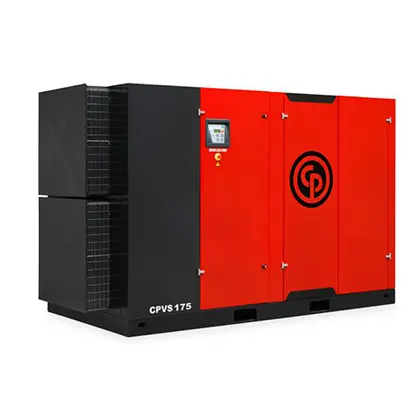
Rotary or reciprocating?
The governing answer:
Neither technology wins every application
It specifically rejects the oversimplified rule:
“Workshop = piston.”
“Factory = screw.”
Real compressor selection requires more variables.
The comparison should not begin with
- PRICE
- Horsepower
- Technology fashion
- “Which one is better?”
It should begin with:
What does the process actually need?
The selection equation
The technology comes after the requirement.
01 — start with FAD
Both rotary screw and reciprocating compressors must ultimately provide:
Useful delivered air
The relevant question is not:
“Which motor is bigger?”
It is:
“Which machine delivers the required FAD at the required pressure?”
02 — pressure & flow must be read together
A compressor can have:
Adequate Pressure but Insufficient Flow
or:
- Adequate Flow but Insufficient Pressure
- Neither condition is acceptable
The same relevant operating requirement
Not just nameplate motor ratings.
03 — duty cycle is one of the most important differences
Piston compressors can have manufacturer-specific limits relating to:
- Loaded Operating Time
- Cooling
- Starts per Hour
- Discharge Temperature
- Pressure
- Environmental Conditions
- That makes duty cycle central to the comparison
04 — reciprocating: generally worth evaluating when demand is intermittent
This is a useful selection direction.
Not a universal rule.
05 — rotary screw: generally worth evaluating when demand is sustained
Rotary screw technology is generally worth evaluating when:
- Air Demand Is Sustained
- Operating Hours Are High
- Plant Air Supports Continuous Production
- Stable Pressure Is Important
- Multiple-Machine Control May Be Required
Again:
Evaluate
Do not automatically prescribe.
06 — the load profile decides
The broader reciprocating section states:
Where demand is:
- High
- Continuous
- Predictable
- Present Across Multiple Shifts
- rotary screw may deserve consideration
Where demand is:
- Intermittent
- Periodic
- Relatively Low
- Characterised by Long Idle Periods
- reciprocating can be commercially and technically attractive
Its conclusion is direct:
THE LOAD PROFILE DECIDES.
07 — intermittent demand
Intermittent demand might involve:
- Short Tool Use
- Maintenance Operations
- Periodic Equipment
- Long Idle Periods
- depending on application
- In such duties, reciprocating equipment may deserve strong evaluation
The compressor is not forced to behave like a continuously loaded production utility.
08 — sustained demand
If the application needs air for:
- Long Operating Periods
- Continuous Production
- Multiple Shifts
- the rotary screw architecture may deserve stronger evaluation
09 — operating hours change the economic case
Electricity over the life of a compressor can become materially larger than purchase cost where utilisation is high.
Therefore compare:
Operating Hours
not just:
Purchase Price.
10 — short-hour operation & high-hour operation are different commercial problems
A compressor operating briefly each day may justify a different capital and maintenance strategy from a machine operating across production shifts.
11 — do not buy higher technology for status
An important economic point:
Installing a more sophisticated continuous-duty system may not produce an economic benefit simply because it appears to be a higher technology level when the actual air requirement is only periodic.
So:
Technology should justify itself through the duty
12 — do not force an intermittent-duty machine into continuous service
The reverse mistake is equally serious.
Forcing an intermittent-duty compressor into continuous industrial service can contribute to:
- Thermal Stress
- Accelerated Wear
- Increased Maintenance
- Shorter Component Life
13 — reciprocating does not automatically mean “small”
Reciprocating technology can exist across:
- Single Stage
- Two Stage
- Multi-Stage
- and selected higher-pressure architectures
Therefore:
Piston ≠ only small garage compressor
14 — rotary screw does not automatically mean “large factory”
The site architecture includes small, medium and large industrial rotary screw categories.
A compact rotary screw may suit a smaller facility if the duty is regular or sustained.
So:
Rotary screw ≠ large plant only
“WORKSHOP = PISTON.”
A high-utilisation workshop may deserve rotary screw evaluation.
16 — factory does not automatically mean rotary screw
The same source rejects:
“FACTORY = SCREW.”
A smaller industrial operation with periodic air demand could still justify reciprocating technology.
Again:
Application first
17 — the source's direct duty comparison
Decision Factor | Reciprocating | Rotary Screw |
|---|---|---|
Intermittent demand | Often suitable | Evaluate economics |
Sustained demand | Model/duty dependent | Often strong fit |
High annual hours | Evaluate carefully | Often strong fit |
Simple small-system architecture | Strong potential | Possible |
Multi-compressor sequencing | Less typical | Strong potential |
Higher-pressure specialised duty | Possible with suitable stages | Model/application dependent |
Explicitly described as:
A DECISION GUIDE—not A UNIVERSAL PERFORMANCE RANKING.
18 — serviceability
Reciprocating serviceability as potentially valuable where:
Parts
and:
- Technical Capability
- are available
But it also warns:
“SIMPLE MAINTENANCE” ≠ “NO MAINTENANCE.”
Reciprocating machines can contain wear components such as rings, valves, cylinders, bearings, belts, gaskets, filters and lubrication components depending on design.
19 — ROTARY SCREW MAINTENANCE IS DIFFERENT—not ABSENT
A rotary screw system can involve:
- Lubrication
- Filtration
- Separators
- Cooling
- Controls
- Drive Components
- depending on actual equipment
Therefore technology comparison should ask:
What maintenance does this exact machine require?
not:
“Which technology needs no maintenance?”
Neither does.
20 — do not claim reciprocating is always cheaper to maintain
Maintenance economics depend on:
- Machine Design
- Operating Hours
- Duty
- Parts Availability
- Technical Capability
- Machine Condition
- Service History
21 — do not claim rotary screw is always cheaper to maintain
The reverse claim is also unsupported.
The comparison should use the actual machine and operating duty.
22 — capital cost
Reciprocating equipment may offer an attractive initial investment in some smaller or intermittent applications compared with larger continuous-duty technologies.
But it immediately warns:
PURCHASE PRICE SHOULD BE ONLY ONE LINE IN THE EVALUATION.
23 — low purchase price does not prove low lifecycle cost
In practice:
The cheapest compressor to buy may not be the cheapest compressor to own
It also says:
THE MOST EXPENSIVE COMPRESSOR IS NOT AUTOMATICALLY THE BEST.
24 — energy should be compared under the actual duty
Comparing:
- Delivered Airflow
- Pressure
- Motor Input
- Operating Hours
- Loaded Time
- Unloaded / Idle Behaviour
- Leakage
- Control Strategy
That is a far more meaningful energy comparison than:
MOTOR kW ALONE
25 — do not ask only “which technology is more efficient?”
This:
The wrong question
The stronger question is:
WHICH MACHINE DELIVERS THE REQUIRED FAD AND PRESSURE AT THE ACTUAL OPERATING PROFILE WITH THE LOWEST ACCEPTABLE LIFECYCLE COST?
26 — there is no universal energy winner
Compare real equipment under real duty.
27 — specific machine performance matters
When comparing actual compressor options, useful parameters can include:
- Motor / Engine Rating
- FAD
- Working Pressure
- Input Power
- Specific Power
- Control Type
- Cooling
- Rating Conditions
- Use equivalent rating conditions wherever possible
28 — FAD basis should be verified
For piston compressors especially, the source warns against confusing:
Theoretical displacement
with:
USEFUL DELIVERED FAD.
A misleading airflow basis can distort the entire comparison.
29 — pressure requirements
Reciprocating and rotary screw families can both exist across different pressure architectures.
Therefore:
Technology type alone does not define working pressure
The actual application and model must be compared.
30 — higher-pressure specialist duty
Reciprocating: possible with suitable stages.
Rotary Screw: model/application dependent.
That is the correct neutral positioning.
Do not turn this into:
“Piston always wins high pressure.”
31 — simple small-system architecture
The source assigns reciprocating technology strong potential for simple small-system architecture while rotary screw remains possible.
That can matter for:
- Small Workshops
- Garages
- Periodic Utility Air
- where actual duty fits
32 — receiver-mounted reciprocating packages
A receiver-mounted piston compressor can offer:
- Compact Installation
- Integrated Storage
- Simplified Small-System Layout
- Intermittent-Demand Buffering
- That can be a practical architecture
- But receiver size must still match the application
33 — storage does not make the technology decision for you
A reciprocating compressor can use receiver storage effectively for short peaks.
Rotary screw systems can also use receivers for defined control/storage purposes.
Therefore:
Receiver = system component
Not:
Technology label
34 — start / stop cycling can matter more for some reciprocating duties
Receiver size interacts with:
- Compressor Capacity
- Pressure-Control Band
- Demand Rate
- Allowable Pressure Change
- Starts per Hour
and that excessive cycling can stress motors, contactors, pressure switches and drive components.
This should be included when comparing intermittent applications.
35 — multi-compressor control
Less Typical potential in reciprocating architecture and Strong Potential in rotary screw architecture.
That can make rotary screw especially relevant where several industrial compressors must operate as one coordinated plant-air system.
36 — multiple machines require competent control
A multi-compressor installation can potentially provide:
- Demand Matching
- Maintenance Flexibility
- Redundancy
- Staged Expansion
- depending on the system
- But controls matter
- Do not assume simply adding compressors creates an efficient system
37 — stable pressure
The dedicated comparison identifies stable pressure as one reason rotary screw deserves evaluation.
“Reciprocating compressors cannot supply stable pressure.”
Storage and controls matter.
38 — AIR QUALITY DOES NOT COME FROM ROTARY vs RECIPROCATING ALONE
Compressor technology is only one part of the air-quality system.
The downstream process may require:
- Moisture Control
- Filtration
- Oil Control
- Defined Pressure Dew Point
- depending on application
Therefore:
ROTARY vs RECIPROCATING ≠ AIR-QUALITY CLASS
39 — OIL-LUBRICATED vs OIL-FREE IS A SEPARATE DECISION
Both technology families can have different lubrication architectures depending on actual equipment.
Do not use:
Rotary = oil-injected
and:
Reciprocating = oil-lubricated
as universal assumptions.
40 — cooling is also a separate decision
Both compressor families may use different cooling architectures where manufacturer design supports them.
Therefore:
ROTARY vs RECIPROCATING
should not automatically be converted into:
AIR-COOLED vs WATER-COOLED
Cooling must be verified independently.
41 — installation matters for both
Reciprocating installation requires:
- Foundation
- Ventilation
- Service Clearance
- Electrical Protection
- Suitable Piping
- Condensate Management
- Pressure Relief
- Isolation
- Rotary screw systems similarly require correct compressor-room integration
- A good compressor can still perform poorly in a bad system
42 — reciprocating may place more emphasis on mechanical cycling & wear items
Reciprocating wear/service components including:
- Rings
- Valves
- Cylinders / Liners
- Bearings
- Belts
- Gaskets
- Filters
- Lubricant-System Components
- This is useful lifecycle context
43 — rotary screw may place more emphasis on integrated system control
as reasons rotary screw deserves evaluation.
That can be especially relevant as compressed air becomes a plant utility rather than a standalone machine.
44 — there is no universal reliability winner
Reliability depends on:
- Application Match
- Installation
- Duty
- Operating Conditions
- Maintenance
- Parts
- Controls
- System Design
“Screw is more reliable.”
- “Piston lasts longer.”
- “ROTARY SCREW IS X dB QUIETER.”
- 46 — there is no universal vibration ranking in this source
Installation and actual machine architecture matter.
If a model-specific comparison is later added, use verified manufacturer data.
47 — there is no universal service-interval winner
Service intervals vary by:
- Manufacturer
- Model
- Duty
- Environment
- Operating Hours
- Lubricant
- Condition
- Therefore “longer service interval” should only appear against verified models
48 — there is no universal life-expectancy winner
Screw lasts Y years.
Machine life depends on actual operating and maintenance conditions.
49 — lifecycle cost should be considered conceptually
The source provides this conceptual framework:
Lifecycle cost =
Not every variable is easy to quantify.
But ignoring them does not make them disappear.
50 — capital simplicity
For some intermittent applications, reciprocating equipment can have practical capital appeal.
But the source deliberately uses:
MAY
rather than:
Always
That distinction should remain.
51 — energy cost becomes more important as hours rise
As annual utilisation increases, operating energy becomes increasingly material in the lifecycle evaluation.
Therefore high operating hours deserve a more detailed efficiency comparison between actual models.
52 — downtime cost can change the decision
The lifecycle formula includes:
DOWNTIME.
A low-capital-cost machine may not be an economical selection if its application mismatch creates repeated production interruption.
Likewise a higher-cost machine should not be selected merely because it appears more industrial.
53 — air treatment belongs in both technology options
The lifecycle formula also includes:
AIR TREATMENT.
A fair comparison should therefore include the complete system required to deliver acceptable air at the process.
54 — installation cost should be compared
The source's lifecycle framework includes:
INSTALLATION.
Consider actual project needs such as:
- Foundation / Mounting
- Electrical Work
- Ventilation
- Receiver
- Piping
- Treatment
- Controls
- rather than comparing bare compressor prices
55 — residual value may matter
This includes:
Residual value
in conceptual lifecycle cost.
But it can legitimately include residual value where actual commercial analysis has a defensible basis.
56 — application example: workshop
Where demand is:
- Short-Duration
- Intermittent
- Moderate-Hour
- reciprocating may deserve evaluation
Where the workshop evolves toward:
- High Utilisation
- Sustained Demand
- Multiple Shifts
- rotary screw may become more appropriate to evaluate
- The application name does not make the decision
57 — application example: factory plant air
Where plant air is:
- Continuous
- Production-Critical
- High-Hour
and may require:
- Multiple Compressors / Central Controls
- rotary screw has strong potential
But a small factory with periodic demand may still deserve a different conclusion.
58 — application example: backup air
A suitably designed machine may provide backup or secondary capacity in certain installations.
That can make reciprocating attractive in some backup roles.
But actual FAD, pressure, starting strategy and criticality still need to match.
59 — application example: higher-pressure specialist duty
However, rotary screw capability remains model/application dependent.
Therefore no generic winner should be declared.
60 — application example: highly variable plant demand
The broader decision tree says highly variable plant demand should trigger evaluation of:
VSD / BASE-TRIM ARCHITECTURE.
That is typically a system-level question rather than a simple rotary-versus-piston label.
61 — do not choose reciprocating just because purchase price is lower
Purchase price is one line.
Not the whole decision.
62 — do not choose rotary screw just because it looks more industrial
If the application uses air for short periods and has long idle intervals, a sophisticated continuous-duty architecture may not produce an economic benefit merely because it is technically more advanced.
Use technology where the duty justifies it.
63 — repair existing reciprocating or change technology?
For existing piston equipment, the source recommends considering:
- Cylinder Condition
- Valve Condition
- Bearing Condition
- Motor Condition
- Lubrication Condition
- Pressure-Vessel Condition
- Parts Availability
- Repair Cost
- Required Reliability
- Do not switch technology only because the compressor is old
64 — age alone does not make rotary screw the correct replacement
In practice:
DO NOT DECIDE BASED PURELY ON EQUIPMENT AGE.
The correct replacement technology still depends on:
- Current Demand
- Pressure
- Operating Hours
- Duty
- Future Requirement
- Lifecycle Economics
65 — actual data required for a serious comparison
For both candidate technologies, compare where available:
- Manufacturer
- Model
- FAD
- Operating Pressure
- Motor Input
- Specific Power
- Control Type
- Cooling
- Duty Limit
- Operating Hours
- Maintenance Requirements
- Installation Requirements
- Air-Treatment Requirements
- Current Availability
- Lifecycle Cost Assumptions
- No winner should be declared from technology name alone
66 — customer data to request
For a rotary-vs-reciprocating assessment:
- Application
- Required FAD / CFM
- Required Point-of-Use Pressure
- Operating Hours / Day
- Days / Year
- Minimum Demand
- Average Demand
- Peak Demand
- Peak Duration
Long Idle Periods?
Number of Users
Receiver Requirement
Air-Quality Requirement
Electrical Supply
Installation Environment
Existing Compressor
Current Energy / Maintenance Concerns
What Happens if Air Is Lost?
Future Expansion
This turns:
“Screw or piston?”
into an engineering decision.
67 — ROTARY vs RECIPROCATING SELECTION GATE
Is the demand intermittent?
Reciprocating deserves evaluation.
Is demand sustained?
Rotary screw deserves evaluation.
Are operating hours high?
Compare rotary screw strongly against actual alternatives.
Are long idle periods common?
Reciprocating may remain commercially attractive.
What FAD is required?
Technology cannot compensate for insufficient flow.
What pressure is required?
Verify model capability.
Does the application need specialist higher pressure?
Evaluate suitable staged reciprocating and verified alternatives.
Is multi-compressor sequencing required?
Rotary screw architecture may offer stronger potential.
Is simple small-system architecture important?
Reciprocating may have strong potential.
What maintenance does each actual machine require?
Compare model to model.
What is the complete lifecycle cost?
Purchase price is not enough.
Then choose the technology.
68 — controlled comparison summary
Engineering Question | Reciprocating | Rotary Screw |
|---|---|---|
Intermittent demand | Strong evaluation case | Evaluate economics |
Sustained demand | Duty/model dependent | Strong evaluation case |
Moderate utilisation | Strong potential | Possible |
High annual hours | Evaluate carefully | Strong potential |
Long idle periods | Can be attractive | Evaluate operating strategy |
Simple small system | Strong potential | Possible |
Stable continuous plant air | Application dependent | Strong potential |
Multi-compressor sequencing | Less typical | Strong potential |
Specialist higher pressure | Possible with suitable stages | Model/application dependent |
Maintenance | Model-specific | Model-specific |
Energy winner | No universal conclusion | No universal conclusion |
Air-quality winner | No universal conclusion | No universal conclusion |
Lifecycle winner | Duty-dependent | Duty-dependent |
This is deliberately a decision framework, not a scorecard.
ROTARY SCREW vs RECIPROCATING IN ONE LINE
Reciprocating deserves evaluation when demand is intermittent, utilisation is moderate, serviceability matters and the pressure/duty suit the machine
Rotary screw deserves evaluation when demand is sustained, operating hours are high, continuous plant air and stable control are important
But the actual load profile and lifecycle cost make the final decision
Closing
- Do not select a compressor by technology reputation
- Select it by operating reality
The comparison should begin with:
FAD
- Pressure
- Duty cycle
- Operating hours
- Demand profile
- Control
- Storage
- Air quality
- Maintenance
- Reliability
- Lifecycle cost
It then explicitly warns that the comparison is a decision guide—not a universal performance ranking—and replaces the weak question “Which technology is more efficient?” with the stronger question:
WHICH MACHINE DELIVERS THE REQUIRED FAD AND PRESSURE AT THE ACTUAL OPERATING PROFILE WITH THE LOWEST ACCEPTABLE LIFECYCLE COST?
And lifecycle cost should conceptually include purchase, energy, maintenance, repairs, downtime, air treatment, installation and residual value.
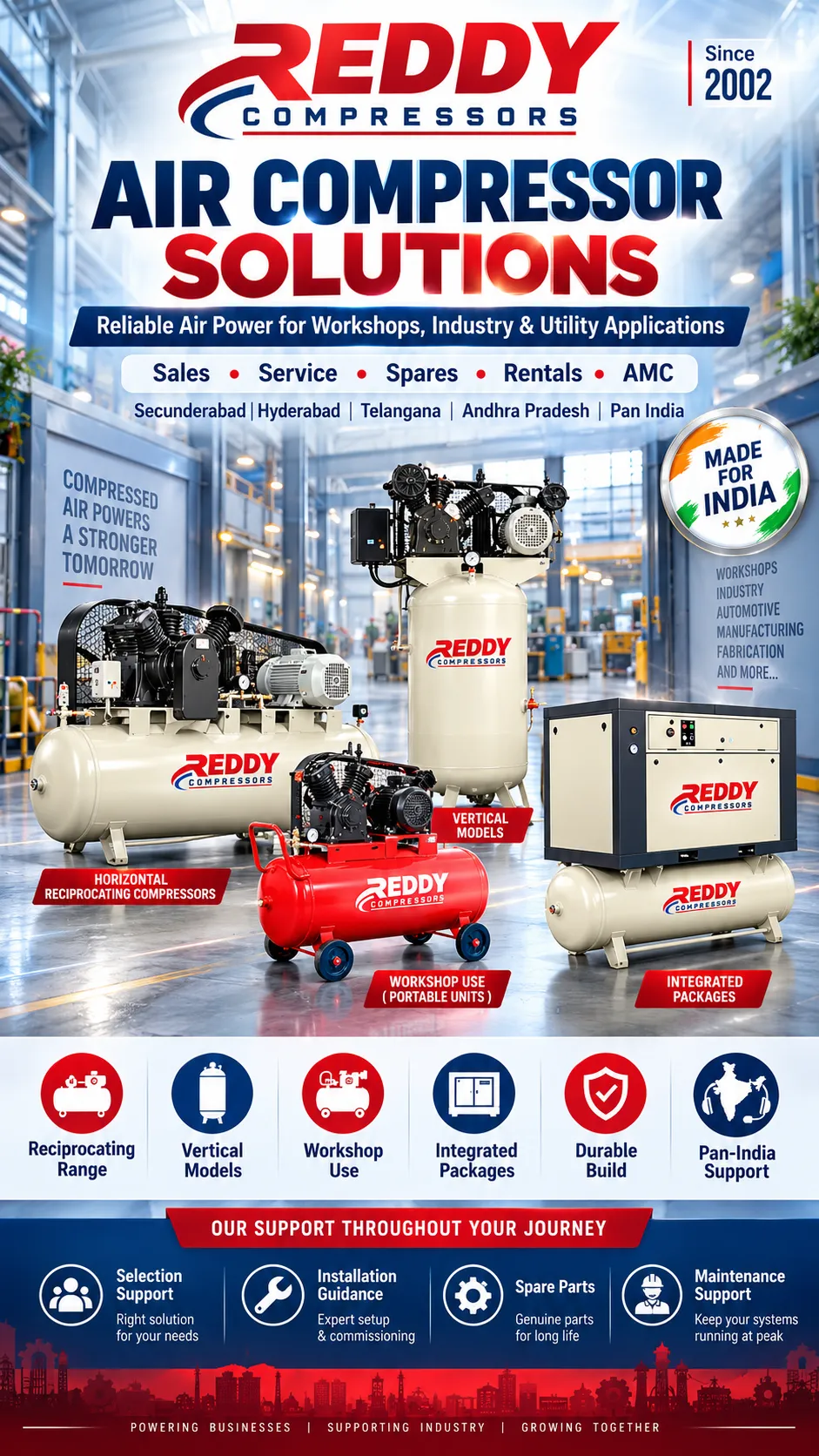
Reddy compressors
- Compressed air. engineered for uptime
- Define the air
- Define the pressure
- Map the demand profile
- Count the operating hours
- Respect the duty cycle
- Compare real FAD
- Compare real input power
- Include maintenance
- Include installation
- Include downtime risk
- Select for lifecycle value
- Primary CTA
Request a Rotary Screw vs Reciprocating Compressor Assessment
Secondary CTAs
Send Your Air-Demand Details
Compare Actual Compressor Models
Request an Existing-System Review
Review Reciprocating Duty Cycle
Review Rotary Screw Selection
Field guide
Screw or piston? Choose by duty, not by price
The question is not which technology is better but which one gives the best reliability, energy cost and lifecycle value for your duty. Judge it on air demand, duty cycle, pressure, energy use, maintenance and total cost of ownership, not on the purchase price alone.
| Factor | Rotary screw | Piston (reciprocating) |
|---|---|---|
| Airflow | Continuous, non-pulsating | Pulsating, needs a receiver to smooth it |
| Duty | Built for continuous, 24-hour running | Best for intermittent demand |
| Energy | Efficient under continuous load | Reasonable for occasional running |
| Noise and vibration | Lower | Higher |
| Maintenance | Less frequent, fewer moving parts | More frequent, but simple and easy to repair |
| Pressure | Mainly 7 to 13 bar standard packages; higher with special machines | Reaches high pressures, multi-stage up to 40 bar and beyond |
| Capital cost | Higher | Lower |
| Lifecycle cost | Lower for long, continuous industrial use | Lower for low utilisation |
A quick match
| Application | Usual starting point |
|---|---|
| Small workshop, garage, tyre shop, fabrication | Piston |
| Manufacturing, textiles, steel, cement, continuous process | Rotary screw |
| Pharma, food, electronics, hospitals | Oil-free (screw, scroll or piston) with the right treatment |
| Sandblasting, construction, mining, drilling, roads, remote sites | Portable diesel screw |
| Very large steady flow (petrochemical, power) | Centrifugal |
Treat the table as a place to start. Your measured demand profile, pressure and hours decide.
Do not stop at the machine
Either technology performs well only with the rest of the system around it: intake filter, aftercooler, moisture separator, receiver, dryer, precision filters, sound piping and condition monitoring. Size the system with the demand calculator and compare running cost with the specific power calculator.