
BH16 Tractor and PTO Driven Compressors
A tractor-associated compressor can mean different things: a unit transported by a tractor, a compressor mounted on a tractor-supported arrangement, or equipment driven through the tractor’s power take-off. The enquiry must identify which configuration is intended. Transport compatibility does not establish drive compatibility or drilling capability.
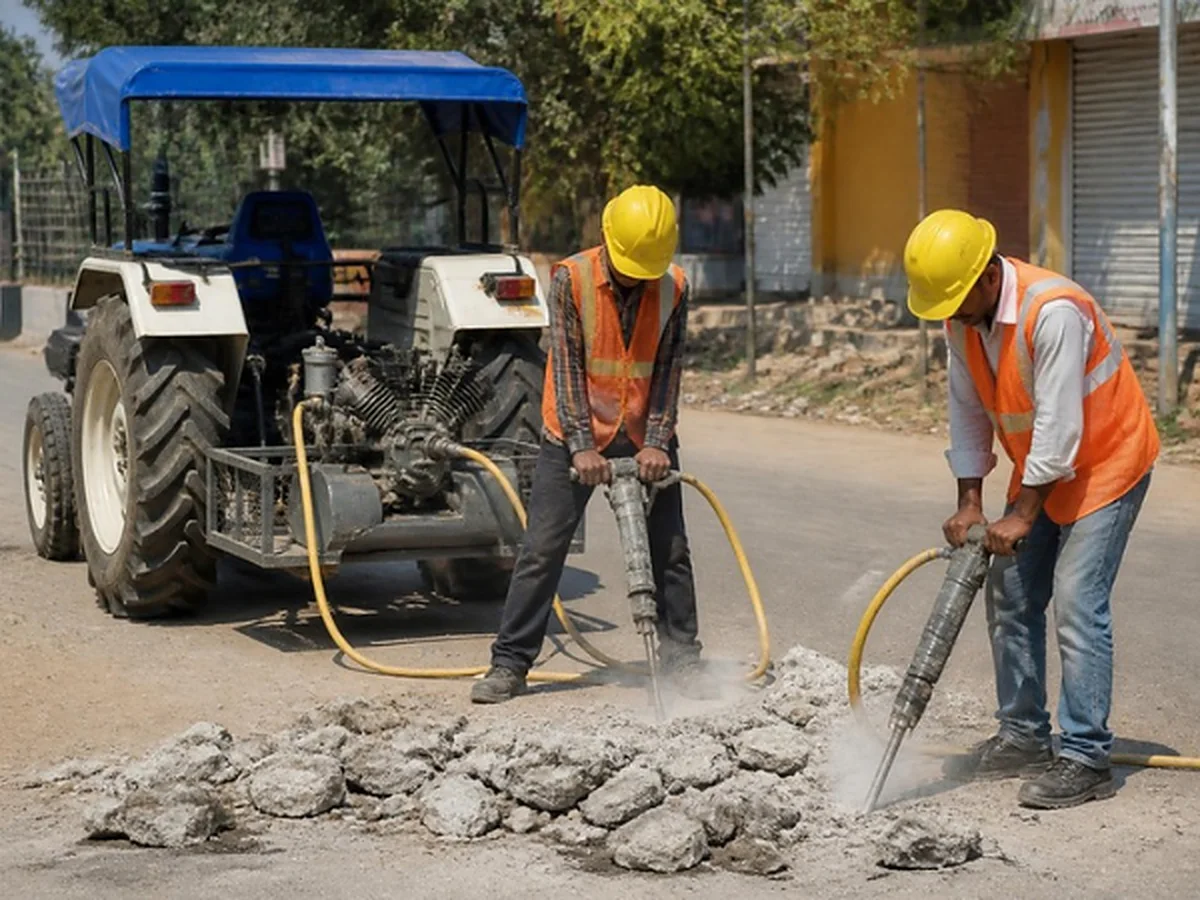
Begin with the tractor and compressor identities
Provide the tractor model, documented PTO specification and the compressor manufacturer’s installation and drive requirements. State whether an existing matched package is being repaired or a new combination is being considered. Include any intervening gearbox, coupling or drive arrangement.
Ask the equipment specialists to confirm required shaft speed, rotation, power and torque capability, connection suitability and operating limits. Tractor engine horsepower alone is not a complete specification for a PTO-driven compressor package. A suitable selection requires evidence at the relevant drive interface.
Guarding is part of the equipment specification
PTO shafts present an entanglement hazard. HSE guidance calls for correctly sized, maintained guards, including non-rotating guards with their restraining devices in place. It also warns against adapters that allow a 1000 rpm, 21-spline shaft to drive a 540 rpm, 6-spline shaft. Treat that as safety guidance, not as an Indian compliance certification.
Ask for the package manufacturer’s approved arrangement and operating procedure. Do not run equipment with missing or damaged guarding, and do not approach a rotating driveline to diagnose it. Inspection, connection and maintenance require the specified shutdown and isolation procedure.
Confirm the air duty separately
Even an approved tractor-drive arrangement still needs a supported compressor duty. Request air delivery at the required pressure and the conditions under which it is rated. If the proposed application is DTH drilling, obtain the hammer requirement and complete rig-interface assessment.
For borewell cleaning or other field-air tasks, identify the method and intended use explicitly. The fact that a compressor is portable or tractor-driven does not validate a well-development method or establish a tested water yield.
Compare ownership and utilisation
Include tractor availability, operating hours, mobilisation, maintenance responsibilities and the consequences of taking the tractor away from other work. Compare an integrated arrangement with a separately powered rental using the actual programme and quoted costs, without assuming one is always cheaper.
Send a tractor compressor enquiry: include photographs, equipment plates, PTO information, the compressor manual and the intended application. Supply and technical support for any particular configuration require confirmation.
Related pages: DTH Compressor Sizing and Duty Confirmation · New Borewell Compressor Sales · Borewell Project Enquiry Brief
Field guide
Tractor-mounted compressors: matching the tractor, the compressor and the tool
A tractor-mounted compressor turns an agricultural tractor into a mobile pneumatic power unit for rock drills, breakers, chipping hammers and air grinders. It is most useful where a separate diesel compressor would be hard to move to the work: stone quarries, small mines, rural roads, irrigation works and scattered work fronts. Suppliers in India commonly offer arrangements for tractors in roughly the 30 to 80 HP class, but the compressor has to be matched to the actual tractor and tool, not to a headline figure.
How the power reaches the tool
The compressor is usually a reciprocating, often two-stage, air-cooled and oil-lubricated pump. Two-stage compression with an intercooler keeps discharge temperature under control at higher pressure.
The parts that decide reliability
- Drive and PTO. Correct PTO speed and pulley ratio, good shaft alignment, a flexible coupling and guards on every belt and shaft. Wrong speed gives low delivery, heat and vibration; misalignment damages bearings, universal joints and the tractor transmission.
- Intake filter. Quarry dust is abrasive. A blocked filter cuts flow and raises power; a missing one wears liners, rings and valves. Draw air from away from the exhaust and the dust.
- Receiver. It steadies pressure, covers short peaks and lets water drop out. It needs a relief valve, gauge, drain and non-return valve, with the working pressure and maker marked. A corroded, modified or unverified receiver is a serious hazard.
- Cooling. Clean fins, a tight fan belt and room around the unit. Overheating breaks down oil and damages valves, rings and cylinders.
- Two lubrication systems. The compressor crankcase and the tool lubricator are separate. A rock drill with an empty lubricator wears quickly; too much oil causes carbon and oil mist.
- Moisture. Compression concentrates water. Drain the receiver and low points and use a separator, or water enters the drill and dilutes the oil.
Selecting by flow and pressure at the tool
Horsepower alone is the wrong measure. A drill that needs 100 CFM at the tool will not be served by a nominal 100 CFM compressor once hose loss, leakage, altitude and heat are counted. A commonly used approach is to add the tool demand, the hose and coupling losses, a leakage allowance, any derating, future tools and an operating reserve (often 15 to 25 per cent), then check pressure at the tool while it works, not receiver pressure at no load. The demand calculator and pipe sizing calculator help with the arithmetic.
Tractor-mounted air is not suitable for deep borewell drilling just because it is mobile; deep work needs far more pressure and flow than a conventional reciprocating unit gives.
Tractor-mounted or portable diesel?
| Factor | Tractor-mounted | Portable diesel |
|---|---|---|
| Prime mover | The tractor engine | A dedicated diesel engine |
| Capital cost | Often lower where a tractor exists | Generally higher |
| Pressure and flow | Usually moderate | Low to very high |
| Tools supported | Often one or a few | Several at once |
| Dependence | Stops when the tractor is down | Independent package |
| Repair | Often simple and local | More specialised |
Before you buy
- Tractor make, model, available PTO power, PTO speed, linkage capacity, rear-axle loading and condition.
- Free air delivery, rated and maximum pressure, stages, duty rating, cooling, receiver volume and unloader.
- Tool type, air per tool, number running together, hose size and length, lubrication and water flushing.
- PTO and belt guards, relief valve, a verified receiver, gauge, emergency isolation and stable mounting.
- Approval claims. Where a supplier cites a regulatory approval, ask for the scope, the installation it covers and the documents, rather than relying on the wording of an advertisement.
Routine care
| Interval | Check |
|---|---|
| Daily | Compressor oil level, belts and PTO coupling, receiver drain, intake filter, leaks, hoses, relief valve, tool lubricator, temperature and vibration |
| Weekly | Mounting bolts, pulley alignment, belt tension, cooling fins, gauge, receiver supports, hose abrasion, guards |
| Monthly | Valves, piston blow-by, oil condition, unloading, delivered flow and pressure, tool lubrication rate, emergency stop |
| Overhaul | Rings, liners, suction and delivery valves, gaskets, bearings, seals, bushes, belts, couplings, pressure switches, non-return valves |
Common problems and where to look
| Symptom | Likely causes |
|---|---|
| Low pressure | Blocked filter, leaking valves or rings, slipping belt, low PTO speed, hose leak, open drain, a tool using too much air |
| Overheating | Poor airflow, dirty fins, low or wrong oil, excess pressure, valve restriction, running beyond the duty rating |
| Oil carry-over | Overfilled crankcase, worn rings, wrong oil, high temperature |
| High vibration | Misaligned PTO shaft, worn joint, loose bolts, uneven belt tension, bent pulley, bearing wear |
| Weak rock drill | Too little flow, hose loss, water in the line, empty lubricator, wrong oil, worn parts, blocked flushing tube |
Safety
The unit combines rotating shafts, stored air and a working tractor. Never run with exposed belts or PTO shafts, repair a pressurised hose, weld or modify a receiver casually, exceed the rated speed, disconnect a live coupling or point air at a person. Use whip checks and locking couplings where a separated hose could whip. Operators need helmet, eye, ear and dust protection, gloves and safety footwear.
The result depends on correct matching: an oversized compressor can overload the tractor, an undersized one runs continuously and still starves the tool, and a narrow hose or an empty lubricator wastes everything upstream. Treat tractor, compressor, receiver, hose, lubricator and tool as one system. For sizing help use the equipment selection enquiry.