
The airend compresses the air
The complete compressor makes the process possible
A rotary screw compressor is sometimes explained too simply:
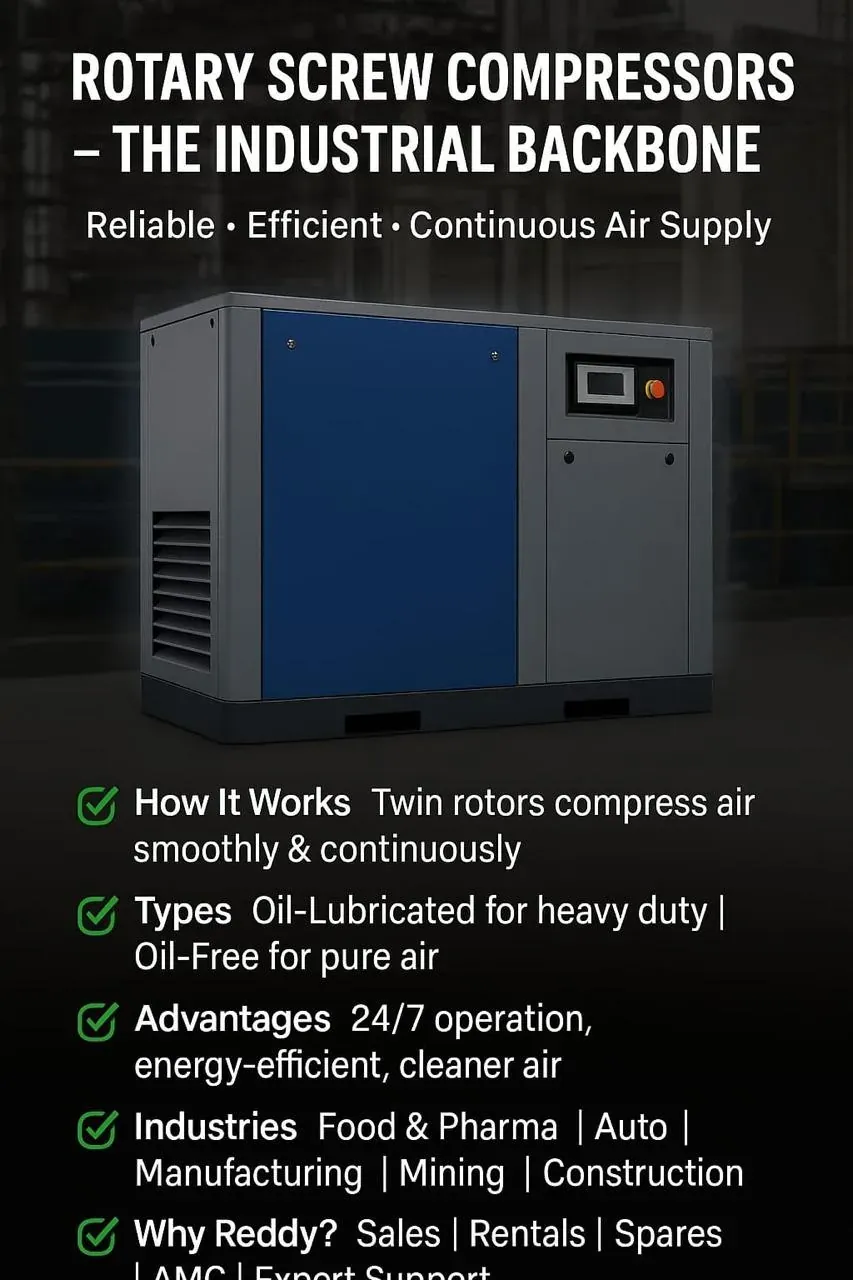
- Motor → Screw → Compressed Air
- That captures only the central idea
A practical industrial rotary screw compressor is a coordinated machine that may include:
- Intake Filtration
- Inlet Valve / Control
- Rotary Screw Airend
- Drive System
- Electric Motor
- Lubrication Circuit Where Applicable
- Separator System
- Aftercooler
- Oil Cooler
- Cooling Fan or Water Circuit
- Controller
- Sensors
- Electrical Protection
- Enclosure
- That distinction is fundamental
The central principle
Reduce the working volume of the air
At the heart of a typical twin-screw compressor is the airend.
That is the core compression principle.
The exact rotor geometry and internal compression architecture differ by manufacturer and technology.
The rotary screw process — system view
A useful high-level operating path is:
The compressor therefore performs one critical part of the complete air-system chain.
It does not independently solve:
- • air quality
- • storage
- • distribution
- • pressure loss
- • point-of-use regulation
- Those remain complete-system responsibilities
01 — intake air
Every rotary screw process begins with incoming atmospheric air.
The compressor may include intake filtration before air reaches the compression element.
This matters because the machine operates in the real environment.
That environment can contain:
- • dust
- • airborne contamination
- • heat
- • other site-specific conditions
The condition of incoming air therefore becomes part of compressor operation and maintenance.
02 — inlet valve / control
Its exact design and control strategy vary by manufacturer.
From the system perspective, the important principle is:
The compressor must control how it responds to air demand
That response may later involve:
- • loaded operation
- • unloaded operation
- • variable-speed operation
- • coordinated sequencing with other compressors
- The airend does not operate independently of control logic
03 — the airend
The central compression element
The airend is where rotary screw compression occurs.
In the source's typical twin-screw description:
- Profiled Rotors
- + Rotation
- + Progressively Decreasing Working Volume
- = Compression
The exact internal design should always be understood from the actual manufacturer's engineering data.
unless tied to verified model-specific documentation.
Why rotary screw technology suits sustained industrial duty
The broader Reddy Compressors architecture positions rotary screw technology strongly where:
- • demand is sustained
- • operating hours are high
- • plant air supports continuous production
- • stable pressure is important
- • multiple-compressor control may be required
The important point is not simply that rotary screw compressors rotate continuously.
It is that the technology can become part of a controlled industrial-air system designed around sustained demand.
04 — the drive system
The airend must receive mechanical power.
Three possible drive arrangements:
Belt drive
Can provide straightforward mechanical transmission and serviceability in appropriate equipment classes.
Direct drive
Can reduce the number of transmission components between motor and airend in certain designs.
Gear drive
Can be used where machine architecture requires gearing for speed matching.
No one arrangement should be declared universally superior.
Drive selection should consider the machine as a whole
Evaluating drive architecture against:
- Efficiency
- Maintenance Requirements
- Alignment
- Service Accessibility
- Manufacturer Design
- Operating Environment
- This is important
A component can only be called “better” in relation to a defined operating requirement.
05 — oil-injected rotary screw compression
Oil-injected rotary screw systems introduce lubricant into the compressor architecture.
Several possible lubricant functions:
- Cooling
- Sealing
- Lubrication
- That lubricant therefore becomes part of a coordinated operating circuit
Its condition can affect:
- • temperature
- • lubrication performance
- • sealing behaviour
- • overall machine condition
06 — separation
An oil-injected rotary screw compressor must also manage the air/lubricant side of the process.
Elsewhere in the master, separator behaviour is linked to:
- • residual oil carryover
- • differential pressure
- • energy consumption
- • lubricant loss
This makes separator condition both a maintenance issue and a system-performance issue.
Separator condition changes over time
The service architecture states that separators load during operation and that differential pressure can increase.
That means the separator is not simply a permanent passive component.
It is part of the lifecycle-maintenance system.
07 — oil-free rotary screw compression
Oil-free screw compressors use a fundamentally different compression arrangement from oil-injected systems.
Oil-free screw technology should be treated as a separate technology-selection pathway where air-quality or process requirements justify it.
That is important because:
OIL-INJECTED vs OIL-FREE
is not merely:
“WITH OIL” vs “WITHOUT OIL.”
It is a technology and application decision.
08 — compression creates heat
This includes:
- Oil Cooler
- Aftercooler
- Cooling Fan or Water Circuit
- as important elements of rotary screw compressor design
This reflects one of the practical realities of compression:
Heat must be managed
The compressor therefore needs a cooling architecture appropriate to its design.
Air-cooled systems
Air-cooled rotary screw compressors require suitable airflow for heat rejection.
Installation considerations including:
- • adequate cool-air inlet
- • hot-air discharge path
- • prevention of recirculation
- • clean cooler surfaces
- • sufficient room ventilation
- The compressor room therefore becomes part of cooling performance
Water-cooled systems
Where water-cooled designs are used, the cooling system introduces another set of operating variables.
Key points:
- Water Quality
- Inlet Temperature
- Flow
- Pressure
- Scaling
- Fouling
- Cooling-System Integration
- Cooling technology does not eliminate heat
- It changes how heat is rejected
09 — aftercooling
The compressor package may include an aftercooler as part of the machine architecture.
But the aftercooler should not be confused with the complete air-treatment system.
After compression, the customer's process may still require additional:
- Moisture Separation
- Drying
- Filtration
- Storage
- according to the actual point-of-use requirement
This reflects the wider Reddy Compressors system philosophy:
The machine produces compressed air
- The system makes that air suitable for use
- 10 — load / unload control
A rotary screw compressor must respond to system demand.
One control method is load/unload.
The compressor produces air while loaded and transitions to an unloaded condition when system pressure reaches the relevant control limit. The energy impact then depends significantly on how long the machine remains unloaded.
This is a crucial operating point.
Running does not always mean productively producing air
A compressor can remain electrically operating while not delivering equivalent useful air production during unloaded periods.
That is why load profile matters.
11 — variable-speed control
In variable-speed operation, motor speed changes according to demand within the compressor's designed operating range.
That can make VSD valuable in suitable variable-demand applications.
But the operating principle must not be converted into a universal savings claim.
The correct question remains:
How does the plant's demand change over time?
12 — multiple compressors & sequencing
In multi-compressor installations, control becomes a system-level function.
Coordinated sequencing can determine:
- • which compressor starts
- • which machine carries base load
- • which machine trims
- • pressure bands
- • standby sequence
- • operating-hour balancing
This means a compressor room containing several good machines can still operate poorly if they are controlled badly.
Good machines do not automatically create a good system
13 — monitoring
Depending on actual equipment capability, useful operating parameters may include:
- Discharge Pressure
- Airend Discharge Temperature
- Motor Current / Power
- Loaded / Unloaded State
- Operating Hours
- Service Hours
- Differential Pressure
- Alarms
- VSD Speed
- Network Status
- The purpose of monitoring is not simply to produce more numbers
Directly:
MONITORING SHOULD SUPPORT BETTER OPERATING DECISIONS.
14 — what changes as the compressor operates?
The rotary screw process is continuous, but machine condition is not static.
Several operating changes:
- Filters Accumulate Contamination
- Pressure differential can rise
- Coolers Foul
- Heat rejection can deteriorate
- Lubricant Ages
- Condition changes with hours, temperature, contamination and environment
- Separators Load
- Differential pressure can increase
- Belts / Couplings Wear
- Connections Can Loosen
- Valves Wear
- Sensors Drift or Fail
Understanding how the compressor works therefore also explains why maintenance matters.
15 — the rotary screw compressor is part of a larger system
The airend can compress air correctly while the plant still has a poor compressed-air outcome.
After the compressor, the air may still pass through:
- Aftercooling
- Moisture Separation
- Receiver
- Drying
- Filtration
- Distribution
- Pressure Control
- Point of Use
The wider Reddy system architecture extends all the way to useful work and states that every component should have a defined purpose.
16 — pressure after the compressor
Pressure can be lost downstream across:
- • aftercoolers
- • dryers
- • filters
- • separators
- • valves
- • piping
- • fittings
- • hoses
- • regulators
The compressor's internal operation and the plant's distribution system must be understood together.
17 — why a good airend can still produce a poor result
A correctly operating airend does not automatically mean the entire compressed-air system is performing well.
Problems can occur through:
- Dirty Intake Filtration
- Cooling Restrictions
- Separator Pressure Drop
- Poor Controls
- Long Unloaded Running
- Downstream Treatment Restriction
- Distribution Pressure Loss
- Excessive System Pressure
Therefore troubleshooting should always ask:
Is the problem in the compression element?
or:
Is the problem somewhere else in the machine or system?
That distinction can prevent unnecessary overhaul or replacement.
18 — why ventilation matters to how the compressor works
The rotary screw machine must reject heat while it operates.
If hot discharge air recirculates toward the intake, compressor operating temperature can rise.
Therefore:
The room is part of the operating environment
A correct compressor installed into poor thermal conditions can become an unreliable installation.
19 — why air quality is not created by compression alone
Compressing air does not automatically make it suitable for every process.
Downstream air quality can depend on:
- • compressor technology
- • cooling
- • separation
- • receiver arrangement
- • dryer
- • filtration
- • distribution
- • point-of-use condition
Compressor technology alone should not be claimed to guarantee point-of-use purity.
This is especially important for:
- • process air
- • food-related applications
- • pharmaceutical environments
- • instrumentation
- • sensitive manufacturing
20 — how the operating process connects to selection
Understanding the machine changes the way it should be selected.
If demand is stable:
Fixed-speed architecture may make sense.
If demand varies substantially:
VSD may warrant evaluation.
If air quality is demanding:
Oil-free technology may need review.
If the plant is production-critical:
Multiple compressors or standby strategy may be relevant.
If the installation is hot:
Cooling and ventilation deserve greater attention.
If pressure at the process is low:
Distribution losses should be investigated before discharge pressure is simply increased.
The working principle and the application cannot be separated.
Rotary screw compressor — functional architecture
A useful way to read the machine is:
Air path
Intake → Control → Airend → Cooling / Separation as Applicable → Discharge
Power path
Electrical Supply → Motor → Drive → Airend
Cooling path
Heat Generation → Oil / Air / Water Cooling Architecture → Heat Rejection
Control path
Sensors → Controller → Load / Unload / Speed / Sequencing Decisions
Lifecycle path
Monitoring → Maintenance → Diagnosis → Repair → Verification
These are not five separate machines.
They are five ways of understanding one coordinated compressor package.
Common misunderstandings
“The airend is the compressor.”
Not completely.
It is the central compression element, but the industrial compressor also depends on intake, drive, cooling, separation where applicable, controls, sensors and electrical systems.
“If the motor is running, the compressor is fully productive.”
Not necessarily.
Load/unload systems can spend time unloaded.
“VSD always saves energy.”
Not supported.
Its value depends on demand behaviour.
“Higher discharge pressure solves low pressure.”
Not necessarily.
The system may be losing pressure downstream.
“Oil-free and oil-injected are the same machine without oil.”
Not architecture.
Oil-free screw technology uses a fundamentally different compression arrangement and should be treated as a separate selection pathway.
How rotary screw compression fits the architecture
The following pages then go deeper into the major design branches:
This prevents all rotary screw configurations from being collapsed into one generic explanation.
Engineering takeaway
The essential operating principle is simple:
The airend uses rotating profiled rotors to create progressively decreasing working volume
But the useful industrial outcome depends on a much wider architecture:
That is why the correct rotary screw question is never only:
“How does the screw compress air?”
It is also:
“How does the complete machine deliver the air the process needs?”
Closing
- The rotors create the compression
- The system creates the operating result
A well-selected rotary screw compressor should therefore be understood from:
- Air Inlet
- → Compression
- → Cooling / Separation
- → Control
- → Discharge
- → Treatment
- → Storage
- → Distribution
- → Useful Work
Reddy compressors
- Compressed air. engineered for uptime
- Understand the airend
- Understand the machine
- Understand the system
- Primary CTA
Explore Oil-Injected Rotary Screw Compressors
Secondary CTAs
Explore Oil-Free Rotary Screw Compressors
Compare Fixed Speed vs VSD
Explore Rotary Screw Drive Systems
Request Rotary Screw Selection
Request Rotary Screw Service