
What this capacity band covers
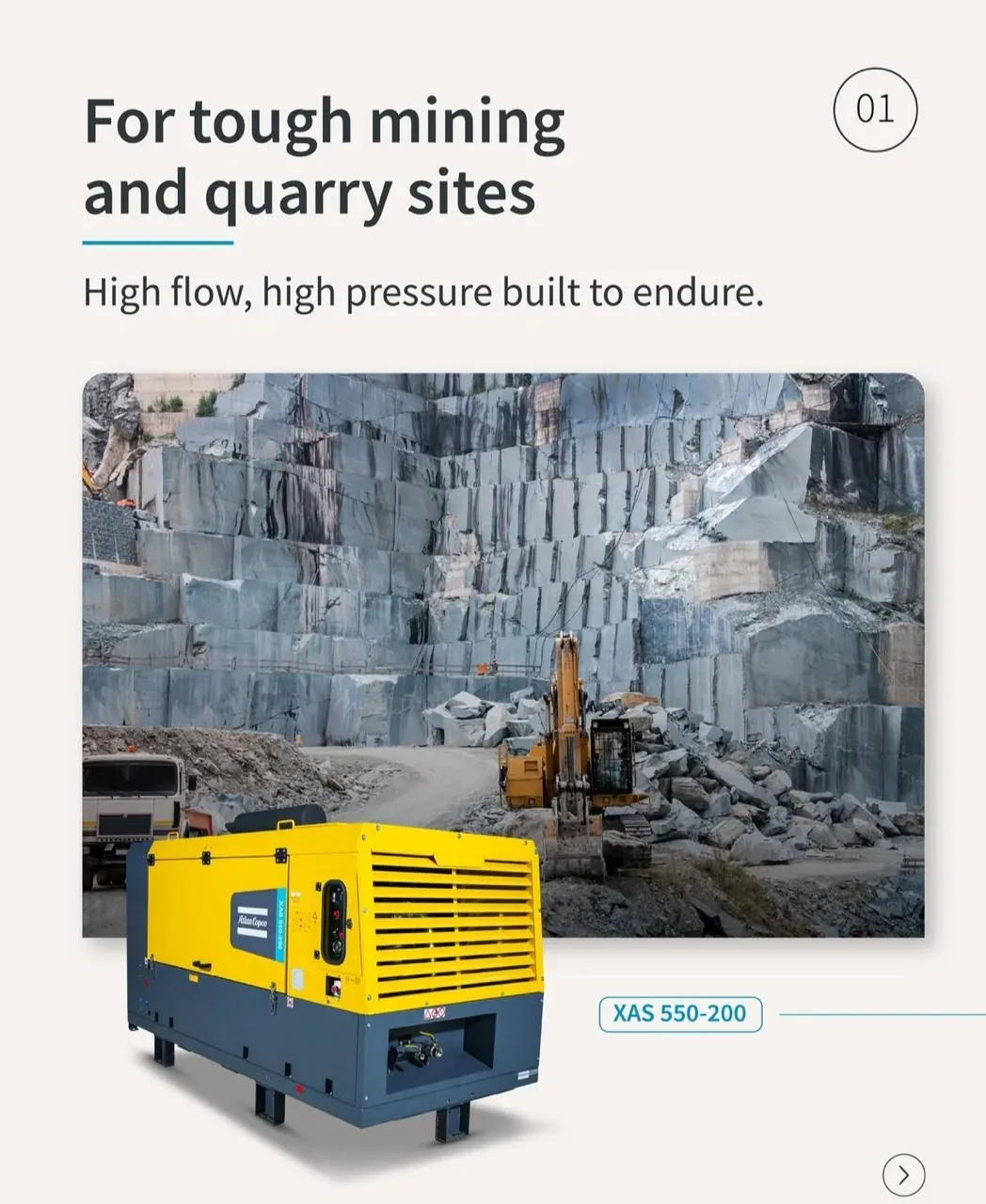
The 500–600 cfm band is the top of the common portable class. Machines are mostly diesel-driven oil-injected rotary screw packages on a towable chassis or skid. In the Indian market you will see 550 cfm machines rated around 14 bar (203.1 psig), 575 cfm machines around 15.5 bar (224.8 psig) and 600 cfm machines at 7 bar (101.5 psig), among others.
That variety is the point. Each rating is an operating point: a free air delivery (FAD) at a stated pressure and measurement basis. A higher pressure rating does not tell you the flow at your pressure, and a larger flow does not tell you the pressure the machine can hold. Ask for both at the operating point your tool needs.
| Typical configuration | Rated pressure | Usual duty |
|---|---|---|
| About 600 cfm standard pressure | About 7 bar (101.5 psig) | Pipe ramming, breakers, blasting, plant air |
| About 550 cfm high pressure | About 14 bar (203.1 psig) | Crawler drills, quarry drilling, pipeline drying support |
| About 575 cfm high pressure | About 15.5 bar (224.8 psig) | Drilling and long hose runs that need pressure margin |
These are typical market configurations, not our model names or stock list.
Pipe ramming: why equal cfm is not enough
Pneumatic pipe ramming drives a steel casing under roads, railways and canals using a percussive rammer powered by compressed air. Rammer makers state an air requirement for each tool size as a flow at a pressure. A large rammer may be listed at around 600 cfm at 110 psig (7.6 bar), for example.
A compressor rated at 600 cfm at 100 psig (6.9 bar) appears to match, but the pressure points differ by 10 psi. That is an open question, not a failure. To close it you need:
- The compressor maker’s delivery figure at the pressure the rammer needs, for the exact machine offered.
- The rammer’s documented air requirement from its manual for the actual tool model.
- The pressure drop through the supply hose, lubricator and couplings to the rammer.
Being able to turn up a compressor’s pressure setting does not by itself show how much flow it delivers at that setting. On many machines, delivery falls as pressure rises towards the engine’s limit. Ask for the data, not the adjustment range.
Ground conditions, casing size, drive length and method belong to the trenchless contractor. Air supply follows the rammer selection; it cannot prove the rammer suits the ground.
How to brief a 500–600 cfm enquiry
- Identify the tool: rammer, drill, nozzle or plant, by make, model and serial number, with its manual.
- Record its air requirement as flow at pressure, and the measurement basis.
- Describe the supply route: hose length and bore, lubricator, manifold, crossings.
- List any other air users on the same compressor and when they run.
- State the duty: hours, shifts, ambient conditions and project duration.
- Ask for the offered compressor’s delivery at the required pressure, in writing.
- Agree who supplies hoses, the lubricator and fittings, and who commissions the system.
| Evidence you have | What it lets you conclude |
|---|---|
| Compressor rated at a lower pressure than the tool needs | Ask for delivery data at the tool’s pressure |
| Adjustable pressure range but no delivery data | Adjustment alone does not confirm flow |
| Delivery data at the required pressure plus hose loss | A sound basis for selection, subject to the tool maker’s limits |
| Field test with a gauge at the tool under load | Confirms the installed system performs as planned |
Other duties this class handles well
- Crawler and quarry drilling: top-hammer and small DTH crawler drills where the drill maker’s data falls within this flow at 10–14 bar (145–203.1 psig).
- Abrasive blasting: one No. 6–7 nozzle with comfortable margin; two No. 6 nozzles need about 600–750 cfm, and a No. 8 uses about 500–540 cfm at 7 bar (101.5 psig).
- Pipeline drying and testing support: supplying dry air for drying and pigging operations under the client’s procedures. Pneumatic pressure testing stores a great deal of energy and must follow the client’s and engineer’s procedures.
- Plant shutdowns and standby: covering a stationary compressor of similar capacity during overhaul or breakdown.
- Construction: five or six breakers at about 7 bar (101.5 psig), depending on tool size.
Borewell rigs usually need more: typically 600–1,500 cfm at 200–400 psig (13.8–27.6 bar). See our borewell and DTH compressor library.
Engine, cooling and controls at this size
A 500–600 cfm diesel package carries a large engine and cooling system. How it is designed and maintained decides whether it holds its rating through an Indian summer.
- Cooling: the oil cooler, aftercooler and engine radiator share a cooling air path. Dust and oil mist on the cores raise discharge temperature; normal oil-injected screw discharge is about 75–95 °C.
- Air filtration: heavy-duty two-stage filters with pre-cleaners and restriction indicators are essential on quarries and pipeline corridors.
- Controls: modulation or unloading matches output to demand; variable-pressure machines let you trade pressure for flow within the maker’s limits.
- Shutdowns: high discharge temperature, low engine oil pressure and high coolant temperature trips protect the machine. Investigate every trip.
- Fuel: consumption depends on load; clean fuel, water separation and tank management prevent most engine stoppages.
Pressure costs fuel: each extra bar needs about 7% more power for the same flow. Set the compressor at the tool’s requirement plus hose loss.
Hire, new or used in this band
Pipe ramming and pipeline work are often short, defined jobs, which favour hire. Quarry and drilling contractors with steady utilisation may prefer to own. Used or refurbished machines suit moderate hours if the airend, engine and records are sound. On our hire jobs we service machines every 300 running hours, with oil change and filter checks. On a power-plant project we supplied two 450 cfm machines at 150 psig and one 400 cfm machine at 100 psig on hire with operators who could run and troubleshoot them, which shows how mixed pressures are often needed on one site.
Common faults and what we check
- Pressure falls under load: we compare delivery at the required pressure with the rating, and check the inlet filter, intake valve and separator element.
- High-temperature trips in summer: we clean and inspect cooler cores, check fan drive, oil level and the thermostatic valve, and review parking and airflow.
- Oil in the air line: we inspect the separator element, scavenge line and minimum pressure valve; rammers and drills need a correct line lubricator, not compressor oil.
- Engine faults: we test starting and charging, fuel filtration and water separation.
- Control instability: we check the regulator, unloader and pressure settings against the maker’s data.
Findings and parts needed are recorded in writing after every visit, so repair or overhaul decisions rest on evidence rather than guesswork.
How Reddy Compressors helps
We sell new and used or refurbished 500–600 cfm compressors, rent them from our own fleet of diesel portables and high-pressure units, and service, overhaul and supply spare parts for them. We work across ELGi, Atlas Copco, Ingersoll Rand, KAESER, Chicago Pneumatic, Doosan and other brands as an independent multi-brand specialist, not an authorised dealer. We have tie-ups with all major and reputed brands. Brand-new machines can be supplied to site for long-term projects, and operators can be provided on hire.
From our office at Tarnaka, Secunderabad, our team of over 20 service engineers and technicians covers all of Telangana and Andhra Pradesh, and we supply compressors, rentals and spares across India. We check the tool’s air requirement against the offered machine’s delivery at that pressure before dispatch, so open questions are settled on paper rather than on site.
What to send us
- Tool make, model and serial number (rammer, drill, nozzle or plant), with its manual or data sheet.
- Required flow and pressure at the tool, and the measurement basis.
- Hose length and bore, lubricator and manifold arrangement.
- Other air users and when they run.
- Shifts, duration, site location and access for a large towed unit.
- Who supplies hoses and fittings, and who approves the working arrangement.
Frequently asked questions
What size compressor do I need for pipe ramming?
Use the rammer maker’s air requirement for your exact tool, stated as flow at pressure. Large rammers commonly need flows in the 500–600 cfm region or more at around 100–110 psig. Choose a compressor whose delivery at that pressure, plus hose and lubricator losses, covers the requirement. Ask for the compressor’s delivery data at that pressure rather than relying on its rated point.
Can a 600 cfm 100 psi compressor run a tool rated at 600 cfm and 110 psi?
Not proven by the ratings alone. The flows match but the pressure points differ by 10 psi. You need the compressor’s delivery at 110 psig plus hose loss, for the exact machine offered. Some machines can be set higher with a modest flow reduction, others cannot. Get the maker’s data and check the tool’s manual before committing.
How many sandblasting nozzles can a 600 cfm compressor run?
Typically one No. 6–7 nozzle, using about 280–410 cfm at 7 bar (101.5 psig) when new; two No. 6 nozzles need about 600–750 cfm and a No. 8 uses 500–540 cfm. Nozzle wear increases consumption, so plan for the worn condition. Add an aftercooler and moisture separator for dry abrasive, and check the hose bore to hold pressure at the nozzle.
Is a 550 cfm 14 bar compressor good for borewell drilling?
It suits shallow holes and small rigs in some ground, but most borewell work in Telangana and Andhra Pradesh uses larger machines, typically 600–1,500 cfm at 200–400 psig (13.8–27.6 bar). Flow is needed to lift cuttings and pressure to drive the hammer at depth. Check the rig and hammer maker’s requirements for your planned depth and bit size.
Why does my 600 cfm compressor lose pressure when the tool runs?
Either demand exceeds delivery at that pressure, or the hose and fittings are losing too much. Check the pressure at the compressor and at the tool under load. Other causes include a dirty air filter, a sticking intake or unloader valve, a worn airend or a blocked separator element. A service engineer can test the machine against its rated output.
Do you supply 500–600 cfm compressors outside Telangana and Andhra Pradesh?
Yes. We supply compressors, rentals and spare parts across India, and provide project-based site support where feasible. Our service teams cover Telangana and Andhra Pradesh directly. Send us the tool details, duty and site location and we will confirm what can be supplied, the package and the support arrangement for your dates.
Related pages
Technical content reviewed by D. Srinivas Reddy, Managing Partner and service engineer, Reddy Compressors. Last updated 7 November 2026. How our engineering content is reviewed.