
Integration can simplify the package
It does not simplify the engineering
A rotary screw compressor packaged together with a dryer can be attractive where the project values:
Across brands
Models we supply and service
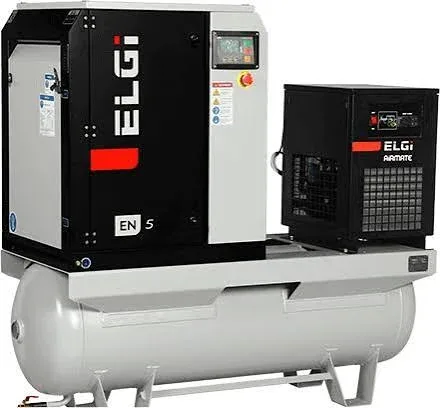
Manufacturer product images, shown to identify machines we sell, service and support. Brand names are trademarks of their owners.
- Compact Installation
- Fewer Separate Equipment Items
- Simplified Small-System Layout
- Local Air Treatment
- Reduced Installation Footprint
AN INTEGRATED DRYER SHOULD BE SELECTED FROM THE REQUIRED AIR QUALITY—not MERELY BECAUSE IT IS BUILT INTO THE COMPRESSOR PACKAGE
The engineering equation
Package integration is useful only when the compressor and dryer both fit the actual duty.
01 — what an integrated compressor + dryer package means
• current availability.
Those must come from actual manufacturer documentation.
02 — start with the process requirement
The correct sequence:
Not:
“The compressor package comes with a dryer, so the air must be suitable.”
03 — compressing air does not make it clean
In practice:
Compressing air does not make it clean
Compression concentrates what was already present.
Atmospheric air can contain:
- Water Vapour
- Airborne Particles
- Other Environmental Contaminants
- and oil-lubricated systems can introduce additional contamination mechanisms
- So the integrated dryer is one part of the air-treatment architecture
- It does not automatically establish total air quality
04 — a dryer primarily addresses moisture
When compressed air cools, water vapour can condense.
Possible consequences include:
- Corrosion
- Water in Tools
- Instrumentation Problems
- Process Contamination
- Product-Quality Issues
- Freezing Under Suitable Low-Temperature Conditions
Moisture control may involve:
- Aftercooling
- Separation
- Drainage
- Drying
- That makes dryer selection functional
- Not decorative
05 — dryer type must be verified
The current source discusses:
Refrigerated Dryers
and:
- Desiccant Dryers
- as different treatment technologies
For each actual model, verify:
What dryer technology is included?
before publication.
06 — refrigerated dryer selection
Refrigerated drying can be appropriate for many general industrial compressed-air applications.
Selection should consider:
- Airflow
- Inlet Temperature
- Ambient Temperature
- Pressure
- Required Pressure Dew Point
- Pressure Loss
- Condensate Drainage
That list should become the core selection gate for any integrated refrigerated-dryer package.
08 — FAD and dryer capacity must match
A correctly sized compressor with an inadequately rated dryer does not create a correctly sized package.
Likewise, an oversized dryer does not correct an undersized compressor.
The complete package must satisfy:
Compressor FAD
AND
Dryer flow capability
under the actual rating conditions.
09 — required pressure dew point
Dryer selection should be based on the required pressure dew point and application, not compressor size alone.
Therefore:
MOTOR kW DOES NOT DEFINE DRYER REQUIREMENT
The process does.
10 — air quality should be defined at the point of use
In practice:
Air quality is a system property
The compressor room may produce one condition while the application receives another because pipework, storage and operating environment can affect the final air condition.
“Integrated dryer = guaranteed air quality at the tool.”
That would exceed the source.
11 — integrated dryer does not mean complete filtration
Filters may target different contamination mechanisms such as:
- Particulates
- Liquid Contamination
- Aerosols
- Fine Downstream Contamination
Therefore:
Drying ≠ filtration
Any filter configuration inside or outside the package must be verified.
12 — no single filter removes “everything”
Against describing one filter as removing all contamination.
unless actual air-quality specifications and verification support the statement.
13 — filter pressure drop
A filter can protect the process.
But a restricted filter can also become an energy penalty.
Maintaining filtration according to:
- Manufacturer Recommendations
- Differential Pressure
- Operating Conditions
- Contamination Load
This matters especially in compact packages where treatment components may be perceived as invisible accessories.
14 — dryer pressure loss
Dryer selection should consider pressure loss.
That means an integrated package should be evaluated using:
Pressure at compressor discharge
and:
Pressure available after the dryer / treatment path
Do not simply increase compressor setpoint without understanding the losses.
15 — point-of-use pressure still controls
The package may contain both compressor and dryer, but the process still requires sufficient pressure at the final point of use.
Pressure losses can exist across:
- Dryer
- Filters
- Receiver
- Piping
- Valves
- Regulators
The compressor-dryer package should therefore be evaluated as part of the entire pressure stack.
16 — condensate drainage is part of dryer selection
An integrated dryer does not mean:
“No drain planning required.”
Actual drain arrangement and condensate management must be verified.
17 — aftercooling & separation may still matter
Moisture control as potentially involving:
- Aftercooling
- Separation
- Drainage
- Drying
- Therefore the integrated dryer should be understood within a treatment chain
- Not as the only moisture-control component
18 — receiver integration is a separate question
Some integrated compressor + dryer packages may also include a receiver.
Others may not.
Integrated dryer = tank-mounted
Actual package configuration must be verified.
19 — receiver still does not create capacity
Where a receiver is part of the integrated package, the rule remains:
Storage is not capacity
The receiver may help:
- Buffer Short Peaks
- Stabilise Pressure
- Support Control Response
- but it cannot permanently compensate for insufficient compressor FAD
20 — compact package, full system responsibility
But compact packaging does not remove the need to engineer:
- Ventilation
- Electrical Supply
- Distribution
- Drainage
- Maintenance Access
- Pressure Regulation
- Air Quality
The system remains complete even if more components are assembled into one footprint.
21 — installation footprint
Integrated packages can potentially reduce the number of separately located components.
Actual:
- Dimensions
- Service Clearance
- Airflow Clearance
- Access Requirements
- must come from current manufacturer data
22 — service access
An integrated package may place several serviceable components inside one enclosure or assembly.
That can change maintenance access.
Before selection, verify the actual ability to service:
- Compressor Filters
- Separator
- Lubrication System
- Coolers
- Dryer Components
- Drains
- Filters
- Electrical Components
- according to the model
23 — integration should not create maintenance blind spots
When a dryer is packaged with the compressor, it can be easy to think only about compressor service intervals.
But the dryer remains an operating asset with its own condition and maintenance requirements.
Therefore:
Compressor maintenance and dryer maintenance must both follow actual manufacturer requirements
24 — ambient temperature
That means an integrated package can be affected by its installation environment on both:
Compressor side
and:
Dryer side
25 — inlet temperature to the dryer
This means the compressor and dryer cannot be selected independently even when they are physically integrated.
The compressor's discharge/treatment condition has to fall within the dryer's verified operating basis.
26 — pressure
Dryer capacity and operation must be evaluated at the actual system pressure.
Again:
Package name does not replace rating conditions
Use current manufacturer specifications.
27 — pressure dew point & process requirement
General industrial applications may justify one dryer technology.
A specialised process may require substantially drier air.
Desiccant drying may be appropriate for selected:
- Instrument-Air Systems
- Outdoor Lines Exposed to Low Temperature
- Specialised Processes
- Critical Production Requirements
Therefore a standard integrated dryer package should not automatically be assumed suitable for every air-quality requirement.
28 — INTEGRATED REFRIGERATED DRYER vs SEPARATE DESICCANT SYSTEM
The correct question is:
What pressure dew point and air quality does the process require?
If the integrated package's verified dryer meets the requirement, it may be appropriate.
If not, a different treatment architecture deserves evaluation.
29 — air quality for cnc & automation
But the actual machine or process requirement must define:
- Pressure
- Moisture
- Particles
- Oil Condition
- not the package label
30 — food & processing support
An integrated dryer does not automatically establish suitability for food or process contact.
Treatment must be selected according to the actual contact and process requirement.
Do not convert:
“Has dryer”
into:
“Food-grade air.”
That claim requires separate verified evidence.
31 — painting / finishing
Moisture-sensitive finishing processes may need carefully controlled:
- Moisture
- Oil
- Particles
- Pressure Stability
An integrated dryer could form part of the solution only if its actual treatment capability fits the requirement.
A dryer alone does not establish paint-quality air.
32 — instrument air
Instrument-air applications may have more demanding treatment requirements.
Therefore an integrated refrigerated-dryer package should not be automatically marketed as instrument-air equipment.
33 — fixed speed or VSD remains separate
An integrated compressor + dryer package may use fixed-speed or VSD compressor control depending on the actual model.
Dryer integration does not determine control architecture.
The demand profile still governs whether fixed-speed or variable-speed compression deserves evaluation.
34 — dryer energy & compressor energy are part of the complete package
Different dryer technologies and regeneration methods can have different energy and operating implications.
Therefore package evaluation should not look only at compressor motor kW.
The complete installed treatment architecture matters.
35 — pressure drop is also an energy issue
If a dryer or filter becomes excessively restrictive, the upstream compressor may be operated at higher pressure to compensate.
That can turn treatment pressure loss into an energy burden.
The correct response is:
Identify the restriction
Not automatically raise discharge pressure.
36 — distribution still matters
An integrated compressor + dryer package can produce suitable treated air at its outlet and still fail to deliver acceptable air at the process if:
- • distribution is undersized
- • pressure loss is excessive
- • contamination is introduced downstream
- • condensate forms under site conditions
- Air quality is a system property and that pipework/storage/environment matter
The air condition at the package outlet is not automatically identical to the condition received by every downstream user.
38 — redundancy
If the compressor and dryer are integrated into one package, failure of one package element can affect the availability of treated compressed air.
For production-critical applications, ask:
What happens if the compressor is unavailable?
What happens if the dryer is unavailable?
Can untreated air be used temporarily?
Is backup treatment required?
Is another compressor/dryer package available?
39 — maintenance strategy
An integrated package should have a defined maintenance plan covering:
Compressor side
and:
Air-treatment side
Therefore exact schedules remain:
- Manufacturer-Specific
- Model-Specific
- Operating-Hour-Specific
- Environment-Specific
40 — model data required before product publication
For each integrated compressor + dryer package, verify:
- Manufacturer
- Exact Model
- Compressor Motor kW / HP
- Verified FAD
- Working Pressure
- Fixed / VSD / Other Control
- Dryer Technology
- Dryer Rated Flow
- Dryer Rating Conditions
- Required / Delivered Pressure Dew Point Where Documented
- Dryer Inlet Temperature Range
- Ambient Limits
- Pressure Loss
- Condensate Drain Arrangement
- Integrated Receiver — Yes / No
- Receiver Volume if Applicable
- Integrated Filters — Yes / No
- Package Dimensions
- Weight
- Electrical Requirement
- Service Requirements
- Availability
- No package feature should be inferred from a similar model
41 — do not use compressor size to assume dryer size
Dryer selection should be based on required pressure dew point and application—not compressor size alone.
So:
30 kW COMPRESSOR ≠ AUTOMATIC DRYER CAPACITY
The full rating conditions matter.
42 — selection data to request
For an integrated-package enquiry, request:
- Application
- Required FAD / CFM
- Required Operating Pressure
- Required Point-of-Use Pressure
- Operating Hours / Day
- Minimum / Average / Peak Demand
- Required Air Quality
- Required Pressure Dew Point
- Ambient Conditions
- Existing Compressor
- Existing Dryer
- Receiver Requirement
- Filtration Requirement
- Electrical Supply
- Installation Space
- Ventilation
- Drain / Condensate Arrangement
- Future Expansion
If the customer does not know these values:
Start with the process and the machines being supplied
43 — integrated package selection gate
Before selecting the package, ask:
Compressor
Does it deliver sufficient FAD at the required pressure?
DRYER
Can it handle the actual airflow under the actual inlet and ambient conditions?
Air quality
What pressure dew point is required?
Pressure loss
What pressure remains downstream of treatment?
Filtration
What contamination risks must be controlled?
Receiver
Is storage integrated, separate or both?
Condensate
How is drainage managed?
Installation
Can the complete package be cooled and serviced?
Reliability
What happens if compressor or dryer availability is lost?
Future expansion
Can the package architecture support planned growth?
Only then should integration be treated as an advantage.
Integrated compressor + dryer in one line
An integrated compressor + dryer package can simplify the physical system
But compressor capacity, dryer rating, air quality, pressure dew point, pressure loss and drainage still have to be engineered separately and verified together
Closing
- Package integration should reduce complexity
- Not reduce engineering discipline
A correct integrated compressor + dryer package requires:
The right FAD
- The right pressure
- The right dryer
- The right pressure dew point
- Verified rating conditions
- Controlled pressure loss
- Correct filtration
- Correct drainage
- Appropriate storage
- Ventilation
- Service access
- Lifecycle support
Refrigerated-dryer selection should consider airflow, inlet temperature, ambient temperature, pressure, required pressure dew point, pressure loss and condensate drainage.
Reddy compressors
- Compressed air. engineered for uptime
- Define the air duty
- Define the air quality
- Verify the dryer rating
- Control the pressure loss
- Manage the condensate
- Verify the storage
- Install for cooling & service
- Check the air at the point of use
- Primary CTA
Request an Integrated Compressor + Dryer Package Selection
Secondary CTAs
Review Dryer & Dew-Point Requirements
Compare Integrated vs Separate Dryer Systems
Review Tank-Mounted Packages
Discuss Filtration Requirements
Request a Point-of-Use Air-Quality Review