
AIR-COOLED IS A COOLING ARCHITECTURE—not A DUTY RATING
A reciprocating compressor can vary by:
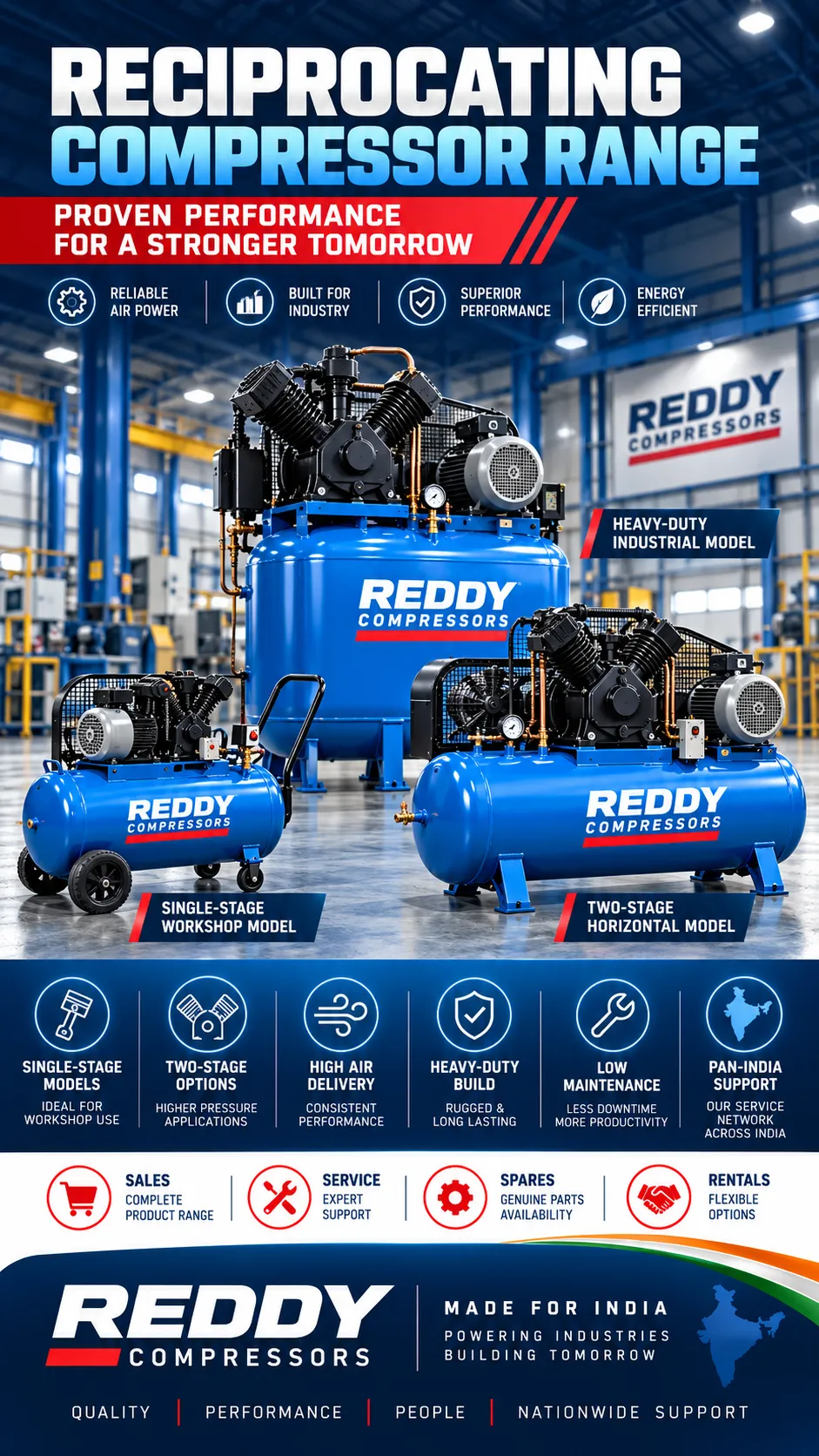
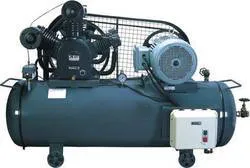
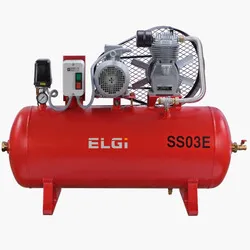
Representative images of machine types we sell, service and rent. Models and capacities are confirmed against your duty.
- Number of Cylinders
- Compression Stages
- Pressure
- Cooling Arrangement
- Lubrication
- Drive
- Motor / Engine
- Receiver Configuration
That means:
Air-cooled does not automatically mean small
- Air-cooled does not automatically mean intermittent
- Air-cooled does not automatically mean single-stage
- Air-cooled does not automatically define pressure
The actual compressor has to be selected as a complete machine.
The selection equation
Air cooling only works correctly when all of these remain compatible.
Across brands
Models we supply and service
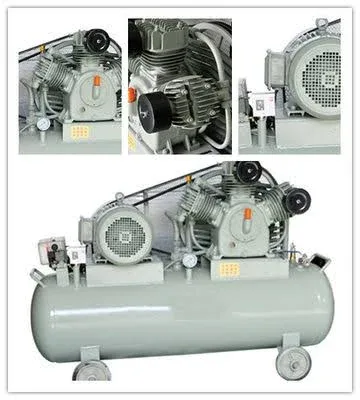
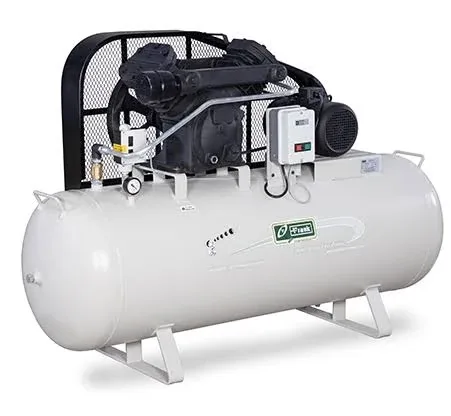
Manufacturer product images, shown to identify machines we sell, service and support. Brand names are trademarks of their owners.
01 — start with the air requirement
Cooling architecture should never become the first selection question.
Start with:
- Application
- Required FAD / CFM
- Operating Pressure
- Number of Users
- Operating Hours
- Expected Duty Cycle
- Receiver Requirement
- Installation Environment
- Air-Quality Requirement
- These are the reciprocating selection inputs
- Only then should cooling configuration be evaluated
02 — FAD still defines useful capacity
An air-cooled label does not tell the customer how much useful air the compressor delivers.
Selection must still establish:
Free air delivery
at:
The required operating pressure
Do not choose an air-cooled piston compressor by:
Motor HP
or:
- Physical Size
- alone
03 — pressure still comes from the application
Air cooling does not determine working pressure.
The machine must be capable of supplying the pressure required by the process while remaining within its actual manufacturer-defined operating limits.
Therefore:
Cooling type ≠ pressure class
04 — duty cycle is the critical cooling question
A compressor can have a published airflow rating without being designed to operate continuously at that output.
Manufacturer-specific limits can include:
- Loaded Operating Time
- Cooling
- Starts per Hour
- Discharge Temperature
- Pressure
- Environmental Conditions
- That means cooling and duty cannot be separated
05 — the question is not only “can it make the air?”
It is also:
“For how long can it make that air under the actual site conditions?”
This directly for reciprocating technology:
A COMPRESSOR SHOULD BE SELECTED NOT ONLY FOR HOW MUCH AIR IT CAN MAKE—BUT FOR HOW LONG IT IS EXPECTED TO MAKE IT.
For an air-cooled piston compressor, that question is essential.
“Air-cooled reciprocating = continuous duty”
or:
“Air-cooled reciprocating = intermittent only.”
Both statements are too broad.
The actual duty capability depends on the verified:
- Machine Design
- Cooling Arrangement
- Pressure
- Operating Hours
- Ambient Condition
- Manufacturer Limits
07 — compression creates heat
Compression raises air temperature in its staged-compression discussion.
That thermal load has to be managed.
For an air-cooled machine, adequate heat rejection therefore becomes part of:
Machine selection
and:
Installation
ADEQUATE VENTILATION.
This is not a cosmetic recommendation.
It supports the compressor's thermal environment.
An otherwise correctly selected machine can still operate poorly if the installation traps heat around it.
09 — air in matters
In practice:
The compressor requires adequate clean cooling and intake air
It recommends avoiding intake locations exposed to:
- Hot Exhaust Air
- Dust
- Process Fumes
- Engine Exhaust
- Excessive Moisture
- Contaminated Air
10 — heat out matters
Compressor input energy ultimately creates substantial heat that must be managed.
Poor ventilation can contribute to:
- Higher Operating Temperature
- High-Temperature Alarms
- Lubricant Stress Where Applicable
- Reduced Component Life
- Uncomfortable Maintenance Conditions
Do not install an air-cooled compressor where heat has nowhere to go
11 — “the room is large” does not prove ventilation is adequate
Physical room volume alone is not enough.
The relevant questions include:
Where Does Cooler Air Enter?
Where Does Heated Air Leave?
Can Hot Air Accumulate Around the Compressor?
Is Dust Blocking Heat-Rejection Surfaces?
Does the Actual Manufacturer Require Specific Clearance or airflow?
12 — no universal air-change rate
Actual ventilation design should use:
- Manufacturer Heat-Rejection Data
- Machine Arrangement
- Room Geometry
- Ambient Conditions
- Number of Compressors Operating
- where available
13 — ambient conditions matter
Therefore actual site conditions belong inside selection.
Do not assume performance from a catalogue reference condition automatically transfers to every installation.
14 — no universal maximum ambient temperature
Use current model documentation.
15 — hot environment + high duty requires particular care
When:
Ambient Temperature Is High
and:
- Loaded Operating Time Is High
- thermal management becomes especially important
This conclusion follows directly from the source's linkage of cooling, discharge temperature, environmental conditions and loaded operating time in duty-cycle selection.
But exact derating or temperature corrections must remain manufacturer-specific.
16 — dust also belongs in the cooling conversation
Intake should avoid dusty conditions where practical.
Dust can also increase maintenance burden around cooling and intake systems.
Instead:
Inspect according to environment + manufacturer requirements + actual condition
17 — cooling condition changes with time
A machine may cool properly when new and perform differently later because of changing:
- Cleanliness
- Airflow Path
- Room Condition
- Maintenance Condition
- Therefore cooling should be considered through the lifecycle
- Not only during commissioning
18 — HIGH DISCHARGE TEMPERATURE IS A SYMPTOM—not A PART NUMBER
If temperature becomes abnormal, do not immediately assume one component is defective.
Review the actual machine and environment systematically.
Potential investigation should follow manufacturer/service procedures rather than generic replacement rules.
19 — do not solve overheating by simply reducing the alarm setting
An alarm threshold is a protection/control parameter—not a substitute for diagnosis.
The correct philosophy remains:
Inspect
→ MEASURE
→ DIAGNOSE
→ CORRECT
→ VERIFY.
20 — single-stage air-cooled reciprocating
Some verified single-stage piston compressors may use air cooling.
But:
Single-stage ≠ automatically air-cooled
Stage architecture and cooling architecture are separate design decisions.
21 — two-stage air-cooled reciprocating
Likewise, some actual two-stage reciprocating machines may use air cooling.
The source's two-stage architecture includes intercooling where the design provides it, but this should not be confused with the complete machine's overall cooling classification.
Therefore:
Intercooling ≠ complete cooling architecture
The actual model must define both.
22 — multi-stage air-cooled equipment
Do not assume all multi-stage reciprocating machines are water cooled.
Similarly, do not assume all can be effectively air cooled.
Multi-stage cooling architecture must come from actual manufacturer data.
23 — oil-lubricated air-cooled machines
An air-cooled reciprocating compressor may use an oil-lubricated architecture where the actual model confirms it.
Oil lubrication does not automatically define how the machine rejects heat.
24 — oil-free air-cooled machines
An oil-free piston compressor may use an air-cooled architecture where verified.
But:
Oil-free ≠ air-cooled
The model defines the combination.
25 — receiver-mounted air-cooled packages
Many compact reciprocating packages may combine the compressor with an air receiver where verified.
The receiver can support:
- Compact Installation
- Storage
- Intermittent-Demand Buffering
but it does not improve cooling simply because the compressor is mounted above the tank.
26 — base-mounted air-cooled compressors
A base-mounted configuration can also be paired with air cooling where manufacturer design allows.
The decision between base-mounted and receiver-mounted arrangements depends on:
- System Size
- Storage Requirement
- Available Space
- Installation Strategy
- not cooling type alone
27 — receiver storage & cycling affect thermal duty indirectly
Receiver capacity interacts with:
- Compressor Capacity
- Pressure-Control Band
- Demand Rate
- Allowable Pressure Change
- Starts per Hour
Frequent starts/stops can create additional stress on motors, contactors, pressure switches and drive components.
Therefore cycling should be reviewed together with duty and cooling.
28 — do not use a large receiver to “fix” a cooling problem
Storage and cooling are separate issues.
A larger receiver may change cycling behaviour in some systems.
It does not correct:
- Poor Ventilation
- High Ambient Temperature
- Restricted Cooling Air
- Dirty Cooling Surfaces
- Wrong Compressor Duty
- Diagnose the actual cause
29 — workshop applications
Air-cooled reciprocating compressors may therefore deserve evaluation in suitable workshop duties.
But:
Workshop ≠ automatically air-cooled piston
Actual FAD, pressure, duty and environment decide.
30 — garages & maintenance facilities
Reciprocating technology can support selected:
- Tyre Equipment
- Pneumatic Tools
- Maintenance Air
31 — small industrial applications
Piston compressors may suit periodic industrial demand.
But if plant air becomes:
- High
- Continuous
- Predictable
- Multi-Shift
- Rotary screw technology may deserve consideration
- Air cooling does not change that fundamental technology-selection boundary
32 — INTERMITTENT vs CONTINUOUS DUTY CAN BECOME AN ECONOMIC AND THERMAL DECISION
Forcing an intermittent-duty reciprocating compressor into continuous industrial service can create:
- Thermal Stress
- Accelerated Wear
- Increased Maintenance
- Shorter Component Life
The cooling architecture must be matched to the duty—not used to justify the wrong duty.
33 — cooling does not eliminate maintenance
Reciprocating compressors can include service items such as:
- Piston Rings
- Valves
- Cylinders / Liners
- Bearings
- Belts
- Gaskets
- Filters
- Lubricant-System Components
- Air cooling is only one subsystem
- The complete machine still requires lifecycle maintenance
34 — service access is part of cooling system health
Installations should permit practical access for:
- Filter Replacement
- Cooler Cleaning
- Motor Inspection
- Belt / Coupling Service Where Applicable
- Electrical Work
For an air-cooled reciprocating compressor, access to relevant cooling surfaces and machine components should be verified against the actual design.
35 — a compressor can physically fit and still be badly installed
A machine fitting into a room does not prove it is correctly installed if safe routine service cannot be performed.
Physical fit also does not prove adequate cooling
Both access and ventilation matter.
36 — electrical protection
The reciprocating installation framework includes correct electrical protection.
Cooling issues should not distract from:
- Electrical Supply
- Motor Protection
- Isolation
- Installation Safety
- which remain essential
37 — suitable piping
Air-cooled architecture does not correct downstream pressure loss.
A compressor can run thermally correctly while the user still experiences poor pressure because of the distribution system.
38 — condensate management
Air cooling does not eliminate moisture.
Compressed air may still require:
- Aftercooling
- Separation
- Drainage
- Drying
- according to the process
39 — air quality remains separate
Air-cooled describes the compressor's thermal architecture.
It does not mean the compressed air is:
- Dry
- Oil-Free
- Particle-Free
- Food-Grade
- Instrument-Grade
- Air quality must still be engineered from point-of-use requirements
40 — cooling & air quality should not be confused
A cooler-running compressor is not automatically producing cleaner compressed air.
Likewise, a process requiring cleaner air does not automatically dictate air-cooled or water-cooled compressor architecture.
These are separate engineering questions.
41 — AIR-COOLED vs WATER-COOLED RECIPROCATING
A proper comparison should ask:
What FAD Is Required?
What Pressure?
What Duty?
What Ambient Conditions?
What Site Utilities Exist?
What Cooling Arrangement Does the Manufacturer Provide?
What Maintenance Does Each Architecture Require?
42 — no universal efficiency claim
than water-cooled reciprocating machines.
Therefore no generic efficiency ranking should be published.
43 — no universal noise claim
Noise depends on actual equipment.
Do not invent sound levels.
“Air-cooled is more reliable because there is no water circuit.”
Reliability depends on:
- Correct Application
- Duty
- Installation
- Cooling Condition
- Maintenance
- Parts
- Operating Environment
45 — no universal maintenance advantage
Use actual model maintenance requirements.
46 — model data required before publication
For every air-cooled reciprocating compressor, verify:
- Manufacturer
- Exact Model
- Motor kW / HP
- FAD
- Working Pressure
- Number of Stages
- Cylinder Configuration
- Lubrication Type
- Air-Cooled Architecture
- Manufacturer Ambient Limit
- Duty Limit
- Discharge Temperature Limits Where Published
- Drive Type
- Motor / Engine
- Receiver Configuration
- Control Method
- Required Installation Clearance
- Ventilation / Cooling Requirements
- Dimensions
- Weight
- Electrical Requirement
- Service Requirements
- Current Availability
- No value should be inferred across models
47 — customer data to request
For an air-cooled reciprocating compressor enquiry, collect:
- Application
- Required FAD / CFM
- Required Pressure
- Operating Hours per Day
- Expected Duty Cycle
- Number of Simultaneous Users
- Ambient Temperature / Site Conditions
- Dust / Contamination Conditions
- Indoor or Outdoor Installation
- Room Dimensions
- Ventilation Available
- Receiver Requirement
- Power Supply
- Air-Quality Requirement
- Existing Compressor
- Current Overheating / Temperature Issues if Applicable
This turns “I need an air-cooled piston compressor” into a real engineering requirement.
48 — air-cooled reciprocating selection gate
Before selecting equipment, ask:
Does the machine deliver the required FAD?
Cooling architecture cannot compensate for inadequate capacity.
Does it deliver the required pressure?
Verify the actual model.
What is the duty cycle?
Loaded time matters.
What does the manufacturer allow?
Respect operating limits.
What are the ambient conditions?
Environment affects cooling.
Is clean cooling air available?
Review the installation.
Can heat leave the room?
Provide ventilation.
Is service access adequate?
Cooling surfaces and components must remain maintainable.
How often will the machine cycle?
Receiver and demand matter.
What air quality is required?
Cooling method does not define it.
Does the complete lifecycle case fit?
Evaluate operation, maintenance and support.
Air-cooled reciprocating in one line
An air-cooled reciprocating compressor should be selected only when its FAD, pressure and duty match the application—and the installation can provide the clean airflow, ventilation and thermal conditions the verified machine requires
Closing
Air cooling is only effective when the heat can leave
A correct air-cooled reciprocating installation therefore requires:
Right FAD
- Right pressure
- Right duty cycle
- Verified cooling architecture
- Suitable ambient conditions
- Adequate ventilation
- Clean cooling air
- Service access
- Correct installation
- Lifecycle maintenance
It also establishes that even smaller reciprocating installations require adequate ventilation, service clearance, electrical protection, suitable piping, condensate management, pressure relief and accessible isolation.
Reddy compressors
- Compressed air. engineered for uptime
- Define the air duty
- Verify the FAD
- Verify the pressure
- Respect the duty cycle
- Provide clean cooling air
- Remove the heat
- Maintain the cooling path
- Verify the actual model
- Primary CTA
Request an Air-Cooled Reciprocating Compressor Selection
Secondary CTAs
Compare Air-Cooled vs Water-Cooled Reciprocating
Review Compressor-Room Ventilation
Review Reciprocating Duty Cycle
Investigate High Compressor Temperature
Request Piston Compressor Service