
Why placement decides how well a rental compressor performs
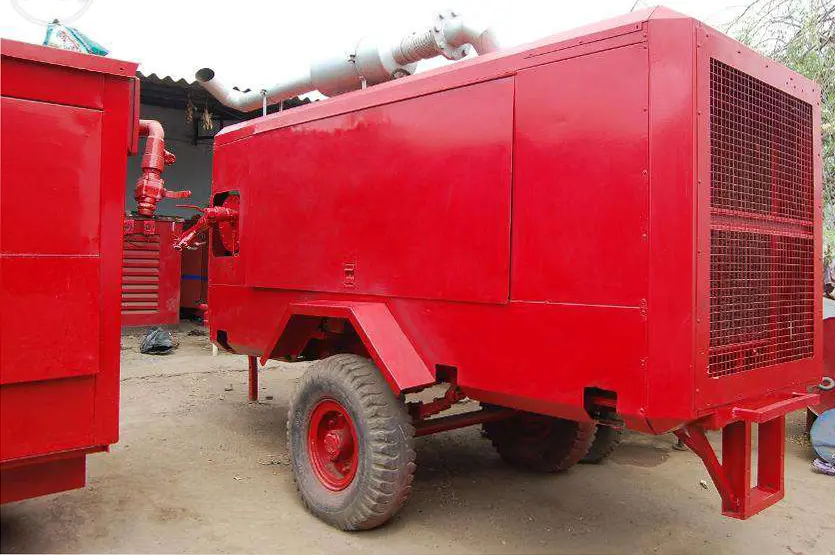
A portable or containerised compressor is designed to work in the open, but it is not indifferent to where it stands. The package draws cooling air through its radiator and oil cooler, draws process air through its intake filter, and, if diesel-driven, rejects engine exhaust and a large amount of heat. Put it in the wrong place and the machine either derates, trips or creates a problem for the people around it.
Typical consequences of poor placement on Indian sites include:
- High discharge-temperature trips in April–June, when a machine parked against a wall or in a corner re-breathes its own hot exhaust air.
- Choked intake and cooler fins from dust on unpaved construction and quarry sites.
- Complaints from offices, hostels, hospitals or houses next to the site about noise or diesel fumes, especially on night shifts.
- Pressure shortfall at the tools because the compressor was parked far away to keep it quiet, without resizing the hose.
- Refuelling and oil changes becoming difficult or unsafe because a tanker or service vehicle cannot reach the machine.
Good placement is therefore an engineering decision, made before the machine arrives, and checked again on the first day of running.
Define the full station footprint, not just the machine
Start by drawing everything that will form the temporary air station, not just the compressor’s skid outline. On most jobs that includes:
- One or more compressors, with their canopy doors opened fully for service.
- Aftercooler, moisture separator, refrigerated or desiccant dryer and filters where air quality matters.
- Air receiver, manifold and the first length of hose or pipe.
- A diesel generator and distribution board where an electric compressor runs without a grid supply.
- Fuel storage or a refuelling point, with spill protection.
- Condensate collection and its disposal route.
- A clear approach for the delivery trailer, crane or forklift, and for removing the equipment at the end.
State how long the station will stay and how many hours a day it runs. A two-hour daytime task and a six-week round-the-clock duty create very different exposure for neighbours and very different servicing needs. Temporary installations often stay longer than planned, so check whether the chosen position would still be acceptable if the hire is extended.
How do you compare candidate positions?
Most sites offer two or three possible locations. Screen them first against mandatory constraints, then compare the rest on performance and convenience. A position that fails a mandatory constraint is out, however convenient it looks.
| Criterion | What to check | Type |
|---|---|---|
| Ground support | Firm, level, drained surface able to carry the machine, trailer jacks and any receiver; no soft fill, drain covers or cable trenches underneath | Mandatory |
| Cooling air | Free inlet and outlet paths with the clearances in the maker’s instructions; no recirculation from walls, other machines or a generator | Mandatory |
| Exhaust | Engine exhaust pointing away from building air intakes, windows, doors, work areas and the compressor’s own air intake | Mandatory |
| Access and egress | Emergency routes, fire points and plant roads stay clear; service doors can open; fuel and service vehicles can reach | Mandatory |
| Hazardous areas | Outside zones where an engine or electrical equipment is not permitted, unless the site’s own assessment says otherwise | Mandatory |
| Intake quality | Upwind of dust, cement handling, chemical vents, paint booths and stack plumes | Performance |
| Distance to use | Hose or pipe length and size that keep pressure drop within budget | Performance |
| Noise exposure | Distance and screening to offices, control rooms, housing and night-time neighbours | Performance and community |
| Weather and water | Away from low spots that flood in the monsoon; shade where possible in summer | Performance |
Score the surviving positions honestly. A location that is 30 metres further away but has clean cooling air and quiet surroundings usually beats a closer one that recirculates hot air, because a larger hose is cheaper than a machine that trips every afternoon.
Cooling air, heat and Indian summer conditions
A compressor turns almost all of its input power into heat. For an oil-injected screw machine, that heat leaves through the oil cooler and aftercooler, and on a diesel unit also through the engine radiator and exhaust. The package is designed for a stated maximum ambient temperature, and many portable units are built for high-ambient work, but that rating assumes the air reaching the cooler is genuinely ambient.
Recirculation is the usual problem. When warm discharge air from the cooler is drawn back into the inlet, the effective ambient rises above the shade temperature. On a 45 °C afternoon in Telangana or Andhra Pradesh, that can be enough to push a normal discharge temperature of about 75–95 °C towards the high-temperature shutdown.
Practical rules that work on site:
- Keep the cooling-air outlet facing open space, never a wall, container or another machine.
- Leave at least the maker’s minimum clearance on all sides, and more when two machines stand side by side.
- Do not stand compressors in a line where one machine’s discharge feeds the next one’s inlet.
- Avoid enclosing the machine with tarpaulins, sheeting or temporary walls to reduce noise unless the design keeps the air paths open.
- Where shade is available without restricting airflow, use it; direct sun on the canopy adds to the heat load.
- Indoors, or inside a shed, check ventilation using a proper heat balance; the compressor room ventilation worksheet gives a quick screening estimate.
Exhaust, intake quality and dust
Diesel exhaust is the most common reason for complaints and the most important health point. Position the exhaust outlet so that fumes are carried away from building air-handling intakes, open windows, canteens, control rooms and any area where people work close by. Think about the prevailing wind and how it changes through the day; a breeze that clears fumes in the morning may push them towards an office in the afternoon.
The compressor’s own intake matters too. Air drawn in at the inlet carries its dust, moisture and contaminants into the machine and, eventually, into your process. Keep the intake away from:
- Its own engine exhaust and the exhaust of generators or vehicles.
- Cement silos, crusher plants, sandblasting areas and unpaved haul roads.
- Chemical vents, solvent stores, paint booths and stack plumes.
On dusty sites, plan for more frequent intake filter and cooler cleaning. Where clean air is critical, for example in pharmaceutical or food plants, the downstream treatment train must be sized for the real inlet conditions; see temporary air treatment trains.
Noise and the people around the site
Portable compressors are usually supplied with sound-attenuated canopies, and makers publish a sound power or sound pressure figure at a stated distance. Those figures are useful for comparison only when the basis is the same, so ask for the measurement standard and distance rather than comparing a bare decibel number.
Points that matter for neighbours:
- Sound reduces with distance, but two or three machines together are louder than one, and a hard wall behind a machine reflects noise back towards people.
- Night-time work is the most sensitive. A level acceptable at noon on a busy road may not be acceptable at 2 a.m. next to housing.
- Keep canopy doors closed during operation; open doors defeat the attenuation.
- Earth bunds, stacked materials or purpose-made acoustic screens can help, but they must not block cooling air or exhaust.
- Unloaded running for long periods still makes noise; matching machine size to demand reduces both noise and fuel use.
Where a site sits close to residences, schools or hospitals, the client or main contractor should confirm any local noise and working-hour conditions that apply. We can help by choosing quieter packages, electric compressors on a grid or generator supply, and positions that use distance and screening well.
Distance, pressure drop and electrical supply
Moving a compressor further away to reduce noise or free up space is often the right answer, but it has a cost in pressure. Every length of hose or pipe, every coupling and every manifold adds pressure drop, and the drop rises steeply with flow. A machine set at 7 bar (101.5 psig) may deliver noticeably less at the tool after a long, undersized hose.
When you increase the distance:
- Calculate the hose or pipe size needed for the full flow and length, not just the standard size supplied with the machine.
- Avoid running several small hoses in series with many couplings; use a manifold and fewer, larger lines.
- Protect hoses at road crossings and in walkways; a crushed hose is a restriction and a hazard.
- Remember that raising discharge pressure to compensate costs roughly 7% more power for each extra bar.
For electric compressors the same trade-off applies to cable length, voltage drop and the starting current. The site’s electrical team should confirm the supply point, protection and cable route; our electrical supply for temporary air packages page explains what to check. Distribution layout is covered in more detail on hose manifolds and distribution.
Ground, vibration, weather and water
A towable compressor puts its weight on wheels and a jockey wheel or jacks; a skid unit or receiver puts it on a small base. Check that the surface can carry it without settling, particularly on newly backfilled ground, over drain covers or near the edge of an excavation. Chock trailer wheels and keep the unit level so that oil levels read correctly and separators drain properly.
Isolate vibration from fragile structures. Flexible hoses between the compressor and rigid pipework prevent vibration and thermal movement from loading flanges and fittings.
In the monsoon, avoid low spots where water collects; standing water around the machine affects electrical safety, access and the condensate system. Route condensate to a proper collection point and treat oily condensate according to site rules rather than letting it drain onto the ground. Fuel storage needs a bund or drip tray, away from drains.
Communicate the plan and check it on day one
Once a position is chosen, record it on a simple sketch with the compressor, treatment, receiver, generator, fuel point, hose route, exclusion zone and access routes marked. Share it with the people who will live with it: site safety, the security gate, neighbouring departments and shift supervisors.
On commissioning day, check what the drawing assumed:
- Run the machine at representative load and watch discharge temperature during the hottest part of the day.
- Confirm the exhaust plume is going where you expected under the actual wind.
- Measure pressure at the furthest point of use with the real demand.
- Walk the site boundary and listen, including at night if night shifts are planned.
- Confirm that refuelling and service can be carried out without moving barriers or blocking roads.
If the site changes during the hire, for example a new building goes up or a road is diverted, review the placement again. Our temporary air site survey describes how we gather this information before mobilisation.
How Reddy Compressors helps
Reddy Compressors has supplied, rented and serviced compressors since 2002 from our office at Tarnaka, Secunderabad. We are an independent multi-brand specialist working with ELGi, Atlas Copco, Ingersoll Rand, KAESER, Chicago Pneumatic, Doosan and other makes; we are not an authorised dealer of any brand. We have tie-ups with all major and reputed brands. Our own rental fleet covers 50–2,000 cfm at 2–30 bar, diesel and electric, and our team of more than 20 service engineers and technicians covers the whole of Telangana and Andhra Pradesh, with equipment supplied across India.
For placement, we:
- Review your site sketch, photographs or drawings and suggest suitable positions for compressors, dryers, receivers and generators.
- Choose packages that suit the location, including quieter units or electric machines where noise or fumes are a concern.
- Size hoses, manifolds and treatment for the distance and duty, so that pressure at the tools is right.
- Arrange delivery, positioning and commissioning, and check temperatures and pressure on the first day.
- Service hire machines every 300 running hours, including oil changes, and keep coolers and filters clean on dusty sites.
- Supply diesel generators through Reddy Generators, which is under the same management, when no suitable electrical supply is available.
What to send us
- Site location, type of site and the hours of operation, including any night work.
- Required flow (cfm or m³/min), pressure at the point of use (bar or psig) and air quality.
- Photographs or a sketch of the possible positions, with distances to the point of use.
- Nearby sensitive areas: offices, housing, hospitals, building air intakes.
- Available electrical supply, if any, and whether diesel is acceptable.
- Access details for delivery vehicles, cranes and fuel tankers.
- Expected hire duration and any likely extension.
Frequently asked questions
Where should I place a rental air compressor on site?
Place it on firm, level, well-drained ground with open space on all sides for cooling air, with the exhaust pointing away from people and building intakes, and with clear access for refuelling and servicing. Then check that the hose route to the point of use is short enough, or large enough, to keep pressure drop acceptable. Avoid corners, walls and positions next to other machines that cause hot-air recirculation.
Why does my portable compressor trip on high temperature in summer?
The most common cause is recirculation: hot air leaving the cooler is drawn back into the inlet, so the machine sees a higher ambient than the weather report. Dust-choked coolers, low oil level and blocked intake filters add to it. Move the machine away from walls and other units, keep canopy doors closed, clean the cooler and check that the cooling-air path is fully open.
How far can a compressor be from the work area?
There is no single distance; it depends on flow, pressure, hose size and the number of couplings. Long runs are fine when the hose or pipe is sized for the full flow and the pressure drop is calculated. If you move a machine further away to reduce noise, increase the hose size rather than raising discharge pressure, which costs roughly 7% more power per extra bar.
How can I reduce compressor noise for neighbours?
Use a sound-attenuated canopy and keep its doors closed, increase distance, avoid hard walls that reflect noise, and use bunds or acoustic screens that do not block cooling air or exhaust. Matching machine size to demand cuts long unloaded running. Where noise is critical, an electric compressor on a grid or generator supply may be quieter at the boundary than a diesel unit.
Can a diesel compressor run inside a shed or building?
It can only where the building has been assessed for exhaust removal, cooling airflow and heat rejection, and where site rules allow an engine indoors. In most cases it is safer and simpler to place the diesel unit outside and pipe the air in. If air must be generated indoors, an electric compressor with proper ventilation is usually the better choice.
What should I do with compressor condensate on a temporary site?
Collect it rather than letting it drain onto the ground. Condensate from oil-injected compressors contains oil and should pass through a suitable oil–water separator or be handled according to the site’s environmental rules. Route drains from the separator, receiver and dryer to the collection point and check them daily, especially in the humid monsoon months when volumes rise.
Related pages
Technical content reviewed by D. Srinivas Reddy, Managing Partner and service engineer, Reddy Compressors. Last updated 17 October 2026. How our engineering content is reviewed.